Ever Been Told, “You Shouldn’t Feel That Way?”

You shouldn’t feel that way.

Get over it.

You’re overreacting.

Have you ever heard any of those statements? Those remarks that leave you angry and confused. Hackles up, yet questioning if the other person is right? Why do people make those remarks? Is it out of ignorance or attack? Are they trying to help or harm? How can we respond those who tell us we do not have the right to feel the way we feel?

I work with middle schoolers – a group that is well recognized for being very emotional and reactive. I have seen a girl become suicidal after a dismissive comment by a friend. I have seen a boy with a shattered face after a fight over a mustard packet. To the outside person, those reactions seem well over the top, like calling the fire department to extinguish a candle. I could have pulled those students aside and told them they were overreacting. I could have said that they should get over it. I could have shared stories of others that had it worse to downplay their feelings.

I think we all realize that such an approach would not be helpful. Simply telling the girl that her despair was stupid or the boy that he shouldn’t be angry would do nothing to dial down their emotions. In fact, it would have made the situation worse because then it would be introducing an element of shame, causing them to question if there is something wrong with them for feeling the way they do.

When we respond with ‘shoulds,’ we are responding only to the surface. If someone appears to be overreacting, there is often much more beneath. That was the case with these two students. The girl’s sister had committed suicide the previous summer. She was feeling abandoned and lost. When her friend slighted her, she felt alone and hopeless. The boy’s family had fallen upon hard times. His only meals were through the school. To him, that packet of mustard was life or death.

So why are we so quick to dismiss the feelings of others? Sometimes, it is from a lack of empathy, an inability or refusal to put yourself in another’s shoes. Sometimes, you may have the empathy but you lack the understanding. Maybe you’re missing key information that explains the reaction. Maybe you want to help, but you’re frustrated and don’t now how.

The truth is that we can never know completely how someone else feels. It’s based on past and perception, two things that are unique to each individual. When it seems that someone’s reaction is over the top, maybe it just means that their brain needs time to catch up with the past pains held in the heart. Rather than berate the brain for not moving faster, try supporting the heart while the brain moves forward. All the heart wants is to be accepted.

If you are the recipient of the ‘shoulds,’ try not to internalize the statement. It is okay to feel the way you feel. Try to see the motivation behind the statement – is this person trying to help you or are they simply unable to comprehend your pain? Also be open to the idea that your past and your perceptions may be harming your present. It’s okay to feel the way you feel and it is also okay to not want to feel that way and to work to make it better.

As for my two students, we (teachers and counselors) worked to validate their feelings in the moment while helping them to understand why they reacted the way they did and how they can cope better in the future. Rather than telling them how they should feel from a place of judgement, we showed them how they could feel better by coming from a place of love. And that is how we should all feel.

You Shouldn’t Feel That Way

sad

You shouldn’t feel that way.

Get over it.

You’re overreacting.

Have you ever heard any of those statements? Those remarks that leave you angry and confused. Hackles up, yet questioning if the other person is right? Why do people make those remarks? Is it out of ignorance or attack? Are they trying to help or harm? How can we respond those who tell us we do not have the right to feel the way we feel?

I work with middle schoolers – a group that is well recognized for being very emotional and reactive. I have seen a girl become suicidal after a dismissive comment by a friend. I have seen a boy with a shattered face after a fight over a mustard packet. To the outside person, those reactions seem well over the top, like calling the fire department to extinguish a candle. I could have pulled those students aside and told them they were overreacting. I could have said that they should get over it. I could have shared stories of others that had it worse to downplay their feelings.

I think we all realize that such an approach would not be helpful. Simply telling the girl that her despair was stupid or the boy that he shouldn’t be angry would do nothing to dial down their emotions. In fact, it would have made the situation worse because then it would be introducing an element of shame, causing them to question if there is something wrong with them for feeling the way they do.

When we respond with ‘shoulds,’ we are responding only to the surface. If someone appears to be overreacting, there is often much more beneath. That was the case with these two students. The girl’s sister had committed suicide the previous summer. She was feeling abandoned and lost. When her friend slighted her, she felt alone and hopeless. The boy’s family had fallen upon hard times. His only meals were through the school. To him, that packet of mustard was life or death.

So why are we so quick to dismiss the feelings of others? Sometimes, it is from a lack of empathy, an inability or refusal to put yourself in another’s shoes. Sometimes, you may have the empathy but you lack the understanding. Maybe you’re missing key information that explains the reaction. Maybe you want to help, but you’re frustrated and don’t now how.

The truth is that we can never know completely how someone else feels. It’s based on past and perception, two things that are unique to each individual. When it seems that someone’s reaction is over the top, maybe it just means that their brain needs time to catch up with the past pains held in the heart. Rather than berate the brain for not moving faster, try supporting the heart while the brain moves forward. All the heart wants is to be accepted.

If you are the recipient of the ‘shoulds,’ try not to internalize the statement. It is okay to feel the way you feel. Try to see the motivation behind the statement – is this person trying to help you or are they simply unable to comprehend your pain? Also be open to the idea that your past and your perceptions may be harming your present. It’s okay to feel the way you feel and it is also okay to not want to feel that way and to work to make it better.

As for my two students, we (teachers and counselors) worked to validate their feelings in the moment while helping them to understand why they reacted the way they did and how they can cope better in the future. Rather than telling them how they should feel from a place of judgement, we showed them how they could feel better by coming from a place of love. And that is how we should all feel.

Pardon Me, Ego. I Need to Get Through.

The Thinking Man sculpture at Musée Rodin in Paris

Ego:

the “I” or self of any person; a person as thinking, feeling, and willing, and distinguishing itself from the selves of others and from objects of its thought. (from dictionary.com)
Ever since we first begin to see ourselves as separate, sentient beings in childhood, our egos define how we interpret the world around us.  That sense of self may actually be holding you back from healing from your divorce.  Do you see yourself in any of the following patterns?
It’s All About Me
When I first realized the extent of my husband’s betrayals, I kept asking, “How could he do this to me? To the one he was supposed to love?”  I saw his actions directed towards me as an arrow towards a target.  I assumed he was thinking about me as he made these decisions.  He lied to me.  He cheated on me.  He stole from me. That pattern kept me fully anchored in a victim state, the recipient of all the pain and deceptions.
Slowly, I realized that it wasn’t all about me.  He lied and cheated and stole, yes.  But he did those things because of whatever demons had him in their grasp.  He didn’t do those things because of me.  He most likely wasn’t even thinking of me while they occurred.  He did them and I was in the way.
I shifted my thinking. When he hurt me, he was acting to protect his own sense of self rather than trying to wound mine.  I began to let the anger go.
It is not easy to remove the ego from interpreting the actions of one so intimate to you. Try looking at the situation with an open mind, letting go of your own ego, and see how your perspective shifts.
The Reflective Ego Shield
Our egos are vulnerable beings; they often cover themselves in highly reflective shields, deflecting any criticism and shining it back at its source.  I used to get very defensive when anyone suggested that I had a hand in my husband’s actions.  I would retaliate, lashing out at them as I tightened the stays on the armor protecting my ego.  It was a very scary proposition to let some of that armor go and to examine what was shielded underneath.  I learned the role that my own insecurities and anxieties played in the end of my marriage.  Instead of reflecting all of the responsibility on him, I took my share.
There is a difference between taking responsibility for your own actions and taking the blame for another’s actions.  If you are carrying your own reflective shield, try lowering it and examining what lies beneath.
The Hidden Wounds
The ego doesn’t like to show its vulnerabilities.  When asked, “How are you doing?,” the ego always answers, “Fine.”
I remember how many times I falsely spoke that word in those early months.  Much of that time, I wasn’t “fine,” I was angry, sad, bitter, anxious, sick, and disconnected.  But I also didn’t want to reveal those wounds.  To let the world see the depth of my pain. I kept it covered with a band-aid of “fine.”
Your wounds cannot heal unless they are exposed to the air.  The bandage can remain on to protect your injuries from the world at large, but you remove them when are in a safe place to let the healing begin.
Ego as Strongman
Our egos are a bit like young meatheads in a gym.  Flexing in the mirror, wanting to appear strong and capable amongst the others.  This means that sometimes we will try to lift more than we can without asking for assistance.  And, just like in the weight room, this can only lead to disaster.
Prior to my husband’s David Copperfield act, I was horrible at asking for and receiving assistance.  In fact, that was actually one of the points of contentions in my marriage; I always made it clear that I could do it alone.  I guess he wanted to prove me right.  Regardless, I made things so much more difficult than they ever needed to be by denying offered help and refusing to ask for help when it was needed.
Are you acting like the young man in the gym?  Ask for a spotter and you’ll not only gain the respect of those around you, but you will also be able to lift more than you ever thought possible.
Our egos tend to operate below our conscious thought.  After all, they are us.  And they are often the biggest barriers in our way.
Pardon me, ego.  I need to get through.

Perchance to Dream

I woke up at 2:30 this morning with pulse racing and limbs twisted under the covers. I had been having a dream where I was trapped in a house with some unknown person that I felt protective of and my former neighbor and her baby (as they were in 2002 or so). Outside the house was a postapocalyptic scene, and I think there may have even been zombies (that’s what happens when you binge on Walking Dead:) ). I remember panicked dashes across the house to get to safer areas and shooting the zombies outside.

English: A zombie

None of that was the scary part. At some point just before I awoke, my ex made an appearance. I don’t even know if he was a zombie or a ‘good guy’ trapped in the house. His arrival was enough to pull me out of my dream and leave me unsettled.

Dreams are such strange things. As a kid, I used to have very vivid and memorable dreams. Some were repetitive and told overarching stories of strange characters (I remember a walking, talking frog with a shirt and no pants, in particular. don’t ask.) where as others would come and go in a single night. I had many dreams that seemed to be premonitions or interpretations. I used to listen to these. I remember waking from some of those meaningful dreams and heading out to my monkey swing in the backyard (kind of my ‘go for a run’ substitute as a kid) where I would swing and spin as I pulled apart the dream, searching for clues. My early nightmares were of the typical monster variety and would send me to a pallet next to my parent’s bed for comfort as I worked my way back into slumber.

Monkey swing:) I used to read and eat popsicles on mine simultaneously. Yup, that’s talent!

As I got older, the intensity of my dreams decreased but the frequency remained the same. I would wake shaking the remnants of a vision from my head several times a week.What’s interesting to me now in retrospect is the theme of the dreams. Not long after my ex and I were together, I started having very vivid dreams every couple of months or so where he cheated on me. I would wake up filled with rage, the sight of his slumbering form next to me making me want to lash out. Perhaps it was due to the lack of a monkey swing to properly analyze these dreams (or more likely my mind’s inability to face the content head-on), but I never did put any merit in those visions. Nonetheless, those were tough days that followed those dreams. I would alert him to my nightmare and he would respond by being especially gentle and affectionate. Even still, it would usually take hours for the residual anger and anxiety to leave my body. It’s strange. Those dreams are the only time I felt anger towards my ex while I was with him. I was just too bone-headed to listen.

Mozart Dancing

After he left, I didn’t sleep. The anxiety gripped my body and caused it to shake, its own tarantula dance, as though I was trying to rid myself of his poison. I spent weeks sitting on the edge of the bed, my eyes fixated on a point on the wall, my mind inhabiting the nightmare that had become my reality. Eventually, I agreed to medication – dosages that would cause a horse to enter a permanent coma barely eased me into slumber. I had only a single dream that entire fall. In it, I was near some benches at a whale watching facility in the Pacific Northwest (where I planned to move at the end of the school year). A male was sitting on a bench, facing away from me. I approach him and place my hand gently on his shoulder. He turns, and I discover it’s him.

Those nightmares stunned me enough I wished for my childhood pallet next to my parent’s bed. He had become the monster, yet he looked like the man I had loved. Variations on the that dream persisted for the first six months. Until finally, they began to fade.

A depressed man sitting on a bench

I remember my excitement when I awoke one morning and realized that I had dreamed of another man – a guy I had been dating. I was thrilled. It was like calling in the Ghostbusters, his appearance sweeping my ex into the vacuum canister.

I weaned myself off the medications that first spring. I left the primary sleep aide until last, fearful that the demons of the night would reappear. For the most part, they haven’t. In fact, my dreams are now few are far between and most are quite innocuous. My ex rarely makes an appearance, but when he does, I still react with panic.

Most importantly, I never have dreams where Brock is unfaithful. I don’t have dreams that cause anger or anxiety that lingers. But if I ever do, you better believe that I’ll listen. And maybe install a monkey swing:)


Opening the Journal

photo-180

Deep breath.

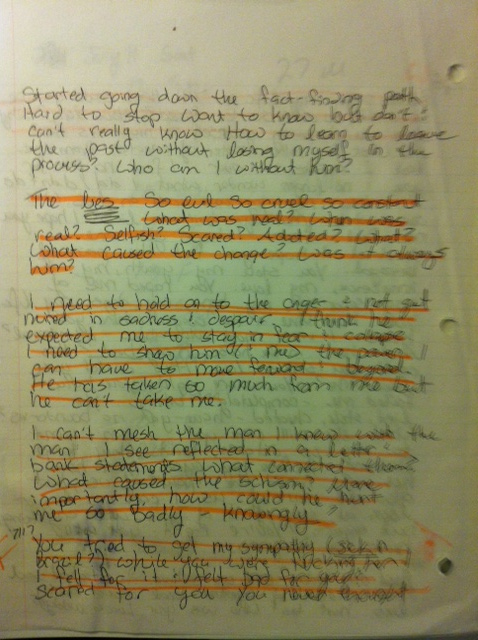
In many ways, this will be my most personal post yet. These are the thoughts, the words, that came in the first few weeks uncensored by the keyboard and unedited by time. I’m choosing to share this to reveal the underbelly of the healing process. I want to show that it is possible to move on from such pain and I want to highlight the importance of positive thinking and goal setting early on in the healing journey.

I started journaling on July 15, 2009, four days after I received the text.I learned about Uganda on July 20 and the bigamy on July 22.  Much of the writing in the journal was done in the early months, as I transitioned to the computer during the late fall and winter.

I chose to divide my journal into three sections and made a rule that each writing session had to begin in section one and proceed through section three.

Section one: This was the space for the unedited vitriol. This was the anger, the poison. I knew I had to release it and there was oh so much to release. The writing is rapid, the angles harsh. I pressed so hard that I tore through the pages in spots. This was the domain of the broken heart.

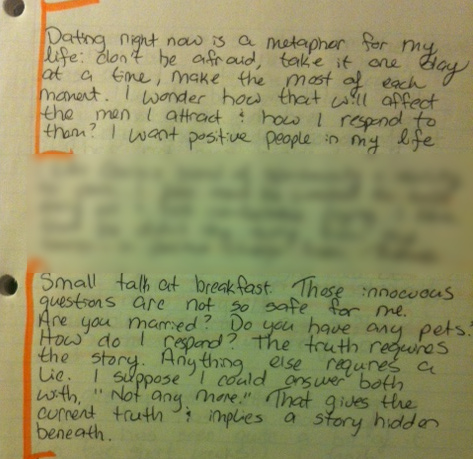
Section Two: This was for the day to day thoughts and practicalities. It was designed for observation and problem solving. This was the domain of the rational mind.

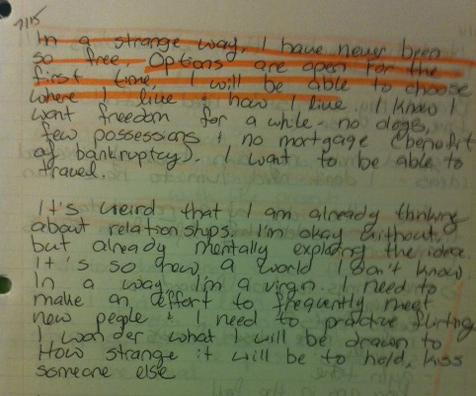
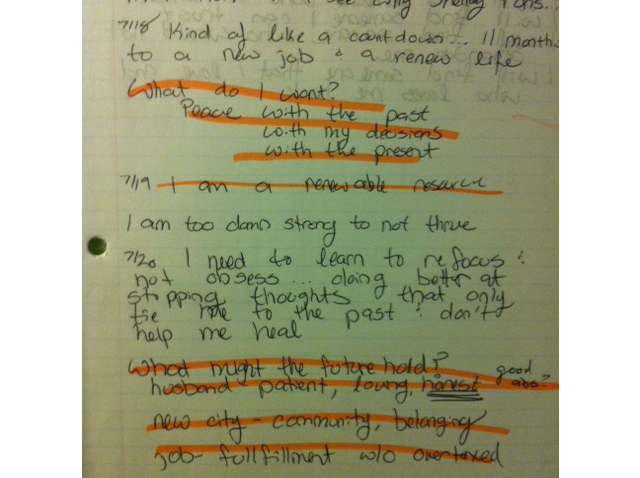
Section Three: The final section was for dreaming. I let my mind focus on the infinite and wonderous possibilities that the future might hold. This was the domain of the spirit.

I have no idea how or why I decided to structure my journal this way. In retrospect, that was surprisingly lucid for my state at the time. Recent research supports this model, as they found that high ruminators (I’m not sure if I am this but I am definitely a high analyzer) benefited from a fact-based, mundane journal but suffered when rehashing the negative feelings over and over. My three part design and my insistence on not ending with the negativity allowed me to vent but kept me from getting stuck in the sadness and anger.

For those of you early on in your journey, I hope you can find recognition and some possibility in these entries. For those partway through, I hope you can find acceptance of the process and be patient with yourself. For those who have come out the other end, I hope that you will find encouragement for how far you have come. On of my biggest lessons in all of this is the enormity of the damage that can occur when you deny your feelings. My ex destroyed his life and impacted others because he refused to face his emotions and instead kept them locked away and hidden beneath a facade.

So, here goes. These are excerpts from the journal, in no particular order. Names have been blurred to protect identities. The highlights are from my work when I was writing the book. For those new to my site, please remember that this was 8 years ago. This is not the space I am currently in.

journal18

journal17

journal16

journal15

journal14

journal13

journal12

journal11

journal10

journal9

journal8 journal7 journal6 journal5 journal4 journal3 journal2 journal1

I can read these now with some distance. I remember the pain, yet time has dulled its sharpness to a mere whisper. I identify with the woman who wrote this; I can see traces of who she is going to become. I am no longer her; however, I don’t have the anger anymore that fills these pages. I have learned to soften and to accept. I have forgiven my ex and let go of the need for understanding.  The messages of hope and the small celebrations make me smile. I almost wish I could reach back and give the me of those days a hug and tell her that it will be okay and that her hopes and dreams will come in time.


Moving on