Forgiveness 101

Forgiveness Mandala by Wayne Stratz
Forgiveness Mandala by Wayne Stratz (Photo credit: Nutmeg Designs)

Forgiveness. That word is often tossed about in hushed and almost reverent tones. It is the holy grail of one betrayed. Have you forgiven yet? We feel pushed to reach that nirvana, yet we are unsure how to navigate the labyrinthine path that leads us there. Nor are we even sure that we would recognize our destination once we have arrived. The trouble is that forgiveness will take on a different facade for every seeker and the path will vary depending upon who is stepping upon it. Even though forgiveness is an individual journey, there are some universal guideposts that can help you navigate your own way.

Understand What it is Not

Someone has wronged you. I get it. I’m not trying to take that away from you. Forgiveness is not a pardon. It is not excusing actions that are immoral or illegal. It is possible to accept the past, acknowledge the wrongs, but not be help prisoner by the actions of the object of your anger.

Blur

Forgiveness has always reminded me of one of those optical pictures where you have to relax your eyes and unfocus in order to see the image hidden in the pattern. If you look too hard and focus too much on absolution, it will remain hidden. Think of forgiveness like a shy kitten. If you lunge towards it and try to grab on, it will run away every time. Relax and soften and let it come to you.

Time

Forgiveness takes time. You can’t schedule it like an event upon a calendar (trust me, I tried).  The time needed to forgive will differ for everyone. It doesn’t mean there is something wrong with you if it takes you longer than it did your friend. Be patient and allow it to unfold on its own schedule. I know, it is easier said than done, but that is the nature of this elusive beast.

Keep Living

Luckily, while you’re waiting for the forgiveness fairy, you can keep living. Don’t put your life on hold. Move forward and move on. Surround yourself with people that bring you joy. Play. Laugh. That ember that still burns inside does not weigh so much that you cannot move despite it. Live as though you have forgiven.

Gratitude

Gratitude and anger are mutually exclusive. Be mindful of what you have and (brace yourself, this is the hard part) what you gained from the person that you need to forgive. I know, your hackles went up. “That ^#%^&? How can I be grateful??  He/She did _______ to me!!” True. I’m not trying to take that away from you. You have a right to be angry. But you also have a right to see the good. Look for it.

Remove the Ego

We all find humor in the self-centered world of the 5 year old, yet we really haven’t evolved that much from kindergarten. When things happen around us, we have a tendency to believe that they happened to us. For example, your child comes home and immediately is defiant and argumentative. Your defences go up and you perceive your progeny’s behaviors as an attack. If you take a moment and breathe and remove yourself from the equation, you most likely realize that the instigation for the behavior is probably something that happened at school minutes or hours before. Spouses are no different. Perhaps you weren’t really a target after all, just collateral damage.

Humanize

We are familiar with the concept of putting someone on a pedestal when we idolize them. We essentially do the same when we demonize a person. It can be easy at those extremes to see a person as two-dimensional, flat. We conveniently remove those characteristics that do not fit our perception. The truth is that we are all human in our messy and sometimes contradictory three dimensionality. Allow yourself to see the human side of the object of your anger. Let your own humanness peek out as well.

Start With Yourself

It is amazing as you take the journey of forgiveness how much changes as your perspective moves. You may be surprised that the target, the object of your wrath has shifted to yourself. We don’t like to be angry at ourselves; it feels traitorous, so we often project it on another. Like with everything, you have to begin with yourself. Soften to your mistakes. We all make them. Be gentle with yourself yet firm in your intentions. Let it go. It’s okay.

How will you know when you have reached your destination? There is no placard that says, “You are here.” No one stands at the gate and hands you a medal. Perhaps forgiveness is best described as peace. I hope you can find your own nirvana. Please leave breadcrumbs for those who follow behind.

You can read about my own journey to forgiveness in Lessons From the End of a Marriage.

Don’t Miss Out!

book saleAvailable on Kindle for only $2.99 for a limited time!

5.0 out of 5 stars Incredible story of loss and growth, February 22, 2013
Amazon Verified Purchase(What’s this?)
This review is from: Lessons From the End of a Marriage (Kindle Edition)

I purchased this book after reading an article by the author about having symptoms of PTSD after sudden and unexpected spousal abandonment, something that I was unfortunate enough to experience a few months ago. The article really slow to me and I decided to buy the book to read the author’s story.

The book is beautifully written and extremely engrossing. I couldn’t put it down. Although it is written from a female perspective, I found a lot to relate to as a man. In the end, this book validated my feelings and offered me great hope for the future.

5.0 out of 5 stars Phoenix Rising, November 21, 2012
Amazon Verified Purchase(What’s this?)

Phoenix rising from the ashes is a myth conveying an inherent message. “LESSONS…” is a true story. It is poignant story, yet the lessons herald inspiration and hope. It is the bona fide story of a real Phoenix who, in the crux of tsunamic devastation, determined to transcend that moment! “LESSONS From the End of a Marriage” is FOR ANY and EVERY ONE who seeks to know that it is possible to sift through cataclysmic debris, and not only rise and walk… YES! You can even run through mud and fire!

The author’s writing style is raw gut honest, laced with sparks of wit and ever-growing wisdom. You’ll find out that it’s ok to crumble, cry, rage, curse… because then you will also find yourself able to laugh, hope, believe, love and live — stronger, better, healthier and more fully alive than before!

Read Lisa Arends story and realize that it is indeed possible to metamorphose tragedy into triumphs!

Read “LESSONS…” and learn more about what Lisa has to offer you! She not only tells a riveting story, she walks her talk and wants nothing more than for you to be encouraged to actualize your full potential. You will see that it is possible to not only survive, you can soar by learning to see life from perspectives that will empower you to live your life with a vibrance and appreciation like never before! And you don’t have to turn into a vampire 🙂

4 of 4 people found the following review helpful
5.0 out of 5 stars Couldn’t Put It Down, October 17, 2012
Amazon Verified Purchase(What’s this?)

This is an extraordinarily well written book that looks into the mind and heart of a woman whose life topples, but who finds the strength to not only get it back, but learn from it and thrive. One doesn’t have to have a troubled marriage, or a marriage on the brink, to be captivated by this book. I took away many insights that remain with me. GREAT BOOK; GREAT READ.

Read about the journey behind the book: Adventures In Publishing

Read the Rest of the Story

Available on Amazon (print and Kindle) or on Nook.

5.0 out of 5 stars Gut-wrenching, humbling, empowering page turner August 5, 2012
Format:Kindle Edition|Amazon Verified Purchase
From the very first page you feel what the author is feeling, you are with her as she is delivered the shock of her life. Her husband is gone, but he didn’t die, he simply up and decides one day to leave her, their pets, and their home behind. You feel her shock, her disorientation, her paralyzing fear and disbelief and sadness from the very fist paragraph. You are there with her on the floor, as she shuts down, trying to process the news, completely immobilized by the sudden, debilitating trauma of her husband making the decision to abruptly end their longtime marriage.

I’m a news junkie, I like to read blogs. I was driven to read this particular story, at first out of sheer curiosity. It started with reading a brief synopsis of her story on her Huffington Post blog. Her story immediately caught my attention, perhaps because I’ve known people like her former husband. People that posses a unique and bewildering talent for weaving elaborate webs of deception. I think what caused me to fixate on this particular story was at first my own desire to understand why some people develop a taste for manipulation, for living in and perpetuating lives based on lies.

From the first sentence, this book is a page turner and quite difficult to put down; as you learn one piece of the story you immediately begin to thirst for the next. In this case, Lisa has truly lived what has often been said, a reality stranger than fiction. I can’t imagine what it must feel like to be manipulated and lied to so succinctly and completely by the one person you’re supposed to be able to rely on and put your trust in the most, /after/ a marriage of ten years and a relationship of sixteen years! It simply boggles the mind and for me, calls me to question my faith in humanity itself. How is it that some people come to be so self-centered, so diluted that they can perpetuate acts of complete and utter treason against not just another person, but their /spouse/?

How could a man be caring and loving and intimate one moment, and for all the many years leading up to that moment, and then decide abruptly, coldly and without any feeling at all to simply vanish from her life, from /their/ life together, with nothing more than a text message and a very cold and unsettlingly impersonal “Dear John” letter? Without ever having a conversation with her, without ever expressing any disinterest or dissatisfaction in or with their marriage? How does a man then also marry another woman while still married to his first wife? How is it that she never saw any signs or clues of his pending blitzkrieg of complete emotional and financial ruin? What could make a man so distorted and narcissistic to consciously make these choices? Well, friends, this book does not disappoint. This true story of betrayal, of infidelity, of bigamy, of a woman’s story of how she picked up the broken pieces of her life and mended her soul and confronted and laughed and cried and began anew will haunt you, will move you, will humble you. And yes, will cause you to question many, many times the sanity of the man she married. I found myself completely captivated by her story.

And, finally, if you are like me, in a happy, loving marriage, it will also give you reason to count your blessings, and be grateful with and humbled by the joy and the tremendous fortune of having a good marriage with a good person. Reading a story like this just makes me love my wife all the more and see how lucky I truly am too. For people like me, this story is a cautionary tale that decrees that at any moment a bomb can fall from the sky and sweep it all away in the blink of an eye.

Was this review helpful to you?
10 of 10 people found the following review helpful
5.0 out of 5 stars Haunting and Hopeful August 8, 2012
Format:Kindle Edition|Amazon Verified Purchase
I have just finished reading Lisa Arends’ “Lessons From the End of a Marriage” and, although I have turned my Kindle off, the story still haunts me. If this book were presented as fiction, readers would say this is not realistic, that no one could be as cruel and destructive as this man was. Yet it is true. It really happened.

Lisa Arends writes with a style that is honest and engaging. She shares with us her journey to recover from having her world kicked out from under her. Her story is a demonstration of the full gamut of emotions that are experienced when something this heart-wrenching happens. The unexpected occasional humor gives the reader more insight into the author’s personality, and I have to admit that chuckling out loud in the midst of reading this book at first felt so wrong. But I quickly came to realize that Lisa’s ability to realistically ‘tell it like it is’ is one of her many strengths that helped her discover who Lisa Arends really is.

This books shows the worst of humanity, but it also joyously demonstrates the amazing potential resilience of the human race. We have the ability to let go of hurt, let go of anger, and to choose instead peace and gratitude. Thank you, Lisa, for sharing your story with us.

Was this review helpful to you?
6 of 6 people found the following review helpful
5.0 out of 5 stars Powerfully amazing and inspirational! September 25, 2012
Format:Paperback|Amazon Verified Purchase
First, let me say that I know the author and witnessed this story. So, consider me somewhat biased in terms knowing how incredible this story is and how incredible this author is to come out of it happier, better and just plain fabulous. But, keep in mind, no matter what I knew, I never knew her whole story–and now I do. Since I have laid my cards on the table I still feel I can write an honest review of her work. This book is truly an example of how truth is stranger than fiction because no novelist or Hollywood writer could make this up! Lisa’s story is one of overcoming trauma, loss and total deception of a magnitude that those of us who learned of it and those of you who will read her story can only wonder how it would be possible to overcome. She is the living embodiment of grace and as her story unfolds one begins to see that she is a survivor who decides she will not be defeated but will triumph in spite of great wrongs done to destroy her. Her story is gripping from the first paragraph. Its almost impossible to believe this is a true story–if she were not my friend I would think this was a story from Dostoevsky or DH Lawrence. I even told her the first time we spoke after her life imploded it would make an awesome book and it has indeed. Lisa’s writing is masterful in terms of literary device such as metaphors and imagery . She is a brilliant wordsmith who knows how to paint a vivid picture while avoiding bodice ripping melodrama–and believe me, this story unfolds along just those lines. Her strength is how she is so honest and insightful about herself. There is no way you can read this book and not find her vulnerable, heroic, hilarious (the gallows humor is a necessary comic relief to such a truly sad story), and a tower of strength. You cannot fail to be astonished by her story, you cannot fail to learn from her, and you will find this book to be a fast-paced page turner that you cannot put down! So, buy it, read it, share it, promote it–its one of those rare books that cuts across any line you can think of and leave you saying, “WOW!!!”

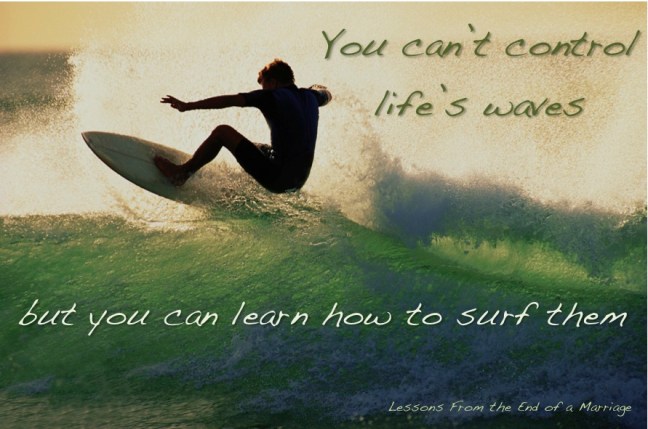
Life’s Waves

Life's Waves

PTSD After Divorce

This is one of those links that I’ve pondered in the past but it has really come to a head in the past few days. First, Paulette posted the following review of my book:

Lisa Arends does an effective job in writing about the aftermath, the fallout, of a life-changing shock, on the abrupt desolation of her marriage. The read is a well done walk through all the PTSD and repeating changes that occur, which is depicted in a letter written to her by her exited husband, the commentary on the letter under the umbrella of the devastating changes she experienced, emotionally, physically and logistically are a walk through the fact that PTSD is not just relegated to victims of war, but to any life encounter that uproots your very existence in a shocking manner. She’s a likeable author, an engaging woman, that you take to and feel for, because she portrays the story, the horror she lived, with veracity and integrity, to allow the facts to unfold on the page even if they point a finger back to her (ie: a text from her spouse to his mother-in-law, Lisa’s mother). Devastation upon devastation unravels and what we hold onto dearly is lost, not just in the relationship but also in the family built around it, fury and otherwise. Arends navigates through this debacle with grace and humility, filled with emotions that are painted with strokes that are sure to offer others in similar situations some reflections and ground; she labels as “Lessons” chapter after chapter, ultimately culminating in what she has learned, valuable life lessons, applicable to anyone. But, this is not just a self-help work, or a read for someone in a similar situation, it’s a compelling story of the frailty and misconceptions we all live with, the thin line of trust & betrayal, confidence and fright, love and rejection, all the things that make the paradoxes of life and keep a balance, hopefully the balance stays in some semblance of equilibrium. In Arends case she tilts off the scale and by the Grace of her very nature, the love of her family, and whatever else strength she draws from she journeys through to meet what is most precious to all of us, connecting and opening to trust (applause to Tiger, no spoilers) despite all temptations not to, and in doing so, learning the ultimate, that love does conquer and cannot be soiled by another’s shadow cast upon our soul.

In the book, I never name PTSD. I only describe the events and my reactions. Yet, here was a third party who deemed that to be an accurate label.

Then, yesterday, a post from Out of the Chrysalis (Does PTSD After Divorce Exist? You Better Believe It)  showed up in my inbox. I totally related to her description of her experience.

And I do believe it. PTSD happens when your mind cannot process the extent of the trauma. It’s like a short circuit in your nervous system, where you have trouble distinguishing between real and perceived threats. We tend to think of PTSD as occurring only in life-threatening situations, but it occur anytime there is an acute or prolonged trauma. Not all divorces lead to PTSD, but if it is sudden or abusive, the trauma can be severe and sudden enough to lead to PTSD-like symptoms.

According to the Mayo Clinic, the following are the symptoms of PTSD:

Symptoms of intrusive memories may include:

  • Flashbacks, or reliving the traumatic event for minutes or even days at a time
  • Upsetting dreams about the traumatic event

Symptoms of avoidance and emotional numbing may include:

  • Trying to avoid thinking or talking about the traumatic event
  • Feeling emotionally numb
  • Avoiding activities you once enjoyed
  • Hopelessness about the future
  • Memory problems
  • Trouble concentrating
  • Difficulty maintaining close relationships

Symptoms of anxiety and increased emotional arousal may include:

  • Irritability or anger
  • Overwhelming guilt or shame
  • Self-destructive behavior, such as drinking too much
  • Trouble sleeping
  • Being easily startled or frightened
  • Hearing or seeing things that aren’t there

From Mayoclinic.com.

After I received the text that ended my marriage, I experienced many of these symptoms. I had the flashbacks and the dreams. I had trouble thinking and remembering. I couldn’t sleep and I frightened easily. But, most of all I trembled constantly, my autonomic nervous system was on high alert, waiting for the next assault.

At first, the triggers were everywhere. Driving along the road that passed by my old house felt like traversing a field with buried landmines. I fully expected an explosion at any moment. I responded as though every mention of his name was literally a threat to my life. At any moment, I could be catapulted back to instant where I received the text. It was as though the phone was always in my hand.

My psychiatrist that I saw that first year stopped short of a full PTSD diagnosis, but she mentioned the disorder and selected medications that are used to treat it. I honestly don’t think I would have made it through without the medications. They allowed me to sleep and eat – two things I could not yet accomplish on my own.

Over time, the triggers decreased. I learned how to sleep and eat without assistance. I stopped the medications and was able to use meditation and exercise to reduce any symptoms. I can still feel the shadows of the trauma when I feel like I’m being abandoned again but, for the most part, my mind and body no longer confuse real and perceived threats.

After my divorce, I learned that most people assumed that depression would be the disorder de jour after a break up. They expected me to be sad and withdrawn. Instead, I was hyperalert,  shaking and always on the lookout for the next blow. It’s important to realize that all divorces are not the same and we all respond differently. There is no ‘right’ way to be after a divorce. The labels can be helpful but even they only tell part of the story. Be gentle and understanding with yourself and others. Seek the help you need and know that it does get better.

I wrote more about PTSD after divorce on The Huffington Post.

Are you struggling to find your center again after divorce? My complete, 12-part coaching course can help you leave the trauma behind and find your way back to happy. Learn more!