You Shouldn’t Feel That Way

sad

You shouldn’t feel that way.

Get over it.

You’re overreacting.

Have you ever heard any of those statements? Those remarks that leave you angry and confused. Hackles up, yet questioning if the other person is right? Why do people make those remarks? Is it out of ignorance or attack? Are they trying to help or harm? How can we respond those who tell us we do not have the right to feel the way we feel?

I work with middle schoolers – a group that is well recognized for being very emotional and reactive. I have seen a girl become suicidal after a dismissive comment by a friend. I have seen a boy with a shattered face after a fight over a mustard packet. To the outside person, those reactions seem well over the top, like calling the fire department to extinguish a candle. I could have pulled those students aside and told them they were overreacting. I could have said that they should get over it. I could have shared stories of others that had it worse to downplay their feelings.

I think we all realize that such an approach would not be helpful. Simply telling the girl that her despair was stupid or the boy that he shouldn’t be angry would do nothing to dial down their emotions. In fact, it would have made the situation worse because then it would be introducing an element of shame, causing them to question if there is something wrong with them for feeling the way they do.

When we respond with ‘shoulds,’ we are responding only to the surface. If someone appears to be overreacting, there is often much more beneath. That was the case with these two students. The girl’s sister had committed suicide the previous summer. She was feeling abandoned and lost. When her friend slighted her, she felt alone and hopeless. The boy’s family had fallen upon hard times. His only meals were through the school. To him, that packet of mustard was life or death.

So why are we so quick to dismiss the feelings of others? Sometimes, it is from a lack of empathy, an inability or refusal to put yourself in another’s shoes. Sometimes, you may have the empathy but you lack the understanding. Maybe you’re missing key information that explains the reaction. Maybe you want to help, but you’re frustrated and don’t now how.

The truth is that we can never know completely how someone else feels. It’s based on past and perception, two things that are unique to each individual. When it seems that someone’s reaction is over the top, maybe it just means that their brain needs time to catch up with the past pains held in the heart. Rather than berate the brain for not moving faster, try supporting the heart while the brain moves forward. All the heart wants is to be accepted.

If you are the recipient of the ‘shoulds,’ try not to internalize the statement. It is okay to feel the way you feel. Try to see the motivation behind the statement – is this person trying to help you or are they simply unable to comprehend your pain? Also be open to the idea that your past and your perceptions may be harming your present. It’s okay to feel the way you feel and it is also okay to not want to feel that way and to work to make it better.

As for my two students, we (teachers and counselors) worked to validate their feelings in the moment while helping them to understand why they reacted the way they did and how they can cope better in the future. Rather than telling them how they should feel from a place of judgement, we showed them how they could feel better by coming from a place of love. And that is how we should all feel.


The Secret Keepers

secrets

My ex husband came from an alcoholic family. And if there is one thing alcoholic families excel at, it’s keeping secrets.

My ex learned his role from a young age. He didn’t discuss his parents with others. He didn’t invite his friends over to his house. He learned how to keep a low profile and stay out of the line of fire. He learned not to have expectations of his parents and how to survive on his own. He learned to shut his door and shut his mouth.

I thought he could overcome his family.

I was brought into the inner folds of the family within a few short months of dating. He told me the stories of his dad passed out on the couch or drunk at his birthday party. I received a call when his dad was taken by ambulance to the emergency room due to excessive alcohol consumption. He relayed the tales of his mom, weeping and emotional, turning to her son for support in the middle of the night. I saw the endless rum and cokes. I witnessed the change in his parents as they drank to hide their pain. I perceived the unsaid behind the silences.

I still thought he could overcome his family.

When I helped his mom rearrange the living room, she showed me his baby pictures which we had unearthed. I learned some of the family secrets. I discovered that his father had been married before and had technically committed bigamy, since the divorce from wife number one was not yet final. I learned of his father’s disgraceful exit from the military and equally disgraceful exit from what was a very prestigious career. I heard about the mismanagement of money and how they went from earning six figures to living in a crumbling house in a undesirable area.

I still thought he could overcome his family.

My ex husband strove to separate himself from his parents. He was determined not to make their mistakes. He looked to the Boy Scouts to be his surrogate parents. He made friends and joined their families. He was driven to succeed and to escape his lineage. He lived in fear of turning into his father.

I still thought he could overcome his family.

He may not have kept the family secrets from me, but he still applied those lessons to other areas. There was an incident at scout camp shortly before we started dating. An incident that left several long ropey parallel scars across his lower back. He never did reveal what happened. I actually looked for familiar names and locations on the recently released list of scout leaders that had been convicted of sexual crimes. Nothing stood out. But I wonder…

I still thought he could overcome his family.

But apparently those lessons of silence and secrets were too embedded. The skill set just waiting in the wings until the right moment came along. When he began to struggle during our marriage (with money, alcohol, depression, employment…who knows?), his reflexes kicked in and he covered it up. He kept silent and he kept secrets. And through those secrets, he turned his biggest fear into reality. He became his father.

I wish that he had been able to overcome his family. And I hope that it is not too late for him. I hope that he is able to see the truth and no longer be compelled to keep it a secret.


There is Only One Week Left!

Only one more week to enter to win a free copy of my book, Lessons From the End of a Marriage on Goodreads!

nook cover


Vanilla, Please

“Vanilla, please.”

That was all I had to say, accompanied with a dollar bill in an outstretched hand. Two words. A simple exchange. Yet I could not do it.

I wasn’t always shy. I remember riding on my dad’s shoulders as a toddler, waving and saying, “Hi” to everyone I passed. I remember visiting the cockpit in the airplane and flirting with the pilot in that way that little kids have. I was three.

But soon after, shyness washed over me and cloaked me in fear. I would hide behind my mom’s leg even while in the company of known people. I would protest about talking to my grandparents on the phone as though I was delivering some great speech to thousands of followers. Instead of making conversation, I would simply recite the alphabet since it calmed my nerves.

The shyness slowly grew until it reached an apex in my eighth year. It was bad. One afternoon, I asked my mom to call my best friend to see if she could spend the night.

Lisa and Friend

She said no. Not my friend, but my mom. It was the best thing she could have done. She knew that if she enabled the behavior, I would be paralyzed through life; hamstringed by my fears. It was a tough lesson for me to learn. That afternoon, my eight-year-old body was on the floor, crying and screaming in protest. I was way too old for a temper tantrum, but that didn’t halt my attempts at creating a record-breaking fit.

The fears were imagined. All I had to do was pick up the phone, dial a number I had memorized, and say to my friend’s parents or brother, “Hi. this is Lisa. May I speak to  – .” So simple. I knew the family. It was only a few words. It was such an easy request and one that could only receive a positive response. It was so simple, yet I made it into something insurmountable.

I don’t remember if I ever summoned the courage to call that day. But I eventually did. I learned how to work through that irrational shyness and speak up for myself. I realized that I could choose to let the fear overwhelm me or I could turn the tables and overwhelm the fear instead.

As adults, we don’t have mom following behind us, forcing us to face those difficult lessons. We have to be our own parent, holding ourselves accountable and refraining from enabling dysfunctional thoughts and behaviors. Your issue may not be shyness. Perhaps you allow yourself to be lazy or engage in excessive procrastination. Maybe you make excuses that prevent you from growing. Or, possibly you permit anger to drive you. Regardless of your personal struggle, think of how you would respond if you were your own parent. Would you allow the behavior to continue? Or, would you stop enabling the actions, thus encouraging a new way of being?

As for the vanilla exchange? It had a happy ending. I decided I wanted some ice cream from a booth at the Kerrville Folk Festival where I had my choice of two flavors pre-served in plastic cups: vanilla or chocolate. When I asked my mom to buy me the ice cream, she responded by giving me the money but she required that I complete the transaction alone. After an entire day sweltering in the intense Texas sun, I finally approached the booth, quietly uttered my two words, held out my sweaty dollar bill and walked away with a cup of creamy and delicious ice cream.

The booths at Kerrville. Scary, aren't they? :)
The booths at Kerrville. Scary, aren’t they? 🙂

I gained more than just a cold treat that day. I learned that I couldn’t expect others to come to my rescue. I learned that I needed to practice being assertive in order to have my needs (okay, wants in this case) met. I realized that my shyness was irrational and that others were not even aware of it. I gained confidence in my ability to face my fears. I am thankful for those lessons every time I face a classroom full of kids, speak in front of adults, engage in conversations with strangers and make media appearances. If it wasn’t for a mom who refused to buy the vanilla ice cream, I might still be hiding behind her leg.

Ghosts of Christmas

Christmas can be such a polarizing season. Some people are enraptured by the sights and sounds, while others, lamenting what they have lost or never had, fall into despair. Why is it that a holiday can have so much power to drive our emotions? Why are some okay with their lives from January through November, but then feel despondent about their lot when the month clicks over to 12? Why do others allow stress to accumulate throughout the month, only releasing it with the ribbons on Christmas mornings? How is it that a holiday that emphasizes togetherness creates intense loneliness in so many?

It’s simple, really. There is no other time of the year as fraught with expectations as Christmas. And loneliness, stress, and disappointment hitch a ride on those expectations, sliding into our minds undetected. We can choose not to welcome them. We can use awareness to exorcise the ghosts of Christmas’s past and future, allowing ourselves to embrace the present and whatever gifts it brings.

Ghosts of Christmas Past

When I was young, I spent Christmas with both my parents. As with all families, we had rituals and traditions. I remember my mom making pineapple ham and my dad coming in from a bike ride, the smell of sweat blending with the scent of the pine needles on the tree. I remember the Christmas eve church services, with me squirming between them awaiting the tradition of opening one gift that night upon our return. I can picture our rides through town, viewing the lights in the trees and luminaries that lined the streets.

And then we were two. My parents divorced and my dad moved across the country. It took us some time to find our stride. Those first couple years felt empty; traditions carried out even though a critical member of the team was missing. We tried to keep it the same, fought against the inevitable change. It didn’t work. It never does.

Eventually, we created our own traditions, some carried through and some newly invented. We had a family friend join us for celebrations, her energy completing the triad. We took trips. We celebrated with other families. Sometimes we had money. Often we did not. But it didn’t matter. We let go of Christmases past and, in doing so, created wonderful Christmases in the present.

Scan 1

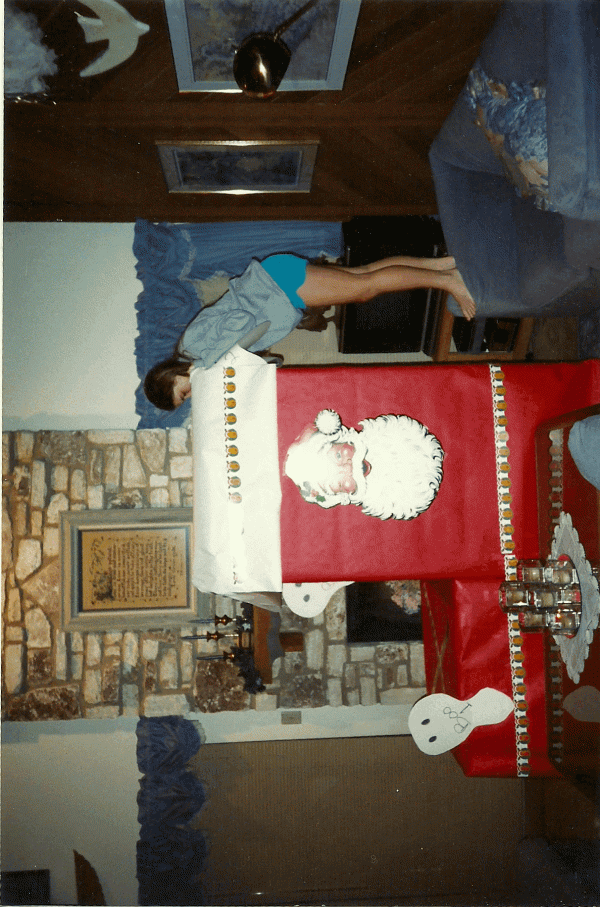
This was one of my favorite Christmases. My mom obtained and wrapped a refrigerator box and a washing machine box and assembled them to make a stocking. I was shocked when I woke up that morning and, at 16, it took a lot to impress me. Our family friend joined us and they both had fun laughing at me as I crawled through the endless “stuffing” that filled the stocking and surrounding wrapped gifts, many of which were inexpensive. This was a great example of how creativity and attitude matters more than money.

I’m thankful for those childhood experiences. They taught me to be flexible and to work within the present reality. As I entered into married life, my husband and I followed a similar model. We were lucky enough to be “adopted” by various families over the years. On some Christmases we traveled, and some we did not. Sometimes we saw family; more often we were devoid of blood relatives. Each year was different. And each year was wonderful in its own way.

Christmas
At my ex-in law’s on Christmas in 2001.

If you have children, realize that your attitude towards the holiday is more important than any traditions. If your family has changed, it is futile to try to recreate the Christmases of the past. But that doesn’t mean that your Christmas cannot still be wonderful.

Ghosts of Christmas Future

Not everyone is haunted by the past. Some people’s expectations are fixated on the future. It is easy to allow expectations to build. We expect Uncle Bobby to act differently than he usually does and we get stressed when his good behavior fails to manifest. We picture perfect children, gleaming and squealing in glee. We envision a table piled high with delectable goodies worthy of Martha Stewart’s kitchen. We allow our minds to ponder what glorious gifts might lie just beneath the wrappings. We watch movies filled with perfect families and see commercials pushing items, implying that they will make your life perfect as well.

christmas dinner at my mom's house

These daydreams may be pleasant, but they have a dark side. Unless you are visiting Martha, the spread will not be perfect. Your kids will inevitably allow grouchiness to overcome them by afternoon. You will probably not find the winning lottery ticket in you stocking. In other words, Christmas will be real. It is easy to become disappointed when we allow our expectations to grow well beyond our realities.

The ghost of Christmas future is often hardest on those who are or feel alone. The divorced parent who does not have custody over the holiday. The single person without family in town. At no time can you feel more alone than during a holiday that celebrates togetherness. But, you are only alone if you allow yourself to be. Let others know you do not have a family to celebrate with; the offers will likely come. Some of my best Christmases were spent with the families of friends or employers. If you’re willing to speak up and be vulnerable, you will find an open home and open hearts. They may not be family, but they are family for the day and sometimes that is enough.

Volunteers

If you prefer not to join another’s celebration, look for volunteer opportunities through church or Meetup.com. Helping others is a surefire way to get your mind off your own troubles. It may feel as though the whole world is paired up or celebrating with family, but that’s just the message, not the reality. You have choice in the matter. You can choose to suffer or you can choose to smile.

The Gift of Christmas Present

This year, my home will be full of family, yet none of them are related to my fiance or me. There is no tree in our  living room, nor lights on our house. I will be serving a vegetarian spread with nary a ham hock to be found. The kitchen will be messy and the plates will be mismatched (and chipped!). But there will be laughter and games. Friendship and smiles.

It won’t be like the Christmases of the past nor will it be a celebration in an imagined future. Rather, it will be the Christmas of now. Exactly as it should be. Let go of the ghosts lamenting the past and brush of those whispering of an imagined future and be with the Christmas of the present.

I wish you and your loved ones a happy (and real) holiday:)