Should You Believe Your Triggers?

I could feel it washing over me like a great wave trying to pull me under, both blinding me and choking me. My body went into full-on fight or flight mode, any rational thinking put on hold until the emergency passed.

What was the emergency, you ask?

My now-husband mentioned wanting to build a home theater in the basement.

I know, it’s a terrifying image.

This happened over six years ago and now I can laugh at the absurdity of my (over)reaction. But at the time, I truly was convinced that this was a serious threat to my well-being. I was responding to something in the present – my husband wanting to build a theater – with the emotions born from past experiences – my ex-husband building a home office in the basement that became the center of operations for his deceptions.

On the day of this particular melt down over the proposed theater, I remember being aware that the intensity of my response in no way matched the reality of the situation. But there was another part of me that was whispering, “What if this reaction is because you’re picking up on some real threat in the present?”

And I didn’t know which voice to believe.

And that’s the problem, isn’t it? We never know know for sure if what we’re feeling is a misplaced echo from the past or our intuition picking up on a real threat in the present.

There are four basic categories between our reactions and what triggers them – Snip20191103_6.png
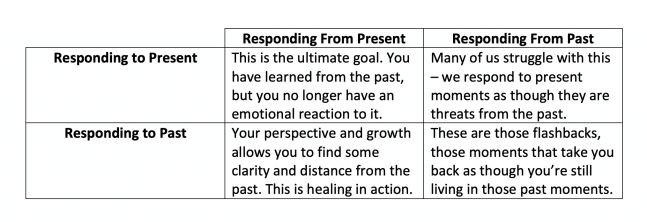
Responding to the Present From the Present

Your past experiences have taught you what to look for. You are better able to see actions that are misaligned to what you’ve been told and you’re more aware of unhealthy patterns. When something concerning happens, you use what you have learned to analyze it to decide if there are any real threats within.

You no longer have much emotional reaction from the past, so you trust that any you’re feeling now is an appropriate response to what is actually happening in the here and now. Furthermore, your reactions are on par with the behavior or sign you’re responding to. The response would be considered a reasonable one for anybody to have in similar circumstances.


Responding to the Present From the Past

Your past experiences are still living just beneath the surface. They have left you fragile, fearful. When something concerning happens in the present, it reignites those past concerns, an alarm sounding at full-blast, warning you that danger has arrived. Only the alarm is often false.

The emotional response is powerful, overwhelming, its intensity way out of line to what you’re responding to. You may even be aware that you’re overreacting, yet you feel powerless to stop it. Panic sets in. You become convinced that this is a sign that the past is about to repeat itself. You may respond with plans to flee, an instinct to fight or the desire to curl up and hide from the perceived threat. It’s best to take a time-out to allow some space for the body to calm before deciding to take any action.


Responding to the Past From the Present

This response comes when you encounter a reminder from the past, but you do not have an emotional response to it. Instead, you are able to look back with some clarity, applying what you know now to what you experienced then.

These are healing moments that provide valuable insight into what threats are real and which ones are born from a fear of being hurt again. This is learning – and healing – in action.


Responding to the Past From the Past

These are perhaps the most terrifying moments, when it’s as though a wormhole has transported you back to where you were with the same intensity of emotions and lack of perspective that you had when you were in the midst of it all.

When in the throws of a flashback, rational thinking and self-control is pretty much an impossibility. It becomes about survival, riding it out until it abates. Reminding yourself that it’s not real, that you are safe.


Should you believe your triggers?

Our emotional reactions are important, they provide us with information about our fears and about what is happening around us. Yet emotions are not always an accurate source of information. So listen to them, but don’t always believe everything they have to say.


Taking Responsibility: How to Tell When It’s Your Stuff to Own

It can be challenging to determine when something falls on somebody else’s shoulders and when it it is ultimately your responsibility to bear. Here are four ways to tell if it’s your stuff to own –


1 – A pattern keeps repeating.

When I first started casually dating post-divorce, I had guys start to pull back after a few days. At first, I brushed it off, lamenting the poor manners and hook-up culture in today’s world. But it kept happening and I eventually admitted that I was the common denominator. With just a brief amount of reflection, I soon embarrassingly realized that they withdrew because I was acting like their wife. Oops. It wasn’t intentional on my part, but since I had been married so long and dated so little, I was an expert in the first arena and a novice in the second. Once I identified the issue, I quickly corrected it and the pattern came to an abrupt halt.

When we repeatedly find ourselves in the same situations or with the same sort of subpar relationships, we often point the finger, blaming anything and everything we can. Yet when the same pattern keeps happening to you, I’m afraid there is a reason and you’re likely the source of it.


Here’s your stuff –

Identify any patterns that have a tendency to occur in your life.

Look for the commonalities between the situations and identify how you contribute to the pattern.

Consider how you can alter the pattern. Can you change the antecedent, your behavior or your response?

Enlist the help of a professional, if needed.


2 – It’s an issue you have now because of something that somebody else did to you.

My ex-husband certainly did not set me up for success with future relationships. By leaving with a text message, he primed me for fearing abandonment going forward and by committing bigamy, he set me up for worrying about future betrayals. Blaming him is futile, as he didn’t seem fazed about the repercussions of his decisions and besides, he couldn’t alter the impact that it had on me. I could also try to shuttle this to my now-husband’s shoulders, dictating his actions because of my past experiences. But not only is that not fair to him, it also won’t undo the damage from my ex.

It’s tempting to state that we need people to treat us a certain way or to do (or not do) certain things because it easily triggers us. And yes, we can (and should) communicate these preferences to others. But ultimately, our responses (or overreactions) are our responsibility because we are the only people that we can control.


Here’s your stuff –

Know yourself and your triggers.

Set yourself up for success by avoiding or limiting certain situations until you are able to handle them.

Communicate your preferences clearly yet without expectations.

Actively work to discharge the energy around your triggers.

Refrain from blaming people that come into your life after the event for what happened.


3 – It is not something that another person can fix for you.

I stress. Big time. My ex-husband learned how to soothe me when I got worked up when we were teenagers. I grew to depend upon his help to calm down when I would become overwhelmed. And then he left, and I was left stressing even more. When my now-husband came into the picture, I assumed that he would also take on the role of professional stress tamer. He refused, rightly pointing out that managing my stress was ultimately my job. I pouted, but I learned. And the techniques that I have in place now are far more effective than anything that my ex could do for me.

We often try to pass off our unwanted struggles on others. After all, it’s easier if we can outsource the things that we don’t want to get our hands dirty with. Life rarely works that way, however. We can – and should –  ask for help. But all others (including therapists) can do for us is offer guidance, support and encouragement. Ultimately, nothing changes until we do.


Here’s your stuff –

Know what you normally struggle with.

Ask for help when you can’t make progress or you are unsure where to begin.

Accept the limits of helping and be prepared to do the heavy lifting.


4 – You find yourself complaining about the issue repeatedly.

I used to have a really hard time going back to school at the end of the summer. I would feel the envy rise as I heard about the amazing vacations that other teachers took while I reflected on my time spent working or looking for somebody available to do something with. This happened more years in a row than I would like to admit. Finally, I realized that the other teacher’s trip weren’t likely to change and neither was my financial status. But I could still shift my summer focus from work to adventure-on-a-budget. And now, when I return, I hear others exclaim over my summer stories and pictures.

We all can fall into pattern of complaining. It’s easy and it can also feel productive since we are actually doing something (even if that something is only moving our mouths). There are two possibilities with the issue you’re complaining about. Either it’s out of your control and so you need to change your mindset or it’s something you can change and it’s time to get busy.


Here’s your stuff –

Be aware of the issues or situations that you frequently complain about.

Release any defensiveness around the issue; it’s only holding you back.

Identify if the issue is within your locus of control or not.

If you cannot change the situation, reframe how you view it.

If you do have some influence, come up with (and initiate) an action plan.


Related: What If it IS Your Circus and They ARE Your Monkeys?

Understanding Triggers


Want more ideas and support on dealing with triggers?


Facing Avoidance

We avoid because we do not want to suffer. Yet suffering then becomes the background noise of our lives.


Learning to Trust Again: How to Deal With the Triggers

There are times when the triggers are activated because of a legitimate and present concern. At those times, it’s important to listen to your gut and pay attention to its warnings. And there are other times when the alarms were pulled too soon, acting more from perceived danger than from a true emergency.


Trigger Points

As a survivor of a traumatic divorce, I am also very familiar with emotional trigger points – painful memories and associated responses caused by repeated or acute trauma. They are areas of hyperirritability where the response far outweighs the preceding factors. They cause intense pain at the time of their trigger and can cause referred pains in seemingly unrelated areas.

A Case of Mistaken Identity

mistaken identity

My car turned yellow while I was at work today.

As did the car next to it.

And the one next to that.

In fact, the entire parking lot looked like it had been handled by the grubby fingers of a kid after eating off-brand Cheetos.

And all because trees are not subject to public indecency laws.

My body has decided that tree pollen is as threatening as a hostile missile attack. No matter how much I try to talk my immune system out of responding at a code red threat level, I’m summarily ignored as the defenses are rallied.

My students laugh as my “sneezures” interrupt class several times an hour. My husband grumbles as I cough and wheeze in my sleep. And even my dog looks at me funny when my voice suddenly sounds like that of a seventy-year-old chain smoker.

And all because of a case of mistaken identity.

The pollen, as much as I like to curse it, isn’t really my problem.

My problem is in my reaction to the pollen.

My misery is rooted in my body’s inability to distinguish between a perceived threat and an actual one.

Geez, that sure sounds familiar.

My brain has been known to have the same problem.

When I think back on the times my mind has perceived a threat in my now-marriage, I can recognize that it was assuming a full-on attack and preparing for assault when the reality was as harmless as some yellow dust on the windshield.

A case of mistaken identity.

And my problem wasn’t really what my husband did or didn’t do, said or didn’t say.

It was in my (over)reaction to the situation because of a misidentification.

One of the possible approaches to treat allergies is to submit to a series of shots where you’re repeatedly exposed to a small amount of the offending substance. The science isn’t fully known, but it’s suspected that the process helps to “teach” the body that the allergen doesn’t actually mean any harm and there’s no reason to prepare for battle when its presence is detected. The shots often work, although relief frequently takes longer than expected.

That’s sounding familiar again.

Over the past few years, I have had many opportunities to face small iterations of my fears of abandonment and betrayal. At first, my reactions were extreme. But over time (and yes, far more time than I expected), I learned that often what I perceived as a threat was closer to the level of a messy irritant. 

And now that I fall victim to mistaken identity far less often, I have found relief.

As long as I avoid the procreating trees.

funny-Spring-allergy-tree-nature-cartoon-vert.jpg


Memory Slammed

This morning, I traveled across town to meet a friend. I ended up with a few minutes to spare, so I stopped in to a Home Depot near her house to peek at the stock in the nursery (starting to get excited about planting again!).

I was over in the area where I used to live and now only visit infrequently. For years, I dreaded traveling back there as every landmark was full of memories like an overripe fruit, sweet bordering on putrid.

But the last couple years, it’s been okay. I can drive the road by my old house and not tense up. I can enter stores and restaurants and not be pulled back to the past.

So today, I walked into Home Depot with no thoughts of the past and no fear or anticipation of memories.

Which perhaps is why it hit me so hard.

I was memory slammed when my back was turned.

I entered in through the nursery, greeted the few shrubs on display, and then crossed the store to visit the restroom. It was as though the bathroom stall was a time machine. As I exited the room and rounded the corner of the hall, I was immediately pulled back to a time about 6 years ago when I left that same bathroom to join my then-husband in line at the register. For a few dozen steps, I was in the past. I was fully expecting to walk up on my then-husband, perhaps slip an arm around his hips, and talk through our plans for the afternoon. It was only when an employee asked if I needed assistance, that I snapped back into the present moment.

It wasn’t painful. It wasn’t like a trigger, initiating an avalanche of memories. It was just odd, jarring, like that transition from one temperature extreme to another that takes your breath away as you adjust.  The memory faded as quickly as it came, leaving me more bemused than upset. After all, it’s nothing to be afraid of. It’s just a memory.

And now I’m off to a different Home Depot with my now-husband to pick up supplies to put the finishing touches on the theater. And I’ll be happy to slip my arm around him while we wait in line. No time machine needed.