Exercises in Vulnerability

After divorce, we often enter a protective state, curled inward and walled off to the outside world. And without practice, we soon forget the critical skill of being able to be fully seen by another. And so that which was advantageous at first, eventually becomes limiting as new relationships cannot fully form when you are wrapped in your emotional armor.

Not only is it scary to immediately open up to others when your heart has been shredded, it can also be risky. Sadly, there are those that look for wounded souls and advantage of your weakened state. Yet if you remain hardened to all encounters, you risk losing the ability to be vulnerable as you become accustomed to your “Nothing can touch me” state.

There is a middle ground. Places where you can practice being open while at the same time ensuring your emotional safety. The following are exercises in vulnerability that maintain your strength and flexibility for when you’re ready to put it in action in a new relationship.


Therapy

This is one of the key benefits of therapy. In many ways, the relationship you have with your therapist within the safety of their four walls gives you an opportunity to practice with a trained professional before you bumble through it on your own in the world. They know when to push you to open a little more and sense when you’re flooded and need a breather. In contrast with the other strategies, this one directly addresses vulnerability and allows for an outsider’s help and perspective.


Massage

This was a key part of my healing from my own divorce. Abandonment had left me traumatized and fearful. I scheduled a monthly massage with a trusted therapist for those first several months. The safe, nonsexual touch helped me learn to relax in front of another person, which I knew was going to be critical for my future wellbeing. We NEED touch and when you’re having trouble trusting people in your life, massage can be a safe way to meet that need.


Time With Kids

Kids have a way of worming through our emotional defenses. Willing to say it like it is, they call us out on our stuff and their own openness and honest curiosity helps to make us feel at ease. Now obviously, they are not the ones to divulge all of your thoughts to, but you can learn how to relax and let yourself feel without passing judgement.


Online Groups

Whether a structured support group or an anonymous account on Twitter, the internet offers myriad opportunities for you to flex your vulnerability muscle. This is an environment where you can be completely open, yet also feel protected behind your screen. Be cautious if you’re not in the relative safety of a private group and you’re still feeling pretty fragile, as here there be trolls.


Book Clubs

Book club discussions often allow ways for us to talk about how we relate to the literature, which can be a way of talking about your feelings and your experiences through the book. This round-a-bout arrival can often feel more comfortable than a direct approach. Plus, you also have the opportunity to learn that you’re not alone with these feelings.


A Guidebook to Handling Your Emotions

We don’t come with emotion-handling software already installed. As young children, we were pure, unrestrained emotion. Any disappointment resulted in a red and tear-stained face and joy over the smallest delight would result in spontaneous and unselfconscious giggles.

And then, over the years, we received guidance on how to handle our emotions. Some of us heard the message that emotions are a sign of weakness and should be avoided at all cost. Others grew up in environments where emotions were a form of currency, used to get what you want from those around you.

Regardless of our particular emotional education, few of us mastered the curriculum by adulthood.

So here’s a little guidebook, a brief refresher on how to handle your emotions. Don’t worry if you still struggle with these reminders. Learning how to be human takes a lifetime.


Do Be Curious…Don’t Judge

It always breaks my heart a little when I hear someone say, “I shouldn’t feel that way.” Because they DO feel that way. And that is entirely okay. Judgment doesn’t make the emotion go away. All it does is frost it with a layer of self-criticism. Instead of judging the emotion, try asking yourself, “I wonder why I’m feeling this way?”


Do Approach…Do Not Attach

We are busy. And with so many tasks and people and apps always demanding our attention, our own internal emotional landscape often takes the back burner. Yet even if we don’t take the time to look, it’s still there, influencing everything that comes into our sphere. Slow down. Take a moment to notice how you’re feeling. Name it. But don’t become too comfortable. Emotions, like clouds, often pass. If you attach too much with a certain feeling, you’re interrupting this natural cycle.

Do Moderate…Don’t Bury

It’s a good thing that most of us have gotten better at handling emotions over time. An entire office building of tantruming workers would be a little awkward. We need to be able to dial down our emotional intensity and filter our emotions through perspective and rationality. Yet sometimes we take this too far, stuffing down our emotions and locking them away. Of course, they are still there. Only now instead of whispering, they’re going to start screaming.


Do Accept…Don’t Enable

You feel the way you feel. That’s okay. What’s NOT okay is to cater to those feelings like they are some sort of monarch. For example, if you feel sad, feel sad. But you don’t need to work to become the best iteration of sadness that ever existed. Instead, feel sad and also hold yourself to your goals. And remember, you are not your feelings.


Do Direct…Don’t Control

Have you ever told a hyper toddler to just sit still in a restaurant? How did that work out for you? Obviously, you can’t just let them unleash the beast within the establishment, but you can take them for a walk around the parking lot before dinner. Our emotions respond in much the same way. If you try to order them to sit and stay, disaster will ensure (and you may be thrown out of the restaurant), but you can channel your emotional energy in acceptable ways.


Do Listen…Don’t Believe Everything They Say

Our emotions are worth listening to. Our rational brains may be smart, but they are also prone to all sorts of fallacies and delusions (confirmation bias, anyone?). Our emotions operate a different level and are often able to pick up on things that our thinking selves are trying to talk us out of seeing. So listen. But also verify. Because much like the dog that sometimes barks at a falling leaf, our emotions sometimes get a little confused about what constitutes an actual threat. Feelings are not facts.


Do Share…Don’t Expect a Certain Response

We are emotional beings. It’s okay to show your feelings. Yet so often when we do share, we do so with an expectation of how the other person will respond. And then if our expectations are unmet, we blame the emotion. When really the fault is with the unrealistic expectations. Emotions are uniquely personal. Although we all feel the same ones, we don’t always feel them in the same way or in response to the same things.


Should You Believe Your Triggers?

I could feel it washing over me like a great wave trying to pull me under, both blinding me and choking me. My body went into full-on fight or flight mode, any rational thinking put on hold until the emergency passed.

What was the emergency, you ask?

My now-husband mentioned wanting to build a home theater in the basement.

I know, it’s a terrifying image.

This happened over six years ago and now I can laugh at the absurdity of my (over)reaction. But at the time, I truly was convinced that this was a serious threat to my well-being. I was responding to something in the present – my husband wanting to build a theater – with the emotions born from past experiences – my ex-husband building a home office in the basement that became the center of operations for his deceptions.

On the day of this particular melt down over the proposed theater, I remember being aware that the intensity of my response in no way matched the reality of the situation. But there was another part of me that was whispering, “What if this reaction is because you’re picking up on some real threat in the present?”

And I didn’t know which voice to believe.

And that’s the problem, isn’t it? We never know know for sure if what we’re feeling is a misplaced echo from the past or our intuition picking up on a real threat in the present.

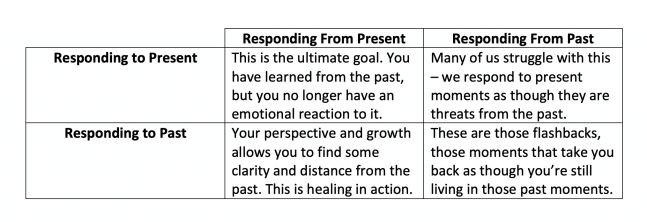
There are four basic categories between our reactions and what triggers them – Snip20191103_6.png

Responding to the Present From the Present

Your past experiences have taught you what to look for. You are better able to see actions that are misaligned to what you’ve been told and you’re more aware of unhealthy patterns. When something concerning happens, you use what you have learned to analyze it to decide if there are any real threats within.

You no longer have much emotional reaction from the past, so you trust that any you’re feeling now is an appropriate response to what is actually happening in the here and now. Furthermore, your reactions are on par with the behavior or sign you’re responding to. The response would be considered a reasonable one for anybody to have in similar circumstances.


Responding to the Present From the Past

Your past experiences are still living just beneath the surface. They have left you fragile, fearful. When something concerning happens in the present, it reignites those past concerns, an alarm sounding at full-blast, warning you that danger has arrived. Only the alarm is often false.

The emotional response is powerful, overwhelming, its intensity way out of line to what you’re responding to. You may even be aware that you’re overreacting, yet you feel powerless to stop it. Panic sets in. You become convinced that this is a sign that the past is about to repeat itself. You may respond with plans to flee, an instinct to fight or the desire to curl up and hide from the perceived threat. It’s best to take a time-out to allow some space for the body to calm before deciding to take any action.


Responding to the Past From the Present

This response comes when you encounter a reminder from the past, but you do not have an emotional response to it. Instead, you are able to look back with some clarity, applying what you know now to what you experienced then.

These are healing moments that provide valuable insight into what threats are real and which ones are born from a fear of being hurt again. This is learning – and healing – in action.


Responding to the Past From the Past

These are perhaps the most terrifying moments, when it’s as though a wormhole has transported you back to where you were with the same intensity of emotions and lack of perspective that you had when you were in the midst of it all.

When in the throws of a flashback, rational thinking and self-control is pretty much an impossibility. It becomes about survival, riding it out until it abates. Reminding yourself that it’s not real, that you are safe.


Should you believe your triggers?

Our emotional reactions are important, they provide us with information about our fears and about what is happening around us. Yet emotions are not always an accurate source of information. So listen to them, but don’t always believe everything they have to say.

Give Yourself Permission

We are often our own harshest critics. We berate ourselves for the same things we respond with compassion to in others. Instead of doing the best we can, we often “should” ourselves into shame and paralysis.


So for today, practice being as kind to yourself as you are to others.

For today, give yourself permission to…


Struggle even when your struggles seem to pale in comparison to those of others.

Sometimes we measure our traumas against those of others. And when they don’t even begin to compare to the magnitude of the horror that some of faced, we believe that we shouldn’t feel the way we do. That somehow we don’t have the right to struggle because our struggles are minor compared to those around us.

Yet one trauma doesn’t negate another. Experiences are measured not by how they compare to others, but by how they compare to what you have been through. You can have a hard time even if it seems minor. Your feelings are real and valid.


Feel okay even when things are falling apart around you.

I attended a tragic funeral recently. And like at all such gatherings, there were moments of shared laughter as people traded stories and memories. Brief periods of respite from the pain, rising through the sadness like bubbles to the surface.

And those moments are precious. It is okay to smile even when you have tears pouring from your eyes. It’s okay to set aside the grief for a period and enjoy life. There is no rule that states that grieving and living are mutually exclusive. You can do them both at once.


Secretly feel relieved even when you’re devastated.

There are times when our hearts and our brains are in opposition. When we know that a loss is needed, but yet we struggle to let go. This is the death after a protracted illness or the divorce after a long period of dysfunction. We grieve outwardly, while secretly also feeling relieved that it is over.

And that’s okay, to both miss something and also be at peace with it ending.


Feel sad just because.

There are days when you’re just not okay. There’s no reason, at least none that you can put your finger on. You’re just sad. Or withdrawn. Or anxious.

And those feelings, whatever they are, are allowed.

When we try to tell ourselves that we shouldn’t feel that way, we tend to only amplify the sensations. Instead, give those feelings permission to be and let them move through freely.


Not be at your best.

Maybe you’re the star employee at work. Or typically a Grade A parent. But not today. Today, you’re struggling to get it together. And then you make it worse by comparing your performance today to your high expectations of yesterday.

It’s okay to have days where you lower the benchmark. So maybe you didn’t prepare the normal healthy breakfast for your kids this morning and you had to rely on a fast food drive through. They still ate. And for today, that’s a success.

Not every day is going to be the best performance. As long as you still show up, you’re doing it right. 


Ask for help.

When it comes to this life thing, we’re all in it together. There is no reason to try to do it all alone.

Asking for help is both the greatest gift we can give ourselves and the biggest sign of courage.

Give yourself permission to feel how you feel and to accept help when those feelings become too much to carry alone.

15 Ways Fear Hides in Plain Sight

fear

It’s one of the few times my mom ever screamed at me. Because of that, the memory is seared into my mind.

I was six years old and ecstatic to visit the “Happiest Place on Earth” for the first time. We were standing at one of the monorail stations, waiting to board the next high-speed train. Curious about the way the unique system functioned, I darted off through the crowd to peer down into the track.

My mom’s angry shriek brought me back from the edge.

But it wasn’t really anger she was expressing, was it?

It was fear.

Fear is a strange emotion. Sometimes it’s easily visible – the shaking hands, the trembling voice, the widened eyes. It can be expressed as worry or anxiety. Or marked with the words, “I’m scared” or “I’m nervous.”

But even more frequently, fear masquerades as something else, especially in people who have been taught that it’s “weak” to show fear or, like with watching your child about to be hit by a train, the fear completely overrides the system. Additionally, fear is not a pleasant emotion and we often allow it to morph into other forms in an attempt to distance ourselves from the discomfort.

So the fear manifests as anger or control or dependency. And if we can learn to recognize – and respond to – the fear behind the mask, we can improve the communication and the interaction.

The following are fifteen common ways that fear hides in plain sight:

1 – Anger

“You’re never going to see the sun again!” the mom angrily threatens when her teenager shows up three hours after curfew. “You’re grounded for the rest of your life!” The parent certainly comes across as furious, with their reddened face and raised voice. But their slight tremble reveals the true emotion – fear that their child wasn’t returning home at all.

2 – Rejection

“I’ve realized I always seem to break up with guys right when we’re getting close,” my friend revealed to me one day. To the men, this behavior read as surprise rejection. Upon further consideration, my friend determined that she ended things out of a fear of growing closer and getting hurt.

3 – Isolation

I am fascinated with the people on the show Life Below Zero, especially Sue, who lives in an extremely isolated camp near the arctic circle. She never reveals much of life story, but her drive to be alone speaks to a deep-seated fear of being close to people.

4 – Irritability

“Why isn’t he picking up his phone,” I grumbled to myself, feeling my annoyance build. On the surface, my irritation stemmed from not having an immediate answer to my benign question. But beneath that impatience was a burgeoning fear that the call went unanswered due to some tragic accident.

5 – Stubbornness

Teaching me to ride a bike was a true exercise in my patience for my parents. Even though I was physically capable of mastering the technique by the age of 7 or so, it took an additional 3 years (and plenty of banana split bribes) for me to lose the training wheels for good. On the outside, I exhibited stubbornness, a resistance to practicing or to removing the supports. On the inside, I was afraid of falling.

6 – Control

Upon hearing about her daughter’s plans to marry before obtaining a college degree, a mother begins to try to dissuade the daughter and the intended husband through manipulation. It comes across as controlling, yet it stems from the mother’s fear that her daughter will not be able to look after herself.

7 – Meanness

The new girl showed up at my school in the middle of eighth grade. She was tall, blond, beautiful and had the best style any of us had ever seen. As the boys tripped over themselves in an attempt to get to know her, the popular girls began immediately to slander her reputation and make her life miserable. This “mean girl” routine was performed out of fear, the popular girls afraid that this interloper would steal their top spot and move them down the (very important in middle school) social ladder.

8 – Delusion

“I won the computer in a raffle at that networking thing I went to today,” explained my then-husband as he placed the new MacBook Pro on the kitchen island. The claim didn’t resonate as true, yet I still accepted his alibi. Because seeing the truth – that my husband was capable of extreme deceit, was too scary to face.

9 – Clowning

I had one student that would become disruptive towards the end of every unit of study. He would interrupt, annoy other students and basically treat the classroom like his own personal stage. Once I became aware of the cyclical nature of the behavior, it became apparent that the clowning was an attempt for him to manage his anxiety about not being prepared for the upcoming assessment.

10 – Distraction

I stood in line for the extreme roller coaster that advertised the steepest drop in the country. As people approached the start of the line, where the view of the first plummet jutted out at a sickening angle, they began to pull their phones out of their pockets and turn their attentions to something less frightening.

11 – Overly Cautious

“I don’t want to get a driver’s license,” the seventeen-year-old revealed to me. I don’t want that responsibility. The former student was one of the more mature ones that I have taught and was more than capable of safely handling a motor vehicle. Although she never admitted that she was afraid of the liability that comes with a license, it was clear that she was holding back out of fear.

12 – Judgmental

“I would NEVER get divorced,” a person on Twitter announced to me. “I would stay and fight for my marriage.” At first, I grew defensive, reacting to the subtext that I too-easily quit on my marriage. Then, it registered that this person’s judgment was really just a veil over their fear of losing their own marriage.

13 – Barriers

“Hi, I’m Lisa. I’m moving out of state within the next few months.” This was basically how I started my first several dates after divorce. I was afraid of getting hurt again, so I basically refused to allow anyone entry.

14 – Dependency

The eighth grader felt more like a preschooler, with his lack of maturity and independence. Once I met his mom and heard her story of a string of miscarriages and years of infertility finally leading to one successful birth, I understood. She was so afraid of losing another child, that she was determined to keep her surviving one a child forever.

15 – Overcompensation

He was easily the largest man in the gym, his biceps roughly the size of my head. Yet although he looked the part of confident bodybuilder, his physique was born of insecurity, a fear that he wasn’t quite enough.