Lose Your Illusion

(Any Guns ‘n Roses fans smiling at the title?)

Illusion
Illusion (Photo credit: Nikos D.)

Brock and I caught the second half of a show on Discovery last night about how easy it is to fool the brain. The first segment we saw had volunteers sitting at a table with their right arms hidden from sight behind a screen. A fake arm was then placed on the table in front of them. The researcher went through a few steps (I didn’t see the beginning, so I’m not sure what all this entailed) to make the participants connect with the fake arm. Then, the researcher slammed a hammer down on the plastic arm. Most of the volunteers jumped. Makes sense. Slam a hammer down in front of me and I’ll startle too. The interesting part, however, was that the majority of the participants claimed to feel pain in their fake hand. The brain was relying on the visual clues and was fooled into believing that the plastic substitute was indeed the real thing.

The brain’s fallibility goes well beyond parlor tricks. The brain is an expert at filling in the pieces, at seeing or hearing what it expects to see or hear and at creating a narrative to make sense of any input. We are not normally conscious of this effect; it happens quickly and automatically. In the case of the situations presented by the show, the illusions were inconsequential. It doesn’t really matter if your brain interprets wet rags on plywood as the sound of raining hamburgers in Cloudy With a Chance of Meatballs. I don’t think that misconception will impact your life one way or another. (I apologize if having this auditory trick revealed causes you any mental distress.)

That’s not always the case, however. When you take the brain’s innate tendencies to misinterpretation and to complete gaps with its own information and you add in all of the messy emotions of the human experience, you have a situation that can lead to trouble. We all live in a land of illusion to some extent. On a biological level, it is impossible to process every single piece of information that our senses are bombarded with every second. Our brain takes shortcuts. It makes sweeping generalizations. It has to. On an emotional level, we can try to be empathetic but we can never truly understand another’s perspective. We see the world through our own fallible filter.

The trouble comes when the illusions go too far. When we stubbornly act as though our fake-arm belief is the truth even when the screen hiding the reality is removed. It’s easy to believe our own narratives even when they are disproved. Manti Te’o held onto the belief that his girlfriend was real even though she never materialized in real life. Lance Armstrong refused to come clean about doping even when evidence to the contrary was produced. My ex husband failed to see his actions as wrong even when he was sitting in a jail cell.

To those of us on the outside, it seems so clear, so obvious. But that’s because it’s not our illusion. We are the bystanders who can see both the real arm behind the screen and the false one in front. It’s so difficult to see our own illusions. The mind puts up such strong defenses. It hates being wrong. Once it has decided on a narrative, it will work tirelessly to find and filter information that supports its conclusions.

My ex husband’s need to maintain the illusions was so strong that he attempted suicide soon after being released from jail. A couple of days later, he reached out to my mother via text. A brush with death had the effect of removing the screen for a brief period. One response of his really stands out:

I tried to create a world where I convinced myself that everything was somehow fine no matter how bad things looked. As crazy as it sounds I believed my own bullshit and just deluded myself into believing that everything could be ok.

Again, from the outside, it seems so clear. How could he believe that everything could be okay when he spent every penny he could find, lied to everyone around him and committed bigamy? It seems crazy. Yet there I was in my own illusion, believing that my husband was honest and loving. My mind also refused to see the truth behind the screen.

So, what do we do? Are we captive to these minds of ours that seem hell-bent on fabrication? Well, yes and no. It’s impossible not to fall sway to any illusions. Even by the end of show last night, I was still fooled by most of the tricks even though I knew they were there. We cannot stop our minds from filtering information selectively and reaching conclusions based on experience. What we can do is let go of the assumption that we are always correct. We can be open to the thought that maybe what we are experiencing isn’t reality. We can strive to see with our eyes rather than with our presumptions. And, we can summon the courage to remove the screen once we become aware of its existence. Just make sure you watch out for any hammers coming your way.


Pardon Me, Ego. I Need to Get Through.

The Thinking Man sculpture at Musée Rodin in Paris

Ego:

the “I” or self of any person; a person as thinking, feeling, and willing, and distinguishing itself from the selves of others and from objects of its thought. (from dictionary.com)
Ever since we first begin to see ourselves as separate, sentient beings in childhood, our egos define how we interpret the world around us.  That sense of self may actually be holding you back from healing from your divorce.  Do you see yourself in any of the following patterns?
It’s All About Me
When I first realized the extent of my husband’s betrayals, I kept asking, “How could he do this to me? To the one he was supposed to love?”  I saw his actions directed towards me as an arrow towards a target.  I assumed he was thinking about me as he made these decisions.  He lied to me.  He cheated on me.  He stole from me. That pattern kept me fully anchored in a victim state, the recipient of all the pain and deceptions.
Slowly, I realized that it wasn’t all about me.  He lied and cheated and stole, yes.  But he did those things because of whatever demons had him in their grasp.  He didn’t do those things because of me.  He most likely wasn’t even thinking of me while they occurred.  He did them and I was in the way.
I shifted my thinking. When he hurt me, he was acting to protect his own sense of self rather than trying to wound mine.  I began to let the anger go.
It is not easy to remove the ego from interpreting the actions of one so intimate to you. Try looking at the situation with an open mind, letting go of your own ego, and see how your perspective shifts.
The Reflective Ego Shield
Our egos are vulnerable beings; they often cover themselves in highly reflective shields, deflecting any criticism and shining it back at its source.  I used to get very defensive when anyone suggested that I had a hand in my husband’s actions.  I would retaliate, lashing out at them as I tightened the stays on the armor protecting my ego.  It was a very scary proposition to let some of that armor go and to examine what was shielded underneath.  I learned the role that my own insecurities and anxieties played in the end of my marriage.  Instead of reflecting all of the responsibility on him, I took my share.
There is a difference between taking responsibility for your own actions and taking the blame for another’s actions.  If you are carrying your own reflective shield, try lowering it and examining what lies beneath.
The Hidden Wounds
The ego doesn’t like to show its vulnerabilities.  When asked, “How are you doing?,” the ego always answers, “Fine.”
I remember how many times I falsely spoke that word in those early months.  Much of that time, I wasn’t “fine,” I was angry, sad, bitter, anxious, sick, and disconnected.  But I also didn’t want to reveal those wounds.  To let the world see the depth of my pain. I kept it covered with a band-aid of “fine.”
Your wounds cannot heal unless they are exposed to the air.  The bandage can remain on to protect your injuries from the world at large, but you remove them when are in a safe place to let the healing begin.
Ego as Strongman
Our egos are a bit like young meatheads in a gym.  Flexing in the mirror, wanting to appear strong and capable amongst the others.  This means that sometimes we will try to lift more than we can without asking for assistance.  And, just like in the weight room, this can only lead to disaster.
Prior to my husband’s David Copperfield act, I was horrible at asking for and receiving assistance.  In fact, that was actually one of the points of contentions in my marriage; I always made it clear that I could do it alone.  I guess he wanted to prove me right.  Regardless, I made things so much more difficult than they ever needed to be by denying offered help and refusing to ask for help when it was needed.
Are you acting like the young man in the gym?  Ask for a spotter and you’ll not only gain the respect of those around you, but you will also be able to lift more than you ever thought possible.
Our egos tend to operate below our conscious thought.  After all, they are us.  And they are often the biggest barriers in our way.
Pardon me, ego.  I need to get through.

Vanilla, Please

“Vanilla, please.”

That was all I had to say, accompanied with a dollar bill in an outstretched hand. Two words. A simple exchange. Yet I could not do it.

I wasn’t always shy. I remember riding on my dad’s shoulders as a toddler, waving and saying, “Hi” to everyone I passed. I remember visiting the cockpit in the airplane and flirting with the pilot in that way that little kids have. I was three.

But soon after, shyness washed over me and cloaked me in fear. I would hide behind my mom’s leg even while in the company of known people. I would protest about talking to my grandparents on the phone as though I was delivering some great speech to thousands of followers. Instead of making conversation, I would simply recite the alphabet since it calmed my nerves.

The shyness slowly grew until it reached an apex in my eighth year. It was bad. One afternoon, I asked my mom to call my best friend to see if she could spend the night.

Lisa and Friend

She said no. Not my friend, but my mom. It was the best thing she could have done. She knew that if she enabled the behavior, I would be paralyzed through life; hamstringed by my fears. It was a tough lesson for me to learn. That afternoon, my eight-year-old body was on the floor, crying and screaming in protest. I was way too old for a temper tantrum, but that didn’t halt my attempts at creating a record-breaking fit.

The fears were imagined. All I had to do was pick up the phone, dial a number I had memorized, and say to my friend’s parents or brother, “Hi. this is Lisa. May I speak to  – .” So simple. I knew the family. It was only a few words. It was such an easy request and one that could only receive a positive response. It was so simple, yet I made it into something insurmountable.

I don’t remember if I ever summoned the courage to call that day. But I eventually did. I learned how to work through that irrational shyness and speak up for myself. I realized that I could choose to let the fear overwhelm me or I could turn the tables and overwhelm the fear instead.

As adults, we don’t have mom following behind us, forcing us to face those difficult lessons. We have to be our own parent, holding ourselves accountable and refraining from enabling dysfunctional thoughts and behaviors. Your issue may not be shyness. Perhaps you allow yourself to be lazy or engage in excessive procrastination. Maybe you make excuses that prevent you from growing. Or, possibly you permit anger to drive you. Regardless of your personal struggle, think of how you would respond if you were your own parent. Would you allow the behavior to continue? Or, would you stop enabling the actions, thus encouraging a new way of being?

As for the vanilla exchange? It had a happy ending. I decided I wanted some ice cream from a booth at the Kerrville Folk Festival where I had my choice of two flavors pre-served in plastic cups: vanilla or chocolate. When I asked my mom to buy me the ice cream, she responded by giving me the money but she required that I complete the transaction alone. After an entire day sweltering in the intense Texas sun, I finally approached the booth, quietly uttered my two words, held out my sweaty dollar bill and walked away with a cup of creamy and delicious ice cream.

The booths at Kerrville. Scary, aren't they? :)
The booths at Kerrville. Scary, aren’t they? 🙂

I gained more than just a cold treat that day. I learned that I couldn’t expect others to come to my rescue. I learned that I needed to practice being assertive in order to have my needs (okay, wants in this case) met. I realized that my shyness was irrational and that others were not even aware of it. I gained confidence in my ability to face my fears. I am thankful for those lessons every time I face a classroom full of kids, speak in front of adults, engage in conversations with strangers and make media appearances. If it wasn’t for a mom who refused to buy the vanilla ice cream, I might still be hiding behind her leg.

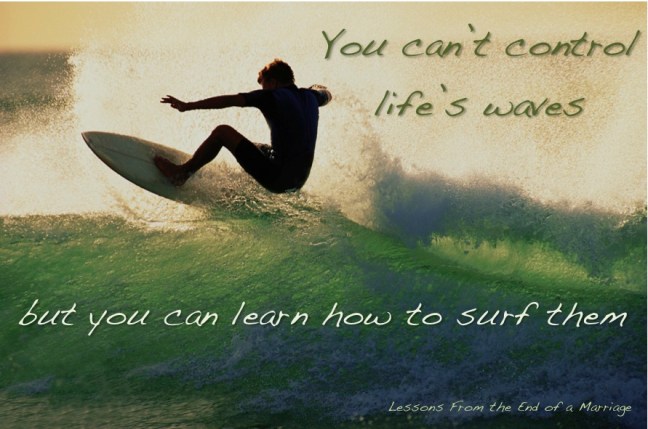
Life’s Waves

Life's Waves

How to Surf a Tsunami

Many of us will face a personal tsunami at some point in our lives. We will be felled by a great wave bringing with it sudden change and loss. Perhaps your tsunami is in the form of the death of a loved one, maybe it is the loss of a job or a way of life or possibly you have lost the health you took for granted. My own tsunami was in the form of an unexpected divorce after being abandoned via a text message.

Regardless of the nature of your abrupt trauma, tsunamis have some common characteristics. By their nature, tsunamis are difficult to predict and even harder to prepare for. You have to face the realization that you cannot control your surroundings. The world that you knew is gone, swept away in a single move. You feel disoriented as you try to navigate this new realm.

Soon after the trauma, it feels like it will be impossible to rebuild. The odds seem insurmountable. The shock and grief permeate everything and make every move a struggle. Restoration after a sudden trauma is not easy, but it is possible. In fact, you can even learn how to surf your tsunami, moving through it with skill and grace.

The following are my healing tips for anyone who has been flattened by a tsunami.

Read the rest on Huffington Post.