Exercises in Vulnerability

After divorce, we often enter a protective state, curled inward and walled off to the outside world. And without practice, we soon forget the critical skill of being able to be fully seen by another. And so that which was advantageous at first, eventually becomes limiting as new relationships cannot fully form when you are wrapped in your emotional armor.

Not only is it scary to immediately open up to others when your heart has been shredded, it can also be risky. Sadly, there are those that look for wounded souls and advantage of your weakened state. Yet if you remain hardened to all encounters, you risk losing the ability to be vulnerable as you become accustomed to your “Nothing can touch me” state.

There is a middle ground. Places where you can practice being open while at the same time ensuring your emotional safety. The following are exercises in vulnerability that maintain your strength and flexibility for when you’re ready to put it in action in a new relationship.


Therapy

This is one of the key benefits of therapy. In many ways, the relationship you have with your therapist within the safety of their four walls gives you an opportunity to practice with a trained professional before you bumble through it on your own in the world. They know when to push you to open a little more and sense when you’re flooded and need a breather. In contrast with the other strategies, this one directly addresses vulnerability and allows for an outsider’s help and perspective.


Massage

This was a key part of my healing from my own divorce. Abandonment had left me traumatized and fearful. I scheduled a monthly massage with a trusted therapist for those first several months. The safe, nonsexual touch helped me learn to relax in front of another person, which I knew was going to be critical for my future wellbeing. We NEED touch and when you’re having trouble trusting people in your life, massage can be a safe way to meet that need.


Time With Kids

Kids have a way of worming through our emotional defenses. Willing to say it like it is, they call us out on our stuff and their own openness and honest curiosity helps to make us feel at ease. Now obviously, they are not the ones to divulge all of your thoughts to, but you can learn how to relax and let yourself feel without passing judgement.


Online Groups

Whether a structured support group or an anonymous account on Twitter, the internet offers myriad opportunities for you to flex your vulnerability muscle. This is an environment where you can be completely open, yet also feel protected behind your screen. Be cautious if you’re not in the relative safety of a private group and you’re still feeling pretty fragile, as here there be trolls.


Book Clubs

Book club discussions often allow ways for us to talk about how we relate to the literature, which can be a way of talking about your feelings and your experiences through the book. This round-a-bout arrival can often feel more comfortable than a direct approach. Plus, you also have the opportunity to learn that you’re not alone with these feelings.


 

The Pitch-Black Room

Heartbreak is a pitch-black room.

At first, you’re disoriented. Confused. How did the familiar world become replaced by this sarcophagus of grief?

There are no windows. No doors. Only darkness.

And you’re all alone. You can hear life as usual just outside your walls, but you are separated from the activity.

The air feels funny. It’s too dense, making every breath a struggle. It presses down on you as you try to move. It feels as though it’s squeezing your very life away.

And yet somehow, your lungs keep following orders. Inhale. Exhale. Repeat.

In that pitch-black room, there is no day or night.

No hot or cold.

No anything, really.

You scream, both in an attempt to release your pain and in an attempt to feel it. The sound echoes off the walls, filling the void until the vibrations cease.


You find that you’re going through the motions. More an act of habit than an act of living.

You dutifully lay down in the bed only to realize later that you’ve been staring at the ceiling for hours, sleep remaining elusive.

You prepare a meal only to sit down and realize that you’re not hungry.

You drink. Not because you’re thirsty, but because some primal part of brain tells you that you must.


You despise the room, with its absence of light and its reverberations of pain. But you also begin to grow comfortable with the room. You know its every corner. And you become accustomed to its confines. It’s life distilled into its most bitter essence. Terrible, but familiar. You begin to forget that there is anything other than this pitch-black room.

The first glimpse of light catches you off-guard. It feels good and wrong all at once. It’s welcome, yet it doesn’t belong. You even feel guilty for smiling at the glow. As though you’re somehow betraying the solemness that the room demands.

You decide to investigate further, drawn to the possibility that there is more than darkness. But as you approach, the light flickers out.

Over the next days…weeks…months… who knows? time has no meaning here…the light reappears of its own volition. Sometimes it fades as soon as it appears. And sometimes the light remains for some time.

You become hopeful. And then defeated, mad at yourself for letting optimism in. After all, this is now your room.

But still the light persists, growing just a little brighter every day.

Until one day, you are able to see the room more clearly. There’s a window after all. And you can see outside. You want to be outside. You desperately search for a way out. But find nothing.


Pacing in frustration, you begin to tell yourself that you’re stuck. That this darkness is all that you’ll know. You repeat it so much that it becomes gospel. So much so that you’re unable to accept the appearance of door in the once-smooth wall.

And then once you see it, you find that you’re both excited about a way out and frightened about the possibility of escape. Because what if you take that step out only to have your heart broken again?

You finally summon your courage, take that tentative step. Your first ventures out are short. You return to the room when you remember your sadness and often, you find your way back there through no reason at all.

The visits slowly become less frequent. Their duration shortens. You find yourself becoming more a part of the outside world and less a resident of the room.

The room is always there. Its walls are solid, bricks of heartache mortared with tears. You know that you can stop by and visit. And sometimes you seem to find yourself there when the calendar reaches certain days or a memory is triggered.

But you also know that you can step out of the room again. And you can close the door behind you.

The pitch-black room holds the memories, and it no longer holds you.


How to Steer Your Dreams

I remember feeling safe. Our bodies were pressed together, recesses and curves paired together as though from complementary molds. His smell was familiar, both comforting and intoxicating, bringing contentment with a whisper of passion. My eyes were closed as we began to kiss, slow caresses that were full of promise and affection. As our lips parted, I pulled back and opened my eyes.

In my dream, I screamed and shoved him away in disgust and revulsion.

In my bed, I sat straight up, my pulse racing and my stomach queasy.

It had happened again.

For the first several months after he left, some version of this dream would visit me on a regular basis. It was one of those persistent ones. The kind that leave a lasting mark like the reddened skin after a pinch, coloring the entire day. I hated those dreams. They embodied my shock and confusion at the discovery that my protector had turned into my persecutor as the dream flipped from love to horror. Furthermore, the dream made me feel violated and dirty, as I no longer felt any sort of attraction to him.

I hated them.

But still they came.

Quickening the pulse and deadening the day.

I tired of them.

I tried ordering my brain to stop force-feeding me those images while I was defenseless.

It stubbornly refused, simply providing variations on a theme.

So I got creative.

It’s impossible to fully control your dreams. Yet you can apply some strategies that help to steer them in the direction you want:

Purge

If you fall asleep with a whole bunch of toxic sludge filling your thoughts, it is no surprise that those thoughts will work themselves into an unwanted dream. Before you head to bed, purge your mind of all those worries and fears bu simply jotting them down. This is not a full writing exercise, simply a listing of words and/or phrases that capture the negativity on your mind. Let it go first and perhaps it will let you rest in peace.

Replace

If your dream is like mine where the context is fine and the person is the problem, work to replace them in your mind. Before you fall asleep, picture the replacement in the situation. If you awake from the dream, similarly picture the stand-in. It’s often easier to tweak an element of a dream than to try to suppress the entire thing.

Edit

Another way to actively modify your dream is to rewrite the portion that causes grief. Most likely, the worst part of the “story” occurs at the point where it awakens you. So, once you are awake and in control again, finish out the story, bringing an ending that is less painful. You’re telling yourself, “Yes, that was scary. But it was not the end of the story. I can still change the outcome.”

Listen

Sometimes our dreams contain a message. Sometimes there are themes we need to address in our lives or voids we need to fill. Examine your dream, looking not at the literal components, but at the overarching truths. Is there something there that you’ve been hesitant to face in your real life? If so, this is your wake-up call.

Journal

Journal writing exists in the space between the conscious and unconscious minds. It is uniquely positioned to allow your thinking self to dialog with your feeling self. Write about your dreams without censorship. Explore the paths that appear. And don’t hesitate to build new paths as well.

Prime

Be cognizant of what you are exposed to right before bed. If your reading or viewing selection if fraught with tension and dark themes, it primes the mental pump to continue these in to slumber. Instead, select media that provides a sense of levity or comfort and allow it to infuse your dreams.

Live

This is perhaps the most important piece. Live while you are awake. Don’t allow your nightmares to limit your dreams.

Once I instituted these ideas, the dreams began to lose their power. First, their intensity was lessened as he was replaced by a replacement. I would still wake up, but I would be left with a feeling more of confusion than of horror. Then, the dreams began to lose their frequency, becoming more and more rare as I addressed the root emotions and continued to build my new life. And now, those dreams are only a memory, safely buried.

I Feel Sad

Are you feeling sad after divorce?

Divorce is a death of a marriage.

A death of the future.

A death of your present.

And, in some cases, a death of the past you thought you had.

Like any death, there is an intense sense of loss. Of mourning.

I remember feeling the aching void left behind by his absence. I worried that I would never trust again. Never love again.

I feared the best was over and loss was all that was left.


mosaic


If you are feeling heartbroken and miserable, these posts are for you:


It’s so easy to believe that the way things are right now is the way they will always be. But everything changes. Even suffering.


suffering


It’s tempting to try to avoid the pain. But you can’t outsource healing; you have to do it yourself.


The Heart


When you are in pain, the calendar can be your enemy. How do you handle anniversaries?


photo 1-75


The pain may have come in a great crashing wave, but it recedes like the tide, slowly and leaving pools behind.

photo-54

For a time, I thought I would have to excise all memories of my marriage from my mind like some cancerous growth. It turns out that memories can remain while the pain fades.


Life Sucks


Are you thinking recursively or using input-output? It matters.


photo 4-54


We zero in on what we know and what we know is the past, the pain. Try making the belief that the best is yet to come at the center of your heart and aim your thoughts that way.


smile


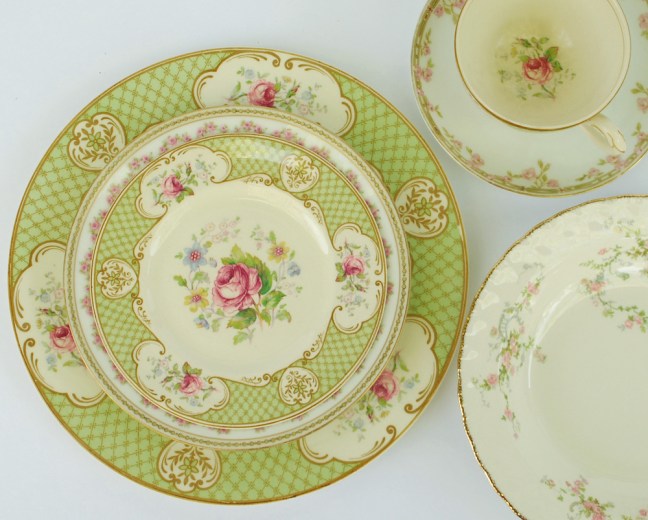
Fine China

It seems like people possess one of two mindsets when it comes to their dishes.

Some invest in a glorious set of matching fine china with visions of dinner parties and holiday dinners dancing through their heads. The dishes are prized, often protected behind the glass barricade of a cabinet. Every use requires an internal debate – is the perceived benefit worth the possible breakage that could occur? Most “china” families that I have known usually ere on the side of caution. The china becomes something to admire from afar while more plain plates grace the dinner table. No event seems quite good enough to unlock the doors.

Those on the other side of the divide either fill their cabinets with accumulated ware or purchase a budget-friendly matched set. There is no debate about bringing out a certain plate. After all, plates are meant to be eaten from. Sometimes, a bowl may chip when it meets the counter’s edge or a plate may shatter if it is dropped to the floor. It is a loss, certainly. But it is understood that some loss is inherent in the use of dishes.

I see that same dichotomy in people’s mindset after heartbreak.

Some people, after experiencing the crushing blow of the end of a relationship, vow to never risk that feeling again. They work to repair their heart and then they hide it away, afraid that using it would open them up to further heartbreak. With each encounter, they carefully weigh the potential risks against the possible reward. And usually they ere on the side of caution. Nobody ever seems quite worth the risk of tearing down the barriers.

Other are less cautious. They feel the heartbreak just as intently, but they understand that some amount of loss is inherent in love. Once their hearts are repaired, they are ready to put it back on the table. Even if that means that it may break again. After all, aren’t hearts meant to love and be loved?

A note to those of you in “china” families: I don’t get y’all, but I’m jealous. My home will never look as good or as put together:) Keep rocking that china! And, on a related note, please don’t judge if you’re over for dinner. You will be eating off chipped plates. Which I happen to think are perfect.