
Keep Dancing


When tragedies happen, we seek understanding. We want to diagnose and cure. We often try to control our surroundings and the actions of others.
We want to feel safe. It’s a basic need. That desire for security is so primal, so strong, that it can cause us to behave irrationally. I experienced this myself in my teenage years. From my softmore year in high school to my freshman year in college, I had 13 friends or mentors die. I will never forget receiving the news of the final two. I was in Austin for college when I called a friend back home in San Antonio to see about getting together on an upcoming break. She told me the news about the latest two deaths.
I broke. I simply couldn’t handle any more loss. My reaction? I shrunk my world. I no longer stayed in contact with high school friends. I built walls to keep out new friends. My then-boyfriend (now ex-husband) was the only one that I allowed to stay close. It worked. By shrinking my world, I eliminated the potential for hearing about or being affected by tragedy. The odds were stacked in my favor. After all, I only had one person in my inner circle.
And then there were none. My greatest fear came true; I lost him as well. Surprisingly, I was okay. I realized that my old ways of living in my walled-off world simply guaranteed less happiness at the time and yet provided no guarantee against loss in the future. I grew less afraid. More willing to take risks. I let people get close. Some have stayed, others have moved on. That’s okay. I am figuring out how to live with the natural cycles of growth and decay rather than try to fight against them.
It’s natural to examine your surroundings after a tragedy. To evaluate the weaknesses around you and to shore up any breaches in the hull. That increased security always has a tradeoff, however. It’s up to you to decide if that particular exchange is worth it.
More than a million people die in traffic accidents worldwide each year. We take precautions to keep this from happening. We gladly pay extra for cars with added safety measures, we sacrifice some comfort when we pull the seatbelt around our chests, and we write and enforce laws that limit who can drive and under what conditions they can operate a vehicle. I think we can all agree that these are reasonable measures; they balance security and freedom. Yet, how many of us look at the statistics for traffic fatalities and decide to never enter a car again? Very few. The tradeoff simply isn’t worth it.
It can be scary out there. Recent events have shown us that we cannot assume safety in our theaters, malls, or schools. There can be a temptation to scale back, pull into a shell and seal it shut. Like with me after the deaths, it does tilt the odds in your favor, but it doesn’t eliminate the risk. And, speaking from experience, life behind walls is no way to live.
Fear is an important feeling. It tells us to run when we are being chased. It tells us to seek shelter when we are under attack. It tells us to avoid high and unstable cliffs or dangerous stunts. However, fear also tells us not to love. It whispers avoidance of risk even when those chances can lead to something great. Fear tells you to hunker down and wait rather than live. Listen to your fears. But you don’t have to believe everything they say.
So continue to wear your seatbelt, but don’t neglect to drive your life.


Deep breath.
In many ways, this will be my most personal post yet. These are the thoughts, the words, that came in the first few weeks uncensored by the keyboard and unedited by time. I’m choosing to share this to reveal the underbelly of the healing process. I want to show that it is possible to move on from such pain and I want to highlight the importance of positive thinking and goal setting early on in the healing journey.
I started journaling on July 15, 2009, four days after I received the text.I learned about Uganda on July 20 and the bigamy on July 22. Much of the writing in the journal was done in the early months, as I transitioned to the computer during the late fall and winter.
I chose to divide my journal into three sections and made a rule that each writing session had to begin in section one and proceed through section three.
Section one: This was the space for the unedited vitriol. This was the anger, the poison. I knew I had to release it and there was oh so much to release. The writing is rapid, the angles harsh. I pressed so hard that I tore through the pages in spots. This was the domain of the broken heart.
Section Two: This was for the day to day thoughts and practicalities. It was designed for observation and problem solving. This was the domain of the rational mind.
Section Three: The final section was for dreaming. I let my mind focus on the infinite and wonderous possibilities that the future might hold. This was the domain of the spirit.
I have no idea how or why I decided to structure my journal this way. In retrospect, that was surprisingly lucid for my state at the time. Recent research supports this model, as they found that high ruminators (I’m not sure if I am this but I am definitely a high analyzer) benefited from a fact-based, mundane journal but suffered when rehashing the negative feelings over and over. My three part design and my insistence on not ending with the negativity allowed me to vent but kept me from getting stuck in the sadness and anger.
For those of you early on in your journey, I hope you can find recognition and some possibility in these entries. For those partway through, I hope you can find acceptance of the process and be patient with yourself. For those who have come out the other end, I hope that you will find encouragement for how far you have come. On of my biggest lessons in all of this is the enormity of the damage that can occur when you deny your feelings. My ex destroyed his life and impacted others because he refused to face his emotions and instead kept them locked away and hidden beneath a facade.
So, here goes. These are excerpts from the journal, in no particular order. Names have been blurred to protect identities. The highlights are from my work when I was writing the book. For those new to my site, please remember that this was 8 years ago. This is not the space I am currently in.


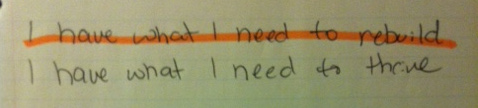
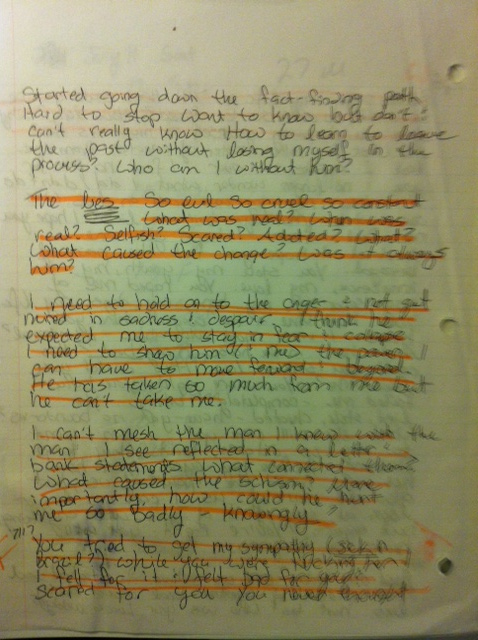


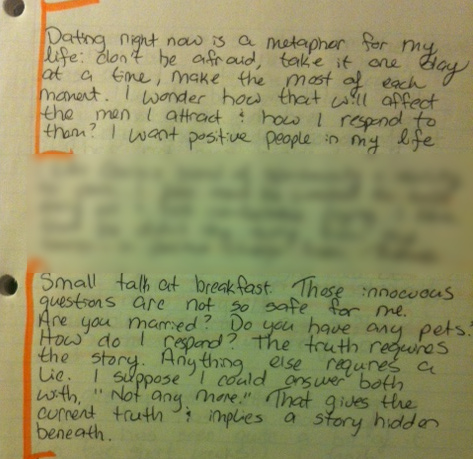


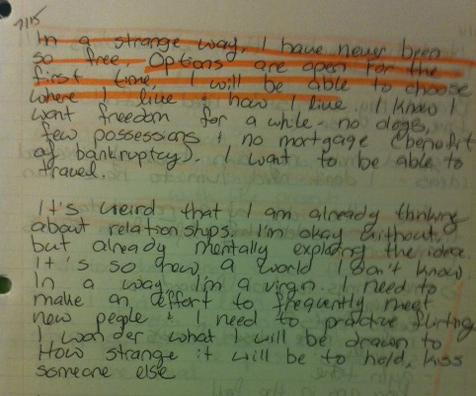

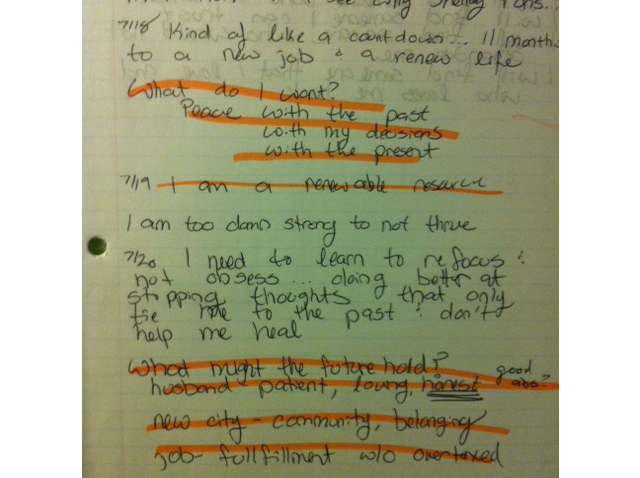

I can read these now with some distance. I remember the pain, yet time has dulled its sharpness to a mere whisper. I identify with the woman who wrote this; I can see traces of who she is going to become. I am no longer her; however, I don’t have the anger anymore that fills these pages. I have learned to soften and to accept. I have forgiven my ex and let go of the need for understanding. The messages of hope and the small celebrations make me smile. I almost wish I could reach back and give the me of those days a hug and tell her that it will be okay and that her hopes and dreams will come in time.
I have a confession to make.
I am a book voyeur.
Whenever I enter a space for the first time, I immediately scan the room for bookshelves. If my eyes are lucky enough to land upon shelves laden with tomes, I find myself pulled towards the books as surely as iron to a magnet. My head soon takes on that particular tilt used to read the turned titles and my hand gently glides along the spines. As I scan the selections, I am taking in information about their owner: interests, abandoned hobbies, areas of study, preferred escapes and future dreams. The books don’t waste time on small talk; each one is there for a purpose and that is communicated through its glossy cover.
Sometimes, even if I am in mid-conversation, I start to slide the books off the shelf, one at a time, and flip through them. If one catches my eye, I will sit cross-legged on the floor next to the bookshelf and I will begin to read. I have been known not to stop until the final page is turned.
My ex-husband and I had hundreds of books between us. We each had our own nonfiction libraries. Mine was filled with math and science books, his with graphic design and rendering texts. We had a co-mingled fiction library overrun with horror and scifi. When I left, I left most of that library behind, as I no longer had the space to store so many books. In the past few years, I have accumulated a small collection again. A collection that speaks to visitors about me.

Calculus& Trig books: I rescued some of the main books I used to use for tutoring from my old house. I haven’t tutored in the past 3 years, but it is always a fallback income. I also have a full collection of math books (algebra & geometry) in my classroom.
Mary Roach’s books: These are the only other rescues. I had just discovered her when my ex left and I couldn’t bear to part with them yet.
Nutrition and wellness texts: These were from my certification program to become a nutrition and wellness coach.
The Lucifer Principle: I picked this up in the bargain aisle at Barnes and Noble while waiting for a date.
Javascript: This was a gift from my dad as I was exploring career options post-divorce. I made it about 1/3 of the way through (doing the exercises along the way) and I fully intend to complete the program.
Shift : I love this book. I use its ideas with coaching clients all the time.
Growing Through Divorce :The only divorce themed book on my shelf, other than mine:)
Lessons From the End of a Marriage: Still feels strange to see my dream in paperback.
The Sociopath Next Door: The first reading I did that gave me something to think about regarding my ex’s mental state.
Hiking and camping books: Duh. You can’t tell me you’re surprised? 🙂
Dictionary: I usually use the one on the computer, but I sometimes like to read the real version for fun. Nerd alert #1.
Stephen Hawkins: Nerd alert #2.
Stephen King: He has been my favorite author since I was 10. I used to have the entire collection. Now, I have two real books and many more on my Kindle. I love his blend of gritty reality and fantasy.
In Search of the Warrior Spirit: This is one that Brock loaned me that ended up in my collection. All his reading centers on martial arts, survival, and training. He directs some of them my way and I’m often surprised to find how much I relate. I love how he and I learn parallel lessons through different avenues.
Dean Koontz and Six Degrees of Separation: Nope, not related except that I bought them from the same used book store on an emergency book run while on a visit to San Antonio.
Nicholas Evans – The Divide: Waaaay out of my usual genre. This was snatched from my mom’s bookshelf on that same trip. This is why I love my Kindle so much – I never have to worry about running out of books again:)
Seattle books: These were a gift from my dad when I was planning on moving to the rainy city.
The Brief Wonderous Life of Oscar Wao: This was a hand me down from a guy I briefly dated.
Mental Floss’s History of the World: I love Mental Floss’s brand of intellectual entertainment. My mom bought this for me from the Carlos Museum’s gift shop while she was in Atlanta for a visit.
During our first holiday season together, Brock grew tired of the spread of books that followed me around his house. He bought me a Kindle, expecting that small tablet would eliminate the literary clutter. Much to his dismay, for the first year or so, it was simply another book, keeping the library loans company. In time, however, I have shifted my reading habits. The library now offers Kindle loans and Amazon always has a selection of free reads. I rarely read print books anymore. This works well for me. It saves space, time, and wrist strength. I thought I would miss the tangible feel of the paper and the distinctive odor that belies the age of the pages, but I do not. What I do miss is the decreasing ability to scan bookshelves. I have no shame in handling the books of a near-stranger, but I would never dream of pursuing the menu of someone’s e-reader of choice. Our choice of books has become more private even as we increasingly live our lives openly online.
Consider yourself warned. If I ever find myself invited into your space, your medicine cabinet is safe. You can trust me with your wallet or your kids. But you might need to watch me around your books:) After all, it’s only fair. I showed you mine.
 Lessons From the End of a Marriage