Have you ever noticed that children do not understand the concept of a guilty pleasure?
Sunday afternoon found me in the bath tub after the completion of a daunting to-do list. I decided to do this bath right – I had the window open to listen to the rain, a glass of wine and a newly downloaded Kindle book. I had no rush, no worries.
As I lay back into the scented bubbles, enjoying the feeling of my arms floating, cradled by the warm water, I was taken back to my childhood.
I used to spend hours in tubs – both of the hot and bath varieties – savoring the slippery denseness surrounding my buoyant frame. I would stay in the waters until hunger or a completed book drove me out, never feeling guilty for wasted time or feeling pressure to accomplish something more meaningful. On the nights I spent at my dad’s apartment in my childhood, he would knock on the bathroom door to check on me about every 30 minutes. Many nights, he made it to four knocks before I finally emerged from the tub.
I understood the concept of pleasure. But I never thought to associate it with guilt.
So why does that change? Why do I now feel guilty or lazy when I indulge? Why do I judge myself?
Part of it is out of necessity. When we are young, our parents and guardians act as our voice of reason, limiting our overindulgences (“You can only have two cookies”). We do not have to self-limit; it is done for us.
But, at some point, that regulation has to shift to us. We have to learn how to work before play and eat our broccoli before our ice cream. We become the care takers and the needs of others are placed before our own. Without that mental management, we would all be living in our parent’s homes, eating Oreo’s all day and playing video games. Well, except for me. I’d be in a bath tub with a book. And probably broccoli.
The problem is that, at some point, many of us get too good at using that internal voice. Not that we always obey it (Ever had an internal argument about if you should eat that dessert? Yeah, who won?) but that we usually feel guilty when we do not.
We indulge. But we don’t necessarily enjoy.
That dessert tastes much better when you’re not berating yourself for eating it. The hope is that the internal monologue of guilt will keep your willpower in check. That if you feel bad about the behavior, you will avoid it in the future. Reality doesn’t work that way. Rarely does guilt about an indulgence keep us in check. We just act as though it does. The reality is that our cravings for whatever the indulgence are more fully satisfied when we fully give in to the experience.
So what’s the answer? How do we balance our need for self-regulation and yet still enjoy our indulgences without guilt?
I know that I am going to let my parental mind set my guidelines and then turn control over to my inner child to enjoy the experience.
All I can say is that it’s good my Kindle has limited battery power. Otherwise, I may never get out of the bath:)
In a recent piece on The Huffington Post, Dr. Mark Banschick describes four outcomes after a cheater is caught or decides to come clean:1) the cheater can make amends and the marriage continues, 2)the cheater can make amends and the marriage ends, 3)the cheated upon can choose to end the marriage or 4)the cheater can blame the other spouse for their actions and then leave the marriage. It seems like common sense, but reading this was a lightbulb moment for me. Part of my pain was in the fact that my husband was a type four – he blamed me and left. Not only were there no amends, but he didn’t even acknowledge his actions. In a way, I was lucky. I had no choice but to accept the fact that he was a type four. After all, leaving the state, refusing contact and committing bigamy made it pretty unlikely that I would get an apology. I had no choice but to move on.
Others are not so lucky. They have a type four spouse but they are holding out for him or her to turn into a type one or two and accept responsibility for their actions. Their hope and their reality do not match and the disconnect adds another layer of pain and anger.
Dr. Banschick classified the end of an affair – the choices left once the betrayal is uncovered. Affairs are different even before the end, with other factors complicating the situation and the healing process. I think it can be helpful to classify your affair as a way of finding acceptance and understanding of your particular situation and the factors that it contains.
Simple Infidelity
Simple does mean easy. This is a straightforward case of infidelity with no complicating factors.
Compound Infidelity
Compound infidelity is where there are secondary or tertiary betrayals.
Known Affair Partner: If the partner is a friend or confident of yours, you will feel betrayed by your spouse and your friend. Both relationships were violated.
Multiple Partners: These are the serial cheaters. The betrayed has to face the knowledge that their partner has made the choice to cheat multiple times with many people. This may have gone on for years before it is discovered.
Children: If there are children in the marriage, there is a sense that the cheater betrayed the family, not just the spouse. If and when the kids learn of the betrayal, they may internalize it and blame themselves for their parent’s infidelity.
Financial Betrayal: This is where the cheater extends the lying to finances. Marital funds may have been used to fund the affair(s). It is another major breach of trust in the marriage.
Complex Infidelity
Complex infidelity is where there are complicating factors that can interfere with the betrayed’s ability to heal.
Abandonment: In many cases of spousal abandonment, the disappearing spouse has another partner at the ready. The betrayed has to face the discovery of infidelity while alone and abandoned. Part of the pain in this case is the feeling of having your voice stolen as there is no spouse to talk to or even scream at.
Gaslighting: This is the type 4 cheater before he/she is caught. The unfaithful partner blames the spouse and make him or her feel crazy for noticing inconsistencies or signs of wrongdoing. This pattern slowly wears away at the confidence of the betrayed, causing them to question what is real and what is fabrication.
Illegitimate Child(ren): When the unfaithful partner has a child as a result of infidelity, it negates any chances of a clean break from the affair partner. In the case of n unfaithful wife, a man may discover that he has been raising another man’s child as his own. Regardless of the circumstances, there is now an innocent who is caught in the web of deceit.
Addiction: Addiction and infidelity are not uncommon partners. They both thrive on secrecy and lies. If there is addiction present, it makes it even more difficult to reestablish trust.
Compound-Complex Infidelity
This is the combination of two or more of the situations above.
Regardless of the nature of the infidelity, betrayal is one of the worst pains someone can experience. Unless you have felt its cutting edge, you cannot fathom the devastation of being stabbed by the one you embrace. It is possible to heal from betrayal and that healing has to start with acceptance. Recognize the complicating factors in your situation. Be aware of where you have control and where you do not. Distinguish between when you need to fight and when to let go.
Learning to trust after betrayal is not easy. Not only is there the struggle with trusting a new partner, but there is also the challenge of learning to trust your own instincts and perceptions, especially if you were unaware of the affair. The body and subconscious mind respond as though there is a threat even when the rational mind knows there is not. It takes patience and time and a willingness to face the discomfort. It’s not easy, but it is also not impossible.
Christmas can be such a polarizing season. Some people are enraptured by the sights and sounds, while others, lamenting what they have lost or never had, fall into despair. Why is it that a holiday can have so much power to drive our emotions? Why are some okay with their lives from January through November, but then feel despondent about their lot when the month clicks over to 12? Why do others allow stress to accumulate throughout the month, only releasing it with the ribbons on Christmas mornings? How is it that a holiday that emphasizes togetherness creates intense loneliness in so many?
It’s simple, really. There is no other time of the year as fraught with expectations as Christmas. And loneliness, stress, and disappointment hitch a ride on those expectations, sliding into our minds undetected. We can choose not to welcome them. We can use awareness to exorcise the ghosts of Christmas’s past and future, allowing ourselves to embrace the present and whatever gifts it brings.
Ghosts of Christmas Past
When I was young, I spent Christmas with both my parents. As with all families, we had rituals and traditions. I remember my mom making pineapple ham and my dad coming in from a bike ride, the smell of sweat blending with the scent of the pine needles on the tree. I remember the Christmas eve church services, with me squirming between them awaiting the tradition of opening one gift that night upon our return. I can picture our rides through town, viewing the lights in the trees and luminaries that lined the streets.
And then we were two. My parents divorced and my dad moved across the country. It took us some time to find our stride. Those first couple years felt empty; traditions carried out even though a critical member of the team was missing. We tried to keep it the same, fought against the inevitable change. It didn’t work. It never does.
Eventually, we created our own traditions, some carried through and some newly invented. We had a family friend join us for celebrations, her energy completing the triad. We took trips. We celebrated with other families. Sometimes we had money. Often we did not. But it didn’t matter. We let go of Christmases past and, in doing so, created wonderful Christmases in the present.
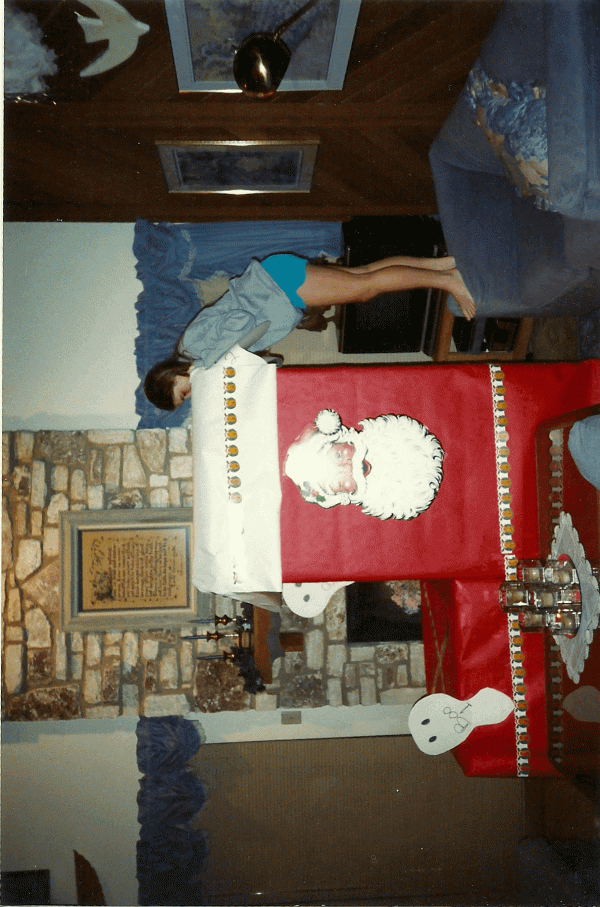
This was one of my favorite Christmases. My mom obtained and wrapped a refrigerator box and a washing machine box and assembled them to make a stocking. I was shocked when I woke up that morning and, at 16, it took a lot to impress me. Our family friend joined us and they both had fun laughing at me as I crawled through the endless “stuffing” that filled the stocking and surrounding wrapped gifts, many of which were inexpensive. This was a great example of how creativity and attitude matters more than money.
I’m thankful for those childhood experiences. They taught me to be flexible and to work within the present reality. As I entered into married life, my husband and I followed a similar model. We were lucky enough to be “adopted” by various families over the years. On some Christmases we traveled, and some we did not. Sometimes we saw family; more often we were devoid of blood relatives. Each year was different. And each year was wonderful in its own way.
At my ex-in law’s on Christmas in 2001.
If you have children, realize that your attitude towards the holiday is more important than any traditions. If your family has changed, it is futile to try to recreate the Christmases of the past. But that doesn’t mean that your Christmas cannot still be wonderful.
Ghosts of Christmas Future
Not everyone is haunted by the past. Some people’s expectations are fixated on the future. It is easy to allow expectations to build. We expect Uncle Bobby to act differently than he usually does and we get stressed when his good behavior fails to manifest. We picture perfect children, gleaming and squealing in glee. We envision a table piled high with delectable goodies worthy of Martha Stewart’s kitchen. We allow our minds to ponder what glorious gifts might lie just beneath the wrappings. We watch movies filled with perfect families and see commercials pushing items, implying that they will make your life perfect as well.
These daydreams may be pleasant, but they have a dark side. Unless you are visiting Martha, the spread will not be perfect. Your kids will inevitably allow grouchiness to overcome them by afternoon. You will probably not find the winning lottery ticket in you stocking. In other words, Christmas will be real. It is easy to become disappointed when we allow our expectations to grow well beyond our realities.
The ghost of Christmas future is often hardest on those who are or feel alone. The divorced parent who does not have custody over the holiday. The single person without family in town. At no time can you feel more alone than during a holiday that celebrates togetherness. But, you are only alone if you allow yourself to be. Let others know you do not have a family to celebrate with; the offers will likely come. Some of my best Christmases were spent with the families of friends or employers. If you’re willing to speak up and be vulnerable, you will find an open home and open hearts. They may not be family, but they are family for the day and sometimes that is enough.
If you prefer not to join another’s celebration, look for volunteer opportunities through church or Meetup.com. Helping others is a surefire way to get your mind off your own troubles. It may feel as though the whole world is paired up or celebrating with family, but that’s just the message, not the reality. You have choice in the matter. You can choose to suffer or you can choose to smile.
The Gift of Christmas Present
This year, my home will be full of family, yet none of them are related to my fiance or me. There is no tree in our living room, nor lights on our house. I will be serving a vegetarian spread with nary a ham hock to be found. The kitchen will be messy and the plates will be mismatched (and chipped!). But there will be laughter and games. Friendship and smiles.
It won’t be like the Christmases of the past nor will it be a celebration in an imagined future. Rather, it will be the Christmas of now. Exactly as it should be. Let go of the ghosts lamenting the past and brush of those whispering of an imagined future and be with the Christmas of the present.
I wish you and your loved ones a happy (and real) holiday:)
Today was one of those picture perfect fall days in Atlanta: crisp, cool and sunny. I met my friend Sarah and her daughter, Kayla, at the annual Scottish Highland Games held at Stone Mountain Park. As soon as I exited my car, almost half a mile from the festival, I could hear the pipe and drum bands warming up for the opening ceremonies. Bagpipes make my soul smile.
Can’t you almost hear the pipes?
I had an hour or so before I expected Sarah and Kayla. I made my way over to the athletic field to watch the guys compete in sheaf throwing, basically using a pitchfork to toss a burlap-wrapped 28 lb ball of hall over a pole 15 feet in the air. Even the pros couldn’t make it look easy. I started chatting with a woman next to me who ran the Savannah Rock n’ Roll Marathon last year and was delighted to hear that I’m running it in two weeks. She warned me that I’m going to catch the marathon bug and that this will be the first of many. My aching body from all of the training miles says she’s wrong. I guess we’ll see.
In case you ever wind up kiltless in Florida…
Before long, I spot Sarah and hear Kayla’s giggles. After a brief interval of playing the coy three-year-old, she immediately warmed back up and wanted me to hold her. In fact, Kayla certainly got her Lisa fix today and I got an upper body workout trying to carry the squirming, growing-bigger-by-the-minute, preschooler. We navigated to watch the pipe and drum bands present their clans for the opening ceremonies. I wear those tunes move through me for weeks to come. I’m not sure how my Norwegian ancestors would feel about that. Oh well, for a day, I figure I can be an honorary Scot.
Think these guys will follow me on my marathon?
After the exhausting task of feeding and pottying a youngster, we navigated to an excellent viewing area to watch the caber tossing. This is my favorite event. There is something about the pure testosterone of burly men in kilts throwing trees end over end that makes me grin with glee. And makes me wish I became a chiropractor.
Tree in a tornado or caber being tossed? You decide.
Of course Kayla was intrigued and somewhat puzzled by the point of the whole sport) so we took her to the children’s area where they had kid-sized versions of the adult games.
Kayla tossing a cardboard “caber.” Does it get any cuter?
Much of the emphasis of this festival is on the reuniting of the various clans. There are booths set up for each lineage where they proudly display their crests and tartans. The intersection of The South and Scotland is an interesting place. Something about a man in full Scottish gear with a Southern drawl just doesn’t allow a straight face.
I guess he’s a member of the camouflage clan:)
I noticed something new this visit. There were some people, mainly women, who had on more than one tartan, thus representing multiple clans. When I inquired about this, I was told that there family, either through marriage or blood, had combined two or more clans. The one deemed less important would be an accessory while the primary colors occupied more prime real estate. It’s a way of honoring ones past while acknowledging the importance of the present.
This guy was watching the exit. Maybe he was checking for stolen cabers? 🙂
Eventually, the game, pipes, and Kayla had played themselves out and it was time to go. My drive home took me through the area where I spent my first year in Atlanta. I drove by the rental business where we got the van that moved us into our home, I passed the location of my wedding reception, and I saw the turn that would have led to the apartment we occupied when we became husband and wife. It was okay. I used to wear that tartan of my marriage from head to toe, but now it has been changed into an accessory and I proudly wear the colors of my new life.
The characteristic that makes possible the control of voltages or currents so as to accomplish gain or switching action in a circuit; examples of transistance occur in transistors, diodes, and saturable reactors.
The characteristic of being resistant to transitions.
Me. Sometimes I feel the need to make up a new word or ascribe a new meaning to an established word in order to say what I want to say. This is one of those cases. Apologies in advance if that offends you.
Anyone involved with education is familiar with the enormous transitions from school to summer and then back again. As a teacher, I am involved with shutting down and then restarting an entire organization every year. It is a transition on a macro scale. Embedded within that transition, each person involved is also facing change. I see it in the rising freshmen in the spring and the incoming sixth graders in the fall. I see it on the faces of the parents as they witness their “babies” growing into maturity. I see it in the teachers as we adapt to new curriculum and new routines. It is an exciting and stressful time for all.
But why is it stressful? The coming of another school year and the aging of children are expected. Normal. So why the anxiety that bleeds into the buzz?
Transistance.
We so easily fall into the trap of thinking that the way things are now is the way they are always going to be. We might plan for tomorrow yet we see it from the perspective of today. That creates a friction between our psyches and the “now” that results in a resistance to change. We know transitions are inevitable yet it is difficult to imagine the biting wind of a winter storm while baking in the summer sun.
The only thing constant is change. Heraclitus
I did not used to be as aware of the affect that transitions had on me. I would find that I didn’t sleep as well or that my mind felt scattered, but I never really dug down into it. I am trying to be more mindful of the transitory periods in my life so that approach them proactively. I make sure to take a little extra time to be quiet: yoga, meditation, or a solo hike or run. I do a better job listening to my body even it that means going to bed before 9:00 p.m. I remind myself that the stress of transition is also temporary and that a new normal will once again be reached. I still experience transistance. We all do. But now I can face it with a smile.
How about you? Have you experienced any transitions lately? Did you have transistance? How do you cope with transitions?






 Lessons From the End of a Marriage