Fear in the Driver’s Seat

When tragedies happen, we seek understanding. We want to diagnose and cure. We often try to control our surroundings and the actions of others.

We want to feel safe. It’s a basic need. That desire for security is so primal, so strong, that it can cause us to behave irrationally. I experienced this myself in my teenage years. From my softmore year in high school to my freshman year in college, I had 13 friends or mentors die. I will never forget receiving the news of the final  two. I was in Austin for college when I called a friend back home in San Antonio to see about getting together on an upcoming break. She told me the news about the latest two deaths.

I broke. I simply couldn’t handle any more loss. My reaction? I shrunk my world. I no longer stayed in contact with high school friends. I built walls to keep out new friends. My then-boyfriend (now ex-husband) was the only one that I allowed to stay close. It worked. By shrinking my world, I eliminated the potential for hearing about or being affected by tragedy. The odds were stacked in my favor. After all, I only had one person in my inner circle.

And then there were none. My greatest fear came true; I lost him as well. Surprisingly, I was okay. I realized that my old ways of living in my walled-off world simply guaranteed less happiness at the time and yet provided no guarantee against loss in the future. I grew less afraid. More willing to take risks. I let people get close. Some have stayed, others have moved on. That’s okay. I am figuring out how to live with the natural cycles of growth and decay rather than try to fight against them.

It’s natural to examine your surroundings after a tragedy. To evaluate the weaknesses around you and to shore up any breaches in the hull. That increased security always has a tradeoff, however. It’s up to you to decide if that particular exchange is worth it.

More than a million people die in traffic accidents worldwide each year. We take precautions to keep this from happening. We gladly pay extra for cars with added safety measures, we sacrifice some comfort when we pull the seatbelt around our chests, and we write and enforce laws that limit who can drive and under what conditions they can operate a vehicle. I think we can all agree that these are reasonable measures; they balance security and freedom. Yet, how many of us look at the statistics for traffic fatalities and decide to never enter a car again? Very few. The tradeoff simply isn’t worth it.

It can be scary out there. Recent events have shown us that we cannot assume safety in our theaters, malls, or schools. There can be a temptation to scale back, pull into a shell and seal it shut. Like with me after the deaths, it does tilt the odds in your favor, but it doesn’t eliminate the risk. And, speaking from experience, life behind walls is no way to live.

Fear is an important feeling. It tells us to run when we are being chased. It tells us to seek shelter when we are under attack. It tells us to avoid high and unstable cliffs or dangerous stunts. However, fear also tells us not to love. It whispers avoidance of risk even when those chances can lead to something great. Fear tells you to hunker down and wait rather than live. Listen to your fears. But you don’t have to believe everything they say.

So continue to wear your seatbelt, but don’t neglect to drive your life.

drive

Opening the Journal

photo-180

Deep breath.

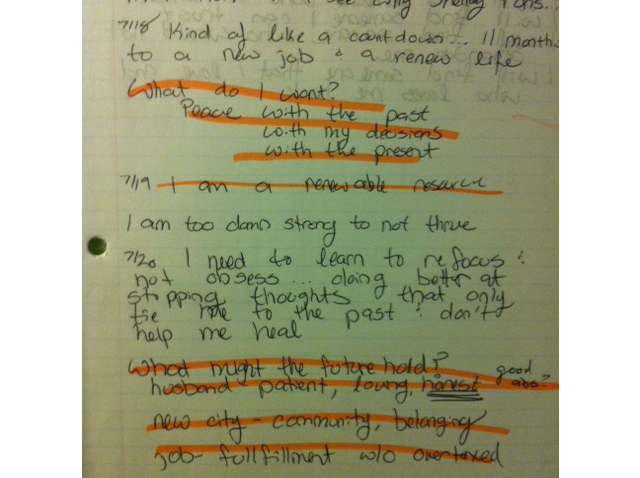
In many ways, this will be my most personal post yet. These are the thoughts, the words, that came in the first few weeks uncensored by the keyboard and unedited by time. I’m choosing to share this to reveal the underbelly of the healing process. I want to show that it is possible to move on from such pain and I want to highlight the importance of positive thinking and goal setting early on in the healing journey.

I started journaling on July 15, 2009, four days after I received the text.I learned about Uganda on July 20 and the bigamy on July 22.  Much of the writing in the journal was done in the early months, as I transitioned to the computer during the late fall and winter.

I chose to divide my journal into three sections and made a rule that each writing session had to begin in section one and proceed through section three.

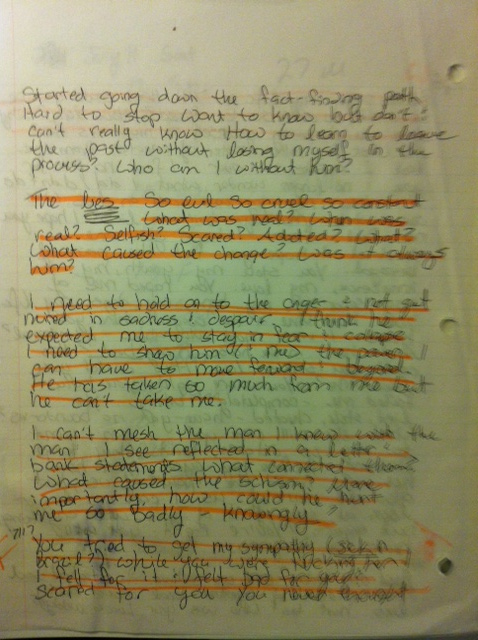
Section one: This was the space for the unedited vitriol. This was the anger, the poison. I knew I had to release it and there was oh so much to release. The writing is rapid, the angles harsh. I pressed so hard that I tore through the pages in spots. This was the domain of the broken heart.

Section Two: This was for the day to day thoughts and practicalities. It was designed for observation and problem solving. This was the domain of the rational mind.

Section Three: The final section was for dreaming. I let my mind focus on the infinite and wonderous possibilities that the future might hold. This was the domain of the spirit.

I have no idea how or why I decided to structure my journal this way. In retrospect, that was surprisingly lucid for my state at the time. Recent research supports this model, as they found that high ruminators (I’m not sure if I am this but I am definitely a high analyzer) benefited from a fact-based, mundane journal but suffered when rehashing the negative feelings over and over. My three part design and my insistence on not ending with the negativity allowed me to vent but kept me from getting stuck in the sadness and anger.

For those of you early on in your journey, I hope you can find recognition and some possibility in these entries. For those partway through, I hope you can find acceptance of the process and be patient with yourself. For those who have come out the other end, I hope that you will find encouragement for how far you have come. On of my biggest lessons in all of this is the enormity of the damage that can occur when you deny your feelings. My ex destroyed his life and impacted others because he refused to face his emotions and instead kept them locked away and hidden beneath a facade.

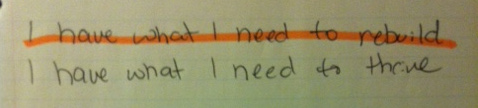
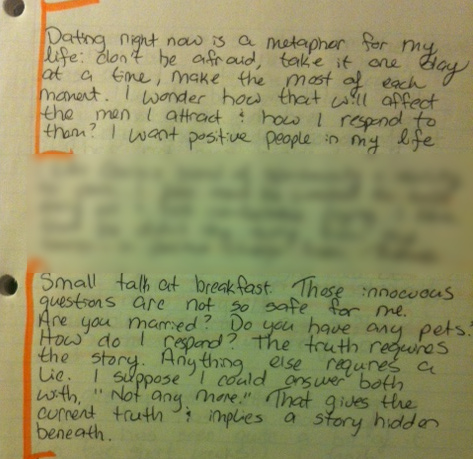
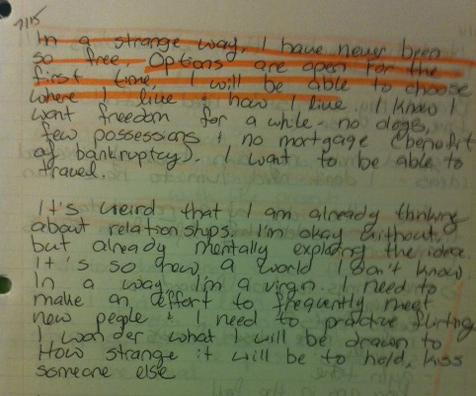
So, here goes. These are excerpts from the journal, in no particular order. Names have been blurred to protect identities. The highlights are from my work when I was writing the book. For those new to my site, please remember that this was 8 years ago. This is not the space I am currently in.

journal18

journal17

journal16

journal15

journal14

journal13

journal12

journal11

journal10

journal9

journal8 journal7 journal6 journal5 journal4 journal3 journal2 journal1

I can read these now with some distance. I remember the pain, yet time has dulled its sharpness to a mere whisper. I identify with the woman who wrote this; I can see traces of who she is going to become. I am no longer her; however, I don’t have the anger anymore that fills these pages. I have learned to soften and to accept. I have forgiven my ex and let go of the need for understanding.  The messages of hope and the small celebrations make me smile. I almost wish I could reach back and give the me of those days a hug and tell her that it will be okay and that her hopes and dreams will come in time.


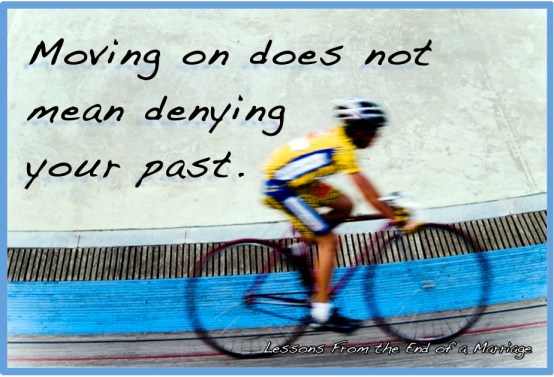
Moving on

S(mile) Markers

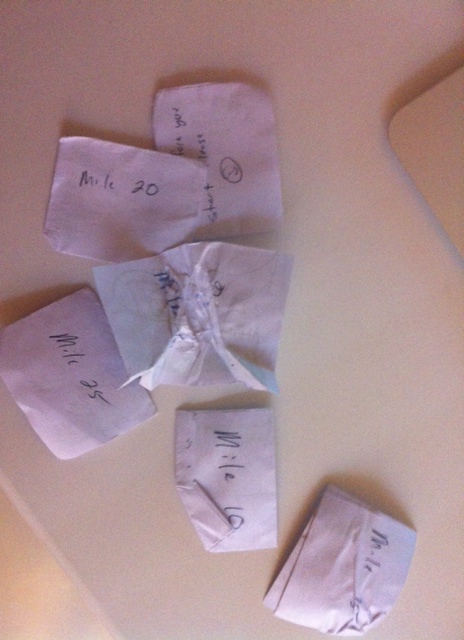
In my marathon recap post, I mentioned something that my boyfriend had done that helped get me through the difficult moments in the race. Before he left to park the car, he handed me a stack of 6 notes, each with a mile printed on the outside. I was instructed to open and read each one at the indicated time. The notes were simple, yet those few words of love and encouragement propelled me through the pain and gave purpose to the race which kept me from giving up. They were my smile markers, as eagerly anticipated as an advent calendar at Christmas for a little kid.

photo-113
They may be crumpled and sweat stained, but they will never be thrown away!

I was telling a mutual friend about these notes the other day and I realized that the concept could be applied in a much broader way. I know in the early days of my divorce, the support from friends and family was overwhelming. I received calls, emails, letters, and cards. Everyone wanted to help, but no one knew exactly how. As is only natural, as time moved on, the contact waned. Life is busy and we all get distracted. I was in a better place, but like the miles in a marathon, I had thoughts of quitting along the journey of the divorce.

If you know someone who is undergoing a divorce or other difficult transition in their life, create smile markers for them. Maybe print the dates of challenging anniversaries or important milestones on the outside. On the inside, write messages of friendship, love, shared memories, inspiration, and hope. Give them the entire stack at once; knowing that you have a gift in the future helps to persevere through any ugliness in the present.

If you are the one in a difficult transition, share this idea with friends and family when they ask how they can help you. They want to help; they just don’t know how. You can also create your own messages, gather quotes and pictures that bring you joy and peace and place them in envelopes with important or difficult dates printed on the outside. Even though you do not have the element of surprise, simply opening a blessing in midst of pain will still bring a smile.

When journeys feel too immense to ever complete, they are best broken up into smaller treks. Why not mark each one with a smile marker? 🙂

34489_134209579940672_100000548926614_269972_6229830_n

Learning to Breathe

I’ve never been very good at breathing. 

My childhood was spent with perpetual croup, the seal-barking cough echoing through the house at all hours.  Eventually, I was diagnosed with asthma, my lungs plied with drugs that were supposed to encourage them to relax.  Regardless of the dosages and names of the medications, I always failed my lung function tests at the allergists.  I wasn’t used to failing tests, but I didn’t know how to study for that one.

I adapted to my lungs.  I knew when an attack was about to have me helpless in its clutches, I knew when pneumonia was setting in.  I let my lungs call the shots and we had an agreement that I would work within their constraints.

Then, one day soon after my 30th birthday, I grew tired of the bondage.  I turned the tables on my lungs and informed them I wanted to start running.  This was a laughable goal, as I had never even completed the mile running in school.  But I was determined.

I started at a local park with a .75 mile loop.  My first try was a humbling experience.  You see, I was in shape.  I lifted weights and could do cardio.  I just couldn’t run.  Within moments of beginning, my chest heaved, my breathing was rapid and gasping.  I was taking in air as though threatened, as though the next breath would never come.  I made it one full loop that first day, but I still didn’t know how to run.

Over the next few weeks, I kept at it, returning to the park 3-4 times a week.  I starting to trust my body.  Believe in my breath.  I worked to consciously slow my breathing, pulling air deep down into the unused basement of my lungs.  As I learned to breathe, I was able to increase my mileage to the point where I outgrew that park in the next two months.

My breath training extended to yoga.  I had been practicing since I was in high school, but I always focused on the positions and movements, not the airflow.  Running had brought the breath to consciousness; yoga taught me how to use the breath to calm and energize the body.

Then July came.  Disaster struck.  I lost contact with my breath, but I didn’t even realize it.  I just knew my chest felt constricted, wrapped in bindings carried in by the trauma.  I wasn’t able to run or to do yoga, getting even further out of touch with my lungs.  It finally took a third party to make the re-introduction; a therapist at a meditation and yoga retreat that autumn after my breath left me.

I lay on the floor of her office, cradled in a soft, fuzzy blanket.  She kneeled next to me, her voice soothing and calm.  She spoke to my breath, encouraging it to return, assuring it that I was ready to make its acquaintance once again.  She spoke to me, telling me to trust my breath, to allow it deep into my lungs.

My chest began to rise, the bindings loosening.  As the oxygen flowed in, I felt grounded.  Whole.  Reconnected.

My breath and I still have a complicated relationship.  I frequently don’t find it until a couple miles into a run or 10 minutes into a yoga practice.  I still have to encourage it, willing it back into my body, especially when I find myself gripped my stress.  It may at times be a tumultuous relationship, but I have no intention of loosing connection with my breath again.

I Can’t Right Now

There is a particular yoga sequence (crescent lunge into a bird of paradise) that used to vex me. I simply couldn’t get my body to twist and open to accomplish the pose. My first attempt was a bit of a disaster but it was also a learning experience.

Every time I enter the yoga studio, I encounter a pose or sequence that is beyond me. I used to tell myself, “I can’t do that” and, after a reasonable number of attempts, I would simply stop trying, thus proving myself right. What I have come to realize is that I need to tell myself, “I can’t do that right now.” That statement acknowledges the truth in the moment but also recognizes that it can change. “I can’t right now” leaves you free to try again and leaves your mind open to the possibilities.

Oh, and that sequence that used to stop me cold? I can now do it with ease. Of course, last Sunday, the instructor added a twisted bird of paradise. I can’t do that….yet.