The Importance of Feeling Safe in a Relationship

When you don’t feel safe in a relationship, your focus shifts from connection to protection.

Instead of turning towards your partner, you’re turning inward or turning away in an attempt to avoid a sense of increasing danger.

And relationship safety is often misunderstood. We tend to oversimplify the state; believing that as long as physical threats are not present, there is no reason to not feel safe (yet there are many ways that we can feel emotionally unsafe in relationships). Additionally, we often dismiss or misinterpret feeling a lack of safety in a relationship. We may chalk it up to our own insecurities or blame it on anxiety arising from within.

You also may be unintentionally behaving in a way that lessens your partner’s sense of safety in the relationship. And so that disconnect or tension that you may sensing could be their attempt to protect themselves.

What Does Not Feeling Safe in a Relationship Look Like?

  • Not knowing what to expect from day to day or moment to moment.
  • A hesitancy to initiate affection or intimacy because of a pattern of rejection.
  • Biting your tongue out of a fear of the repercussions of speaking your truth.
  • Your emotions being mocked or dismissed.
  • Always being asked to change your appearance or demeanor in order to be accepted.
  • A feeling of walking on eggshells because of repeated emotional outbursts or unexpected and over-the-top reactions.
  • Intimacy and connection are used as both reward and punishment – if you’re “good,” you get attention and if you’re “bad,” it’s withheld.
  • A feeling that you have to put on a front or hide certain aspects of yourself in order to avoid rejection or ridicule.
  • Your partner frequently threatens to leave or divorce.
What Characteristics Make People Feel Safe in a Relationship?

Physical

Your partner doesn’t hit you, hold you down or use their body to intimidate you. You don’t expect a physical altercation and you don’t flinch when they reach towards you. If you are hurt or ill, they will attend to your physical needs. If you reach towards them, they accept your touch. Any physical rejection is done with kindness and not blame or shame and sexual activities are never forced or coerced.

Consistency

You generally know what to expect from your partner and your relationship. Their actions and reactions are familiar and somewhat predictable. Additionally, except in extreme cases, emotional responses are not over-the-top and are appropriate for the situation.

Authenticity

You feel like you can be you. The real you. You don’t feel like you have to hide or pretend in order to be accepted. You can speak the hard truths without fear of overreaction or detonation. You also trust that your partner is revealing their true nature and that they are not holding back anything of importance. An authentic relationship is not always happy, but it’s also not hiding anything.

Vulnerability

You can be weak without fear of being taken advantage of. You can reveal your fears and insecurities without ridicule or emotional blackmail. You feel like it’s okay to not be okay and that a temporary state will not become a permanent point of contention.

Acceptance

You feel listened to. Valued and valuable. Your partner doesn’t try to change you or frequently compare you to others. Criticisms are aimed at your behaviors rather than at your core self. They accept you as you are, not as they want you to be. Any requests or encouragement towards change is both fair and approached with your wellbeing in mind.

The Link Between Relationship Safety and Anxiety or Insecurity

Our primary relationships often set the tone for the rest of our experiences. We expect to be able to come home and relax our guard, to be authentic without the risk of excess judgement or the fear of being taken advantage of. To be our best, we need our relationships to be our stable ground from which we grow into the rest of our lives.

And so when home is more unpredictable wobble board than sanctuary, the effects extend outwards. Much like an infant with an insecure attachment to a parent shows less confidence in exploring the world, an adult that doesn’t feel safe in their primary relationship may hesitate to to take risks or be prone to excess worry.

Of course, not all anxiety or insecurity is relationship-based. Yet if your symptoms increase when you’re around your partner or are primarily present at home, this may the root cause of your stress. Also pay attention to a lasting sense of “walking on eggshells.” This feeling is common during times of stress or transition, but if it continues, it indicates that you are afraid of triggering a reaction.

Often people are surprised when they feel calmer and more confident when a significant relationship ends. But it’s not surprising at all when they never felt safe within that relationship.

How Past Betrayal and/or Abandonment Impact Relationship Safety

Part of the trauma of both betrayal and abandonment is that they destroy any sense of safety. And those effects are lasting, even following you into a new relationship. This is especially true if you felt safe and secure until the moment you realized that the firm ground was instead an illusion crafted to keep you unsuspecting.

A sense of safety is related to trust, yet it is also its own domain. Trust comes down to believing that your partner’s actions align with their words. Safety also relies on a sense of consistency and acceptance. And both obviously suffer after betrayal or rejection.

If you have experienced this kind of relationship trauma, it will be some time before you feel steady again, no matter how secure your footing. Part of the healing process is learning what is a true danger and what is merely a malfunctioning alarm.

The Limitations of a Safe Relationship

There is no such thing as a fail-proof relationship. It is impossible to be involved with another person and never feel hurt or disappointed. Feeling safe in a relationship does not mean that your emotions will never be bruised. Instead, it comes down to trusting that your partner will never internally seek to harm you and if they do misstep, they will take responsibility for their part in the transgression.

The Powerful Benefits of Feeling Safe in a Relationship

Safety is a primary need. Without a sense of safety, much of your energy is extended towards being ready to run, hide or fight if needed. And when that need is met, your energy is freed towards growth and you feel securely anchored enough to take risks in other areas.

When at their best, our relationships give us both the firm ground on which to stand and the encouragement to extend beyond our perceived limitations.

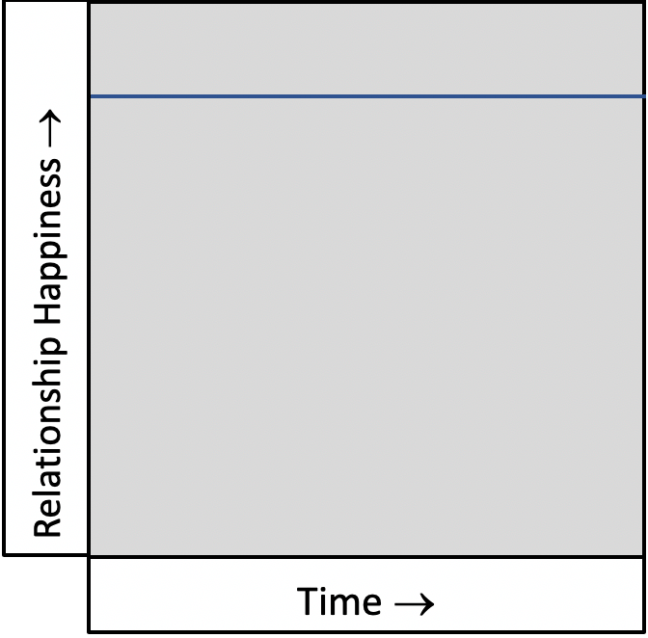
 

Understanding Relationship Happiness Over Time

There are certain patterns that relationships tend to take over time in regards to overall happiness and satisfaction. In order to truly understand your relationship, it’s best to take a broader view, rather than examine a small slice of time that may not be representative of the whole. Which of the following patterns do you relate to?


The Idealized Relationship

Snip20190712_14

This is the relationship that Hollywood tells us to expect. We are conditioned to believe that once we find “the one,” the relationship will be easy and happiness will be guaranteed and omnipresent.


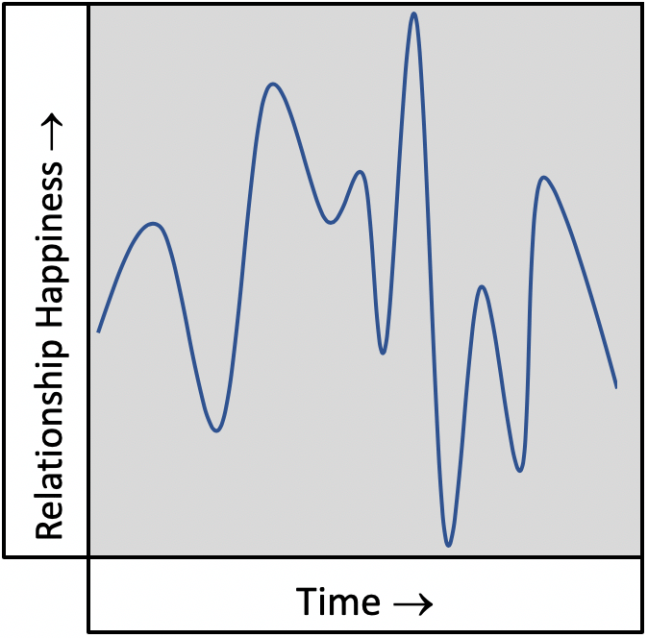
The Volatile Relationship

Snip20190712_10

This pattern can be addictive because when it’s good, it’s REALLY good. On the other hand, when it’s bad, it’s horrid. The highs keep you in it and hope that it will smooth out keeps you from leaving.

The What Goes Up Must Come Down Relationship

Snip20190712_17.png


This is the relationship that is on fire in the beginning and then settles down into a more sedate happiness and contentment over time. It’s far from bad, but the partners may find themselves craving the intensity of the beginning.


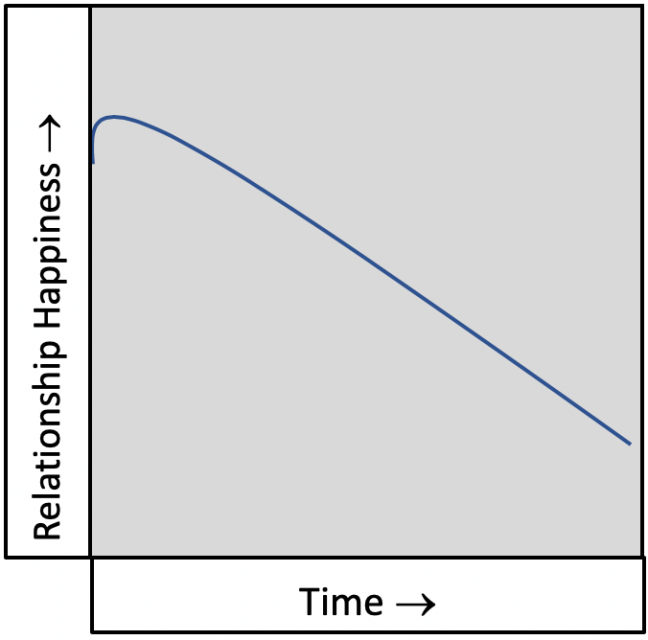
The Slowly Declining Relationship

Snip20190712_11

It WAS good, but it seems to be trending further and further away from that place. The connection is waning and you may feel like you love them, but you’re no longer “in love” with them.

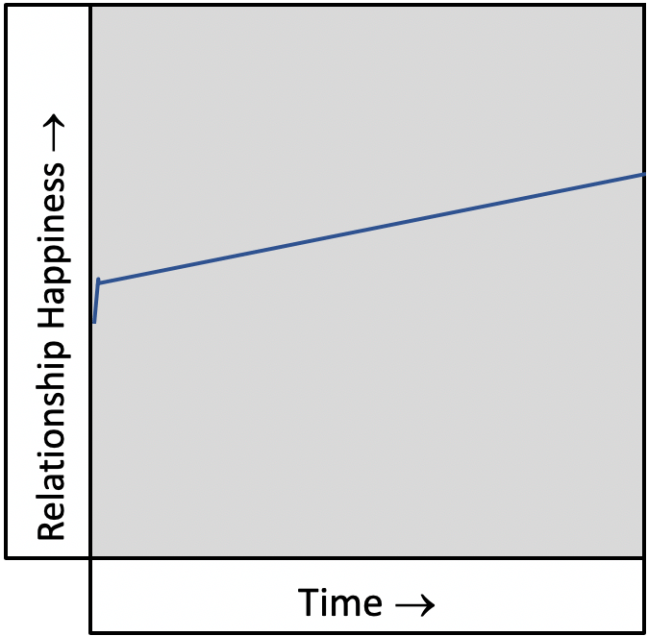
The Gradually Improving Relationship

Snip20190712_12

This is the relationship between two people that are growing together. Over time, they have learned to temper their expectations and to accept the other as they are.


The Devil You Know Relationship

Snip20190712_15

It’s not good, but for now, it’s better than being alone. Strangely, the consistency of this relationship can be comforting; you know exactly what to expect.

The Life is a Highway Relationship

Snip20190712_13

This is different from the volatile pattern because the ups and downs are less extreme and balance each other out. This is the marriage that is happy overall with some good days and some not-so-good ones.

How Do You Know When You’re Ready For a New Relationship After Divorce?

“You have to wait one month for each year you were married.”


“It’s like riding a horse. The sooner you get back in the saddle, the better.”


“After divorce, you must stay single for at least two years to truly find yourself.”

I heard it all after my husband left. Yet none of it really felt right to me. I knew I wasn’t ready to start a new relationship immediately. Even the thought made me feel a bit ill. At the same time, some trite and trivial timeline didn’t resonate either. Who was to say that I didn’t need more than a month for every year or that I would be ready far sooner than the two-year mark?

The truth is that the time needed after divorce before entering a new relationship is different for everyone and, this is the important part, only you know when you are truly ready.

You’re ready to enter into a new relationship when…

You’re not involved with somebody to spite your ex or in an effort to ignite jealousy.


In a moment of divorce-induced insanity, I had a notion of bringing the guy I was dating to the courthouse on the day of my legal dissolution. Luckily, my attorney was not insane and she put her foot down. My reasons for wanting him there were twofold – I was scared to face my ex and I thought my new guy’s presence would help to shore up my courage and I wanted to show my ex (who not only committed adultery, but also bigamy), that I could get somebody else.

That inclination on my part was a sure sign that I was not ready to date. In order to have a chance, a new relationship must be established independent of any previous ones. If it only exists to show vengeance or in an attempt to stir up feelings of regret and envy in your ex, it is more farce than partnership.


You’re not trying to replace your ex and you’re not caught up in comparing.


After divorce, you face an ex-shaped hole in your life. And it’s tempting to try to find someone who can fill that place exactly, like a custom-made puzzle piece. Not only is that impulse not fair your new potential partner, it’s also not fair to you. The divorce has changed you. Perhaps altered your ideas about what is important in a partner and what characteristics really don’t matter.

Rather than trying to find someone who matches what you had, identify what is important to you and which of those needs you want to be met by your partner and which can be met elsewhere. And once you’ve made that choice, refrain from comparing. It only brings with it misery.


You’re able to acknowledge and address your part in your marriage’s struggles.


Oh, did this used to make me mad! I was furious when others implied that I needed to accept my part when my ex was so obviously the “bad guy” in the marriage. But what I eventually realized that I may not have been responsible for the end of the marriage (and certainly not for all of the betrayals within), but I did play a role in the particular dynamics that allowed the malignant culture to grow. And until I was ready to accept that and address those traits (hello, conflict avoidance!) within myself, I wasn’t ready to try again.

Divorce provides you with the gift of perspective, and although it’s a gift too late to use for your first marriage, it’s one that can carry over. It usually takes some time and some distance for the emotions to fade enough that you can take a pragmatic view of your marriage and its particular dynamics. Take the time to learn how you behave and how you respond in relationships. If there are issues, address them now before you end up replaying them with someone else.


You’re able to manage your own emotions and triggers.


I was looking forward to moving into my own apartment (after living with a friend for a year) when I received the news that my ex hadn’t paid the utility bills, leaving me scrambling to find another $1,200 before I could finally start me independent life. Livid and panicked, I pulled into my boyfriend’s driveway. He took one look at me, cleared the floor around the heavy bag hanging in his garage, strapped the gloves on me and started a Tool playlist before heading upstairs.

Later, he wisely told me that if we were going to make it, I would have to get a handle on my anger. He was right. So I did and we did, marrying a few years later.

Before you are ready for a new relationship, you have to learn how to recognize and address your over-the-top emotions. Take yoga, pick up running or a pen or maybe find a therapist. Take ownership of your feelings and responsibility for their management.


You’re not looking for a savior or for a “perfect” relationship.


“You poor thing,” he said, wrapping me in his arms. “You deserve someone who will take care of you.” And at first, the offer of basically being a kept woman sounded good after all of the stress following years of financial infidelity and the limitations of the family court system. But upon second thought, I felt a horror at allowing myself to be controlled again. Because that’s what saviors do – they rescue you from one circumstance only to trap you in another.

Likewise, it’s easy to blame your divorce solely on picking the wrong person. And to become convinced that once you have the “right” person, everything will fall into place without any problems. Ever.

Newsflash. There are no perfect people or perfect marriages. It begins with choosing wisely. But that’s just the beginning.

Perfection and white knights only live in fairy tales. And you live in the real world.


You’re not lonely and you’re ready to take the risk of being vulnerable.


Loneliness is born more from our internal view and external reactions than from the people we have around us. When we are lonely, we are guarded, protected. Afraid of being seen and also miserable being isolated. If we enter into a relationship while in a state of loneliness, we set the stage for either grasping onto the other person in desperation or continuing to feel alone because of a fear of being vulnerable.

There’s wisdom behind the advice warning against viewing relationships are making you “whole” and the same concept applies to needing a relationship in order to not feel lonely. The phrase, “finding yourself” is perhaps somewhat corny, but it does apply here. You have to be okay with you and only you before you’re ready to welcome another.

Besides, loneliness is a horrible matchmaker. It simply selects the first person it sees.


You’re making progress on healing even if you don’t consider yourself “healed.”


I have the somewhat controversial view that some parts of healing after divorce can only happen once you’re in a new relationship. It’s all well and good to work through mental exercises or journal entries on trust but until you are in the position of having to put your faith in a new partner, it’s all simply pretend.

Additionally, there is no marker in the sand that declares you “healed.” It’s not a point you can define or even recognize. So if you’re waiting for it before you enter into a new relationship, you could be waiting for a very long time.

Instead of setting a goal of being completely healed, set an intention of making progress. Of having more good days than bad ones. Of doing better at managing your emotions and communicating your feelings. Of taking responsibility for your own stuff and making an effort to understand and address it.


You’re past the post-divorce mania stage and yet you’re excited about the possibilities the future holds.


There’s a common reaction after divorce that takes many people by surprise. It characterized by a sudden uptick in energy, an overwhelming optimism and a youthful, even careless, approach to life. I call this the post-divorce mania stage. It can be fun, but it’s also fleeting and irrational and certainly not a time to commit to a new relationship.

But that morning when you finally wake up excited yet rational, cautiously hopeful for the new day and the opportunities in love it may provide, that’s when you know you’re ready for a new relationship. Don’t forget what you’ve learned in the meantime.

Six Reasons Smart People Are Dumb in Love

smart people dumb love

I’ve always considered myself a smart person. And so, when I was confronted with the harsh reality of how stupid I was in my first marriage, it was a tough reality to accept.

How could I be SO dumb when it comes to love?

1 – Smart People Are Still Subject to the Addictive Nature of Love

No matter how smart you are, you are still impacted by your biology. And our biology has evolved to encourage us to form strong social bonds and to procreate. Oxytocin and serotonin help to create the feeling of love and encourage us to stay close.

But those aren’t the dangerous one.

That moniker goes to dopamine, the neurotransmitter that gives us a little jolt of pleasure whenever it is stimulated. And the best way to stimulate is through intermittent rewards.

Dopamine is present in high amounts at the beginning of a relationship when you cannot stop thinking about the other person. It’s the first, heady rush of the drug in your system. And it can easily become the dragon you keep chasing.

Manipulative people are masters at controlling the dopamine response in their partners. These are the abusers that follow their assault with copious amounts of affection and attention. Or, the ones who ignore your bids for attention and then randomly provide you with the love hit that you crave. They control you as surely as researchers doling out treats to the rats in the cage.

Much like any addict, when you’re under the influence of love, you can do some irrational and dumb things while seeking out the next high. And like any addict, it’s difficult to see the addiction while you’re still under its spell.

2 – Smart People Set Goals for Themselves and Are Used to Achieving Them

Smart people are used to dictating their lives. When they set goals of getting married by a certain age, they fully intend for that to happen. The problem arises when the goal of marriage becomes the sole focal point and the nature of the specific relationship is viewed as secondary.

In school, there is a direct correlation between the hours of study and score on the exam. At work, more effort leads to better results. When it comes to fitness, more hours at the gym results in a more favorable outcome. Yet in love, the corollary between energy and results is much more nebulous because no matter how much we try, we cannot control the behaviors of others.

You can set all the goals you want for your relationship. But if your partner does not share those goals or refuses to put forth the effort to reach them, those goals become moot. This is a difficult truth for smart people, especially when they see the potential within their partner. The question then becomes, are you in love with the person or with their potential?

3 – Smart People Have High Expectations of Themselves and Assume the Same of Others

Smart people are experts at reflection and course correction. They have high expectations of themselves and are often on a lifelong journey of self-improvement. They naturally assume that everyone else is capable of self-reflection and can articulate what they want. Unfortunately, this is not always the case. 

There are people who go through life taking advantage of those who see the best in others. People who do not hesitate to operate behind the veil of optimism and good graces. It’s almost impossible for those victimized by this behavior to understand it because it is so far removed from their very nature.

4 – Smart People Adapt to Their Environments

When you put sane people into an insane environment for any length of time, they will begin to adapt in order to survive. The analogy of slowly turning up the heat in order to boil the frog is apt here; even as the situation becomes dire, there is a constant recalibration of “normal.”

Smart people are good as assessing a situation and responding in a way that is advantageous for survival. Often, this is a desirable response. But when the response means that you have to continually bite your tongue or hide your true nature, the reactions have become maladaptive.

When the situation is toxic, it may be better to escape rather than to continually acclimate. After all, even if the water no longer feels hot, it can still scald.

5 – Smart People Often Trust Their Brains More Than Their Guts

When you’re smart, you learn to trust in your perceptions and your conclusions. You become adept at analyzing a situation and assembling evidence to support your case. This trait, useful in most areas, can be dangerous when it comes to love.

First of all, we want to believe that we made a sound decision when we selected our partner. So we’re reticent to admit to any signs that perhaps we made a mistake. Additionally, we fear losing love and ending up alone. So we create complicated narratives that excuse red flags in order to avoid facing that painful experience.

Smart people often dismiss their gut feelings, viewing intuition as a lesser skill than reasoning and believing only in things that can be proven through factual evidence.

Even when we can’t prove them, our gut feelings are important. They often operate like the sensors placed to recognize even the slightest increase in seismic activity. The disturbances are so slight that they operate below the level of conscious awareness, yet the gut can still tell that “something” is off.

6 – Smart People Fall Into the “Sunk Cost Fallacy” Because They Don’t Like to Quit

Once you have invested years into a relationship, it’s easy to use the time spent as justification for spending more time and energy. Sometimes, this inclination is advantageous. But if the demise of the relationship is inevitable, it’s simply throwing good money after bad in a desperate attempt to keep from admitting defeat.

Smart people have learned that success comes from effort and perseverance. They may struggle to understand the distinction between quitting (born from fear or frustration) and letting go (which arises from courage and acceptance). As a result, they will often do – and try – anything to keep from giving up. Even if it means giving up on themselves.

There is a silver lining to all of this…

Smart people learn from their mistakes. They understand how to break down a situation and reflect upon its merits and detriments. Smart people don’t shy away from responsibility or hard work. They see the correlation between effort and outcome and know that anything worthwhile isn’t easy to obtain.

Smart people can learn how to become smart in love.

IMG_3594

Signs You’re Holding On When It’s Time to Let Go

holding on

Letting go is hard.

Damned hard.

I first learned this as a young child, exploring my grandmother’s basement, packed to the ceiling with carefully labeled and organized items as though she was preparing to seek refuge from the apocalypse.

Which, in many ways, she was.

She lived through starvation and disaster on the Dakota prairie that followed the first World War. Later, she experienced the Great Depression and the subsequent war that followed. She felt the burden of providing for three children while also caring for a sister and a husband that faced medical crises.

All of this occurred long before I was born. So I puzzled at the multiples of cans stacked on a windowsill that approximated a grocery shelf when a fully-stocked pantry and fridge occupied the kitchen above. From my perspective as a middle class American kid, the grocery store was a constant. I simply couldn’t understand the need to create an additional level of food security at home even as I could see how deeply the need went within her.

Then my parents divorced. And for the first time in my young life, I felt that overwhelming need to hold on to something – anything – in an attempt to create that sense of security and certainty that I needed to feel safe in the world. In fact, that need was part of what drove my attachment towards my first husband. Sometimes I wish that hindsight could be aimed forwards.

At some point, most of us experience that sense of life pulling the rug from beneath our feet. We reach out. And grab on. 

Only to realize much later that we’re still holding on long after it’s time to let go. 

The following are possible signs that you’re still holding on when perhaps it is time to let go:

The person, object or situation no longer brings you joy or fulfills a purpose.

The first hosta that I planted in my old front yard brought me endless pleasure. I admired its immense green span when I pulled into the driveway and marveled at the unfurling of its new leaves. As the sun intensified over the ensuing weeks, the once-pristine leaves began to brown, turning shriveled and deformed in the face of the sun’s relentless beating. The plant no longer brought me joy. Instead, the sight of the failing foliage brought me guilt and shame and frustration. Even as I refused to admit defeat and replace it with something more suitable.

We all have a tendency to that, to stubbornly hold on to our choices even when we no longer find joy or usefulness with our selection. Life’s too short for placeholders and clutter. If it doesn’t bring joy (to you or someone else) or fulfill a purpose, why continue to hold on?

You show signs of anxiety when you consider letting go that are out of proportion with the actual loss.

Have you ever removed a pacifier, favored toy or security blanket from the hands of young child? Did they act as though you were threatening their very existence? This just goes to show how easily we assign great meaning to things that can be relatively inconsequential.

We use these things – whether people or items – much like first responders use gauze to pack a wound. We stuff them in around the bleeding spaces in an attempt to halt the flow of emotion. Their presence means that we don’t have to examine the wound. And we fear that if we remove them, we will succumb to the underlying injury.

The opportunity cost is beginning to be a burden.

I was in contact with a person who was in an on-again, off-again relationship. They were torn. On the one hand, they were afraid of being alone and were appreciative of the positive aspects of this particular partner. On the other hand, there were significant communication struggles and work that both needed to do to past this. Ultimately, this person decided to move on – literally – because continuing to say “yes” to this relationship meant saying “no” to many exciting opportunities that were presenting themselves.

Whenever you are holding on to one thing, you are preventing yourself from holding on to something else. Are you finding that you have goals that you cannot seem to meet because your attention is still directed towards this other thing? Are your hands too full to pick up what you desire?

You find yourself making excuses and becoming defensive when questioned.

My need for my ex husband was extreme. So extreme that I was not able to face the thought of losing him, much less confront the reality of who he was. I made excuses for his excuses and defended him to myself and others. And the one time someone asked if I was afraid about infidelity while he travelled? Let’s just say that they never tried to bring it up again.

We often feed ourselves the narrative that we’ve made choices and now we have to live with them because it’s easier than facing the fact that maybe we made the wrong choice and we have the power to change it. Denial is powerful and it puts up quite the fight when it feels threatened. As such, when you feel yourself gearing up for a battle when there are no weapons drawn, it’s a sign that you may be grasping onto something that would be better off released.

The fear of the leap is the only thing in your way.

It’s scary to take a leap of faith.

The thought of letting go when you fear that you may plummet seems like a fool’s mission.

Yet if you’re always holding on, you’ll never know what you can reach.

Related: The Danger of Holding On

Let That Sh*t Go!

images-39.jpeg