How to Rewrite Your Divorce Story

With personal life events, the facts matter less than your interpretation of them.

I wish I had known that in the year following my own divorce. Instead, I chased down the facts like a terrier after a rat, convinced that as soon as I had assembled all the particulars and made sense of the information, I would find peace.

The exercise was one of futility and failure. No matter how much I questioned or how hard I looked, there were certain things that would remain unknowable. My need to comprehend became obsessive, consuming my thoughts and breaking me down in the process.

In my unease with those voids, I filled them with my assumptions and reactions, feelings acting as the mortar between the bricks of what happened. And I assumed the worst, as we often do. I believed that my ex acted out of deliberate malice with a personal and directed attack. I eagerly assigned him the label of “sociopath” in an attempt to understand his actions. And I held tight to the facts I did know, using them as an excuse both inwardly and outwardly for my response.

And instead of finding relief, I only felt worse.

Time moved on and with it, the clarity of some of details faded. The facts muddied as they tumbled through my thoughts with my perceptions, like whites thrown into the wash along the darks. As first I panicked, afraid that I would forget the reality of what happened. I went through old emails, pulled out worn files in an effort to remind myself of the facts.

I was startled to realize that they no longer mattered. And even more importantly, I realized that the emotional stories that I told myself to fill in the missing information had more staying power and influence than the facts themselves.

On that day, I made a decision to actively reframe all of my earlier assumptions and conclusions surrounding the known facts of my divorce. Instead of believing that my ex acted out of malevolence, I decided to believe that he was scared and seeking to alleviate his own pain. I replaced “sociopath” with “depressed” and “addict,” both of which elicited empathy more than hatred. I reframed his ongoing lies as desperate measures in an effort to regain control of a life spinning out of hand.

I actively worked to excise the emotion of my earlier reactions. With each remaining fact and facet, I made the effort to assume the best possible motivation and intention. The mental exercise was like pouring Tide into the tumbler along with the facts, brightening the facts and softening the harsh edges.

And I found relief.

Those facts are still stored in my brain and on some hard days, one will rise to the surface and cause my breath to catch in my throat with the intensity of the memory. But for the most part, when I think about my own experience, I see it through the lens I crafted. The reworking of the facts that allows me to feel empathy instead of rage, peace instead of rejection and pity instead of betrayal.

Because when it comes to personal life events, the facts matter less than your interpretation of them.

If you want to rewrite your own divorce story, these are the steps you need to take:

  • Recognize your assumptions. We all have a tendency to take people’s words and actions personally when it is often not about us. Strip away all of your beliefs about why something was said or why a certain behavior occurred.
  • Write the facts and only the facts. Keep it simple and keep it brief. There is no need to focus on the nuance; you only need to capture the broad strokes.
  • Pretend these same facts were presented about somebody you feel kindly towards or written about a positive character in a book. What conclusions might you reach about why these things happened?
  • Shift those beliefs to your own situation. Be persistent – your earlier and more emotional reactions will fight you for dominance.
  • Notice how you feel as those positively-spun stories start to resonate. Are you breathing a little easier? Feeling a little lighter?

Your divorce and perhaps your ex have already hurt you enough. There is no reason for you to allow your thoughts to hurt you even more.

“I Want You” vs. “I Need You”

I want you I need you
There’s nothing sexy about being needed.

I feel it after a long day at work after hundreds of children have made their demands, becoming more task-monitor and cognition-manager than woman. Mothers describe feeling like little more than a milk-generating machine during those months when breastfeeding may be a constant. Bread-winners may start to feel more like a money-making automaton than a living, breathing creature. Caretakers often begin to resent their charge, love clouded by a fog of endless need.

Those on the other side often chafe at their sense of dependency. They need, but they don’t want to need. They desire independence, yet may be unable (or unwilling) to strive for it.

There’s nothing sexy about being needed.

Yet, so often, “need” is exactly the energy that begins to permeate our relationships after the initial, heady rush of burgeoning love. As “I want you” is slowly replaced by “I need you.”

You hear this from people who bemoan that their spouse is essentially another child who is absolutely clueless at handling the day-to-day on their own. They begin to see their partner as dependent and incapable, neither of which are particularly attractive traits. Others may become overly needed on an emotional level. Often called emotional labor, this feeling of always being “on” and taking care of the family’s relationship, communication and emotional needs is as tiring as physical labor (if not more so). Those that are fearful of being alone may overly cling to their partner. And feeling suffocated by somebody’s anxieties is a sure way to dull any attraction.

And in all of these cases, the needed one speaks to seeing their spouse as more like a friend or a roommate than a romantic partner. The more needy partner can begin to take offense at their position and may begin to act out. Furthermore, the unhealthy dynamic can lead to an increase in irritations and frustrations on both sides.

Here’s the unbridled truth – if you are both adults, neither one of you truly needs the other (no matter what it feels like).

In fact, I think this is possibly the most important lesson I learned from the end of my first marriage. I sure believed that I needed my first husband. After all, I had never navigated adulthood without him. He would handle making retail returns and spending hours debating with the gas company on the phone, both tasks with which I struggled. He knew just how to soothe me after a stressful day and he would laugh at all of our inside jokes. He (sometimes) brought in needed income and used his impressive carpentry and handy-man skills to upgrade and maintain our home on the cheap. He was always willing to talk (even in the middle of the night) and so I rarely felt alone or ignored.

I thought I needed him.

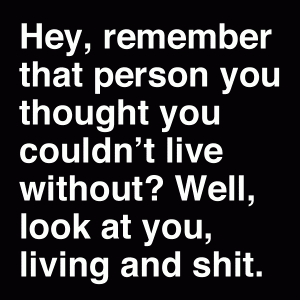
But it turned out I was wrong. Somehow, with a few changes and some missteps along the way, I was able to survive (actually thrive) without the person I thought I couldn’t live without.

Thank goodness:)


lookatyoulivingandshit


Being needed can feel good. It gives you purpose. Shores up your confidence and helps to mitigate any fears about being alone (after all, if someone needs you, they’re unlikely to leave you). Yet, taken too far or applied too liberally and being needed can begin to feel like an inescapable prison.


On the other hand, we all like to feel to wanted.

It’s a compliment, an acceptance. It makes us feel both desirable and powerful. It speaks to being chosen. Appreciated and valued.


“I want you” vs. “I need you”


I need you says that you are responsible for my happiness.

I want you declares that I’m happier when you’re around.


I need you implies that neither one of you are free agents and that you’re trapped.

I want you suggests that there are other options and you are the chosen one.


I need you sets the stage for an imbalance of power as one gives and the other takes.

I want you acknowledges the power within both of you and allows for an equal exchange.


I need you speaks to what you can do for the other person; it focuses on the tasks you perform.

I want you expresses a desire for the person; it focuses on who you are.


There’s nothing sexy about being needed and there’s nothing sexier than hearing someone you care about say,

“I want you.”


How to Rewrite Your Divorce Story

When divorce happens, it can leave you feeling like a failure. Powerless and adrift in your life. It’s easy to internalize these feelings, to recite them to yourself as if they were gospel.

But what might happen if you change your story? Take back your power?

And rewrite your divorce?

Learn the steps you need to take to release your divorce find your voice again.

I Reject Your Reality and Substitute My Own

gaslighting

In my ex husband’s mind, why tell the truth when you can invent it? Why yell when instead you can quietly manipulate through gaslighting?

In all of the pain after my ex husband left, there is one pain that stands out as more acute than the rest. After being arrested for bigamy and bailing out of jail, my ex decided to overdose on sleeping pills. It appeared to be a sincere suicide attempt, but he made sure to cover his bases in case he survived.

He composed and emailed a suicide letter to both his new wife and to my mom. I read that email while sitting outside the DA’s office waiting to meet the victim advocate. He was recovering in the ICU.

I felt reality slipping away as I processed the words that distorted the world I knew. In the letter, he speaks of me being “impossible to live with” and “negative.” He talks about my irresponsible spending habits and how I “just had to have my way” and he “couldn’t tell me no.”  Our last trip together – that he initiated, planned and executed – was recast as my demand for a vacation. He spoke of my insistence on building a deck when he counseled that we couldn’t afford it. He tells my mom that she “would love [the other wife]” and that he hopes they get to meet.

His words hit like a punch to an unguarded gut. I spent hours dissecting them, talking them over with each of my parents in turn. I knew they weren’t true but they still caused me to doubt. I feared that others (including my mom) might think his words were genuine. It felt like a vicious, spiteful attack on my character. And it wasn’t even factual.

He was rejecting reality and substituting his own.

He was gaslighting – using deception and manipulation to cast himself as the sane and balanced one and to make me look unstable and vile.

And it wasn’t his first time.

He was a master at creating and convincing others of his own reality. And, as trusting of him as I was, I was easy to convince. When you’re being gaslighted and you are unaware of the sleight of mind tricks being applied, you feel crazy as you begin to doubt your own perceptions and conclusions. It’s disorienting as the friction between what you see and you’re told you see don’t quite line up, almost like the view through 3D glasses when you turn away from the screen.

For months, I hated that letter. Every reading caused me to feel ill, like I’d swallowed something that needed to be purged. I shared it only with my parents and the close friend I lived with that year, finding comfort in their assurances that his words were mere deflection and trickery.

But still I wondered.

You see, he had trained me well. I still struggled not to believe his words over my own memories.

I struggled, that is, until I rejected his reality and found my own.

I picked apart each of his claims and refuted them one by one with physical evidence:

I spend too much? Then why do I read library books while he spent over a hundred dollars a month on Kindle downloads as evidenced by the checking account registry. And why do I drive the old, paid for car (that I still have!) while he insisted on buying a new one that came complete with a $500 monthly payment. I made a list of his possessions vs mine. It wasn’t even a contest.

I demanded the vacation? I unearthed an email sent to my work address where he proposed the cruise and described its details.

I insisted upon the deck? I found a trail of emails that covered everything from the summer school income I earned being used to pay for the costs to his enthusiastic sharing of his deck designs.

As for me being difficult and negative, that was harder to disprove. But the fact that I had many friends offer to take me in that year told a different story. I bolstered their offers with the hundreds of notes I had received from students over the years, praising my passion and positivity.

And as for my mom wanting to meet the other wife? Well, that was just plain funny.

Eventually, the letter lost its sting as I saw it for what it really was – an attempt to save his image by destroying mine. I wavered over whether to include the letter in the book. I was afraid I would be seen as the hateful woman he described. I decided to include it, even at the risk of his words being believed by people who did not know me. I knew that many of the readers would relate to being controlled by lies and I wanted to share a rare physical manifestation of gaslighting. Because the most painful part of gaslighting and what makes it so effective is that the evidence usually disappears like smoke in the wind, leaving you with only doubts and questions.

Gaslighting is a subtle yet relentless abuse. It’s one person using power and manipulation to control another. The damage is hidden and persistent, the worm of uncertainty taking up residence and calling everything into question. The effects linger as memories collide with new understanding, the deceptions fighting for dominance over the truth.

Gaslighting is often paired with physical abuse or addiction, the repainting of reality used to keep the partner calm and in place. It is a favored tool of narcissists and sociopaths. Those that are adept at its use tend to be charismatic and intelligent, lending a believability to their assertions. It is deliberate and cruel and can be immensely damaging.

Recovering from gaslighting takes time. Even recognizing that you were gaslighted takes time.

No one should have the power to create your reality other than you.

And your trust in another should never be greater than your trust in yourself.

Gaslighting thrives on doubt.

Starve it by believing in yourself.

Why I Refuse to Call My Husband a Narcissist

Character Assassination

Covert Abuse

So the Wind Blows

The storm pummeling Atlanta today has been described already as “historic.” I’m not sure if that will be the case but the howling wind and pelting ice outside my window certainly sound as though they are harbingers of the winter apocalypse.

I keep having flashbacks to the only other major ice storm I’ve been through. It was in 2000, 6 months after I’d moved to Atlanta and just over a month after I got married. My husband had just had a vasectomy the day before the storm hit. At least he was able to enjoy his Playstation and ice his wound for a day before we lost power! We ended up spending 3 days without power in an all-electric 3rd floor apartment without a working fireplace. We played board games in the living room during the day and slept (with the dog and cat) in the only interior room – the bathroom. I remember clearly the gunshot cracks of the 80 foot tall pine trees as they snapped one by one under the weight of the ice. Within two days, the surrounding woods looked as though a picky tornado had thinned them.

So here I am again, a newlywed awaiting the ice storm. I’m glad that this time I have lower floors to occupy, gas water heater and a working fireplace with plenty of wood ready to go. Oh, and a husband who didn’t just have surgery:) One way I’m less prepared? Books. I don’t have many really ones anymore and Kindle batteries don’t last forever. I may end up reading the backs of everything in the pantry:)

I couldn’t sleep last night. I do that when I’m concerned about something. I don’t know why. It’s not as if I can keep the trees standing simply by being awake. I gave up a little while ago and decided to enjoy coffee and a real breakfast, not knowing what the future may hold (have a feeling it may be a diet of protein bars and faked coffee – thank goodness for camping supplies).

Since I may be out of commission for a while, I pulled three pieces from the vault for you. See if any of them tickle your fancy.

While you’re reading, I’m going to enjoy a hot bath and a good (non-Kindle) book and pretend that the creaking trees are the masts of wooden boat sailing the Caribbean.

Pardon Me, Ego. I Need to Get Through

Ego:

the “I” or self of any person; a person as thinking, feeling, and willing, and distinguishing itself from the selves of others and from objects of its thought. (from dictionary.com)
Ever since we first begin to see ourselves as separate, sentient beings in childhood, our egos define how we interpret the world around us.  That sense of self may actually be holding you back from healing from your divorce.  Do you see yourself in any of the following patterns?
It’s All About Me
When I first realized the extent of my husband’s betrayals, I kept asking, “How could he do this to me? To the one he was supposed to love?”  I saw his actions directed towards me as an arrow towards a target.  I assumed he was thinking about me as he made these decisions.  He lied to me.  He cheated on me.  He stole from me. That pattern kept me fully anchored in a victim state, the recipient of all the pain and deceptions.
Slowly, I realized that it wasn’t all about me.  He lied and cheated and stole, yes.  But he did those things because of whatever demons had him in their grasp.  He didn’t do those things because of me.  He most likely wasn’t even thinking of me while they occurred.  He did them and I was in the way.
I shifted my thinking. When he hurt me, he was acting to protect his own sense of self rather than trying to wound mine.  I began to let the anger go.
It is not easy to remove the ego from interpreting the actions of one so intimate to you. Try looking at the situation with an open mind, letting go of your own ego, and see how your perspective shifts.

Of Teddy Bears and Security Systems

For most of my married life, I felt secure. I had a husband that I trusted. I owned a home and had been at the same job for many years. I felt comfortable in my life; I trusted that change, if desired, would come from intention. It was predictable and I liked that. If you had asked me where I would have been five years down the road, I would have answered without hesitation.

That feeling of security and blind trust is what allowed me to become complacent. Too comfortable. I was petrified of losing that feeling of security. I was very conservative in my decisions, choosing to avoid risk whenever possible.

I lost all semblance of security when he left. Everything was in question; nothing was sure. I didn’t have time to let it scare me. I simply had to survive. I was operating at the base level of Maslow’s hierarchy: eating, sleeping and breathing were my priorities.

I started tiptoeing back into life. I branched out but much was still unknown. I could not even imagine where I would be five years hence. And I was okay with that.

Read the rest of Of Teddy Bears and Security Systems.


Trigger Points

As a runner and weight lifter, I am very familiar with trigger points – painful balls of muscle or fascia caused by acute or repeated trauma. They are  hyperirritable, overresponding to even the slightest pressure or pull. They cause intense pain at their source and can often lead to referred pain in a distant area, frequently occurring along predictable pathways.

As a survivor of a traumatic divorce, I am also very familiar with emotional trigger points – painful memories and associated responses caused by repeated or acute trauma. They are areas of hyperirritability where the response far outweighs the preceding factors. They cause intense pain at the time of their trigger and can cause referred pains in seemingly unrelated areas.

I am consistently amazed at the magnitude and quantity of my emotional triggers. A snippet of a song last night brought me to tears as it reminded me of one of the dogs in my other life. Nothing is safe – smells, sights, words, movies, a date on the calendar. Sixteen years is a long time and it doesn’t leave much untouched. Triggers are like a black hole through space-time, pulling me back to a place of fear and pain.

Read the rest of Trigger Points.