Should You Believe Your Triggers?

I could feel it washing over me like a great wave trying to pull me under, both blinding me and choking me. My body went into full-on fight or flight mode, any rational thinking put on hold until the emergency passed.

What was the emergency, you ask?

My now-husband mentioned wanting to build a home theater in the basement.

I know, it’s a terrifying image.

This happened over six years ago and now I can laugh at the absurdity of my (over)reaction. But at the time, I truly was convinced that this was a serious threat to my well-being. I was responding to something in the present – my husband wanting to build a theater – with the emotions born from past experiences – my ex-husband building a home office in the basement that became the center of operations for his deceptions.

On the day of this particular melt down over the proposed theater, I remember being aware that the intensity of my response in no way matched the reality of the situation. But there was another part of me that was whispering, “What if this reaction is because you’re picking up on some real threat in the present?”

And I didn’t know which voice to believe.

And that’s the problem, isn’t it? We never know know for sure if what we’re feeling is a misplaced echo from the past or our intuition picking up on a real threat in the present.

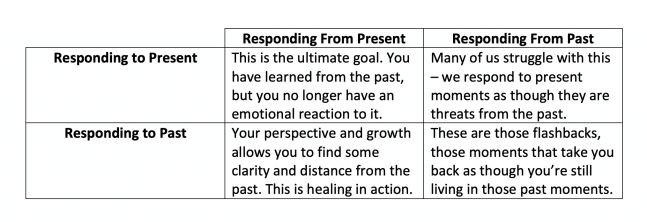
There are four basic categories between our reactions and what triggers them – Snip20191103_6.png

Responding to the Present From the Present

Your past experiences have taught you what to look for. You are better able to see actions that are misaligned to what you’ve been told and you’re more aware of unhealthy patterns. When something concerning happens, you use what you have learned to analyze it to decide if there are any real threats within.

You no longer have much emotional reaction from the past, so you trust that any you’re feeling now is an appropriate response to what is actually happening in the here and now. Furthermore, your reactions are on par with the behavior or sign you’re responding to. The response would be considered a reasonable one for anybody to have in similar circumstances.


Responding to the Present From the Past

Your past experiences are still living just beneath the surface. They have left you fragile, fearful. When something concerning happens in the present, it reignites those past concerns, an alarm sounding at full-blast, warning you that danger has arrived. Only the alarm is often false.

The emotional response is powerful, overwhelming, its intensity way out of line to what you’re responding to. You may even be aware that you’re overreacting, yet you feel powerless to stop it. Panic sets in. You become convinced that this is a sign that the past is about to repeat itself. You may respond with plans to flee, an instinct to fight or the desire to curl up and hide from the perceived threat. It’s best to take a time-out to allow some space for the body to calm before deciding to take any action.


Responding to the Past From the Present

This response comes when you encounter a reminder from the past, but you do not have an emotional response to it. Instead, you are able to look back with some clarity, applying what you know now to what you experienced then.

These are healing moments that provide valuable insight into what threats are real and which ones are born from a fear of being hurt again. This is learning – and healing – in action.


Responding to the Past From the Past

These are perhaps the most terrifying moments, when it’s as though a wormhole has transported you back to where you were with the same intensity of emotions and lack of perspective that you had when you were in the midst of it all.

When in the throws of a flashback, rational thinking and self-control is pretty much an impossibility. It becomes about survival, riding it out until it abates. Reminding yourself that it’s not real, that you are safe.


Should you believe your triggers?

Our emotional reactions are important, they provide us with information about our fears and about what is happening around us. Yet emotions are not always an accurate source of information. So listen to them, but don’t always believe everything they have to say.

Moments of Vulnerability After Divorce

There are things about divorce that nobody tells you ahead of time.

This is one of them.

Before my tsunami divorce, I felt like a capable adult.

After?

There were moments where I felt like a complete badass.

And moments where I felt like a weak and vulnerable child.

Those feelings of vulnerability have a tendency to pop up at the most unexpected times.


When Somebody Shows You Kindness

I felt a strange mixture of relief and vulnerability when I first talked to the officer that arrested my then-husband. Relief because I had somebody who knew what they were doing to take control for a bit. And vulnerability because his kindness revealed both how in need I was and helped prevent me from an “everybody sucks and I’m going to become a hermit” mentality.

For months, every act of kindness extended my way was met with tears. Of gratitude and also from a feeling of powerlessness. Because apparently I wasn’t as good as hiding my vulnerability and pain as I liked to think I was.


During an Uncontrolled Reaction to Something Small

Every time my phone would buzz, I would jump. I feared more bad news from the attorneys or police. I dreaded yet another fruitless and scary conversation with a creditor. And I secretly hoped it was my still-husband, full of apologies and regrets.

I hated the power that damn phone had over me. I wanted to be in control of my feelings and it was such a humbling admission that this little brick of metal and plastic had more sway with my emotions than I did.


When You’re Sick or Injured

It was just a run-of-the-mill stomach bug. But on top of feeling miserable, I felt completely helpless. Not only was my body useless, my mind was as well. And this time, I didn’t have my husband to lean on and act as my protector while I healed. More than ever before, I related to animals that hide in their burrows whenever they’re sick or injured. It’s simply too scary to face the world when you’re less than a hundred percent.


When You Need Help With a Task

It’s funny in hindsight. I was shoving things in my car to take them from my marital home turned mausoleum to the friend’s house where I would be staying. At one point, I needed three hands to both carry things, open a door and shoo away a pernicious yellow jacket.

Only there were no hands nearby to help.

I set down the things I was carrying with the intention of swatting at the insect and opening the door. Instead, I ended up sitting on my driveway (only it wasn’t really mine anymore) sobbing for the next several minutes. In that moment, everything seemed impossible.


When You Realize You’re Alone

It was just a stupid form.

Yet it was so much more.

“Emergency contact” stared back at me with accusing eyes, as though taunting me that I didn’t have anyone to put in the blank.

I could put in one of my parents, yet they both lived across the country, so that seemed somewhat silly. I could pencil in the friend I lived with, but she was completely overwhelmed with being the emergency contact for her new baby. I sifted through other friends, yet I kept picturing them confused when they received a call as my emergency contact. “Why did she pick me?” they would think.

And so I left it blank.

Realizing that ultimately, I had to take care of myself.

When You Meet Someone New

I was supposed to be happy.

And I was.

But I was also scared sh*tless.

Because if I developed feelings for this guy, it meant I would have to open up.

And if I opened up, I risked being hurt all over again.

But if I stayed curled up in my protective burrow, I knew I would never live again.


Gratitude Without the Bullsh*t

Gratitude.

It’s become quite the buzzword, hasn’t it. It’s right up there with kale and yoga in the perpetual quest for wellness and happiness.

We are told we should buy gratitude journals or download the latest app that will send us reminders that we should be grateful. Ads pop into our feeds with t-shirts emblazoned with, “Thankful, Grateful, Blessed.” And we hear everyone from scientists to pop stars lecture us about the importance of gratitude.

And some days we’re feeling it. The sun is shining and we actually have the bandwidth to appreciate it.

Other days?

The pressure to feel grateful just feels like one more burden and the inability to reach that goal simply feels like one more failure.

Which kinda defeats the purpose, doesn’t it?

_____

The problem with the constant push for gratitude is that it begins to feel forced. As inauthentic as a carefully posed and filtered Instagram image. We do it, but we don’t feel it. And even worse, when gratitude is feigned, we feel a dissonance as we deny what we are really feeling in the moment.

An intentional relationship with gratitude has been important in my healing process from my tsunami divorce. I’ve found a way that works for me to practice gratitude without feeling forced or denying that sometimes life is just hard. Maybe these strategies will work for you too.

Gratitude Without the Bullsh*t

1 – What Are You Looking Forward To?

I try to start every day with this question – “What are you looking forward to?” I take a moment and think about what is coming on that day as well as what is on my calendar for the coming weeks and months. Some of the anticipations are small – a cup of tea brewing on the counter, a pleasant weather forecast or wearing my favorite shirt. Others are more exciting, like an upcoming visit with friends or a planned trip.

When I find that I’m struggling to find things to look forward to, I make a concerted effort to schedule some smiles. Those are just as important to have on the calendar as any meetings or appointments.

There is a caveat to this strategy – you have to keep your expectations in check. There will be times when the looked-forward-to-thing doesn’t happen and if you’re too wedded to a particular outcome that is outside of your control, it’s easy to become disappointed or even defeated. The point of this exercise isn’t to place your happiness on a certain event, but rather to simply recognize that there are always good things on the horizon and to celebrate that excitement that comes with anticipation.


2 – Both And

When we suddenly lost our very special dog Tiger two years ago, it was very hard. The grief was intense and the loss overwhelming. My husband and I dedicated the weekend to remembering him and his impact on our lives. Interwoven with the grief was a gratitude that we had 8 years with this very special dog along with the awareness that the reason the pain was so great was because he was so great.

Finding gratitude through life’s hardest moments is powerful. But if artificially applied like a pigmented lacquer to try to hide peeling wood, it only leaves you feeling worse. It’s important to acknowledge the hard stuff, to be honest with yourself that sometimes life sucks and there are no silver linings.

And it’s also not allowing this great pain to block out all light, to eclipse all awareness of the joys in life. It’s not denying the loss; it’s feeling the loss and leaving room to see the joys. We cannot force ourselves to be grateful for everything, but we can also make an effort to keep our eyes open and look for the opportunities to be grateful.


3 – Reflect On the Totality

I start the day looking forward and I end the day looking back. I spend a few moments (and yes, with a gratitude journal) reflecting back on the day. I acknowledge those little moments to celebrate and I see if I can reframe any annoyances or struggles to see the other side.

Like many of you, my days are busy. Chaotic even. And I find it challenging to be too mindful during much of it as I focus on getting things done and meeting everyone’s needs. This time for reflection at the end of the day acts like a deep breath at the top of a hill where I look back on the path that brought me there, taking note of the moments of the journey.


4 – Give Yourself Permission to Have Bad Days

Guess what? You’re not always going to be grateful. There are going to be days (or weeks or even months) where you can’t see anything but the clouds. Times when the mere suggestion of gratitude feels like an unwanted embrace and leaves you feeling violated and coerced.

And that’s okay.

Bad days happen. 

Horrible days happen.

But you know what?

Good days and good moments within bad days happen too.

Gratitude is about seeing both.


When Is the Hard Work of Relationships TOO Hard?

There are two seemingly conflicting schools of thought –

A relationship requires hard work. You can’t just give up on someone because it requires effort.

and

A relationship is only hard if it’s with the wrong person. A good relationship shouldn’t take that much effort.

Yet, as with many pat pieces of advice, both contain elements of truth yet fail to address the very real complexity of the situation. A relationship can require no work and be unhealthy (I provide my first marriage as evidence) and there are also certainly times that one or both people in a relationship keep trying harder when perhaps the best solution is to walk away.

So what is “normal” when it comes to hard work within a relationship? And what are the signs that perhaps all of this hard work is wasted energy trying to fix something that contains a major structural flaw?


Periods of Ebb and Flow

Normal: There are days, weeks or months when you feel especially close with your partner and times when you feel a little more disconnected. Sometimes, you can identify a root cause – external stressors, illness, distraction – and sometimes it just comes on for no apparent reason. Maybe you talk about this distance or maybe you just ride it out until one or both of you reach out to reestablish the intimacy. There isn’t too much emotion tied up in these phases since there is mutual trust in the strength of the relationship and the transient nature of the ebb.

Maybe it’s Too Hard: Instead of gentle ebbs and flows, it feels more like the extreme highs and lows of a roller coaster. When it’s good, it’s great and when it’s bad, it’s awful. With each up, you feel elated. Unstoppable. While each down crushes your spirit and the fear and negativity sparked by the potential end of the relationship spread throughout your life. Your relationship status dictates the quality of your day.

During the up times, you’re balancing hope for a better future and fear that another downturn is around the corner. When the relationship is going through another rough patch, you’re both making promises to yourself that things will be different while simultaneously falling back into the same patterns as before.


Unequal Efforts

Normal: You feel irritated or frustrated that your partner never seems to do their share of the housework. You bring it up and there is an improvement, at least in the short term. During periods of additional workload or illness, one person picks up the slack, both people simply doing what needs to be done.

Even with these surface disturbances, there is an understanding that you are a team. That you both are working together towards a common vision. You may not always agree on the path, but you both believe in the destination and put in the effort to get there.

Maybe it’s Too Hard: From the thousands of people I’ve talked with as well as my own experiences, I think this is the ultimate dealbreaker. When your partner isn’t willing to work – to listen, to adapt, to attend counseling, to try something different, to address their own issues – there is only so much you can do.

From Til Death Do You Part?:

I see the vows as like the wheels on a bicycle. Ideally, both are fully functioning and working in concert. If one tire is a little flat, the other can help support the weight for a time until the tire is re-inflated. If one wheel is bent, the ride may not be over as long as the metal is hammered back into shape. Yet if one wheel is removed, the bicycle is useless no matter how hard the remaining wheel works. And it’s time to either find a new wheel or learn how to ride a unicycle.

If you’re the only one working, there’s only so much you can do.


Disagreements

Normal: “How could you be so ignorant?” you think as you hear your partner defend a point. Some arguments are minor, often carried in on the heels of a difficult day. Others are over more major things and these either move towards resolution in time (and this may take years) or become differing points of view to simply accept and live with. There may even be repeated friction over the same recurring issues and fights that follow familiar patterns without seeming to fo anywhere in particular.

During arguments, some harsh words may be spoken. Feelings may be hurt. One or both people may not always respond in the best way and things may get quite heated. But there are known boundaries that are not crossed, whether that is to refrain from physical confrontation or avoid using certain words. And when cooler heads prevail, apologies are offered, responsibility is taken and, most importantly, connection and commonalities are reestablished.

Wondering how to improve conflict in your relationship? Learn more here. 

Maybe it’s Too Hard: The fights come fast and furious. One or both of you are always walking on eggshells, uncertain what might spark anger in the other. During the arguments, boundaries are repeatedly crossed as brutal words or even fists rain down. Gottman’s four horsemen: contempt, stonewalling, criticism and defensiveness make a frequent showing at these arguments, ensuring that a productive conversation cannot occur.

The arguments never seem to come to any resolution. Promises are made yet somehow you always seem to end up in the same place. It’s as though you’re trying to coauthor a book only you speak two very different languages.

The disagreements are frequent. Instead of being the raisins sprinkled periodically throughout your relationship, they are the cookie itself. In fact, you often wonder if it wasn’t for the fights, if you would have anything holding you together at all.


Disliking Things About Your Partner

Normal: You can’t stand your partner’s taste in clothes. Or their new haircut. Maybe the way they brush their teeth sets yours on edge. All of that is totally normal. It’s impossible to spend an extended amount of time with someone and not become annoyed with certain traits and since we’re not all clones, there will always be things about another that you don’t like.

Yet underneath that dislike is love and maybe even some lighthearted humor about the things you find objectionable. You are able to separate the person you love from the particular trait that you don’t.

Maybe it’s Too Hard: Dislike has turned into disgust. Something about them actively turns your stomach. Or, there is something about them that you find so objectionable that you carefully tuck it away and try to forget about it.

Maybe you’re embarrassed of them, hesitant to bring them around your friends and family, fearing their reaction. On some level, you don’t think they’re quite up to your level.

And bigger than that is when you find that you’re beginning to dislike yourself. Are there patterns in the relationship that bring out the worst in you? Or are they being emotionally abusive and their words have become your own?


Questioning Your Decision to Be Together

Normal: Sometimes you wonder what your life would be like if you were single. Or with somebody else. It’s not a pressing desire, more a curious daydream that occasionally drifts through your mind. This may be prompted by a passing attraction to another person or from observing somebody else’s life and wondering what it’s like in their shoes.

Other times, this question is more pressing when the relationship is going through a particularly difficult period. You wonder if you made the right choice, your current pain manifesting as confusion. Yet this feeling doesn’t persist as you’re reminded again why this is a person that you want as your teammate in the game of life.

Maybe it’s Too Hard: More days than not, you wonder if you’re doing the right thing. You find yourself continually weighing out the pros and cons. Maybe you ask for the input of others because you feel like you can’t trust your own instincts.

Are you scared to leave and only staying because it’s what you know or because of the time and energy invested? Are your goals in life incompatible with the relationship and you either leave your partner or leave yourself?


Time Spent Apart

Normal: You look forward to the business trip so that you can have time to yourself at the house. You enjoy solo travel or a dinner with your friends. It’s healthy for couples to spend time apart from each other and this is supported and encouraged.

When apart, there are certain expectations around boundaries and communication. As long as those are met, there is not undue anxiety or jealousy about the other’s whereabouts or actions.

Maybe It’s Too Hard: You count down the minutes until your partner leaves for the day and you dread the moment they come back through the door. Or, when they’re away, you’re constantly wondering if they’re cheating and so you find yourself anxious and questioning. Or maybe it’s your partner that is controlling and leaves you feeling guilty for every moment you take for yourself.


Final Thoughts

I like to tell my students that anything worthwhile takes effort. And when that comes to relationships, I certainly believe that to be true.

From Why Are Relationships So Hard?

Staying together requires a lot more effort than getting together.

Relationships are not stagnant. Just when you finally learn how to talk with your partner about money without falling into a blame/defensive pattern, something changes. And then you have to change in kind. There is no status quo. It takes energy and effort to grow.

Yet sometimes that relationship has become a black hole and that energy may be better spent in a new direction. And only you can can decide if the work is going towards growth or the work is taking energy away from your growth. Only you will know if it’s time to try harder or it’s time to walk away.

Wondering if you should divorce? Here are 12 questions to ask yourself.

Wondering why you’re not seeing the results you expected? Here are some common reasons. 

Wondering if you tried hard enough to save your marriage? Hint: If you’re even asking this, it’s a sign you put in the effort. Here’s more to think about. 


A Tale of Two Marriages

Today is our 6th wedding anniversary.

That number has some meat to it. It feels substantial. Like we’re past the appetizer and into the main meal.

For some reason, I’ve been particularly reflective this year, looking at this marriage and my first one from the perspective of today.

I don’t remember my 6th anniversary in my first marriage. But that’s not surprising. Not only did we not make a big deal out anniversaries, but both time and trauma have significantly dulled my memories of much of the sixteen years I was with him.

Even without specific memories or knowledge, I suspect that he started living a double life in earnest around our 6th anniversary. It was around that time that he was laid off from his latest job and he decided to go solo. And as I learned later, the company that he started never was profitable. Of course, he worked hard to hide that from me at the time and shared extensive details about projects that he was working on. Projects that I don’t think ever existed.

I can’t help but contrast that with my now-husband. He’s had a couple down years at work due to certain accounts. And I’ve known about it every step of the way. He’s been frustrated about the cuts, but instead of hiding the finances, he’s strategized and worked harder. All while being open with me about what has been happening.

From my perspective at the time, my first marriage was good. If I was to graph its happiness and our connection over time, it would be a horizontal line with only the most minor of deviations. The marriage was steady and we were consistent.

My marriage now is different. When I look back over our 9+ years together, it’s been a positive trajectory. We’re closer now than we were when we married. There’s more intimacy. Better teamwork and communication. More awareness of our own triggers and baggage, which we’ve both made major strides on addressing.

There’s been some hard times, but ultimately, we have both grown as individuals (with the support and encouragement of the other) and the marriage has grown as well.

In my first marriage, we never talked about the marriage. It just was. Something as certain and inevitable as the sunrise.

In contrast, my now-husband and I talk about our marriage quite a bit. What’s working. What’s not. What we appreciate and what we observe. It’s not something we take for granted; it’s something that we make an effort to nurture and grow every single day.

I used to worry that I would never have love like my first husband again. What I couldn’t have imagined was that I would find better. Realer. This love is more challenging and also so much more rewarding. And I would trade this for anything.