How to Get Over Being Cheated On

get over being cheated on

“How do I get over being cheated on?”

This phrase makes its way into my messages several times a week.

And no matter how many times I read it, my stomach still clenches at those words.

Because I can remember the desperation that I had for that answer. It was part fear – “Can I EVER move past this?” and part plea for help – “HOW in the world can I get through this gutting pain?”

Required Readings: The Aftermath of Infidelity

Here’s what I wish I could go back and tell myself in those first, awful months after the discovery of betrayal:

Love Testing

Love testing.

It’s one of the reasons that teenagers are difficult to deal with. Before they take the leap out into the adult world, they want the security that comes from knowing that you love them unconditionally. Your words and prior actions are often not sufficient for these temperamental creatures. They want reassurances. They want proof.

Operating below the level of full consciousness, they engage in behaviors and make decisions that they know you disapprove of. They often fail to hide these choices and they may even flaunt them. Of course, some of this is fueled by the teenager’s desire for exploration and their lack of a developed prefrontal cortex.

But that’s not the only motivator.

These undesirable actions are often driven by the teenager’s search for the answer to this question –

“Will you still love even if …”


And teenagers aren’t the only ones that engage in love testing. Adults, especially those that have been betrayed or abandoned, can utilize this strategy as well in romantic partnerships. Like the teenagers, these adults are seeking reassurances that the past will not repeated. They are testing the strength of the commitment by weighing it down with  ever-increasing challenges. They want security. Promises. Certainty.

And so they test. Maybe treating their partner with disrespect. Or flirting openly with another person. Or letting the weight begin to comfortably settle around the waist. Or continually breaking up only to pick back up again. Or spending just a little more than was agreed upon. Boundaries are nudged and the reactions observed.

Will you still love if…

There are problems with this approach. Partners are not parents. Their love does have its limits. At some point, the weight tied to the commitment will be too much to bear and their acceptance will be be withdrawn. And that point will inevitably be reached because    no matter how many love tests they’ve passed, until you trust in yourself and your ability to handle whatever may comes, it will never be enough to assuage your insecurity. And regardless of how many transgressions the love survives, there is no such thing as certainty in love.

That’s not to say that love should be welcomed without confirmation. The tests will come naturally over time as life presents you with challenges and obstacles. Take this opportunity to observe how they respond – Do they shut down or shut you out? Do they find refuge in the guise of victimhood and point fingers? Or do they see you as a team and work cooperatively towards resolution or acceptance?

Once we’ve been hurt, we will do anything to avoid being hurt again. But love doesn’t work that way.

As I’ve written before, 

Love is all or none.

If you try to hold it at a distance, you end up pushing it away.

If you attempt to control it, you will inevitably strangle it.

If you build walls and hang back out of a fear of being hurt, you are avoiding the very intimacy that is the foundation of a relationship.

If you punish your new partner for the sins of the old, you are wrapping the new in the cloak of the past.

If you assume that this partner will also hurt you, you are more likely to be hurt again. After all, the dog that you expect to bite often does.

Love is always a risk. Whether you’ve been hurt before or not.

It’s just that those of us who have felt the anguish of an end know exactly what it is we are risking.

And you may decide that it’s not for you. That you’re happier alone and don’t want the risk or the compromises again.

That’s okay. Life is not one size fits all. Tailor your life to your specifications.

But if you do decide you want to let love in, you have to be ready to embrace it. Risks and all.

That ten-foot pole may make you feel safer, but all it’s really doing is keeping love at arm’s length.

Love is all or none.


Understanding Projection

My ex husband accused me of cheating.

Never to my face, maybe because he feared my response or because on some level he knew the claim was baseless, but to his friends and coworkers. After he left, I learned that others had been hearing graphic and disturbing stories of my supposed infidelity for years.

He then went on to detail my irresponsible spending in his “suicide” letter to his other wife and to my mom (he made a suicide attempt when he was released from jail). He described how I wouldn’t take “no” for an answer and I always needed the latest and greatest things.

My initial reaction to my discovery of these accusations was one of unmitigated horror. You see, I trusted him so much and had slowly been groomed to accept his description of reality, that I initially believed that his claims must be true.

And then I grew confused. Because none of the facts, which I obsessively detailed to those who surrounded me in the aftermath of the tsunami, matched his claims. I struggled to understand what was real as the oil of his accusations failed to blend with the water of my recollection.

Finally, it became clear. He was charging me with the exact misconduct that he was guilty of. He was projecting and I was the screen.


What is Projection?


Projection is a common cognitive dance where self attributes or actions are shifted to another person. Much of the time, it is relatively harmless. Yet in the hands of an addict or abuser, projection can be used in a more detrimental way to distract or to transfer blame.

We all engage in some amount of projection. In some cases, projection allows us to empathize with others when we superimpose how we believe we would feel in a given situation over their stated experience. Other times, we may assume that someone feels the way we do or that they have the same aptitudes or perspectives. You see this when people caught behaving badly offer up the excuse that “everybody does it.”

Projection is also used as a defense mechanism. When there is some aspect of your beliefs or behavior that does not align with your view of yourself, you experience something called cognitive dissonance, where you either have to alter your view or amend your behaviors. One “solution” to the discomfort caused by this misalignment is to assign the disallowed characteristics to somebody else in the classic, “It’s not me, it’s you” move.

Often times, projection occurs when we are aware of something, yet we’re not yet ready to see it in ourselves (an example of this would be the claim that, “You don’t love me” when the reality is that we’re starting to doubt our own love). After all, it takes quite a bit of courage to look within.


Projection As a Weapon


I’ll never know to what extent my ex husband was aware of his projections. It’s possible that he was so deluded that he accepted his lies as truth (in fact, he actually told my mom after the suicide attempt that he had started to believe his own bullshit). But it’s also likely that his projection was largely conscious, distilled and aimed in order to cause the maximum damage.

By accusing me of horrific misdeeds, he excused his own undeniable choice of abandonment. When he projected his deceptions on me, he painted himself as the victim. His indictments acted as a slight of hand, keeping me distracted from looking too closely at what was happening on the other side of the stage. And finally, he used projection as a form of gaslighting, blurring and altering my view of reality.

If you’ve been in a situation where you have endured emotional abuse or faced the helplessness and frustration that comes from living with an addict, you’re vulnerable to believing the displaced accusations. Your self-image and confidence are likely low and you’re prone to assume responsibility for another’s well-being. When these accusations arise, refrain from blind acceptance. Ask yourself first if those claims are actually a better fit for your accuser.

As the divorce proceedings progressed, I found my new awareness of his tendency to project helpful. Whenever he accused me of something (withholding information, lying on a discovery document, etc.), I knew what to expect from him. Because even though his projections were aimed at me, they were simply a reflection of him.

Three Reasons NOT to Seek Closure

I was good at coming up with excuses.

I must send him another email (even though he didn’t respond to the first two) so that he knows the impact of what he’s done and it might prompt him to apologize.

I have to contact the police about his bigamy because it is a crime and he should face the legal consequences.

I need to look at his other wife’s blog so that I have an idea if he’s going to show up to court.

I read through scores of emails and stared at countless images of his face, all in the name of finding closure.

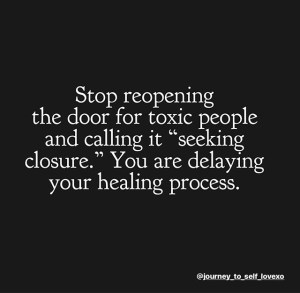
Yet with every message I sent his way, every piece of evidence collected for the court case, every glance at the other wife’s blog and every peak at his face or his words, what I was really doing was reopening the wound. Delaying healing all in the name of closure.

IMG_2873


The concept of closure is a malleable one. Generally, people use the term to signify that they have harvested any lessons from the situation, found acceptance and are ready to move on. In that sense, closure is a respectable and desirable goal. The problem arises when the pursuit of closure is used as justification for detrimental behaviors.


Using Closure as an Excuse to Maintain Contact

It’s rarely easy limiting contact with your ex during a divorce. For some, they miss the companionship and reach out under the guise of “talking things out” in order to maintain the familiar friendship. Others bombard their ex with questions, convinced that they need these answers in order to understand the demise of the relationship. (Hint: You don’t actually need to understand in order to move on.) And then there are those like me that maintain “virtual” contact by following the ex’s actions online, with the pretense that the other person’s actions are somehow important to your own happiness (Spoiler alert – they’re not.).

There’s a reason that “no contact” with the ex is recommended whenever possible (and it’s possible in pretty much every case without children and can often be limited even when kids are in the picture). Whenever you have exposure to your ex during the healing process, the scab is ripped off and the wound reopened. Go back and look at the ultimate goals of closure – learning, acceptance and moving on. You’re not going to find any of those by seeing your ex smiling alongside some new hottie on their Instagram.


You’re Wanting Things to Be Different

Sometimes, closure really means, “I’m not happy with the reality and I’m going to keep poking at it until it matches my vision.” You can become convinced that if you ask the right questions or just dig deeply enough, you’ll discover that things aren’t as they appear.

In my case, I wanted evidence that he was remorseful for his actions. I convinced myself that I needed an apology (I didn’t) or at least some scrap of information that would demonstrate that he did love me and that he was heartbroken over the consequences of his choices.

This type of closure is in opposition to acceptance. Whenever you’re dictating what you want to find, you’re trying to make reality match your wishes. And that’s a losing battle.


When What You’re Looking for Doesn’t Exist

In seeking closure, many of us are looking for the neat and clean ending that wraps up most fictional stories. We want the lessons presented in an easy-to-understand format. We want the protagonist to find happiness and we want to see karma bite any bad guys in the tale. All of this makes for a great movie ending, but it doesn’t exist in the real world.

Life is messy. Any lessons that you can learn from your divorce won’t be found in a distilled moral to the story. Your happiness will be variable and karma may be stuck in traffic. Closure doesn’t mean that you will never again feel the pain and it doesn’t mean that you will forget. Closure simply means that you’re willing to let the past go.

And if you’re using closure as an excuse, maybe it’s time to let that go too.


And if you’re looking for healthy ways to create your own closure (that don’t require the participation of your ex), read this!


Understanding Triggers


Want more ideas and support on dealing with triggers?


Facing Avoidance

We avoid because we do not want to suffer. Yet suffering then becomes the background noise of our lives.


Learning to Trust Again: How to Deal With the Triggers

There are times when the triggers are activated because of a legitimate and present concern. At those times, it’s important to listen to your gut and pay attention to its warnings. And there are other times when the alarms were pulled too soon, acting more from perceived danger than from a true emergency.


Trigger Points

As a survivor of a traumatic divorce, I am also very familiar with emotional trigger points – painful memories and associated responses caused by repeated or acute trauma. They are areas of hyperirritability where the response far outweighs the preceding factors. They cause intense pain at the time of their trigger and can cause referred pains in seemingly unrelated areas.