In My Other Life

Duma Key
Duma Key (Photo credit: Wikipedia)

In my other life, I never used to listen to audiobooks. From a practical standpoint, my commute wasn’t much more than a mile each way so I wasn’t in the car long enough to tire of the radio. There was another reason, as well. I am a visual learner. Big time. If I see it, I remember it. However, I have always struggled with auditory input that is passive in nature, such as lectures or, yes, audiobooks. When I tried to listen, even to a familiar story, I would get lost and frustrated with my inability to keep the characters and narrative straight.

But that was my former life. I turned to audiobooks from the library first out of desperation. I know spend about an hour in the car each day and the antennae on my 14-year-old car chooses to rise only occasionally. In my old life, I used to say that I can’t comprehend audiobooks. In my new life, I was willing to learn. My commute is now one of the highlights of my day as I work my way through my library’s selection of books on CD. I use the time to explore genres and non fiction topics that I would usually pass by (inspired by the necessity of a limited collection) and I “reread” favorites from my past.

I am currently on a Stephen King kick. I’ve read everything that man has published, much of many years earlier. The high quality of the narration on his audiobooks makes it a distinct pleasure. I find myself completely pulled into his world as I travel to and from work each day. It’s interesting how his books resonate differently with me now than they did in my other life.

My current selection is Duma Key, a book primarily set on an island in Florida that follows Edgar, a man who took a “geographical” after a tragic accident cost him his health and his marriage. There, he meets Wireman, also drawn to island after catastrophe. I was drawn to a particular line, uttered repeatedly by both men throughout the book:

“In my other life…”

Both men suffered great losses. Edgar, formerly a contractor, lost his arm, his mobility after a hip was crushed and experienced head trauma after being crushed by a crane. While he was recovering, his wife filed for divorce. Wireman, a lawyer,  lost both his daughter and his wife and, as a result, attempted suicide, the slug taking his vision as it traveled through his temple. Those losses were stark, a clear delineation between their past lives and their present.

I am drawn to the matter of fact way they accept their new worlds. They don’t spend time bemoaning their losses, although, especially in the case of Wireman’s wife and daughter, the pain is evident when they talk about it. They work within their new limitations to make the most of their new lives without trying to recreate the old.

That is what I have tried to achieve with my own life. I have had to accept that my other life is gone and is beyond reach. Rather than spending time nurturing the loss or trying fruitlessly to recreate what I had, I try to focus on building the best life possible now. I now talk matter of factly about my other life, as distantly as if I was discussing a character in a book.

Some of the changes between my former life and now have been dramatic. I never used to write. I was a private person. And, I always made decisions very conservatively, planning for an imagined future. I have a new name, a new city, a new beau, a new job, a new dog. A new life.

Some of the changes are slight, and strike me as funny.

In my other life, I never rolled the toothpaste tube. This drove my ex crazy, even though we didn’t share toothpaste and it was stored out of sight. Now, I am a dedicated roller.

In my other life, I never used to finish any beverage, always leaving a quarter inch of fluid in the bottom of any glass. I now enjoy every last sip.

In my other life, I hated asparagus. Now it is one of my favorite vegetables.

At a cellular level, our bodies are constantly renewing themselves, shedding the old cells as they die and replacing them with new. Sometimes we need to shed our other lives so that we have room for the new growth.

My other life was lived by an other me. And now I have a new life that fits the new me.

Forgiveness

forgiveness

Opening the Journal

photo-180

Deep breath.

In many ways, this will be my most personal post yet. These are the thoughts, the words, that came in the first few weeks uncensored by the keyboard and unedited by time. I’m choosing to share this to reveal the underbelly of the healing process. I want to show that it is possible to move on from such pain and I want to highlight the importance of positive thinking and goal setting early on in the healing journey.

I started journaling on July 15, 2009, four days after I received the text.I learned about Uganda on July 20 and the bigamy on July 22.  Much of the writing in the journal was done in the early months, as I transitioned to the computer during the late fall and winter.

I chose to divide my journal into three sections and made a rule that each writing session had to begin in section one and proceed through section three.

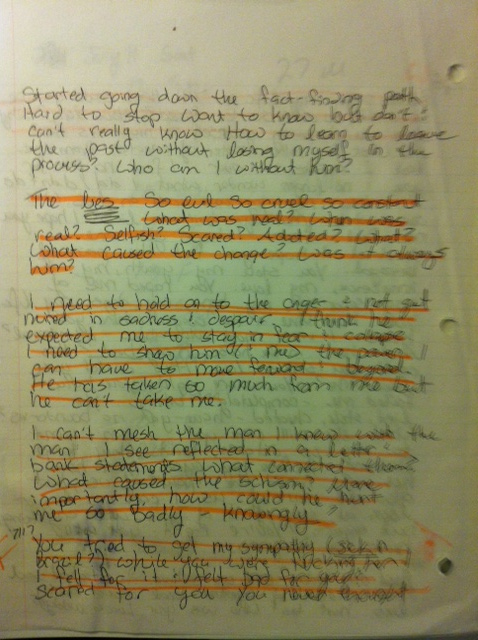
Section one: This was the space for the unedited vitriol. This was the anger, the poison. I knew I had to release it and there was oh so much to release. The writing is rapid, the angles harsh. I pressed so hard that I tore through the pages in spots. This was the domain of the broken heart.

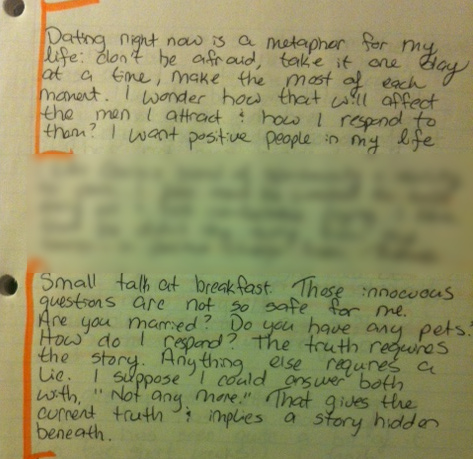
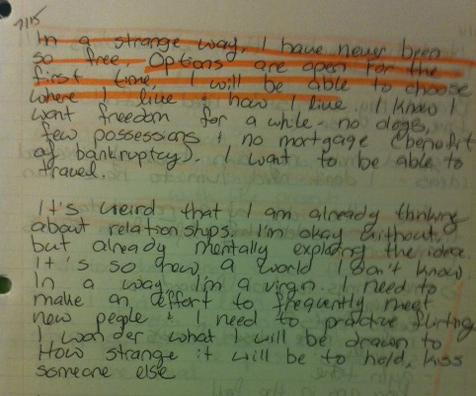
Section Two: This was for the day to day thoughts and practicalities. It was designed for observation and problem solving. This was the domain of the rational mind.

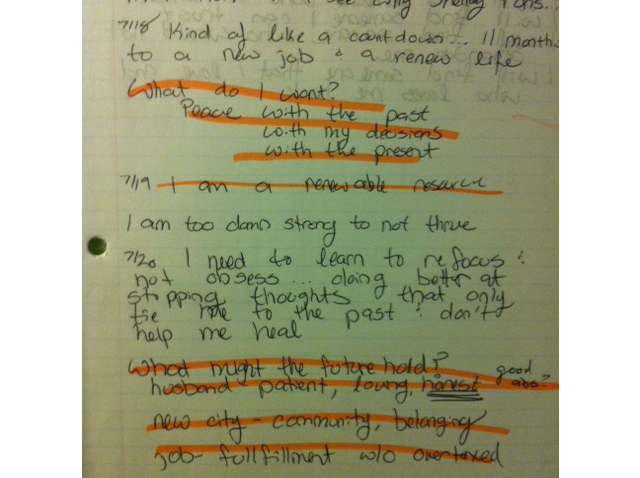
Section Three: The final section was for dreaming. I let my mind focus on the infinite and wonderous possibilities that the future might hold. This was the domain of the spirit.

I have no idea how or why I decided to structure my journal this way. In retrospect, that was surprisingly lucid for my state at the time. Recent research supports this model, as they found that high ruminators (I’m not sure if I am this but I am definitely a high analyzer) benefited from a fact-based, mundane journal but suffered when rehashing the negative feelings over and over. My three part design and my insistence on not ending with the negativity allowed me to vent but kept me from getting stuck in the sadness and anger.

For those of you early on in your journey, I hope you can find recognition and some possibility in these entries. For those partway through, I hope you can find acceptance of the process and be patient with yourself. For those who have come out the other end, I hope that you will find encouragement for how far you have come. On of my biggest lessons in all of this is the enormity of the damage that can occur when you deny your feelings. My ex destroyed his life and impacted others because he refused to face his emotions and instead kept them locked away and hidden beneath a facade.

So, here goes. These are excerpts from the journal, in no particular order. Names have been blurred to protect identities. The highlights are from my work when I was writing the book. For those new to my site, please remember that this was 8 years ago. This is not the space I am currently in.

journal18

journal17

journal16

journal15

journal14

journal13

journal12

journal11

journal10

journal9

journal8 journal7 journal6 journal5 journal4 journal3 journal2 journal1

I can read these now with some distance. I remember the pain, yet time has dulled its sharpness to a mere whisper. I identify with the woman who wrote this; I can see traces of who she is going to become. I am no longer her; however, I don’t have the anger anymore that fills these pages. I have learned to soften and to accept. I have forgiven my ex and let go of the need for understanding.  The messages of hope and the small celebrations make me smile. I almost wish I could reach back and give the me of those days a hug and tell her that it will be okay and that her hopes and dreams will come in time.


Moving on

Right This Moment

Since last April, my daily breakfast has consisted of a green smoothie: 1/2 a banana, frozen mixed berries, protein powder, cinnamon, vanilla, kale, spinach, almond butter, and almond milk. Prior to last spring, I consumed my pumpkin oatmeal every day for almost 5 years: oatmeal, pumpkin, blueberries, flax seed, protein powder, almond milk, and walnuts. I’ve loved the switch to the smoothie. It still fills me up until lunch and it helps me increase my consumption of leafy greens without the time commitment needed for endless salads. I’ve loved the smoothies. Until today.

Georgia welcomed its first real cold front of the season last night. I awoke to a cold house, the wind blowing through the cracks in the windows and reaching up through the floors to wrap itself around my ankles. I poured myself out of bed, wrapped my body in layers of rediscovered winter clothes, and went to make the coffee. While I was enjoying my coffee, I realized I was dreading my breakfast. Dread or not, I made my smoothie and drank it down, which led to a subsequent drop in my core temperature with accompanying shivers. I usually meditate after breakfast, but this morning that was replaced with a mad dash to a hot shower.

Those smoothies, in all their green-powered awesomeness, are perfect in the warmer months. But, perhaps, I need to recognize that just because something was right for me yesterday, does not necessarily mean that it is right for me today. I suppose I will need to revert to my pumpkin concoction for the next few months or invent a new breakfast. Spinach oatmeal, anyone?

The Gift