Adventures in Publishing

Somehow it seems appropriate to be here three years after my tsunami divorce.

Just days after the end, I picked up a pen and wrote voluntarily for the first time in my life.  Days after that, I moved my journal to the computer and began to craft a book out of my life. I wrote consistently, even compulsively, for a couple months.  It was therapy.  I spewed my rage and sorrow upon the keyboard and somehow some a story was crafted. Then, as abruptly as I started writing, I stopped.  For two years, I knew that I intended to finish the book, but I couldn’t bring myself to work on it.  The original intensity had faded, yet it was too painful to give the file more than a cursory look.

Finally, last winter, I knew I was ready to begin again.  A friend recommended that I start this blog.  It was a great suggestion, as this has been a place for honing my writing, brainstorming ideas, learning to be comfortable with my writing and story being “out there,” and it has opened up bigger opportunities.  It has also been a distraction from writing the book; 800 word typo-filled blog posts are much easier to write than a full-length fully-edited book.  Who knew? 🙂

It’s tangible.

My goal for this summer was to actually finish the book rather than just talk about it.  I’m pretty much there.  It’s written. It’s formatted. It’s currently being edited.  Once the final changes are made, I’ll upload the final version into KDP (Kindle Direct Publishing) and click “submit.” (…and then re-format the whole thing again for the print version…but I’m not ready to think about that yet!)

A few months ago, I wrote a post contemplating when I could call myself a writer.  I definitely feel like one now after a solid month of sitting on a hard chair in a hot office pounding away at the keys.  The sore brain and butt confirm it. So does the almost full ream of paper it took to print the thing for the editor:)

Computer on the left, book on the right.

It’s been a crazy summer pushing to get all my projects done before school starts up again (which for teachers around here is just a couple weeks away!). I used a 4-part motivation/organization/idea board to keep me going.
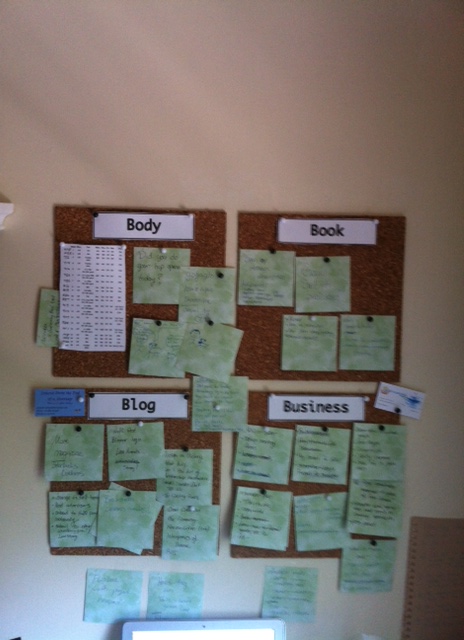
FYI – “Body” has my marathon training schedule and reminders to stretch!

It’s crazy to think that I’ll be ready to change the label on the “book” square soon.  Any suggestions for what I should add there?

I know my boyfriend and the animals will be happy to have me spend more time downstairs instead of holed up in my office.  He (the boyfriend, not the dog!) leaves me little notes around my desk.  I found this one in the spiral I use to jot down notes a couple days ago.

You finally get to see what the boyfriend looks like! 🙂

Tiger and Maddy have enjoyed my time writing.  This is on the couch behind my desk.

We think of Tiger as a Pit Bull Ambassador.

This has been an amazing adventure.  The book has been so therapeutic to write; working with the story has helped to distance me from some of the pain.  I have learned so much in the process as I have taken the needed steps to take the book from its infancy three years ago to a finished and published (and hopefully read!) product.

I love that I’m celebrating (yes, celebrating) the three-year anniversary of the tsunami with the completion of the book. It feels like I’m ready to close that chapter of my life and move on to my new lessons.

Until then, I am enjoying some summer (which means resting my brain and running my butt) while awaiting word (hopefully not too many!) from the editor.  And, soon, I hope to push “submit!”

Adventures in Publishing, Part II

How to Become a Huffington Post Blogger

In the last few weeks, I have been receiving quite a few inquiries about how I started blogging for the Huffington Post.  The short answer?  It was a combination of daily work and luck.  Here are my tips for those of you who are interested in getting your writing out on the big stage:

Image representing Huffington Post as depicted...

1) Read the Huffington Post.  Daily.  You don’t have to read the entire site, just focus on the sections which are of interest to you and are similar in topic to your writing.  You won’t know what they are looking for if you are not familiar with the material on the site.  I find that it is easiest to subscribe to my sections of interest  in my RSS reader so that I get a notification when a new article is posted.  That becomes especially important with tip #2.

2) Comment on articles and blogs.  Take the time to craft well thought out responses that add to the post or provide an alternate view in a respectable tone.  The best comments provide some information while hinting that you have more to say on the topic at hand.  Leave them wanting more.  You can link to your blog or your other writings on the topic.  This is where the work comes in; I spend thirty minutes or so a day reading and commenting on appropriate articles.

3) In the meantime, work to create a body of writing if you have not already.  This shows your writing style as well as demonstrates that you have a unique view or story to share.

Writing

4) Keep this up for a while and you may get lucky and have an editor contact you with a blog idea.  If this doesn’t happen, then proceed to #5.

5) On the “Contact Us” link on Huffington Post you will find a link to submit a pitch for a blog.  They give you the option of submitting the full text or just a description of your blog idea.  I have not gone this route, but I would recommend submitting the entire post so that your ability to craft a quality product is not in question.  Also, write about an area where you are passionate; it will show in your writing and will pull others in.

I wish everyone the best on their writing, whether you keep a private journal, a public blog, or are working to become a published author.

You can find my Huffington Post submissions here. My book is available on Amazon and you can read about my experiences with publishing here and here.

Huffington Post also led to my appearance on The Jeff Probst Show!

Dating After Divorce: Lessons From the Classroom

Here’s my latest on Huffington Post:)
http://www.huffingtonpost.com/lisa-arends/fearless-dating-101_b_1641291.html

Taming the Monkey Mind: Taking the Monkey to the Gym

I only began consciously meditating within the last couple of years.  I have actually been practicing mindfulness much longer than that, however please keep that a secret from my monkey mind. I have used weight training as a tool for bringing my focus to the moment since I was a teenager. I lift heavy, more to direct my thoughts rather than to build my frame. Lifting was a way to force my mind to rest.  I could stay within my comfort zone of strength training and yet flirt with the exotic (to me at the time) world of meditation behind the scenes. When executing a compound movement with heavy weight, my mind could not wander; the monkey that normally scurried around the folds of my cortex was silenced under the burden.  Breath was forced into the smallest bronchi, as the body demanded extra oxygen. Each flexion of muscle was accompanied by a relaxation of mind, a perfect partnership of mind and body.

Zen Habits beautifully explores his experiences with the meditative power of iron.

:zenhabits.

So, if your monkey mind resists the yoga mat or the meditation pillow as mine sometimes does, try taking your monkey to the gym and shut him down with some heavy weights!  Just don’t tell him that he’s actually meditating:)

10 Life Lessons From the Dog Whisperer

Yes, I know what you’re thinking, “The Dog Whisperer?  That guy deals with…dogs. What on earth could he teach me about life?”  Remember that yours truly has found life and relationship lessons in barefoot running shoes, the actions (or lack thereof) of an elderly cat, a campground, and a fencing strip.  Oh, and I’m married to a guy who learns about life from the dojo.  So, see, life lessons from Cesar Millan is suddenly not so strange now, is it? Besides, his methods have worked to make my 95-lb pit bull  the world’s best dog!


1) Energy Transfer

Whenever Cesar meets with a new case, he watches the owner(s) interact with the dogs.  He pays more attention to the behavior of the owner than that of the dog.  His claim is that anxiety or a lack of confidence in the owner transfers to the dog.  He frequently says, “I rehabilitate dogs, but I train people.”  In our lives apart from dogs, we also transfer or energy.  If you find that you experience stress interacting with someone, check your own energy.  What are you responsible for transferring?

2) Don’t Grip the Leash Too Tightly

This is an extension of the lesson above.  When you watch the owners walk their troubled dogs, they grip the leash too tightly and pull with all their might if their dogs lunges at another dog.  This is transferring the anxiety to dog, but even more importantly, it is giving power to the anxiety.  In order to control the dog, the owner has to learn to let go of the illusion of control and has to begin to trust their dog.

English: Australian Cattle Dogs, Thommo and Du...

3) Prepare for Greetings

Cesar always prepares the dogs carefully before allowing them to enter a dog park or greet other dogs.  He makes sure that they are calm and submissive so that they are well-received by the rest of the pack.  It is worthwhile to check your own mental state before greeting someone.  I know I can come in from a stressful day and take it out on my boyfriend instead of pausing and waiting until my own mind was calm.  And, no, I’m not recommending that you start greeting people by sniffing their butts!


4) Work With Nature

According to Cesar, dogs process the world through their noses first, followed by their ears and eyes.  Obviously, we tend to use those senses in reverse and we all too often expect that from out pets.  Cesar advocated working with the nature of the animal so that you get the results you are looking for with the least amount of resistance.  Look around you.  Not everyone perceives the world the way you do.  Do you expect them to conform to you, or do you allow them to use their nature?

5) Be Aware of the Precursors

On the show, Cesar will often correct a dog when I cannot see any misbehavior.  Until the sequence is played in slow motion, that is.  Then, you can see a slight tuck of the tail or a tip of the ear, a slight precursor to the attack that is about to occur.  Cesar is so successful because he recognizes and responds to these early warning signs.  I know in my own life, I am often too busy to notice those little signs, much less respond so quickly to them.

6) Move Forward

When dealing with anxious or aggressive dogs, especially ones that he is trying to form a pack with, Cesar frequently begins by taking them for a walk or a rollerblade ride (I think he has a death wish here!).  His reasoning is that when the dogs are moving forward, it is impossible for them to focus on anything else. Now, I do think our brains are more monkey-minded than our canine friends, but we can still benefit from forward movement to calm ourselves.  So, when you are angry, sad, or anxious, try going for a walk.  Or a rollerblade ride if you’re more daring than I!

Cesar Millan, the dogwhisperer

7) Calm and Assertive

Cesar always works to get the dogs in a calm and submissive state.  The counterpoint to that in the owners is a calm and assertive state.  He is very kinesthetic and models what this looks like: shoulders back, head relaxed, arms relaxed.  It projects confidence and a calm mind.  When I feel stressed, I find myself emulating the body language of Cesar to trick my mind into responding.

8) Trust Your Senses

Cesar relies heavily on intuition; he does not spend too much time in the “thinky place.”  He trusts his instincts and, when he needs extra information, he trusts the instincts of his pack as they give him feedback on a new dog.  We all too often discount intuition and try to over-analyze everything.  Sometimes, it is better to trust your gut or the gut of a friend if yours is out of order.


9) See the Possible

About once a month, I see an episode with a dog that I think is hopeless.  Cesar doesn’t give up.  Some cases take longer and take more effort, but they can all improve.  He brings the worst cases to his ranch, where they are surrounded by a healthy and stable pack.  This is a good lesson in our own lives when troubles seem insurmountable.  Improvement is always possible.  Learn from Cesar, if you need more help, surround yourself with those who are healthy and balanced.  Their energy will transfer.  And, if that doesn’t work, maybe try chasing a tennis ball.

10) Redirect With Play

Need I say more?

Woof!  This post is Tiger-approved.