Understanding Relationship Happiness Over Time

There are certain patterns that relationships tend to take over time in regards to overall happiness and satisfaction. In order to truly understand your relationship, it’s best to take a broader view, rather than examine a small slice of time that may not be representative of the whole. Which of the following patterns do you relate to?


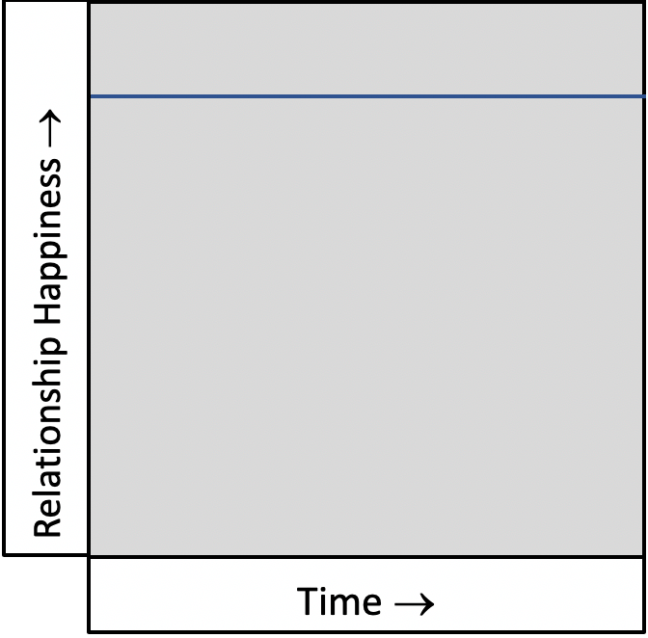
The Idealized Relationship
Snip20190712_14

This is the relationship that Hollywood tells us to expect. We are conditioned to believe that once we find “the one,” the relationship will be easy and happiness will be guaranteed and omnipresent.


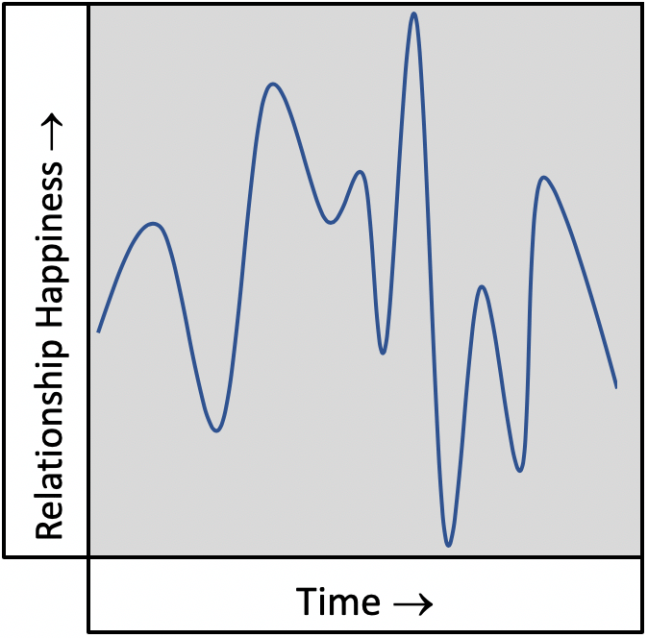
The Volatile Relationship
Snip20190712_10

This pattern can be addictive because when it’s good, it’s REALLY good. On the other hand, when it’s bad, it’s horrid. The highs keep you in it and hope that it will smooth out keeps you from leaving.

The What Goes Up Must Come Down Relationship

Snip20190712_17.png


This is the relationship that is on fire in the beginning and then settles down into a more sedate happiness and contentment over time. It’s far from bad, but the partners may find themselves craving the intensity of the beginning.


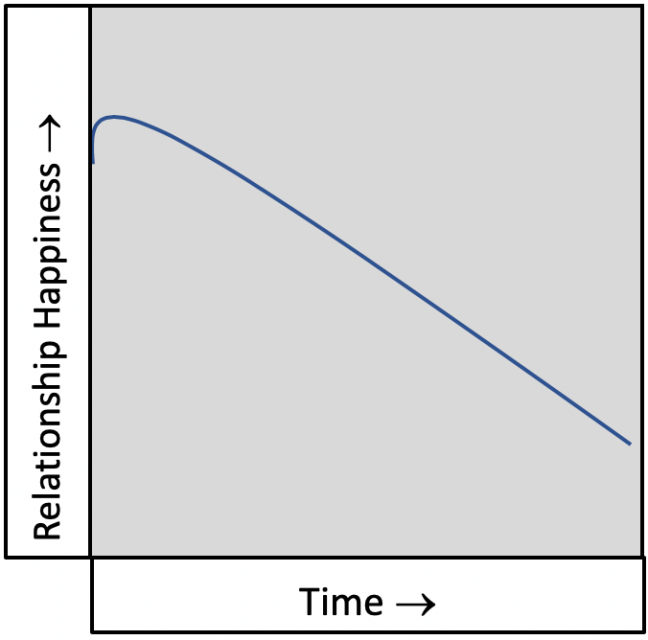
The Slowly Declining Relationship
Snip20190712_11

It WAS good, but it seems to be trending further and further away from that place. The connection is waning and you may feel like you love them, but you’re no longer “in love” with them.

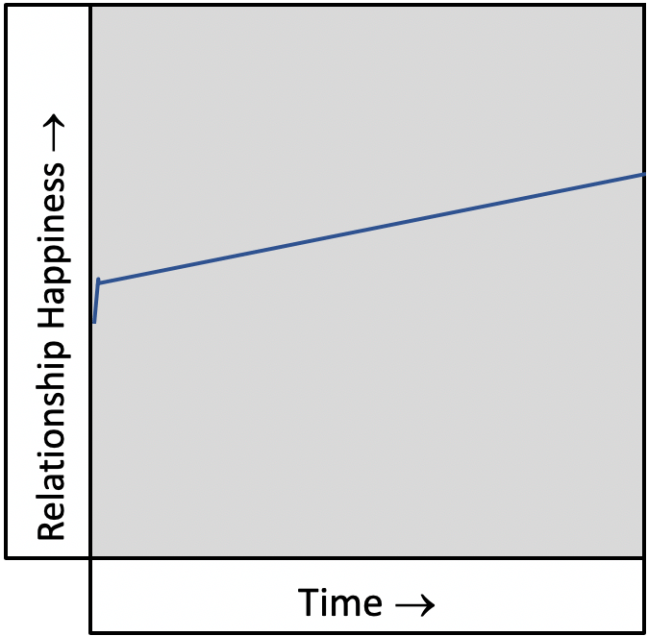
The Gradually Improving Relationship
Snip20190712_12

This is the relationship between two people that are growing together. Over time, they have learned to temper their expectations and to accept the other as they are.


The Devil You Know Relationship

Snip20190712_15

It’s not good, but for now, it’s better than being alone. Strangely, the consistency of this relationship can be comforting; you know exactly what to expect.

The Life is a Highway Relationship

Snip20190712_13

This is different from the volatile pattern because the ups and downs are less extreme and balance each other out. This is the marriage that is happy overall with some good days and some not-so-good ones.

Thought Patterns

The way we pattern our thoughts has an enormous impact on our mental health and happiness. Thought patterns can be divided into two main categories. I’m going to call these recursive and input-output. A note to those who are math-phobic: I am going to use some math concepts to explain these thinking patterns. Stay with me; I promise I’ll make it simple:)

Recursive Thinking

In math, we can look at functions (think of these like a rule or pattern) recursively by only considering the output. The rule ignores the input completely and only considers the starting output and the pattern to get from one term to the next. For example, in the table below, the rule would say, “Start with 12 and add 3 each time.” Recursive rules feed upon themselves, with each output based on the one before. They are like a chain, with each term linked to the one before and the one after.

InputIn recursive thinking, your thought pattern is initiated by something: a memory, a trauma, a comment. Your thoughts then feed upon themselves with no regard for any external input. This type of thinking can lead to depression or anxiety as the brain simply continues the emotionally equivalent of “plus 3” with no end in sight. When you feel stuck emotionally, this is the type of pattern you are experiencing. When your reaction builds well beyond the initial stimulus, you are thinking recursively. When you feel sad or angry or anxious even in the face of calm, you are allowing the chain of thought to continue unbroken.

Input-Output Thinking

An input-output rule in math relates the output to the input. For example, in the (identical) table below, the input-output rule would say, “Multiply the input by 3 and add 9.” The output is dependent upon the input. Change the input, and you alter the output.

In input-output thinking, your reactions are based upon the external stimulus rather than your previous thoughts. You may be sad, but the emotion and associated thought patterns are due to your situation. You may respond in anger or feel fear but these are due to the inputs you experience. If you change the input, the associated thoughts will change with it.

Recursion is easy, effortless – which is why it is so valuable in computer programming. Its endless loops create the self-similarity needed for programs to run unaltered. Recursive thinking can be beneficial when it is positive in nature, but all too often it is the negative thoughts that pull us into its pattern.

Recursion has a weakness. Since each output is dependent upon the one before, if you break the chain, you break the pattern. If you catch yourself in this cycling thought pattern, find a way to interrupt the flow. Do something differently to break the cycle. Whatever you normally do or say, don’t. Recursion requires a hands-off approach to survive. So get your hands dirty and change it.

Then, consciously shift your thinking to input-output and deliberately choose positive inputs to encourage positive outputs. Surround yourself with nature, connect with friends, do something that feels good. Change the input and your thoughts will follow.

Input

Igniting the Conversation

photo-226

Relationship trauma will do strange things to you. With my ex, I was never timid about initiating a conversation about a potentially difficult topic. I would even wake him up so that we could talk before I went off to work if I didn’t want to carry the burden and fear of the issue all day. Of course, it was easy to “talk” with him about difficult things; he would lay on the affection and soothe me with his words. Yeah, he sure knew how to rock me back to sleep.

Now, post divorce, my communication style has changed. I am more tentative; I tend to hold things in too long, rolling them around in my mind (and often letting them gain steam) before letting them out. Brock’s communication style has contributed to this tendency. He generally starts off by talking at, not with, and then settles into a place where he is receptive and able to listen. I’ve seen this enough to know to ignore the first minute or two, but it doesn’t make it any easier for me to take the plunge.

Enter the talking candles.

After one conversation that I initiated well after I should have, Brock came up with an idea. He pulled two candles – one white and one blue – from the living room and set them on a small table in the dining room.

“These are the talking candles,” he began. “When you need to talk about something, set the white candle on the kitchen island. I’ll do the same with the blue.” He demonstrated this as he talked.

“When we see the other’s candle, we must make that conversation a priority.”

It was brilliant.

We haven’t used the candles much, but they have certainly helped to change the communication dynamics between us for the better. By setting out the candle, it gives the sign that a conversation needs to happen. The other person then has notice and can approach with the right frame of mind. We are less likely to talk while one or both of us is still decompressing from the day and the start-up is much more gentle. I am more willing to be assertive and not as defensive. He is more likely to listen from the beginning and to be more empathetic.

When we are aware of patterns, we can begin to change them. And that is a conversation worth igniting.