8 Reasons Relationships Move Too Fast (And Why You Should Slow It Down)

relationship fast

Are you worried that your relationship is moving too fast?

It’s so easy to get carried away when you first meet somebody you’re attracted to. The oxytocin is flowing, the possibilities seem endless and you’ve yet to learn how annoying they can be on a long car ride. And sometimes that early intensity moves quickly into exclusivity, commitment and even cohabitation well before you even know much about your partner’s inner workings.

The following are 8 common reasons why relationships move too fast:

Fear of Being Alone

I see this fear in ever-increasing numbers in my friends as we all move towards middle age and beyond. It often seems as though it is better to have somebody than nobody, and so a new love interest is quickly catapulted into the role of “life partner.” Some people are aware of being motivated by a fear of being alone, while others are not conscious of the reasons behind their drive to be coupled.

It can be isolating when you’re not in a primary relationship and the fear that you will always be alone can solidify into conviction, prompting a ride on the fast track into partnership. But, as you may have experienced, the wrong relationship can be far, far worse than no relationship and there is no greater loneliness than that of feeling alone in a relationship.

Afraid of Losing “The One”

A belief in a soulmate, a perfect-fit partner, can create a desire to grasp onto someone out of a fear of missing out on “the one.” Maybe you’re afraid if you don’t commit soon, they’ll walk away. Or maybe they even presented you with an ultimatum. Regardless, the belief in a soulmate can create a sense of urgency, much like a one-day-sale at a department store encourages you to pull the trigger on a purchase.

I don’t believe in soulmates. There are many people that can be a good fit for you. And “the one” is part found (similar values, right timing, etc.) and part grown (developing intimacy, communication, history). That second part cannot be rushed. Or if it is, you may find later that the relationship is only partially developed.

Confusing Hormones for Love

There’s a reason the beginning of a relationship is so exciting – you’re literally high. Stoned on oxytocin, your body telling you to bond and bond fast. And it’s easy to listen to that siren song of lust, spending every waking moment you can with your new obsession and running into a relationship.

Oxytocin is powerful. But it’s also blinding. Would make a major life decision while you’re drunk? Because if you’re pledging yourself to another while still under the effects of those early hormones, that’s exactly what you’re doing.

Only Know How to be Committed

This was the one that got me when I started dating. When you have been married or in an exclusive relationship for a long time, it is all you know. And so you may approach dates as though they are a date night with your spouse. Not because you intend to move too quickly, but because commitment is what is known and comfortable.

Like anything, dating takes practice. Refrain from seeing only one person if you’re afraid you’ll slip back into commitment like a pair of fuzzy slippers. Learn to navigate through those early “getting to know you” weeks and months before you think about what comes next.

Continue to read the rest.


Biological Reasons Breakups Suck

I think when it comes to the end of a relationship, our physical and chemical bodies are on the side of our ex.

At least it certainly feels that way as they both seem to do everything in their power to make the bad practically unbearable.

The good thing, as with your ex’s behavior, once you begin to understand why your body is doing what it is doing, it’s a little easier to distance yourself from its tantrums and not take them as gospel.

So take a read and then hopefully find some comfort in the scientific reasons that you’re having trouble after the end of a relationship.

Stupid biology: 7 reasons breakups wreak such emotional havoc

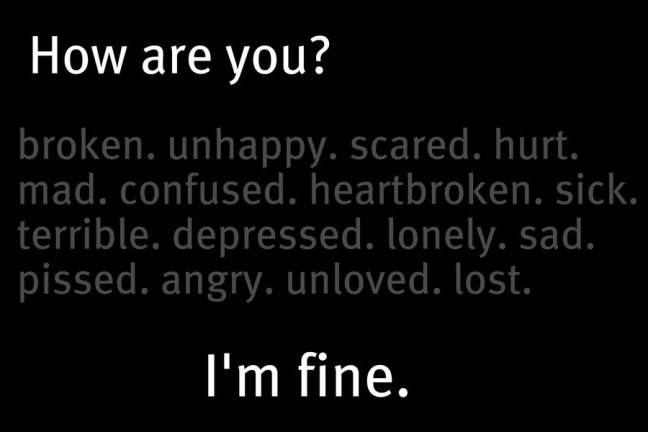
“I’m Fine.” (But What Are You Really?)

I'm fine

“I’m fine.”

How many times have you declared those words?

Hundreds?

Thousands?

Maybe more?

And how many times were those utterances accurate, describing your well-being as exceptional? Thriving? Or, in the more modern use of the term, simply satisfactory?

And how many times were they offered in reflex, in deflection or even as an outright lie?

__________

Here are some of the true feelings that can hide behind “I’m fine.” Do you relate to any of them?

“I’m afraid that if I start talking, I’ll start crying.”

My world is a mess right now and I’m trying to just get through. I may look okay, but I’m really just going through the motions.

“I’m trying very hard to pretend that I’m fine. Please don’t intrude on my delusion.”

If I really paid attention to my intuition, I would probably know that something is not right. But I’m not ready to face it yet so I’m going along with the idea that I’m fine.

“I’m not fine, but I don’t feel safe sharing that with you.”

Things are really hard right now and I wish I could talk about it but I’m afraid that you’ll ridicule me or somehow add to the pain. So I’d rather play it safe and keep my feelings tucked inside.

“I don’t know how I’m doing, to be quite honest with you. I don’t really give it much thought.”

I haven’t allowed myself to slow down enough to be aware of how I’m doing. I stay busy and pretend that as long as I’m doing, I am fine.

“I’m afraid that if I admit to not being fine, you’ll see me as weak.”

I know you see me as the strong one. The one that holds it all together. And I don’t want to be seen as weak or have you think that I can’t be counted on.

“I’m not fine and that’s my problem.”

I don’t want to burden you with my troubles. You have enough on your plate.

“I believe that I should be fine, so I play the part to the world.”

It’s been a long time since the event. I have so much going for me. I have nothing to complain about. I feel guilty for not feeling fine when so many others have it much worse.

“I don’t have the energy to explain my not-fineness to you.”

I’m tired. Defeated. And even just the thought of trying to explain how I feel is exhausting. So I give you the two syllables needed to stop you from probing further.

“I’m frustrated or upset with you, but I don’t want to rock the boat.”

I’m not fine, but I’m afraid that if I tell you how I feel, you’ll be angry or disappointed. And my fear of your reaction is greater than the pain of holding back. For now.

“I was taught that my feelings aren’t valid. So I suppress them.”

My parents taught me that feelings were stupid. I learned that nobody will listen or respect my emotions. So they stay hidden. Even from me.

“I want to be left alone.”

I really just want to crawl into bed and hide under the covers until this fades. Please don’t come in after me.

“I need time to process my feelings and put words to them.”

I want to open up, but I need to do it at my own pace once I wrap my brain around what I’m feeling.

“I need someone who will just listen. Not try to fix things.”

I’m not fine. But I’m also not helpless. I want to be able to share my feelings without you trying to step in and fix everything.

__________

I’m not suggesting that the next time the cashier at the grocery store asks you how you’re doing, you should respond with a truthful unloading of your current worries. Unless you want to be the one they all try to avoid when you walk through the door, that is.

After all, many of our daily interactions are superficial and that’s okay.

But not all of them are.

And when “I’m fine” becomes a habit, a reflex, that we apply to our friends, family, therapists, doctors and even ourselves?

We’re robbing ourselves and our relationships of the vulnerability and connection that comes from the courage to respond with authenticity.

So next time somebody asks how you’re doing, respond consciously.

Here are some words to choose from:

sad  nervous  excited  anxious  lonely  energized  confused  frazzled  aroused  irritated  content  elated  angry  lost  melancholy  fatigued  overwhelmed  engaged  hurt  fabulous  frightened  playful  relieved  embarrassed  awed  vulnerable  relaxed  jealous  unsure  apathetic  curious  grief-stricken  grateful       rough around the edges   better every day      making progress     happy to be here

Or even just fine.

How Do You Know When You’ve Moved On After Divorce?

move on

Some milestones in divorce are clear – the day the decree is final, the day you establish your own home and the day you go on your first date.

But the most important milestone? The one that anyone who has ever been through divorce eagerly awaits?

That one is more subtle.

So how do you know when you have moved on after your divorce?

The Memories Lack Emotional Punch

When I first used to share with others that I had been left by my partner of sixteen years, I felt as though I had come down with some super-bug. My limbs would shake, my temperature would rise and I felt as though my stomach was trying to run away (perhaps to catch my runaway husband).

Over time, these physical symptoms dissipated – the stomach would twinge rather than threaten to expel its contents, the shaking was reduced to a slight tremble in the hands and the internal thermostat was regulated.

And then one day, when I had to tell my story, I realized I had no physical – and no emotional – reaction. It just was. The events had become fact. Not feeling.

When you can remember bits of your past and share your story without feeling like you’ve been punched in the gut, it’s a sign you’ve moved on.

Memories Do Not Have to Equal Suffering

photo-256889_1920

The Divorce Is Not Used As An Excuse

“I can’t afford that.” “I’m not ready for a relationship.” “I’m afraid to open up and be hurt again.”

I said it all.

And as long as I said it (and acted upon it), I was allowing the divorce to hold me back. Decide what I could and couldn’t do.

And that was a clear sign that I hadn’t moved on.

And now?

Yeah, it’s not always easy.

So what?

I’ll be damned if I let it hold me back.

When you can accept that the divorce may have set your floor but that it doesn’t dictate your ceiling, it’s a sign that you’ve moved on.

18 Steps to Financial Independence During and After Divorce

chain-690088_1920

You Can Appreciate the Good In the Marriage

In the beginning, I could not accept any good in my former marriage or my former husband. I had to make it all-bad so that I could make it all-okay. Because when an unwanted divorce arrives on your doorstep, the best way to accept it is to pretend that you wanted it.

In time, good memories starting sneaking in through the cracks in my hastily-built wall. I remembered the goofy, gangly kid that I fell in love with, the unsure but determined young man that accepted a move across the country and a chance at a real career and the confident (seeming, at least) guy that accepted accolades in his work. The moments we shared started to bubble up to the surface and with them, smiles.

The beginning and the middle became separate from the end. And I grew to appreciate what was good without either overanalyzing it looking for cracks or following the tracks to its demise.

When you can treasure what was good in your marriage without dwelling on why it is gone, it is a sign that you have moved on.

Finding Happiness After an Unwanted Divorce

camera-820414_1920


Continue to read the rest.

What to Expect In Your Teenager When You’re Divorcing

teenager

I had someone ask me earlier if I had any resources on kids during divorce. My first reaction was to say that, although I’m a child of divorce, I don’t really have any experience as the adult in that situation.

But then I asked what grade the kid in question was in.

And once I received the answer of 8th, I realized that I do have some insight. Even though they’re not my kids and it’s not my divorce impacting them, I have 15 years of witnessing the ways that teenagers deal with their parents’ divorce.

It is so difficult to tease out any acting out caused by the divorce from normal teenage behaviors. Well, as normal as they can be when their prefrontal cortex is not completely formed.

Teenagers are not in their right minds. Literally.

But I do see patterns of behavior that often signal that a divorce has occurred or is in process. Many of these patterns are more common in one gender than the other, although the gender lines are by no means firm. In some ways, divorce can amplify the normal teenage behaviors and other times it completely alters them.

The behaviors are usually the most extreme when the parents are in the middle of the legal process (especially if the kid is being used as bait) but can also appear well after a divorce that occurred in elementary, where the child seemed fine at the time. They can be brief and mild or longer lasting and more severe.

Here are the top behaviors I see in teenagers having trouble trying to process divorce:

The boys are…

Oppositional

The boys can get angry. Very angry. Sometimes it’s directed at a particular person (especially if they see one parent as being at fault), but often it is scattered and nondiscriminatory. They get into fights. They challenge authority at school. Often, when I am able to get them to open up, they are feeling pressure to be the “man of the house” and are trying to toughen up before their time.

These kids need a safe outlet for their anger (martial arts comes to mind), a safe place to be vulnerable, consequences for their misbehavior and reassurance that they are still kids and not responsible for the household.

Withdrawal

Instead of acting out, some boys draw in. Their hair becomes longer and rarely washed. They seem to curl inside themselves at their desks. Their schoolwork suffers as they fail to complete and turn in assignments. Some turn to cutting or other self-harming behaviors. Many turn to video games as an escape. Sometimes I learn of a diagnosis of depression.

These kids need patience, persistence and intervention. If you’re at all concerned about their mental health, seek help sooner rather than later. And try to engage them in life outside the screen.

Using

I can usually tell which of my students drink or use drugs on a regular basis. And many of those are boys with divorcing parents. Some see it as an escape. Some take advantage of a distracted single parent. Some are trying on adulthood. And some are just lost.

These kids need tough love. And soon. Don’t try to handle this one alone. Call on the professionals, for you and your kid.

The girls are…

Perfectionists

These are the ones that often slip under the radar. They’re pleasant. They perform well in school. You may think you have lucked into the perfect teenager, even after going through the breakup of a family. Yet under the guide of perfection is an overwhelming anxiety; some of these girls are trying to do it all out of a fear that they must be perfect to be lovable and accepted. And at some point, they will burn out.

These kids need consistency, reassurance and a way to build confidence (martial arts comes to mind here as well). Encourage play and discourage excessive time on schoolwork. Refrain from associating value with performance.

Mean

The anger in the girls usually presents differently than the boys. They are more covert. Manipulative, perhaps out of a desire to try to exert control when they feel they have none. Their anger is more pointed, either at classmates or at a parent (or often at a new boyfriend or girlfriend of a parent). They develop this “nobody else will ever hurt me” armor and they attack with their words and actions.

These kids need boundaries and they need to face the natural consequences when they’re crossed. The key to softening the armor is usually a relationship with a trusted, non-parent adult – a teacher, a family member, a counselor, who can help them face the pain under the anger.

Acting Out Sexually

Most teenage girls are boy (or girl) -crazy. But most are doing more talking than anything else. For girls going through a family divorce, especially when the father is absent, some start dating older boys and acting on that talk. They want to know they are pretty, special and desired. And they’ll take it any way they can get it. Some of these girls feel abandoned. Others neglected. And some just feel ignored.

These kids need structure to limit their unsupervised access to technology and a watchful eye on their interactions. They also need attention, so strive to provide the attention in positive areas. Most of all, they need love. They are still kids regardless of what behaviors they’re engaged in.

And all teenagers of divorce are…

All of the kids I see with divorce in their story are working through trust issues; they’re often slow to establish bonds. Most look for attention, some by being the “teacher’s pet” and others by being the “class clown.” They’re often a little more on the extremes of the “needy” to “leave-me-alone” curve.

And they’re teenagers. 100-pound hormonal two-year-olds, as I affectionately call them. They’re still learning who they are, how the world works and figuring out their place in it.

Love on them even when they’re irritable. Uphold the rules no matter how many times they’re broken. Give them support when they need it and let them struggle when they don’t. And see them as they are and help them see who they will become.

And be thankful that they’re not teenagers forever.