Ten Easy Communication Hacks For Your Marriage

Scan any list about the most important elements of a happy marriage and effective communication will be somewhere between “shared values” and “physical intimacy.” Its ubiquitous inclusion is not because relationship writers are lazy. It’s because communication truly is key in any relationship. Especially one where you face each other every day prior to morning coffee, tackle everything from kitchen remodels to retirement plans and expose your greatest vulnerabilities and dreams.

The reason that communication can become a point of contention in a relationship is that while talking is easy,

Listening is hard.

And taking responsibility for our own emotions and responses is harder still.

But that doesn’t mean that everything to do with improving your communication has to be hard. Here are ten easy hacks to start improving the communication in your marriage beginning today:

Use Figurative Language

Feeling misunderstood is extremely frustrating. And it’s easy to get caught up in blaming your partner for refusing to listen. But maybe they’re listening and simply not relating. Not because they don’t want to. But because they don’t have anything to latch on to.

So instead of getting irritated, try getting creative. Reach back in your mental archives and pull up those metaphors and similes from your school days. Instead of explaining what it is, try painting a picture of what it’s like. You’re not trying to replicate every detail or match every trait. You’re just working to establish an anchor point for understanding. You can fill in the gaps later.

Follow the Percent Rule

I am a huge fan of the 80/20 rule – do the “right” thing 80% of the time and cut yourself some slack the other 20% of the time. Although this is most often applied to nutrition, it works with communication as well.

Share 80% of the positive thoughts you have about your partner or your relationship. (Yes, it would be nice to aim for 100%, but life, you know? So strive for 80%.) This means every time you admire your partner’s butt as he or she walks away, each time you notice that the garbage has been taken out and whenever you see him or her tackle something with ease, you speak up. Or write a note. Or send a text.

And the 20%? Share only 20% of your negative thoughts. This means you may have to choose them wisely. Don’t waste those words on a gripe about the scattered socks unless that’s really something that you to express and you want addressed. These words should be reserved for problems that can be solved together, not complaints for the sake of grumbling.

Pay Attention to Physical Comfort

One of the worst grades I ever made on a college exam was on a chemistry test that was administered in a frigid room while I sat on a cold, unforgiving metal stool. My body was in such discomfort that my mind wasn’t operating anywhere near its best.

Conversations operate the same way. There’s a hierarchy of needs and a full stomach, a rested body and an acceptable environment come before listening and responding effectively.

So by all means, go to bed angry if you need to. Staying up and staying engaged in the discussion will only backfire.

Ask More Questions

Do you find yourself responding defensively or getting angry after a statement by your partner? The instinct is to respond with a sledgehammer, shutting down that line of discussion completely and utterly.

Instead of smashing the claim (and you partner) into smithereens, try increasing the amount of questions that you’re asking. This strategy has a two-pronged benefit – it helps give you added information to aid in your understanding and it validates to your partner that you’re listening to them.

Use a Candle

Do you or your spouse have trouble initiating difficult or complex conversations? Try this simple idea.

Tell Stories of Your Shared Past

One of the ways that researchers are able to predict divorce in a couple is the relationship origination story that they tell. Happy couple tell happy stories, making light of or brushing over any rough patches on the way to the alter. Do they tell happy stories because they are happy or does the mere retelling of a happy story cultivate additional happiness?

I would wager it goes both ways.

Make a habit of telling favorable tales about your shared relationship history. You’re making deposits in the marital bank and reinforcing your bond.

Write It Out Before Talking It Out

Have you ever uttered, “You make me feel…?” No shame. I’m guilty too. We say that because it’s easy, skimming the surface – you did this, I felt this – instead of digging deeper – you did this, it reminded me of that, and I felt this.

One of the biggest things you owe your spouse is to take responsibility for your own stuff. And that starts by being aware of your stuff. The connections between your present and the luggage you brought with you from your past.

So talk to your journal before you talk to your partner.

Because writing your thoughts is a great way for you to see those connections between what was done and how you feel. Because nobody else can make you feel a certain way.

Engage In a Shared Task

The body tells our minds how to feel. If you clench your fists, you will respond more aggressively in conversation. If you roll your shoulders back, you not only appear more confident, you speak more confidently.

So when you want to communicate to establish a connection, begin with a physical association through a shared activity. This doesn’t need to be complicated – washing the dishes, taking a walk, shopping for groceries all count as joint tasks.

Just another reminder that you’re in this thing together.

Use Texting Wisely

In a marriage, texting should only have two uses: 1) Planning or 2) Play.

Logistics comprise a significant portion of any relationship. And texting is a great way to work out the details of shared lives in real time.

But a marriage that only shares plans isn’t much of a marriage.

And phones are great for sharing more than just reminders and schedules.

Flirt. Seduce. Banter. Joke. Play.

And ban anything negative or complicated from your texting vocabulary. Some things are better addressed in person.

And the number one hack you can utilize to improve your communication?

Release Expectations

So often the reason that a conversation heads south is that we react to what we expect to hear instead of what is said. We construct a response before we even hear our partner out.

In other words, the battle is really within ourselves.

The single most important change you can make in your communication is to approach with curiosity instead of conclusions.

Listen.

And you just might learn something new about your partner.

Or even yourself.

If I Had Known This One Thing, I Would Have Divorced Differently

When I first hired my attorney, I was pursuing a divorce through publication (not that I even knew what that was until I was left with a text message and a husband that then disappeared). At that time, mere days after the tsunami, I had no idea what happened and no evidence other than the empty accounts and maxed-out credit. My only option at that juncture was to seek a “no fault” divorce.

And then I found the email. And discovered the affair. And the bigamy.

I learned where he was and contacted the police to report the dual marriage.

Even though that first email, which indicated that band hired for his wedding had not yet been paid, sent me through a dark tortuous path that seemed to birth more questions than answers, I not regret the search for information. The drive for information was too strong. The need for some sort of understanding was too overwhelming to simply walk away.

I contacted my attorney with the updated information.

And that’s when I made my mistake.

In Georgia, you have two options when it comes to divorce – fault or no fault. In order to file a fault divorce, there has to be some concrete evidence that one person’s actions directly led to the divorce.

And with the copy of his second marriage license in hand, I had that proof.

So when my attorney asked me if I wanted to continue with a no fault divorce or if I wanted to alter my approach, I responded immediately that I wanted to change course.

But I didn’t really understand what that meant.

Here’s what I thought at the time –

No fault makes it sound as though we simply grew apart. As though the divorce was a mutual decision made over time and with both party’s well-being in mind.

No fault excuses him of his (criminal and otherwise) actions and makes me (since I was the one filing) look like the one responsible.

No fault made me physically ill. It made me feel like he could spit on me, ground my heart and my finances into dust, abandon his family and responsibilities and that I publicly acknowledging that all of those things just happened.

That they weren’t really his fault.

And at a time when what I wanted more than anything was for him to acknowledge the destruction and pain he caused, a public absolution (as I saw no fault indicating), caused the smouldering anger to flare.

I believed that the word “fault” directed at the defendant on the top of the pages would alert the judge that he or she was dealing with somebody unscrupulous.

I thought that placing him at fault would earn me the favor of the courts and positively influence any rulings in my direction.

And I hoped that having the finger-pointing at him would make my then-husband feel guilty for what he done. And maybe even prompt him to apologize.

And here is what I learned –

The. Courts. Don’t. Care.

About the reasons for the divorce. About infidelity. About blindsiding. About abandonment. About financial betrayal.

They don’t care.

My attorney was more than happy to switch gears to a fault divorce. Because proving fault takes time.

And therefore money.

And I’m not even sure the judge noticed the fact that there wasn’t a “no” before fault on the paperwork submitted to her that day. She proceeded as though my almost-ex was a rational and rule-following man as she divvied up responsibilities.

I didn’t receive any favors for not being the at-fault party and I certainly didn’t receive any empathy.

And I didn’t feel validated in the slightest my the fact that the records showed that my ex was at fault.

Because he never accepted responsibility.

And that was what I really wanted.

Something that the courts could never provide.

In the end, removing those two letters – n o – from my suit for dissolution of marriage cost me added months of stress and thousands of dollars.

And brought me nothing.

A note about the legal process – I am by no means an expert in the legal proceedings of divorce. In my state and in my situation, the difference between fault and no fault was negligible. This is not always the case. Make sure you take the time to fully research the path you’re taking. And don’t make assumptions that legal terms have anything to do with the real world.

It is so incredibly difficult to separate the emotional separation from the legal, especially when you have not been preparing for divorce. And even though from my current standpoint, I say that I wish I had not filed a fault divorce, I can’t promise that I would have listened to that advice at the time.

Make the best decisions that you can. And then forgive yourself for any mistakes.

Divorce is one of things that you don’t really understand until you’ve been through it. And I don’t think anyone wants to practice it enough to get better at it.

One Event Does Not Define You

It was parent conference week at my school this past week. It’s a week I always look forward to (even while I dread the long hours required). I love getting a chance to talk with the parents after I have been able to see their child’s strengths, weaknesses, celebrations and struggles. Most of the conversations and strategies are pretty run-of-the-mill. Helping middle schoolers learn to prioritize, time-manage and organize is an on-going and ever-present task.

But every year since my first in the classroom, I have had a handful of conferences that are anything but run-of-the-mill. Some of the kids that come through my classroom have been through tragedy. Loss. Trauma. And as the teachers sit around the table and learn the information, the missing assignments suddenly become less important than the missing childhood. The focus shifts from succeeding in school to creating a support system to help the child succeed in living.

Once I learn of the background, there is one talk I always make sure to have with any student that went through too much far too soon.

I call it my “defining speech.” And it goes something like this:

———-

“Make a line through this point,” I ask, drawing a dark mark in the center of a blank white sheet of paper.

point“Where should I make the line?,” some students inquire, while others simply follow my command and draw a line on the paper. The perfectionists make themselves known by insisting upon a ruler.

line

“Is that the only line you can make through that point?” I ask.

“Well, no. I could make a bunch of different lines.” I gesture for them to show me.

linesssI then turn the paper over and draw two points.

pointsss“Make a line through these.”

line2“Is that the only line you can make through these two points?”

I usually get a “Is my teacher crazy?” look at about this point.

“Well, yeah? I mean, two points make a line, right?”

“True. If it’s straight,” I say with a slight smile. “Try connecting them with something that isn’t linear.”

This is where I can tell who is willing to take risks. But they all manage to create some sort of nonlinear path through the two points.

curve“Is that the only curve you can make that can connect these two points?” I continue.

“No. Do you want me to draw more? I mean, there are infinite ways!”

“No, it’s okay. I just want you to see that there are multiple paths to get from one of those points to the next.”

The shoulders relax as the brow rises, wondering about the point of this exercise.

“Almost done. I just have one more for you.”

scatter“Connect ALL of these points any way you want to.” If I do this after our lessons on scatter plots, it drives them crazy not to simply draw a line of best fit 🙂

Once they’ve completed the task, I bring the point home. Yes, pun intended.

“I want you to think of these points as events that happen in life. When you have a single point or event, it does not define your path. There were many routes you could take. When there were two points, there was only one way if you chose to see it that way. If you were more creative, you could find many more. But life doesn’t consist of just one or two events, even though certain ones may stand out more than others. Life is a series of events. And it is your choice how you move through them. Look at how you connected your points here on your last picture. You had to include the outliers, but it didn’t completely change the general shape of the graph.”

“I know you’ve had some stuff in your past that makes you feel like you’re stuck on a predetermined path. But you’re not. You had to walk through that point. That event or series of events. And now you decide what direction you go.”

“One event does not define you. YOU define you by the choices you make and the path you choose.”

Okay, class dismissed 🙂

Back to the Past

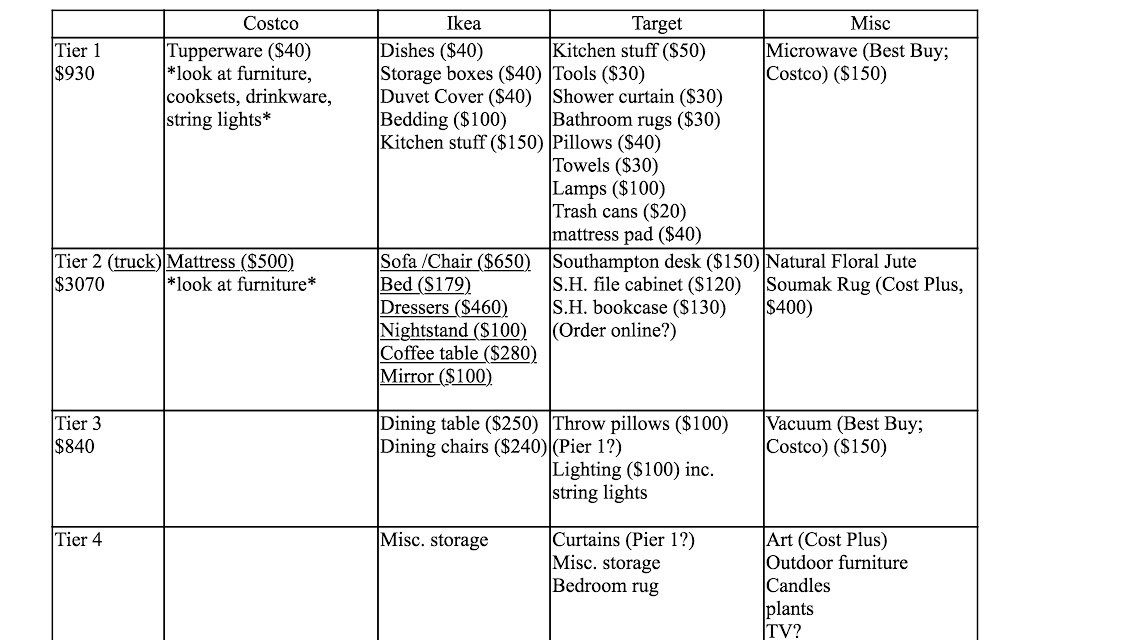
I recently stumbled across this spreadsheet mixed in with a bunch of math files on an old USB drive.

IMG_4405

It’s eye-opening to revisit.

I remember writing this one day, sitting at my desk after work. I had just made the decision to remain in Atlanta for the following school year and give my nascent relationship with Brock a chance.

I was preparing to move out of my friend’s home that had been my sanctuary for a year and into my own place.

My budget was small.

My needs were not.

As you can tell from the spreadsheet (yes, I am a math geek), I had nothing. Not even a towel.

Tier 1 were small and could be purchased early. I bought them about two weeks before moving and stashed them in Brock’s garage. I think he was a little nervous that I was moving in and staking my territory. I wasn’t – it was way too soon for that. I was just being efficient.

Tier 2 was the doozy – items that were still critical (more on the rug later), but also big-ticket. Brock gave me his extra mattress, giving me some breathing room (along with some of the tier 1 items that came as gifts from a housewarming- lifewarming?-party a friend had for me). My debit card was turned down at IKEA because the purchase amount was over my daily limit (what the what is that about???). My credit union was closed on Sunday, so we had to do an elaborate dance of the funds where my dad paid via credit card on the phone and I sent him a check the next day.

The rug stands out. It was pricey and not officially needed.

But it was a seed.

And therefore, important.

Many of the tier 3 and 4 items (lower on the priority list) were never purchased. And that’s okay.

This spreadsheet was part plan.

And part dream.

A ladder from where I was.

To where I wanted to be.

And that same IKEA sofa now sits in our living room, now covered in a more Brock and Tiger-friendly grey slipcover instead of the original white.

And underneath that sofa?

That floral jute rug.

In full bloom now.

Gentrification of a Marriage

I’ve been in Atlanta over fifteen years now and in that time, I’ve seen some neighborhoods slide into disrepair and I’ve watched others climb back from near-ruin. It’s fascinating to observe how an area can go from “No way would I ever live there” to “I wish I could afford to live there!” in under a decade.

And this cycle of new hope, establishment, inattention and renewal is not unique to neighborhoods and it effects more than real estate.

We can also witness it in marriages.

A new marriage is like the construction of a new neighborhood. It is full of promise, even as it is devoid of roots and rituals. Everything can seem perfect as no veneer has yet been worn away from use. New friends are made and a different schedule and routine is worked through. Dreams are shared freely and rarely tempered with reality. This is a period of excitement and possibility.

In a relatively short period of time, the new family transitions into a period of establishment and growth. This may be marked by the raising or children or the focus on nurturing careers. Money, time and attention are directed towards the family. The surroundings and environment are personalized to match the needs as the default template of the new marital construction is discarded. This is a period of creation and purpose.

And now is when the problems can begin to occur. The surroundings may begin to feel stale and too constricting. The small issues can grow into larger ones until they crowd out the good. Life gets in the way and places extra demands. Attention and care may no longer directed towards the family and this inattention starves the marriage. This is a period of uncertainty and fear.

In real estate, this is when some people choose to leave the older neighborhood and look for a newer and fresher home elsewhere. Others stay put and still refrain from putting money into their homes, continuing their disrepair. And some stay and invest in their homes, reinventing their existing space.

It’s the same in marriage. You have three choices.

And if you choose to stay and infuse your established relationship with new vitality, take a cue from gentrification:

Much like the early investors and artists that venture into a neighborhood that has seen better days, you have to be willing to take risks and think creatively.

Instead of tearing down everything, look at the underlying structure to see what can be preserved and enhanced.

Be willing to re-purpose. Just because it’s always been that way, doesn’t mean it always has to be that way.

Do those things you have always wanted to do but always put off.  Put those early dreams into action.

Freshen up. Make you and your space inviting and warm.

Know your limitations. Hire help when needed.

Be empathetic and thoughtful when making changes that impact others.

Balance expectations with reality, wants with needs and frustration with thankfulness.

Make your relationship your hub. Your city center. Surround it with what you need.

Talk up your marriage as if it is the most desirable place to be.

Sell it.

And then buy it.

This is a period of renewal.

Hopes and dreams rooted in connection and history.

Best of the old and the new.