The Value of Therapy

value of therapy

“What is the value of therapy?” the email continues, after the writer has detailed her struggles moving through divorce.

Another message contains the statement, “I’ve been in therapy for years and I’m wondering if it’s working.”

“How do I know if therapy is for me?” implores a man who has been blindsided by his wife’s infidelity.


What is the value of therapy?


People generally turn to therapy when they are struggling with negative emotions or having trouble processing something in their past or present.  Therapy can serve different purposes depending upon the needs of the person and the specialization of the therapist.

In general, therapy can assume one or more of these roles:


Highlighter

It’s hard to see the forest for the trees. Therapists can offer valuable perspective and insight when we’re all-too-easily distracted by the details cluttering up our lives. A skilled therapist can listen to twenty minutes of unloading about a difficult situation and can sum up the core issue(s) in a couple of sentences. Then, once the challenges have been highlighted, you are better able to focus your energy in the areas where you can best effect change.


Skill Developer

Many therapies are designed to give people access to a variety of tools that they can then apply on their own in order to improve relationships or personal well-being. A therapist will identify your needs and work with you to develop and practice a variety of coping strategies. As part of this process, you will also learn to recognize the precursors that indicate a need for a particular strategy.


Neutral Third Party

Relationships are by definition, emotional. As a result, it can be difficult to work through certain situations within the context of a relationship. The stakes are simply too high to avoid either withdrawal in an attempt to avoid vulnerability or becoming too intense and prompting flooding in the other person. A therapy session offers a safe space and an uninvested third party to work through issues or to practice better communication.


Interpretor

What we’re feeling isn’t always an indication of how we feel. As an example, fear often manifests within one or more of these fifteen disguises. Therapists are trained to recognize the emotion behind the presentation. They are adept at naming and describing what you’re feeling. And naming it is often he first step to regaining control over it.


Guide

Therapists often act as trail guides. This may be unfamiliar terrain for you, but they have been down this path many times and are familiar with the hazards and the milestones. They will help to prepare you for the upcoming climbs, cheer you on when you become frustrated and will ensure that you don’t stray too far off the path.


Affirmer

If you are currently in or were raised in an environment that is abusive or rife with criticism, your therapist can be a vital source of affirmation and acceptance. When you’re feeling cut down, beat down or judges by those around you, therapy can help you see the good within yourself.


Why might therapy be ineffective?


One of the critical factors that makes it difficult to assess the value of therapy is that the results are highly subjective: Do you feel better? Has your functioning improved? Are you having more good moments and fewer bad ones?

And sometimes the answer to those questions is, “No.” The following are some of the reasons that therapy may be ineffective:


You waited too long.

You can’t ignore signs of cancer for months and then expect a doctor to immediately cure your stage 4 malignancy. In the same manner, if you have ignored mental health issues for years, there may be limits to what therapy can accomplish. That doesn’t mean that it’s useless, but early intervention often favors better results.


You have unrealistic expectations.

No matter how skilled the therapist, they cannot undo the damage caused by a parent’s abandonment. They don’t possess magic wands that can immediately make everything better. If you show up to marriage counseling and you’re spouse has already given up, the therapist can’t force them to change their minds. If your expectations are unrealistic, you will never achieve your goals, therapy or not.


You’re seeing the wrong therapist or using the wrong technique for you.

You wouldn’t go to a grill master to learn how to improve your baking, so why go to a therapist who specializes in psychodynamic therapy to learn strategies for dealing with the daily symptoms of anxiety? Before you enter therapy, make sure you know what you’re looking for and that you can communicate those goals to someone who can help you navigate your options.


You’re being defensive.

If you’re always looking to defend yourself and/or prove your therapist wrong, you will get nowhere. It’s important to recognize that your therapist is there to help you. And part of that help is challenging your assumptions and ways of interacting. You’re there because you want change and the first step of any transformation is admitting that you can do things differently.


You’re not applying the tools.

If the only practice you’re getting with the strategies and skills your therapist is teaching you in in their office, you’re undermining yourself. Changing habits and patterns takes practice. Lots of practice. If you don’t implement what they’re teaching you, your investment is pretty useless.


You’re failing to address the underlying issues.

Childhood traumas often present themselves throughout life until we have addressed the initial problem. If you present the current situation to your therapist but neglect to delve into the childhood traumas that primed the pump for your present struggles, your work will have limited success. You have to identify and neutralize the cause.


You’re not being honest or transparent.

Your therapist can only work with the material that you give them. If you’re hiding, you are not allowing them to help you. It’s natural to feel ashamed or embarrassed about certain things; however, a therapist’s job is to listen without passing undo judgment. Trust me, they’ve probably heard worse than what you’re holding back. Ultimately, they cannot help you shine light on your problems if you refuse to open the door.


Your therapist is retaining the power.

Like with parenting, the role of a therapist is to ultimately put themselves out of a job. Unfortunately, there are therapists out there that like being needed and so they want to ensure that you remain dependent upon them. If you sense that this is your therapists, please look for someone new.


Is therapy for you?


If you identify with any of the following, therapy may be a good option for you:


You’re having suicidal thoughts.

You are having trouble with basic life functions.

Your feelings – sadness, anxiety, anger, etc. – seem overwhelming and difficult to control.

You’re struggling to communicate with somebody in your life.

What you’re trying isn’t working.

You know there’s a problem, but you can’t seem to identify it.

You need a “jump start” to get you on the right track.

You’re feeling isolated and as though you don’t have a strong support system.

You want to increase the tools that you have to deal with life’s challenges.

You’re feeling “stuck” or you are fixated on something in your past.

You want some support and guidance to navigate a life transition (marriage, divorce, death, childbirth, retirement, etc.).

You’re looking for a professional’s opinion on something in your life.


Ultimately, therapy is a tool. It can be a valuable opportunity for you to make critical and vital changes to your life or your mindset. Yet, as with any tool, it’s only valuable if it’s the right one for the job and you use it effectively and in a timely manner.


PTSD After Divorce

PTSD divorce

Can you develop PTSD after divorce?

When my husband left, I trembled for a year. That’s not just some figurative language used to convey emotion; I literally shook. For a year. My body quaked from the aftershocks of the sudden trauma, my legs constantly kicking and my hands quivering. Those weren’t my only symptoms, either. I had flashbacks and nightmares that took me back to the to the day where I received the text that ended my marriage. The 21-word incoming message read: “I am sorry to be such a coward leaving you this way but I am leaving you and leaving the state.” From then on, the sound of an incoming message would actually send me to the floor, where I braced myself for another digital attack. I felt numb and had trouble remembering aspects of my marriage or my husband. I avoided sights and sounds that were associated with my marriage, often driving well out of my way to steer clear of my old neighborhood. I couldn’t sleep; I was hyper alert, always scanning every room and ready to fight or flee at any moment. I could not eat and my weight fell to dangerous levels.

As far as I know, my life was never in actual danger. But apparently my mind and body never received that message. In an instant, the person I trusted the most became someone whom I feared. I felt threatened and unsafe.

I didn’t know what was real and who to trust.

My husband never forced himself upon me, but I felt as though I had been violated when I learned I had been sleeping with the enemy. He never physically hit me, but the psychological blows left scars just the same. I’ve never been to war, yet every interaction with his lawyer was a battle that left me paralyzed with fear for my ability to survive.

I by no means intend to trivialize the horrors endured by those who have been the victims of abuse or those have been through war. Those are traumas on a scale well above what I have endured. What I have come to realize, however, is that trauma can come in many forms and in many degrees. The psychiatrist I saw that first year after my divorce stopped short of diagnosing me with Post Traumatic Stress Disorder (PTSD), but the term came up as I described my symptoms, and the medications she prescribed are frequently used in the treatment of PTSD. Another therapist I saw also mentioned the disorder and used complimentary strategies.

PTSD happens when your mind cannot process the extent of the trauma.

It’s like a short circuit in your nervous system, where you have trouble distinguishing between real and perceived threats. We tend to think of PTSD as occurring only in life-threatening situations, but it can occur anytime there is an acute or prolonged trauma. Not all divorces lead to PTSD, but if it is sudden or abusive, the trauma can be severe and sudden enough to lead to PTSD-like symptoms.

According to The National Institute of Mental Health, PTSD includes flashbacks, bad dreams, staying away from triggers, feeling emotionally numb, feeling guilty, having trouble with memory, being easily startled, feeling tense and angry. Additionally, the diagnosis of PTSD requires that the symptoms persist beyond 30 days and that they interfere with daily life. There is a difference between normal grief, shock and anxiety and the pathology of PTSD.

PTSD occurs when a perfect storm of conditions are met. First, prior traumas can “prime” someone for PTSD as the stress can actually cause epigenetic changes, rewiring the body to be extra sensitive to further trauma. Women are also more likely to experience PTSD, possibly due to heightened fear conditioning. PTSD is also more likely to occur when traumas accumulate. When someone who has some of these risk factors undergoes a divorce, particularly one that is sudden or especially toxic, PTSD-like symptoms can occur. Sudden abandonment or attack by a loved one can trigger panic and disorientation as real as any physical threat.

The trauma is stored in the body as well as the mind.

During my divorce, I learned that most people assumed that depression would be the disorder de jour after a break up. They expected me to be sad and withdrawn, curled up on my bed with a box of tissues and endless pints of ice cream. Instead, I was hyper vigilant and always on the lookout for the next blow. It’s important to realize that all divorces are not the same and we all respond differently. There is no “right” way to be after a divorce. I was embarrassed for a time to reveal the true nature of my symptoms. I felt like I wasn’t permitted to feel that way since I didn’t have a knife to my throat. I felt ashamed that I couldn’t cope with the basics of eating and sleeping. I felt weak every time I over-reacted to a stimulus. Once I admitted my struggles, I was able to actively seek help to overcome them. I also learned that I was not alone in my reaction to the divorce.

There is help for those who are experiencing PTSD-like symptoms after a divorce. First, communicate your symptoms to your doctor or therapist. A checklist can be a useful tool, especially if you are having trouble putting words to your feelings. Be firm. I found that some therapists and doctors didn’t really listen to me, rather they projected how they thought I should be feeling. Different therapies, including EMDR, have been shown to be effective against PTSD. There are medications that can be useful to limit the anxiety and to calm the mind and body. Additionally, mindfulness practices, including yoga and meditation, can also help to reset the sympathetic nervous system and regulate the release of stress hormones.

Allow the body to teach the mind how to relax.

In my case, medication helped me survive the first year while a combination of mindfulness training, yoga and exercise has alleviated most of the symptoms permanently. I still have moments of unexplained panic where a slight trigger causes an extreme reaction, but those moments are thankfully few and far between. I no longer feel like I’m a prisoner to my anxieties, trapped in a purgatory where I’m forced to relive those awful moments time and time again. I am now able to visit those memories without panic and live my life without waiting for the next blow.

I never formally acquired the label of PTSD, but it served to be a valuable framework for me to understand and communicate my symptoms and to eventually overcome them. Labels, such as PTSD, can be helpful as we try to understand a complex situation, but even they only tell part of the story. Be gentle and understanding with yourself and others. Don’t be quick to judge or make assumptions. Don’t be ashamed to ask for assistance and admit when you cannot do it alone. Seek the help you need and know that it does get better.


A review of Lessons From the End of a Marriage, the book that details my experience:

Lisa Arends does an effective job in writing about the aftermath, the fallout, of a life-changing shock, on the abrupt desolation of her marriage. The read is a well done walk through all the PTSD and repeating changes that occur, which is depicted in a letter written to her by her exited husband, the commentary on the letter under the umbrella of the devastating changes she experienced, emotionally, physically and logistically are a walk through the fact that PTSD is not just relegated to victims of war, but to any life encounter that uproots your very existence in a shocking manner. She’s a likeable author, an engaging woman, that you take to and feel for, because she portrays the story, the horror she lived, with veracity and integrity, to allow the facts to unfold on the page even if they point a finger back to her (ie: a text from her spouse to his mother-in-law, Lisa’s mother). Devastation upon devastation unravels and what we hold onto dearly is lost, not just in the relationship but also in the family built around it, fury and otherwise. Arends navigates through this debacle with grace and humility, filled with emotions that are painted with strokes that are sure to offer others in similar situations some reflections and ground; she labels as “Lessons” chapter after chapter, ultimately culminating in what she has learned, valuable life lessons, applicable to anyone. But, this is not just a self-help work, or a read for someone in a similar situation, it’s a compelling story of the frailty and misconceptions we all live with, the thin line of trust & betrayal, confidence and fright, love and rejection, all the things that make the paradoxes of life and keep a balance, hopefully the balance stays in some semblance of equilibrium. In Arends case she tilts off the scale and by the Grace of her very nature, the love of her family, and whatever else strength she draws from she journeys through to meet what is most precious to all of us, connecting and opening to trust (applause to Tiger, no spoilers) despite all temptations not to, and in doing so, learning the ultimate, that love does conquer and cannot be soiled by another’s shadow cast upon our soul.

In the book, I never name PTSD. I only describe the events and my reactions. Yet, here was a third party who deemed that to be an accurate label.


According to the Mayo Clinic, the following are the symptoms of PTSD:

Symptoms of intrusive memories may include:

  • Flashbacks, or reliving the traumatic event for minutes or even days at a time
  • Upsetting dreams about the traumatic event

Symptoms of avoidance and emotional numbing may include:

  • Trying to avoid thinking or talking about the traumatic event
  • Feeling emotionally numb
  • Avoiding activities you once enjoyed
  • Hopelessness about the future
  • Memory problems
  • Trouble concentrating
  • Difficulty maintaining close relationships

Symptoms of anxiety and increased emotional arousal may include:

  • Irritability or anger
  • Overwhelming guilt or shame
  • Self-destructive behavior, such as drinking too much
  • Trouble sleeping
  • Being easily startled or frightened
  • Hearing or seeing things that aren’t there

From Mayoclinic.com.

After I received the text that ended my marriage, I experienced many of these symptoms. I had the flashbacks and the dreams. I had trouble thinking and remembering. I couldn’t sleep and I frightened easily. But, most of all I trembled constantly, my autonomic nervous system was on high alert, waiting for the next assault.

At first, the triggers were everywhere. Driving along the road that passed by my old house felt like traversing a field with buried landmines. I fully expected an explosion at any moment. I responded as though every mention of his name was literally a threat to my life. At any moment, I could be catapulted back to instant where I received the text. It was as though the phone was always in my hand.

My psychiatrist that I saw that first year stopped short of a full PTSD diagnosis, but she mentioned the disorder and selected medications that are used to treat it. I honestly don’t think I would have made it through without the medications. They allowed me to sleep and eat – two things I could not yet accomplish on my own.

Over time, the triggers decreased. I learned how to sleep and eat without assistance. I stopped the medications and was able to use meditation and exercise to reduce any symptoms. I can still feel the shadows of the trauma when I feel like I’m being abandoned again but, for the most part, my mind and body no longer confuse real and perceived threats.

Ten Metaphors for Divorce

divorce metaphors

Which metaphor best describes your divorce?


1 – The Too-Small House

It seems perfect. The spaces seem custom-built to accommodate your needs and it immediately feels like a home. Over time, as the family grows and the demands on the home increase, those walls that once felt comforting begin to feel like a prison. The house is simply too small.

Sometimes people outgrow relationships. The person that once fit nicely into their lives is now a source of frustration. Support has turned into constriction and the need to fully expand becomes too great to ignore.


fashion-1283863__480

2 – The Unraveling of the Favorite Sweater

At first, it is coveted, although a little unfamiliar. It still holds the creases of the hanger and the pigment is true and bright. Over time, it begins to mold to your body. Soften. It is a familiar hug, a safe place to return. The initial damage seems slight, inconsequential. It’s only a loose thread. Yet that single thread is what holds the sweater together.

Marriages can mirror this same pathway, moving from shiny and new to familiar and then to worn and damaged. There is a both bittersweet memory of the original shape and a discontentment with the current status.


3 – The Sudden Allergy

It comes on quickly, a shock to all present. What was perfectly acceptable and even enjoyed has now become a source of illness. The underlying cause of the dramatic change is difficult to pinpoint. But the result is the same. These two entities can simply no longer coexist.

In relationships, this sudden allergy may be due to some environmental shift or it can also arise from unidentified underlying issues. The abrupt shift will come as a surprise and it may take some time to accept the needed alterations. Yet, until this essential incompatibility is addressed, the maladaptive reactions will continue to occur.


4 – A Graduation

At some point, the student no longer needs the teacher. Graduation brings about complex emotions. It is the remembrance of all the lessons learned and the shared struggles and triumphs in the classroom. There is celebration born from completion and also fear of the upcoming unknown and a concern about being ready to tackle the challenges ahead.

Some marriages end because the lessons have been learned. It becomes time to close one chapter in order to begin the next where the lessons can now be applied in a new situation. These are bittersweet endings as the shared journey is remembered and honored even as the natural end is acknowledged.


apple-2391__480

5 – The Rotten Apple

It seems so tempting. Its taut and shiny skin unblemished under the artificial lights of the store. It promises sweet, crispy sustenance just beneath the surface. With joyous anticipation, you bite down. Only to discover that the flesh beneath the skin is black and rotten.

These are the marriages entered into with the narcissist or other personality that likes to hide behind shiny promises. It seems too good to be true. And eventually, you discover that it is.


6 – A Remodel

At one point, the decor was perfect for you. It matched your aesthetic and your lifestyle. But then your tastes changed, slowly at first. You began small, replacing some artwork and maybe freshening up the throw pillows. Over time, you start to realize that the changes have a domino effect and that the entire space needs an overhaul.

We all change over time and through experiences. Sometimes we find that these small changes have a compounding effect and that a relationship that once fit in nicely no longer matches anything else.


7 – Vision Correction

The lens clicks into place and suddenly the eye chart, once nothing but a muddy blur, comes into sharp focus. You see it all and for once, you see it clearly. You no longer have to guess at the truth behind the fuzzy images.

Sometimes we have trouble truly seeing the person right in front of us. And when our vision is blurry, we fill in the details with expectations and assumptions, often born from past experiences. It can be quite surprising when your vision is suddenly corrected and you see the person as they are. Especially when you realize that the reality is far from what you imagined.


8 – The Training Wheels

We fix training wheels to children’s bicycles not because of any physical need, but to address their need for a sense of security and safety. Likewise, their removal is due more to an increase in confidence than in a change in ability.

Sometimes relationships are the preferred training wheels of adults. These are partnerships often entered into young, before the individuals have developed confidence in themselves to be able to operate alone. Then, as one or both spouses begin to replace their self-doubt with more assurance, they may discover that the training wheels are no longer needed and that they would prefer to ride unencumbered.


9 – A Malignancy

It has to come out. The tumor is a source of poison, restricting life-force and threatening your very survival. It will be painful. Brutal, even, as there is a certain about of healthy tissue that must be removed as well in order to assure that all of the diseased material is removed. Yet even with the trauma, the removal brings a sense of hope.

These are the abusive marriages. The abuser inhabits their victim, slowly programming the cells to behave as they dictate. As with a tumor, the removal must be swift and it will be painful. And there may be some residual scars left behind.


10 – The Tsunami

There is no sign of impending disaster. The skies are blue, the water clear. And then, without warning, the placid ocean becomes a voracious beast, swallowing what seems to be the entire world. Leaving behind nothing but destruction and emptiness.

Some marriages end with the suddenness and force of a tsunami. Often, the one leaving has been silently gathering up resources and making plans. And once they act, they disappear without concern for what was left in their wake.

Benefits of Traveling Outside Your Comfort Zone

comfort zone

images-33

I had two choices for my morning run today – the relative comfort of a treadmill in my dry and air-conditioned gym or the muddy trails of a nearby park in the rain and oppressive mugginess that blankets the east coast in the warm months.

I debated for a few moments, considered how miserable I would likely be on an outdoor run as I struggled to breathe in air that was more water than oxygen and how tempting it was to remain in the manufactured comfort of air-conditioned space.

After swallowing the last of my coffee, I went downstairs and selected my trail-running shoes, opting for the less comfortable option. At the beginning of the trail, I questioned my choice. The sweat was already soaking through my shirt, my lungs were threatening to wheeze and a strange guy on the relatively empty trail caused me to grip the mace I carry just a little tighter.

But then after the first mile, I began to find my stride. The moisture in the air became less noticeable, my breathing began to acclimate and the weird guy stayed weird, but also stayed back. And by the time I made it back to my car, looking like I had just completed a mud run complete with a culminating dunk in a body of water, I was happy that I chose the less comfortable route.

images-36


Which are you more likely to regret – the step that takes you out of your comfort zone or the inaction that keeps you there?


We all like to be comfortable. All of us fear the unknown and to some extent, shudder at the thought of potential failure. We shy away from experiencing any sensation that could be labeled as unpleasant. All of us have become experts at crafting and disseminating excuses that give us permission to maintain the status quo, telling ourselves stories to justify our inaction and our conclusions.

images-34

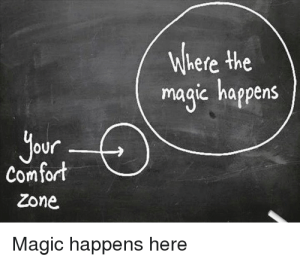
Life – real life – happens outside your comfort zone.


When we take steps outside our comfort zone, we are granted permission to fail.

Once you’ve been labeled “good” at something, you are expected to perform at a certain level every single time. In contrast, when something is brand new to you, any failure is somehow less personal and more situational. That makes it much easier to face.


When we take steps outside our comfort zone, we are allowed to be unsure.

I don’t know about you, but I always feel pressure to appear confident about my decisions and my actions. I feel like this is one of the great lies of adulting. When we were little, we assumed that adults knew what they were doing. Only now, we’re the grown ones and we’re just faking it. When you’re doing something new, you’re allowed to reveal that insecurity.


images-32

When we take steps outside our comfort zone, small achievements are recognized and celebrated.

When you were a baby, your every “first” was marked and even memorialized. That recognition of small successes often fades as we age. When you’re outside your comfort zone, you are far more aware of those “firsts” and mark them of signs of growth.


When we take steps outside our comfort zone, we have fewer expectations from ourselves or from others.

Expectations can be powerful limiters. Just look at those studies where teachers of completely average classes were either told that their children were brilliant or behind. The children performed not based on their ability, but according to their teacher’s expectations. And in our day-to-day lives, we are just as likely to limit ourselves with claims of, “I can’t.” When we take that step outside of our comfort zone, we are instead asking, “But what if I can…?”

our-comfort-zone-where-the-magic-happens-magic-happens-here-18784279


When we take steps outside our comfort zone, assumptions – and beliefs – are challenged and often adjusted.

WE often reach conclusions based on what we experience. So the more limited your experiences, the less-informed and potentially more biased your assumptions will be. When we meet new people and experience new ways of seeing the world, we are forced to re-examine and maybe even readjust our beliefs.


When we take steps outside our comfort zone, learning combats frustration born of stagnation.

Humans get bored. Just watch a modern queue and take notice of how many people are engaged in their phones to avoid a few minutes of idle and purposeless time. The same thing happens on a larger scale. We thrive on novelty, on challenge. When there is nothing left to learn, we become stagnant and then frustrated. The space outside a comfort zone offers unlimited opportunities for learning.

images-35


When we take steps outside our comfort zone, curiosity dominates and inspires wonder.

Have you ever watched a kid in a new environment? A place that is known to you suddenly becomes alive with possibility when seen through their eyes. Our brains have literally evolved to disregard that which is too ordinary. And when your life is spent entirely within a comfort zone, you risk having your brain ignore it all. Newness encourages our brains to wake up and pay attention, bringing with it a childish sense of exploration and wonder.


When we take steps outside our comfort zone, we allow space for authenticity and purpose.

We all-too-often become our labels – mother, father, caretaker, employee, etc. We forget who we really are and what really inspires us and drives us. When we leave our comfort zone, we often discard those labels for a period of time, allowing us the the opportunity to discover what is really important to us.


images-37


Common Challenges in Post-Divorce Relationships

relationships dating divorce

Post-divorce relationships are often where the fears of experiencing heartbreak again collide with the hope and heady infatuation of early attachment. These opposing emotional forces, along with any lingering unresolved divorce issues, present certain common challenges in relationships entered into after one or both parties experienced divorce.


You meet the right person at the wrong time.

Finding a good match is as much about the timing as it is the person. You may encounter somebody who radiates potential, but if either one of you is not yet ready for a relationship, that potential has to be put on hold. It can be tempting to try to push it; to discount the warning signs that there is still healing work to be done. It’s scary and disheartening to release the possibility of a connection when you have been feeling alone and afraid of finding somebody. Yet sometimes, accepting that the timing isn’t right is exactly what is needed so that you’re not pouring energy into a relationship that is built on unstable ground.


You carry over blame or suspicion meant for your ex to your new partner.

If your ex behaved badly, you may be primed to assume that your new partner is also up to something whenever your back is turned. Instead of coming from a place of innocent until proven guilty, you may be operating from a place of assumed guilt where you’re looking for evidence to support your beliefs. This is easy to do. If you’ve been fooled once by a liar or a cheater, you don’t want to ever experience that humiliation and betrayal again. However, there is a big difference between staying alert for bad behavior and assuming that bad behavior is occurring.


A fear of further heartbreak or relationship failure hinders – or prematurely ends – the relationship.

The pain that comes from the end of a relationship is brutal and it’s only natural that we act to avoid experiencing similar heartbreak again. A healthy approach to this is to address the factors that led to the divorce and to learn to accept that sometimes relationships serve their purpose and come to an end. Yet, more commonly, the fear of further pain prompts a person to leave before they’re left, making an exit before the attachment – and the predicted pain – becomes too strong.


You expect the new relationship to be as intimate and fulfilling as a marriage from the very beginning.

After divorce, the loneliness and isolation are gutting. So when you meet someone and feel those initial sparks fly, you become hopeful that the loneliness is over and that you again have someone that will truly see and appreciate you. Yet, this neglects to acknowledge that building a relationship and a shared history takes time. It’s not fair to expect that level of a connection in the beginning; you have to provide it with the opportunity to grow.


You are expecting the new relationship to heal you and to fill in the gaping void you’ve felt since divorce.

If you believe Hollywood, all you need is the right person to come into your life when you’re down and everything will be better. There’s a reason that these stories are presented as fiction; it doesn’t happen that way. There are certain post-divorce wounds that can only be healed within the context of a relationship (not necessarily a romantic one), but the work is still yours to do.


You are afraid of being open and vulnerable again, so you only let them in so much before the walls come up.

When we’re afraid, sometimes we fight, sometimes we flee, and sometimes we simply freeze. The latter is what happens when you feel too exposed in a new relationship and so you tuck yourself away behind carefully constructed barricades, built in an attempt to protect the heart from further assault. Although this strategy does limit risk, it also inhibits growth and fulfillment. It’s much like an attempt to learn to swim while refusing to get out of the shallow end of the pool.


You mistake the intensity of early attraction as the sign that you’ve found the “right one.”

In a long marriage, the intensity of the initial attraction inevitably fades over time. And so when you experience that jolt of biochemical desire again, it sends a powerful message. It’s easy to interpret this common biological response as a sign that this is the right person for you. By all means, enjoy the surge of passion and excitement, yet refrain from making any major decisions until you’ve given your body chemistry time to normalize.


You overreact to benign situations because it triggers memories from your marriage.

There will be times when you and your new partner are reading from different scripts. They may think that you’re arguing over something in the present while you’re whisked backwards in time and replaying a role from your marriage. These moments are challenging in a new relationship because the person who is triggered is flooded with emotion and if that continues unaddressed, it threatens to drown the new partnership as well.


You grasp onto a relationship that isn’t working because you want to avoid another ending.

Sometimes, we fall prey to the belief that someone is better than no-one. We will grasp onto a relationship not because we love the person, but because we fear being without a person. This is one of the main reasons for the advice to spend some time single before you enter into a new relationship. If you know that you’re okay alone, you’re much less likely to stay with somebody just for the sake of being coupled.


You attribute everything that was wrong in your marriage to your ex and expect everything to be instantly better with a new person.

Choosing the right person is certainly important. But it’s not everything. No matter what went wrong in your marriage, it is your responsibility to identify and address areas where you can do better. If you don’t, you may find that similar patterns continue to play out in future relationships, no matter who you choose to partner with.


Jealousy of former partners or relationships poisons the new connection.

It can be strange entering into a relationship with somebody that had an entirely other life – and love(s) – before you. It can be threatening to see evidence of this former life. Depending upon the situation, ex-spouses may even be a part of the new relationship. It takes a certain amount of maturity to recognize and accept that these early loves can coexist with your new one.


You compare your new partner to your ex.

It’s only natural to compare two different people who fill a similar role in your life. Yet comparison can be damaging if it impedes on your new partner’s ability to be accepted as their own person with their own inherent strengths and weaknesses. They will not be the same as your ex. In some facets, they will be a dramatic improvement and in others, they may be lacking. It’s up to you to select someone who has the characteristics that you deem critical and it’s up to you to not expect them to meet all of the positive traits that your ex possessed.


You experience an increased complexity in joining established lives.

If you married young, commingling two lives was probably relatively simple. That’s not the case in post-divorce relationships, with their higher bank accounts and debts, increased responsibilities and commitments and maybe even children or an ex that is still in the picture because of shared responsibilities. These external demands and restrictions are very real and can add a significant amount of challenge to a post-divorce relationship.


Common relationship challenges and transition points cause panic that the end is nearing.

Especially if the end of your marriage came as a surprise, you may find yourself panicking anytime your new relationship hits a rocky patch. This is tricky, because you want to take these signs seriously, yet if you overreact, you may end up sabotaging what you’re trying to save. It may take some practice to approach these issues with the right amount of energy and attention.


None of these common post-divorce challenges are insurmountable. Love after divorce is not only possible, you may even find that it’s better than before.