Pandora’s Envelope

It looked like nothing special really.  A plain brown 13″ x 9″ envelope.  It sat tucked in a file drawer for two years, its brown frame slightly larger than the file folder which contained it.  Over time, the edges grew a little worn, but the clasp stayed sealed tight.  I didn’t think of it often, but when I would open the drawer, it sat there taunting me.  Haunting me.

It looked like nothing special really.  But it was.  That plain envelope contained a few sample images of my former life, pictures and memories I had not faced in years. I had imbued the images within with power, talismans of a former life. I didn’t know what the consequences would be for breaking that seal.  I feared the pictures would act like horcruxes, their sum total assembling into some great evil.

Last year, I was finally ready to find out what would happen when I broke the seal.

I made the preparations.  Secluded outdoor table at a coffee shop? Check.  Dark sunglasses to hide the tears? Check.  Journal and pen ready?  Check.  Bravery?  Check, I guess. I began to pull the pictures and letters out one at a time, recording my memories and reactions.

My ex’s first car was a ’56 Chevy.  It was a noble, yet fickle beast.  He had to carry entire flats of oil in the trunk so that he could top it off every 100 miles or so.  In this picture, we were redoing the upholstery while parked in my mom’s driveway.  The older man next door always came out when the Chevy was in the driveway and he would share memories of his 20s, when he owned the same car.
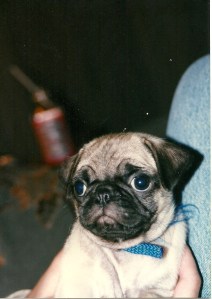
This picture was the only one that actually brought tears to my eyes.  This was Max, our Wonderpug.  We got her shortly after we moved in together and she quickly became an integral part of our family.  She was so full of spunk and spirit. We would take her camping, hiking, and swimming, earning her the title, “All Terrain Pug.”

When I found myself suddenly alone and adrift, I was completely unable to care for any my dogs physically, emotionally, or financially.  Friends and family helped to find homes for all three of them.  Giving them away was the most painful part of the entire divorce, but I had to do what was best for them.  Max was the hardest to place, as she was elderly and in failing health.  One of the amazing volunteers at Southeast Pug Rescue personally took her in and gave her a wonderful home in which to spend her remaining years.  Here come the tears again…

A family portrait with an adult Max.
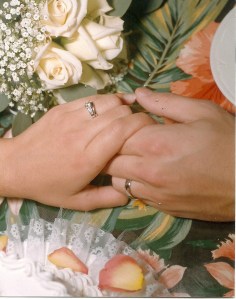
We had an unorthodox wedding.  We were married on the beach in Vero Beach, FL.  The only attendees were the minister (a gay Methodist minister who looked like David Lee Roth and threatened to marry us while wearing a speedo) and the photographer, who actually worked for the newspaper.  We both cried when reciting our vows, trembling with emotion.  As soon as the ceremony was over, we removed our shoes and walked along the beach for miles.

We honeymooned on a Windjammer cruise.  Apparently I though short-alls were the height of Caribbean fashion.

It was strange seeing him in these photos.  His face no longer seemed familiar to me.  What stood out was one picture where you could see a mole on his neck.  That image, not his face, brought memories rushing back: the feel of his hands, the texture of his chin, the smell of his hair.  I examined all his images, looking for emotion.  Looking to see if his love was real.  Comparing the pictures of him then to his more recent mugshot.  It’s not the same man.

Strangely, the wedding pictures did not bring sadness.  Just a disconnected sort of reminiscence.

Not long after we were married, we bought our house.  This began 10 years of remodeling projects as we worked to make it our own.  We always worked so well together.

This was the last picture I pulled from the envelope: my cat looking out my old dining room window at the activity in the garden.  That cat is all that I still have with me from all these pictures.

The past only has power if we allow it to. By keeping those pictures hidden for so long, I built them up in my mind and made them into more than they really are. Now they they have been released from the envelope, I find  that they have also been released from my thoughts.

I only have a few pictures with me.  Most of them, along with other memories, are in a sealed  box in my mother’s attic across the country.  I’m no longer afraid to open this Pandora’s box; I know I can handle what comes out of it.

Igniting the Conversation

photo-226

Relationship trauma will do strange things to you. With my ex, I was never timid about initiating a conversation about a potentially difficult topic. I would even wake him up so that we could talk before I went off to work if I didn’t want to carry the burden and fear of the issue all day. Of course, it was easy to “talk” with him about difficult things; he would lay on the affection and soothe me with his words. Yeah, he sure knew how to rock me back to sleep.

Now, post divorce, my communication style has changed. I am more tentative; I tend to hold things in too long, rolling them around in my mind (and often letting them gain steam) before letting them out. Brock’s communication style has contributed to this tendency. He generally starts off by talking at, not with, and then settles into a place where he is receptive and able to listen. I’ve seen this enough to know to ignore the first minute or two, but it doesn’t make it any easier for me to take the plunge.

Enter the talking candles.

After one conversation that I initiated well after I should have, Brock came up with an idea. He pulled two candles – one white and one blue – from the living room and set them on a small table in the dining room.

“These are the talking candles,” he began. “When you need to talk about something, set the white candle on the kitchen island. I’ll do the same with the blue.” He demonstrated this as he talked.

“When we see the other’s candle, we must make that conversation a priority.”

It was brilliant.

We haven’t used the candles much, but they have certainly helped to change the communication dynamics between us for the better. By setting out the candle, it gives the sign that a conversation needs to happen. The other person then has notice and can approach with the right frame of mind. We are less likely to talk while one or both of us is still decompressing from the day and the start-up is much more gentle. I am more willing to be assertive and not as defensive. He is more likely to listen from the beginning and to be more empathetic.

When we are aware of patterns, we can begin to change them. And that is a conversation worth igniting.


Of Teddy Bears and Security Systems

Teddy Bear

For most of my married life, I felt secure. I had a husband that I trusted. I owned a home and had been at the same job for many years. I felt comfortable in my life; I trusted that change, if desired, would come from intention. It was predictable and I liked that. If you had asked me where I would have been five years down the road, I would have answered without hesitation.

That feeling of security and blind trust is what allowed me to become complacent. Too comfortable. I was petrified of losing that feeling of security. I was very conservative in my decisions, choosing to avoid risk whenever possible.

I lost all semblance of security when he left. Everything was in question; nothing was sure. I didn’t have time to let it scare me. I simply had to survive. I was operating at the base level of Maslow’s hierarchy: eating, sleeping and breathing were my priorities.

I started tiptoeing back into life. I branched out but much was still unknown. I could not even imagine where I would be five years hence. And I was okay with that.

At some point I realized that the security that I had held so dear was an illusion, the equivalent of a child clutching a stuffed bear to ward off the dangers in the night.

I had outgrown the need for the illusion of security. I realized that the house, the job, the marriage could disappear.  There were no guarantees in mortgages and marriage certificates. They could be pulled from my hands just as easily as that stuffed bear, leaving me to face the night alone.

I had an experience that highlighted my changing views of security during my Match Madness phase. I dated one man for several weeks. He had money. I mean, real money. After only a few weeks, he mentioned the idea of me moving in, leaving my job and becoming basically a kept woman. I was repulsed by the idea but fascinated by my response. At that point, I had put in my resignation at my job and had no idea where I was going to live or how I was going to make money. I was facing the very real debts from my ex and had not yet received innocent spouse relief from the IRS. In other words, being kept should have been a temptation.

But it wasn’t. It felt like a prison.

I realized that the illusion of security works to hold us in, using our fears as restraints. I would have been bound to him by the fear of being penniless, not out of mutual respect and love. It went both ways. He was accustomed to using his bank account to hold women; he never had to work on relationship skills since he assumed that his wallet would do it for him. He was scared by the thought of a relationship without that hold.

Security looks different for me now. I don’t look for it externally, rather my security comes from trusting myself and knowing that I can make it through regardless of what happens. By next year, I will again have a marriage certificate, a mortgage and a secure job. But now I won’t be looking at them for comfort and assurance; that will come from within. I no longer clutch onto the metaphorical stuffed bears, but nor do I refuse to hold them.

Rebooting: Are You in Safe Mode?

Rebooting in safe mode.

Divorce is a major reboot of your life.  Control-Alt-Del of all that is familiar.  The process can vary, some may have time to save and safely exit their open files.  For others, applications are subdued with repeated clicks of the “force quit” button.  Divorce causes damage to the system, errors and gaps.  For most of us, we have to start our lives over again in safe mode.

According to Microsoft,

Safe mode is a troubleshooting option for Windows that starts your computer in a limited state. Only the basic files and drivers necessary to run Windows are started. The words “Safe Mode” appear in the corners of the display to identify which Windows mode you are using. If an existing problem does not reappear when you start in safe mode, you can eliminate the default settings and basic device drivers as possible causes.

After a divorce, safe mode means that your life is powered up again in a limited state.  Only the necessary applications  for living are in place; it is survival mode.  There is nothing wrong with this state; in fact, it is often required to be able to function at all.  However, just as a computer in safe mode is not truly operational, a life in safe mode is not truly living.  Safe mode is a time, a space, a tool that should be used to diagnose and treat any maladaptive hardware or software issues so that a full reboot can occur.

Look at your own life.  Are you in safe mode?  Does this state still serve you, or is time to complete the repairs and perform a full reboot of your life?

Bloom

bloom