Should You Believe Your Triggers?

I could feel it washing over me like a great wave trying to pull me under, both blinding me and choking me. My body went into full-on fight or flight mode, any rational thinking put on hold until the emergency passed.

What was the emergency, you ask?

My now-husband mentioned wanting to build a home theater in the basement.

I know, it’s a terrifying image.

This happened over six years ago and now I can laugh at the absurdity of my (over)reaction. But at the time, I truly was convinced that this was a serious threat to my well-being. I was responding to something in the present – my husband wanting to build a theater – with the emotions born from past experiences – my ex-husband building a home office in the basement that became the center of operations for his deceptions.

On the day of this particular melt down over the proposed theater, I remember being aware that the intensity of my response in no way matched the reality of the situation. But there was another part of me that was whispering, “What if this reaction is because you’re picking up on some real threat in the present?”

And I didn’t know which voice to believe.

And that’s the problem, isn’t it? We never know know for sure if what we’re feeling is a misplaced echo from the past or our intuition picking up on a real threat in the present.

There are four basic categories between our reactions and what triggers them – Snip20191103_6.png
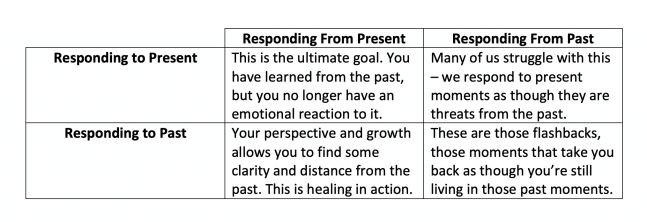
Responding to the Present From the Present

Your past experiences have taught you what to look for. You are better able to see actions that are misaligned to what you’ve been told and you’re more aware of unhealthy patterns. When something concerning happens, you use what you have learned to analyze it to decide if there are any real threats within.

You no longer have much emotional reaction from the past, so you trust that any you’re feeling now is an appropriate response to what is actually happening in the here and now. Furthermore, your reactions are on par with the behavior or sign you’re responding to. The response would be considered a reasonable one for anybody to have in similar circumstances.


Responding to the Present From the Past

Your past experiences are still living just beneath the surface. They have left you fragile, fearful. When something concerning happens in the present, it reignites those past concerns, an alarm sounding at full-blast, warning you that danger has arrived. Only the alarm is often false.

The emotional response is powerful, overwhelming, its intensity way out of line to what you’re responding to. You may even be aware that you’re overreacting, yet you feel powerless to stop it. Panic sets in. You become convinced that this is a sign that the past is about to repeat itself. You may respond with plans to flee, an instinct to fight or the desire to curl up and hide from the perceived threat. It’s best to take a time-out to allow some space for the body to calm before deciding to take any action.


Responding to the Past From the Present

This response comes when you encounter a reminder from the past, but you do not have an emotional response to it. Instead, you are able to look back with some clarity, applying what you know now to what you experienced then.

These are healing moments that provide valuable insight into what threats are real and which ones are born from a fear of being hurt again. This is learning – and healing – in action.


Responding to the Past From the Past

These are perhaps the most terrifying moments, when it’s as though a wormhole has transported you back to where you were with the same intensity of emotions and lack of perspective that you had when you were in the midst of it all.

When in the throws of a flashback, rational thinking and self-control is pretty much an impossibility. It becomes about survival, riding it out until it abates. Reminding yourself that it’s not real, that you are safe.


Should you believe your triggers?

Our emotional reactions are important, they provide us with information about our fears and about what is happening around us. Yet emotions are not always an accurate source of information. So listen to them, but don’t always believe everything they have to say.

Was Any of It Real?

“When do you think it started?” I was asked recently in regards to my ex’s betrayals.

“I traced it back more than two years, but then I made a decision to stop looking. So really, I have no idea.”

I responded to her question while my mind was busy posing its own question to me –

Was any of it real?”

It’s a question that plagued me in the beginning. Haunting me. Taunting me as I replayed memories built over sixteen years, examining them for signs of fabrication.

Was the entire marriage, the entire relationship, a sham? Did I unknowingly turn my life over to a master manipulator to be used and discarded as easily as a prop on a magician’s stage?

Or, was it once real? Pure and sweet before it became rotten and poisoned from some outside source?

I will never know.

Yet even amidst that perpetual uncertainty, I have made up my mind.

It doesn’t matter what was real and what was not.

Whatever his mindset and motivations were behind all of those precious memories are inconsequential. Because at the time those experiences and feelings occurred, they were real to me.

And that is what matters.

I will never know what happened behind the scenes. His experiences and thoughts will forever remain a mystery. And since a mystery takes up more mental space than a known entity, I have chosen to no longer entertain the question

Since the marriage is gone, its veracity no longer has any real meaning and serves no purpose outside of my own mind. It seems cruel to myself to settle on the more painful option, so I have elected to not contribute to the torment that he put me through and believe that at some point,

it was real.


The Importance of Feeling Safe in a Relationship

When you don’t feel safe in a relationship, your focus shifts from connection to protection.

Instead of turning towards your partner, you’re turning inward or turning away in an attempt to avoid a sense of increasing danger.

And relationship safety is often misunderstood. We tend to oversimplify the state; believing that as long as physical threats are not present, there is no reason to not feel safe (yet there are many ways that we can feel emotionally unsafe in relationships). Additionally, we often dismiss or misinterpret feeling a lack of safety in a relationship. We may chalk it up to our own insecurities or blame it on anxiety arising from within.

You also may be unintentionally behaving in a way that lessens your partner’s sense of safety in the relationship. And so that disconnect or tension that you may sensing could be their attempt to protect themselves.

What Does Not Feeling Safe in a Relationship Look Like?

  • Not knowing what to expect from day to day or moment to moment.
  • A hesitancy to initiate affection or intimacy because of a pattern of rejection.
  • Biting your tongue out of a fear of the repercussions of speaking your truth.
  • Your emotions being mocked or dismissed.
  • Always being asked to change your appearance or demeanor in order to be accepted.
  • A feeling of walking on eggshells because of repeated emotional outbursts or unexpected and over-the-top reactions.
  • Intimacy and connection are used as both reward and punishment – if you’re “good,” you get attention and if you’re “bad,” it’s withheld.
  • A feeling that you have to put on a front or hide certain aspects of yourself in order to avoid rejection or ridicule.
  • Your partner frequently threatens to leave or divorce.

What Characteristics Make People Feel Safe in a Relationship?

Physical

Your partner doesn’t hit you, hold you down or use their body to intimidate you. You don’t expect a physical altercation and you don’t flinch when they reach towards you. If you are hurt or ill, they will attend to your physical needs. If you reach towards them, they accept your touch. Any physical rejection is done with kindness and not blame or shame and sexual activities are never forced or coerced.

Consistency

You generally know what to expect from your partner and your relationship. Their actions and reactions are familiar and somewhat predictable. Additionally, except in extreme cases, emotional responses are not over-the-top and are appropriate for the situation.

Authenticity

You feel like you can be you. The real you. You don’t feel like you have to hide or pretend in order to be accepted. You can speak the hard truths without fear of overreaction or detonation. You also trust that your partner is revealing their true nature and that they are not holding back anything of importance. An authentic relationship is not always happy, but it’s also not hiding anything.

Vulnerability

You can be weak without fear of being taken advantage of. You can reveal your fears and insecurities without ridicule or emotional blackmail. You feel like it’s okay to not be okay and that a temporary state will not become a permanent point of contention.

Acceptance

You feel listened to. Valued and valuable. Your partner doesn’t try to change you or frequently compare you to others. Criticisms are aimed at your behaviors rather than at your core self. They accept you as you are, not as they want you to be. Any requests or encouragement towards change is both fair and approached with your wellbeing in mind.

The Link Between Relationship Safety and Anxiety or Insecurity

Our primary relationships often set the tone for the rest of our experiences. We expect to be able to come home and relax our guard, to be authentic without the risk of excess judgement or the fear of being taken advantage of. To be our best, we need our relationships to be our stable ground from which we grow into the rest of our lives.

And so when home is more unpredictable wobble board than sanctuary, the effects extend outwards. Much like an infant with an insecure attachment to a parent shows less confidence in exploring the world, an adult that doesn’t feel safe in their primary relationship may hesitate to to take risks or be prone to excess worry.

Of course, not all anxiety or insecurity is relationship-based. Yet if your symptoms increase when you’re around your partner or are primarily present at home, this may the root cause of your stress. Also pay attention to a lasting sense of “walking on eggshells.” This feeling is common during times of stress or transition, but if it continues, it indicates that you are afraid of triggering a reaction.

Often people are surprised when they feel calmer and more confident when a significant relationship ends. But it’s not surprising at all when they never felt safe within that relationship.

How Past Betrayal and/or Abandonment Impact Relationship Safety

Part of the trauma of both betrayal and abandonment is that they destroy any sense of safety. And those effects are lasting, even following you into a new relationship. This is especially true if you felt safe and secure until the moment you realized that the firm ground was instead an illusion crafted to keep you unsuspecting.

A sense of safety is related to trust, yet it is also its own domain. Trust comes down to believing that your partner’s actions align with their words. Safety also relies on a sense of consistency and acceptance. And both obviously suffer after betrayal or rejection.

If you have experienced this kind of relationship trauma, it will be some time before you feel steady again, no matter how secure your footing. Part of the healing process is learning what is a true danger and what is merely a malfunctioning alarm.

The Limitations of a Safe Relationship

There is no such thing as a fail-proof relationship. It is impossible to be involved with another person and never feel hurt or disappointed. Feeling safe in a relationship does not mean that your emotions will never be bruised. Instead, it comes down to trusting that your partner will never internally seek to harm you and if they do misstep, they will take responsibility for their part in the transgression.

The Powerful Benefits of Feeling Safe in a Relationship

Safety is a primary need. Without a sense of safety, much of your energy is extended towards being ready to run, hide or fight if needed. And when that need is met, your energy is freed towards growth and you feel securely anchored enough to take risks in other areas.

When at their best, our relationships give us both the firm ground on which to stand and the encouragement to extend beyond our perceived limitations.


Progress and Room to Grow

Because of the nature of my first marriage (conflict-less because of a deadly combination of his tendency to lie about everything and my inclination to avoid anything too anxiety-provoking) and the way that it ended (suddenly and without warning), I have struggled at times with my now-husband.

In the beginning, I alternated between being totally flooded and in a panic about being abandoned again at the slightest sense of conflict or withdrawal to an “I’m out of here” conclusion as my traumatized brain assumed the worst about a situation. Additionally, my f’ed up brain decided that if I wasn’t the “perfect wife,” I would again be dropped. Of course, that doesn’t lead to good things because I could never do enough to calm the anxiety and none of this was stuff my husband asked for (or expected) anyways. And then for the cherry on top, I had a hard time bringing up the difficult conversations, my years of avoiding anything anxiety-producing had trained me well.

It’s been years of work learning how to change these patterns. I can now initiate the difficult conversations and I’m more able to stay present during them instead of disappearing into an emotional whirlpool. I trust that my now-husband is in it for the long haul and that he is not a quitter or a coward. As I process a disagreement or issue, I’m finding less and less that it directly has more to do with my past than my present.

Which is good.

But of course, the past is still imprinted on my being. I still have a tendency to take everything too personally and respond at a level ten to something that should be counted on one hand’s worth of fingers. I get in my head too much, thinking when I should be being. And it’s a vicious cycle. Because when I get this way, I become more convinced that I’ll be left again. Which then leads me right back to where I started.

There’s obviously room to grow.

I think part of my recent anxiety is tied to my upcoming trip (I leave in the morning!!!). It’s been almost ten years to the day since I left to go visit my father in Seattle. On that trip, like with any trip, I expected to return to Atlanta and my life at its conclusion.

But that life disintegrated while I was gone.

I returned to an empty home. A missing husband. A depleted bank account. A gutted heart and a shredded soul.

There is nothing in my life now that suggests that scene will ever be repeated. But I think it’s there in my subconscious mind, softly whispering, “what if?” and making me more needy, more sensitive and yes, more anxious.

I’ve come a long way in the last ten years. But I still have a ways to go.

Four Types of Marital Abandonment You Need to Know About

When I filed for a “fault” divorce (which, in retrospect, was a mistake), one of the reasons cited was “marital abandonment.” It was a clear call – he walked out of the house and out of my life, leaving everything behind in order to start a new life in a new state. It’s the textbook form of abandonment we’re all familiar with, a sudden and complete severing of the marital ties.

But it’s not the only way that a spouse can desert their marriage. These other forms of abandonment may be more subtle, but their impact is no less excruciating.

It’s important for us to be aware of the ways that we may be rejecting our spouses and if we’re on the receiving end, it’s helpful to understand what is happening.


Physical Abandonment

Physical abandoment can occur even when the body remains in the shared home. It can take the form of reduced affection, touching less and less as the years progress. Sometimes it’s a literal turning away when one partner bids for attention, leaving the request for physical contact unfullfilled. Other times, physical abandonment occurs in a more subtle way, a slow decline over time.

This type of abandonment can also be sexual, where one parter desires sexual connection and the other continually rejects their advances. Even when this rejection originates from valid concerns (such as illness that makes sexual contact difficult or painful), the partner who desires the physical contact tends to feel abandoned.

For many of us, touch is an important part of feeling loved. Feeling desired. And so when that touch is removed from a relationship, we feel discarded and worthless.


Attentional Abandonment

We all want to be seen, especially by the person that we love. Attentional abandonment occurs when we feel invisible within our own home as our spouse’s focus is directed elsewhere for extended periods of time. This can often be seen after the birth of a child, when the infant becomes the sole focus and the spouse is moved to the periphery. It also happens when one – or both – partners are focused on work, ailing family members, other people or hobbies.

Every marriage goes through patches of attentional abandonment with outside responsibilities have to take priority for a time. The problem arises when it becomes habitual and energy is continually funneled outside the marriage.

Without attention, a marriage, like a lawn, will whither. Whatever you nurture, grows.


Emotional Abandonment

When one person shares their emotional state with the other, it is a time of vulnerability. And when the response is dismissive or lacking, it leaves the vulnerable person feeling stranded without support or validation. When this is a continual pattern, it often leads to withdrawal and a lack of trust.

A lack of emotional connection weakens a marriage and can lead to a situation here two people are living alongside each other instead of living with each other. Ideally, each person can feel like the other has their back – both physically AND emotionally.


Spiritual Abandonment

This type of desertion can be as clear as one partner renouncing the faith that was a cornerstone of the relationship from the beginning. But it can also be beneath the surface of the marriage. All relationships have certain key values and goals and that center – family, personal growth, financial success, etc. And when one person in the marriage no longer holds those same guiding values, it leaves the other feeling discarded.

Of course, each person has the right and the freedom to shift their values and driving principles over time. Regardless of how it is handled, one partner may feel abandoned by the other. However, when there is open communication, the feeling of personal rejection will be lessened.

No matter what the intentions of our partners, we all can feel rejected sometimes. But there are ways that we can limit this reaction. Overall, feelings of abandonment are increased when the changes are abrupt and there is no discussion of the situation. When we feel like we understand why the withdrawal is occurring, we are less likely to take it personally and less likely to view it as a desertion of the marriage.