The Three Stages of Utilizing Anger After Relationship Trauma

Anger is a natural reaction to relationship trauma. You feel angry that your needs were ignored and your boundaries crossed. You’re enraged that your voice was silenced and that you were not allowed to have input on what happened. The unfairness sparks fury as they seem unaffected and you’re struggling to survive.

This anger has an energy to it; it powers your thoughts and often your actions. Yet, it is not a static fuel and its nature changes as you begin to heal. These are the stages of how anger is utilized in the healing process after divorce, infidelity or other relationship trauma:


I’ll Show Them How Hurt I Am

This first stage is automatic and can be quite overwhelming, even leading to irrational behaviors. Pain demands to be heard, to be acknowledged. And anger is simply pain screaming to be heard.

We recite the wrongs done to us obsessively, meticulously enumerating all of the wounds in the goriest detail. This list becomes the soundtrack we live by, each retelling solidifying our role as the wronged one.

Sometimes we lash out in an attempt to inflict comparable pain upon them. This may bring a brief moment of satisfaction. But it is always short-lived as it never seems to encapsulate the sheer magnitude of the pain. And then it’s compounded by the fact that it never feels good to hurt someone else, even those that have caused us pain.

We may even unconsciously sabotage our chances at getting better, seeing our own healing as a sign that they have “won.” It becomes a pissing contest of pain, stubbornly holding onto and displaying the myriad of grievances.


I’ll Show Them What They Lost

In the second stage, the attention is still focused on the person that caused the pain, but the energy is directed to making them sorry instead of making them hurt.

This is the phase where people are motivated to make changes in an attempt to be perceived differently by the person that hurt them. These are often in direct correlation to any insults delivered by the injuring party.

For example, those that have been called “fat” by their spouses often dive head-first into an exercise program after divorce. If the affair partner was well-educated and the person who was cheated on always felt embarrassed about their education, they may start a new degree program.

This is an interesting phase because the outcomes can be quite beneficial even while the motivation behind them is still anchored in the past. Often these external changes contribute to a greater sense of self and confidence in our abilities. Which taken together, allow us to enter the final stage of utilizing anger.


I’ll Show Myself What I’m Capable Of

From the outside, this can look identical to the previous phase. There is a commitment to bettering yourself and courageous steps taken outside the comfort zone.

But inside? It’s quite different. Because now the motivation has nothing to do with the person that hurt you. Now, you realize that you are the one that has been holding yourself back. And now, you are ready to get out of your own way and see what you can do. Not to show them, but to show you.


Post Traumatic Growth

One of my husband’s “ah-ha” moments came in his early adulthood when he caught a snippet of an Oprah show. The guests that day were two brothers who had endured horrific abuse during their childhoods. One became the epitome of success, applying discipline and intentional effort to all areas of his life, which resulted in a fulfilling career and marriage. The other turned to drugs and crime to fuel his addictions. By all measures, his life was tragic and wasted.

Oprah asked each brother in turn, “Why did you make the decisions that you did?”

Both brothers answered the same, “I had no choice.”

But that’s not really true, is it? They had no choice, no agency, when it came to the abuse they suffered. The damage caused was real and significant for both of the men. Yet as they left childhood and began to make their own lives, they did have a choice –

They could allow what happened to become a limitation, using the damage as an excuse to whither and self-destruct.

Or, they could choose to view the traumatic childhood as a trial, a training ground to learn how to avoid falling into those same unhealthy patterns and instead, grow from the experience.

I highly doubt that even the successful brother looks back upon his childhood with fondness. I suspect that even while he attributes some of his fortitude and wisdom to the abuse he suffered, he still would not excuse the actions of his parents or wish the same on others. However, he probably understands that good things can come from bad situations and that, while he was helpless as a child, he is not helpless now.

I think sometimes we conflate growing from trauma with excusing the trauma. As though by finding positive change we are discounting the impact of whatever happened to us. It can be challenging to hold both things true at once – it was horrible and yet it also provides opportunity for growth – yet that is so often the case. Using trauma as a springboard for positive change doesn’t mean the actions that hurt you are okay; it means that you are determined to be okay despite the actions.

Nobody would ever choose trauma as a mechanism for growth. We all would prefer to learn to swim under the patient and kind tutelage of a coach, yet sometimes the tsunami forces us to learn before we are ready. We can allow ourselves to go under, cursing the relentless wave, or we can use it an opportunity to learn how to paddle like hell in order to keep our heads above water.

You DO have a choice.

You cannot change what happened.

But you can change how you view it.

Is it going to drown you or train you?


10 Strategies to Release the Anger From Financial Betrayal

Top Ten Posts of 2019

1 – 7 Reasons Your Ex Getting Married is the Worst (And 7 Reasons it’s Not)

This has been a leader for a few years now. I think people are caught off guard with the intensity of their reaction when they learn that their ex is getting married and they turn to Google to validate their feelings and reassure themselves that they’re not alone. I also created a video this year that addresses the topic.


2 – Subtle Signs You’re Being Manipulated by a Covert Abuser

Covert abuse is sneaky. Knowing the signs is the first step in protecting yourself.


3 – 5 Things You Don’t Understand About Divorce Until You’ve Lived Through It

I don’t think any of us knew what to expect before we went through divorce ourselves. This post is both validating of your experiences and helps you understand while some people in your life may struggle to “get it.”


4 – Finding Happiness After an Unwanted Divorce

When you’ve been hit by the Mack Truck of an unwanted divorce, being happy again feels impossible. This post helps to reassure you that it’s not.


5 – Is it Love? The False Dawn of a Rebound Relationship

It feels real. And you desperately want it to BE real. But there is a reason that those early post-divorce relationships don’t tend to last.


6 – Five Empowering Ways to Recover From Gaslighting

Gaslighting leaves you feeling so confused and powerless that it’s difficult to see the way out. This post gives you actionable strategies that can help you heal.


7 – How Do You Get Through Your Anniversary After Divorce?

The first one is awful. And subsequent ones can still be a bittersweet reminder of what was loved – and lost. I share ideas what what you can do before, during and after that day to help ease you through.


8 – 15 Questions to Ask Yourself If You’ve Been Cheated On

After being cheated on, your mind is a swirling mess of emotions. These 15 questions act like a guide rail to help you find your way.


9 – Ten Metaphors For Divorce

These are a mixture of eye-opening and funny as divorce is compared to everything from a favorite sweater to a visit to the eye doctor. Which do you relate to?


10 – The Importance of Feeling Safe in a Relationship

I wrote this post after I realized how little we talk about the importance of feeling emotionally safe in a relationship. Based on the views and the reaction on Facebook, it’s a conversation that needs to happen.


Should You Believe Your Triggers?

I could feel it washing over me like a great wave trying to pull me under, both blinding me and choking me. My body went into full-on fight or flight mode, any rational thinking put on hold until the emergency passed.

What was the emergency, you ask?

My now-husband mentioned wanting to build a home theater in the basement.

I know, it’s a terrifying image.

This happened over six years ago and now I can laugh at the absurdity of my (over)reaction. But at the time, I truly was convinced that this was a serious threat to my well-being. I was responding to something in the present – my husband wanting to build a theater – with the emotions born from past experiences – my ex-husband building a home office in the basement that became the center of operations for his deceptions.

On the day of this particular melt down over the proposed theater, I remember being aware that the intensity of my response in no way matched the reality of the situation. But there was another part of me that was whispering, “What if this reaction is because you’re picking up on some real threat in the present?”

And I didn’t know which voice to believe.

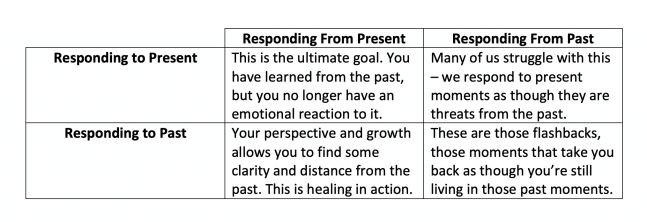
And that’s the problem, isn’t it? We never know know for sure if what we’re feeling is a misplaced echo from the past or our intuition picking up on a real threat in the present.

There are four basic categories between our reactions and what triggers them – Snip20191103_6.png

Responding to the Present From the Present

Your past experiences have taught you what to look for. You are better able to see actions that are misaligned to what you’ve been told and you’re more aware of unhealthy patterns. When something concerning happens, you use what you have learned to analyze it to decide if there are any real threats within.

You no longer have much emotional reaction from the past, so you trust that any you’re feeling now is an appropriate response to what is actually happening in the here and now. Furthermore, your reactions are on par with the behavior or sign you’re responding to. The response would be considered a reasonable one for anybody to have in similar circumstances.


Responding to the Present From the Past

Your past experiences are still living just beneath the surface. They have left you fragile, fearful. When something concerning happens in the present, it reignites those past concerns, an alarm sounding at full-blast, warning you that danger has arrived. Only the alarm is often false.

The emotional response is powerful, overwhelming, its intensity way out of line to what you’re responding to. You may even be aware that you’re overreacting, yet you feel powerless to stop it. Panic sets in. You become convinced that this is a sign that the past is about to repeat itself. You may respond with plans to flee, an instinct to fight or the desire to curl up and hide from the perceived threat. It’s best to take a time-out to allow some space for the body to calm before deciding to take any action.


Responding to the Past From the Present

This response comes when you encounter a reminder from the past, but you do not have an emotional response to it. Instead, you are able to look back with some clarity, applying what you know now to what you experienced then.

These are healing moments that provide valuable insight into what threats are real and which ones are born from a fear of being hurt again. This is learning – and healing – in action.


Responding to the Past From the Past

These are perhaps the most terrifying moments, when it’s as though a wormhole has transported you back to where you were with the same intensity of emotions and lack of perspective that you had when you were in the midst of it all.

When in the throws of a flashback, rational thinking and self-control is pretty much an impossibility. It becomes about survival, riding it out until it abates. Reminding yourself that it’s not real, that you are safe.


Should you believe your triggers?

Our emotional reactions are important, they provide us with information about our fears and about what is happening around us. Yet emotions are not always an accurate source of information. So listen to them, but don’t always believe everything they have to say.