Anger Isn’t the Only Emotion to be Managed: 9 Ways to Tame Your Feelings

manage emotions

When I was a kid, I used to have tantrums.

And not just any tantrums.

The on the ground, store-clearing, face-purpling variety.

And I had them a bit longer than was considered to be developmentally appropriate.

Sorry, mom and dad.

I can still remember the feeling. It was like a bucket of fizzy emotion had just been poured into a shot glass, overwhelming me with its intensity and confusion and frustrating me with my inability to make sense of what I was feeling and to communicate it to others.

And it was the latter that prompted the tantrums, that external display of anger that actually came from anger at myself and my struggle to reign in my other emotions.

If I had still been engaging in these external displays of excess emotion once I reached school age, I would have been referred for anger management classes.

When really what I could have used was emotion management classes.

But for some reason, anger seems to be the only emotion we feel has to be managed.

When the reality is that part of being a healthy, functioning adult is managing your emotions. ALL of them.


I went from that over-emotional mess of a kid to a much more controlled young adult. In fact, my mom even accused me on occasion of not feeling. But that wasn’t the case. After experiencing the potentially overwhelming nature of emotions, I was afraid to give them the floor. So as much as possible, I turned the analytical brain on and shut the emotional one off. Or at least turned the dial down low and ran them through a rational filter, which seemed to serve me fine.

And then the divorce happened.

And my analytical side went on the fritz and once again I had the sensation I was drowning in emotions.

I thought about throwing myself on the floor of my classroom and crying until my shrieks ran my students out of the room and my tears dried me out.

But I realized that I still needed my paycheck. And besides, I really didn’t want my face on a middle school carpet. Yuck!

My first step towards emotional management was basic; I divided areas in my life into two categories – safe to cry and keep those tears in, lady!

And for the most part, I succeeded. As long as you didn’t look too closely at the sweat pouring down my face while I was on the treadmill:)

But that wasn’t enough. I was dealing with emotions on a grand scale and I even if I wanted to wrangle them back in, they were flat-out refusing. The following are the nine  ways I learned to manage my emotions while sill acknowledging my emotions.

1 – Set boundaries.

Much like I did with my refusal to cry at work, create some hard lines in the sand where you are going to keep it together. Your brain is trainable; teach it when to think and when to feel. And don’t fall into the trap I did for a while – you can’t set your entire life as a “don’t feel” zone! You need some times and places where you feel safe crying and some times and places where you feel safe that you won’t cry.


2 – Be aware of triggers and do what you can to mitigate them.

Know thyself. Pat attention to your patterns. If you understand the antecedent, you will be better prepared for the reaction. Taken a step further, you may find that it’s easier to get a handle on things before your emotions spill over than after.

Are you irritable because you feel stifled? Get out and move. Are you feeling brittle and overwhelmed? You probably need sleep or, at the very least, rest. Do you find that you’re more prone to emotional wash-outs when hormones are peaking? Learn to ride easy at that time. Do certain calendar dates hold sway over you? Give yourself permission to grieve on that day and schedule a smile for the following.


3 – Breathe through the emotions.

The first thing our bodies do when we’re flooded with emotion is to stop breathing. The instinct when we’re trying to hold in all together is to hold it all in, including the breath. It’s a strange adaptation, like the body is summoning its reserves to attempt some great feat or is grasping onto its last breath out of fear that it will indeed be the last.

Learn to breathe deeply and slowly while you’re feeling the emotions. It’s a sign to your brain that emotion is nothing to fear, you don’t have to fight it or flee from it. Breathe it out and ride it out.

And while your at it, express some gratitude too. It’s pretty powerful stuff.


4 – Acknowledge emotions and name them without judgment.

With some of the autistic kids I’ve worked with, the teachers used an emotion board, a study page with simple illustrated faces displaying a variety of emotions. Those kids didn’t have the language to describe how they were feeling, so they were taught to simply point at the image that captured their emotions.

emoticons-154050_1280

I know I have a tendency to get too complex when I try to pinpoint my own emotions. I explain certain things away, outright dismiss others and try to make connections and interpretations. And then I stop and think of those kids and the elegance of selecting one image.

It’s amazing the power that naming an emotion can have. By acknowledging, “I feel sad right now,” it provides a sense of awareness and control over the feelings. Keep it simple, pick one emoticon: happy sad, scared, frustrated, angry, anxious, tired, surprised, disgusted. Keep the statement neutral. You’re human; it’s okay to feel any of those things. And saying that you shouldn’t won’t make you not.

And note the “right now.” Those two words are important. They concede that you feel that way now, yet allow that you may feel differently later.


5 – Release excess emotion without indulging it.

I remember when the advice was to treat anger by screaming into a pillow or attempt to beat a punching bag into submission. Yet research disagrees with that approach. It seems as though when you scream or hit when angry, your brain then solidifies that connection, leaving you more prone to screaming or hitting when you’re angry.

I would suspect a similar mechanism is at play with the negative effect journaling has been found to have in some cases – if you’re feeling low and all you write about is your sadness, it’s indulging it, not managing it. Which is why I frequently recommend this journal strategy.

Some people release emotions through writing. Others, running. Some may knit. Some may sleep. And some may whip up a feast. Know your own soothers and have them ready.

And try to keep from indulging your excess emotion. It’s just feeding the beast and upping your drama set point.


6 – Be aware of the impact your emotion may have on others.

What you feel, you project, even if you never part your lips. And what you project will impact how others respond to you. Be aware of the impact your feelings have on those around you. Try to understand the cause and effect and if you don’t like the response, aim to change the call.

You may need to apologize for your actions, but never apologize for the way you feel. It’s appropriate to express regret for snapping at someone. It’s not okay to make it sound as though you’re not allowed to be irritated.

Above all, strive to be kind.  After all, we’re all in this thing called life together.


7 – Accept responsibility for your emotions.

“You made me feel that way!” Ever said that? Yeah, me too. But it’s not accurate.

Here’s a powerful idea – what is one identifying trait of an abuser? They lay the blame for their actions at the feet of their victim, “You made me hit you.” We know that’s not true. It’s a shifting of focus and a way to escape responsibility. So why is this any different?

Others are responsible for their words and their actions. You are responsible for your response, either emotional or actual. Yes, people will do some sh*tty things sometimes. And you have every right to be angry. You’re angry because your boundaries were crossed. Or your sense of fairness violated. Own your anger. When you try to make the other person responsible, you’re allowing your anger to own you.


8 – Listen to your emotions, but don’t believe everything they have to say.

Think of  an unruly toddler. When they scream, “I hate you!”, do you listen? Or do you recognize that they missed their nap and they’re overtired? And what are toddlers but walking, talking squishy balls of emotion?

We evolved as emotional beings for a reason; we are social creatures and depend upon connection to thrive. Emotions serve to bring us together and also to protect us from threats inside and outside the group.

And our emotions are smart. There’s a reason that we feel uneasy about certain situations before our thinking brain has had a chance to process any danger. When we ignore our emotions, we do so at our own peril.

Yet, if we listen to everything they say, we’re blindly following an uneducated leader. Just think about your body’s response at the top of a roller coaster. Your fear says, “I’m gonna die!” while, if you like a rush of adrenaline, your cognitive brain looks forward to the fun.


9 – Be compassionate towards yourself and kick your butt if you need it.

For a recent “get to know you” activity for my new school, we were asked to stand up in front of the group and reveal two truths and one lie about ourselves. The group was then supposed to call us out on our lie. I volunteered to go first and in my best loud and bubbly teacher voice, announced

I’m an extrovert.

I’m scared of going downhill.

I went skydiving last summer and I’m excited to go again in a few weeks.

All of those that knew me responded, “You’re not an extrovert!” While the strangers all assumed that somebody afraid of a hill would never voluntarily jump out of a plane, so one of those must be false. When the reality is that I refuse to let my fears (or any other emotions) limit me.

When I go skiing, I know that it’s harder for me than the others. So I congratulate myself for facing my fear instead of comparing myself to those that don’t share that anxiety.

There’s a balance between accepting where you are and always pushing yourself to be better. Basically, give yourself a hug and kick your own butt at the same time. And please post a video – I’d love to see that! 🙂

Emotions are feral and often require domestication to play nicely. Don’t ignore them and also don’t be afraid to tame them. With the right work, they make great companions.

And if you feel like you’re constantly drowning in emotion, get help. There’s no shame in it. 

If There Has to Be An Ending, Why Not Make It a Good One?

My school of the last five years is involved in a meiosis of sorts, splitting and dividing into two halves, each pulling some of its identity from the whole. Good schools become families, adults coming together with the shared goal of nurturing and launching children. The restructuring of a school is the break up of a family, with all of the associated heartache and opportunity. And it’s often a break up that nobody wants.

Last night, we celebrated the final day of the existence of the staff as a single entity before the last strands are cut today as we move into our new schools and our new roles.

And it was a wonderful celebration. Equal parts belly laughs and tears. Differences set aside in lieu of gratitude for shared experiences and the unique gifts that each person shared during their tenure.

Yes, it was sad. We traded stories about some of our most challenging – and rewarding – students, realizing as we shared that we may never again be in the company of others who participated in that same memory. We grew a little apprehensive, wondering how in the world we would ever build this kind of connection and camaraderie in our new schools. The task feels daunting, especially when compared to the already-built relationships. We poked fun at each other’s warts without causing distress because we all know it comes from a place of love and acceptence. And we wondered if our new family would be accepting as well.

It was sad. It is sad.

But it’s not only sad.

Last night was a rememberence and celebration of all that had been and the early excitement of what is to come. A perfect blend of memory and anticipation. An acknowledge of the end tempered with gratitude that it existed.

As I listened to two talented teachers lead a inside-joke filled presentation, I thought how wonderful it would be if we could always approach life’s endings in this way.

With equal parts belly laughs and tears.

If there has to be an ending, why not make it a good one?


Are You Tired of Hearing, “It Will Be Okay”?

be okay

“It will be okay” is sometimes a platitude, uttered in ignorance by people who have not ever tried on your shoes, much less walked in them. And that pat phrase, along with its twin, “You’re never given more than you can handle,” can spark ire in the one who is in the midst of the very-much-not-okay and there-is-no-way-I’ll-be-able-to-handle-this. It those cases, “It will be okay” feels dismissive, empty, hollow. A brush off followed by a watering down.

But those speaking in ignorance aren’t the only ones to share that phrase. Others come from a place of experience. They’ve been on the floor amongst the ruins of their life. They’ve lost everything and felt that overwhelming ache of the unfilled void. As they listen to your cries, they are transportated back to their own fresh pain (when nothing ever felt like it would be okay again) and they contrast it with where they are today (okay or even better).

And when they tell you, “It will be okay,” they’re speaking from experience. Not ignorance.

Sometimes we think of “okay” as “the same as it was.” And that will obviously never happen. In my mind, “okay” means adaptation to the change, accepting what is and building upon that base. “Okay” doesn’t mean that there isn’t loss, that there isn’t pain. It means that the loss is no longer all-consuming and the pain is no longer your identity. “Okay” doesn’t undo what was done, it doesn’t erase the past. “Okay” is a place of hope, a whisper that tells you one more breath, one more step. “Okay” means that the way you feel right now is not the way you will always feel because everything changes, even pain. “Okay” says that no matter what has happened, you can still find happiness and peace.

Everything really will be okay.

Is Living After An Unwanted Divorce Worth It?

unwanted divorce

“Is living after an unwanted divorce worth it?”

That particular search string has been leading people to my blog these past few weeks.

And every time I see it, I feel a pull to reach out to them and a twinge because I cannot.

But if I could somehow identify the struggling soul on the other side of the keyboard, this is what I would say:

Yes! 100%, unequivocably yes! Living after an unwanted divorce is absolutely worth it.

Now, I know you don’t feel that right now and I know you can’t see how, so please just try to keep an open mind right now and let those who have been through it strengthen your faith in your future.

I know you know the pain. The void. The never-ending loss of lives ripped apart.

So I’m not going to go there. You need no guide to the suffering.

Instead, I’m going to start at the beginning.

Because divorce is the end of one life

but the beginning of another.

Trying to compare where you are right now with where you were before the divorce is like trying to equate a lot cleared for a house with a personalized and well lived-in home.

They’re not the same thing.

And here’s the hard part, the part that took me some time to accept –

One is no better or worse than the other. Just different. And this one feels worse because it is new and foreign and unwanted.

It starts with accepting that you’re at a beginning. A blank slate, albeit a tear-stained one.

Your divorce was unwanted. Perhaps you had no say.

Now you do. You may be starting with nothing. From nothing.

But you’re still starting.

You may feel as though your ex has taken everything from you. So, get angry. And use that anger to fuel your conviction that you will not allow your ex to take away your future as well.

That’s your energy pushing you forward.

Now find something to pull you as well.

What do you have to live for? Who do you have to live for?

It’s there. It may be hidden under the cloak of the divorce, but it’s there.

Latch on.

I know the empty wasteland is overwhelming. So don’t look at it in its entirety. Instead, build a picture of what you want your life to look like. No, not what it was. I know that trick. But what you really, really want. Because every marriage, every life, no matter how good we thought it was left some desires unfed. There’s no reason to suppress them now.

Let that image of your desired life be your beacon.

While you simply focus on your next step.

And your next breath.

———-

I can still vividly recall the devastation and utter hopelessness I felt after my ex left me with no warning and no opportunity for discussion. I remember the hollowing, the agony, the blinding fear.

I recollect wondering if life after would be worth it. If I would ever be happy again.

And those feelings now are as far away as joy was then.

Because not only is life after an unwanted divorce worth living, it can be even better.

Accept where you’re beginning.

Summon your motivation.

See where you want to go.

And take one step. And then another.

You are worth it.

———-

I am generally a very independent and headstrong person. In the first few days, I refused any professional intervention. By week two, I learned that I could not do it alone and sought medical and psychiatric assistance. And I could not have done it without them.

If you are experiencing a persistent feeling of hopelessness or prolonged changed in eating or sleeping, please seek help. Remember, you’re at the end of one life and the beginning of another. And we ALL need help at the beginning and end of life.

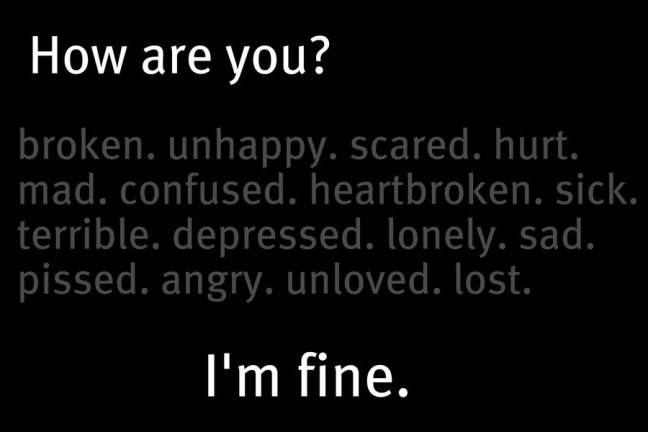
“I’m Fine.” (But What Are You Really?)

I'm fine

“I’m fine.”

How many times have you declared those words?

Hundreds?

Thousands?

Maybe more?

And how many times were those utterances accurate, describing your well-being as exceptional? Thriving? Or, in the more modern use of the term, simply satisfactory?

And how many times were they offered in reflex, in deflection or even as an outright lie?

__________

Here are some of the true feelings that can hide behind “I’m fine.” Do you relate to any of them?

“I’m afraid that if I start talking, I’ll start crying.”

My world is a mess right now and I’m trying to just get through. I may look okay, but I’m really just going through the motions.

“I’m trying very hard to pretend that I’m fine. Please don’t intrude on my delusion.”

If I really paid attention to my intuition, I would probably know that something is not right. But I’m not ready to face it yet so I’m going along with the idea that I’m fine.

“I’m not fine, but I don’t feel safe sharing that with you.”

Things are really hard right now and I wish I could talk about it but I’m afraid that you’ll ridicule me or somehow add to the pain. So I’d rather play it safe and keep my feelings tucked inside.

“I don’t know how I’m doing, to be quite honest with you. I don’t really give it much thought.”

I haven’t allowed myself to slow down enough to be aware of how I’m doing. I stay busy and pretend that as long as I’m doing, I am fine.

“I’m afraid that if I admit to not being fine, you’ll see me as weak.”

I know you see me as the strong one. The one that holds it all together. And I don’t want to be seen as weak or have you think that I can’t be counted on.

“I’m not fine and that’s my problem.”

I don’t want to burden you with my troubles. You have enough on your plate.

“I believe that I should be fine, so I play the part to the world.”

It’s been a long time since the event. I have so much going for me. I have nothing to complain about. I feel guilty for not feeling fine when so many others have it much worse.

“I don’t have the energy to explain my not-fineness to you.”

I’m tired. Defeated. And even just the thought of trying to explain how I feel is exhausting. So I give you the two syllables needed to stop you from probing further.

“I’m frustrated or upset with you, but I don’t want to rock the boat.”

I’m not fine, but I’m afraid that if I tell you how I feel, you’ll be angry or disappointed. And my fear of your reaction is greater than the pain of holding back. For now.

“I was taught that my feelings aren’t valid. So I suppress them.”

My parents taught me that feelings were stupid. I learned that nobody will listen or respect my emotions. So they stay hidden. Even from me.

“I want to be left alone.”

I really just want to crawl into bed and hide under the covers until this fades. Please don’t come in after me.

“I need time to process my feelings and put words to them.”

I want to open up, but I need to do it at my own pace once I wrap my brain around what I’m feeling.

“I need someone who will just listen. Not try to fix things.”

I’m not fine. But I’m also not helpless. I want to be able to share my feelings without you trying to step in and fix everything.

__________

I’m not suggesting that the next time the cashier at the grocery store asks you how you’re doing, you should respond with a truthful unloading of your current worries. Unless you want to be the one they all try to avoid when you walk through the door, that is.

After all, many of our daily interactions are superficial and that’s okay.

But not all of them are.

And when “I’m fine” becomes a habit, a reflex, that we apply to our friends, family, therapists, doctors and even ourselves?

We’re robbing ourselves and our relationships of the vulnerability and connection that comes from the courage to respond with authenticity.

So next time somebody asks how you’re doing, respond consciously.

Here are some words to choose from:

sad  nervous  excited  anxious  lonely  energized  confused  frazzled  aroused  irritated  content  elated  angry  lost  melancholy  fatigued  overwhelmed  engaged  hurt  fabulous  frightened  playful  relieved  embarrassed  awed  vulnerable  relaxed  jealous  unsure  apathetic  curious  grief-stricken  grateful       rough around the edges   better every day      making progress     happy to be here

Or even just fine.