Won’t You Take Me Out of Funky Town?

funk

I’m gonna be real here.

Real real.

I’ve been in a bit of a funk since this school year started. And I’m in the South, so that was two months ago. I’m doing that thing that I used to do in my old life that I promised myself I wouldn’t do anymore. I’m waiting. Promising myself that it will be better as soon as…

Except some of those milestones have passed and I’m still waiting. And still funky.

I can enumerate the reasons I’ve been funkified:

  1. I’m feeling overwhelmed and overworked. Yes, I know I say this every fall. Yet this year feels worse (even though I know I say that every year too). I’m needed more by some of the other teachers this year and I’m struggling to balance their needs with the needs of my students (along with trying to remember that I have needs too and these are just as valid). I keep waiting for the groove to come, but I’m not sure it will.
  2. My husband underwent cervical fusion at the end of August. It was stressful waiting for the surgery (there was a minimal but very real risk of paralysis if there was any impact to the neck before the fusion). And of course, surgery itself is scary. The procedure went well and healing is progressing nicely. But it’s still hard. I’ve had to take on more and he’s without his normal martial arts outlet, which takes a toll on both of us.
  3. I haven’t had much social connection since school started. I do best with social contact about once a week or so. I’ve had only two encounters with friends in the past month. Definitely not sufficient, especially because I’m pretty isolated from adult contact at work.
  4. Many of my favorite podcasts are still on summer hiatus. Trivial, I know. except it’s not. Between my morning dog walk, my commute and my monotonous teacher tasks (like collating and stapling unit summaries), I can easily consume about three hours of audio content a day. So when it’s limited, I notice.
  5. This one is 100% my fault. I slipped on the daily gratitude journal again. It’s been easy to claim that I’m too busy. Except it takes less than 60 seconds, so that’s utter bullshit. I’m not too busy. I’m too IN the busy. And still stuck on the mindset that if I just keep my head down and keep pushing, I’ll push through and have space to breathe.
  6. And probably the hardest part – when I’ve shared with others that I’m struggling, they seem to dismiss it. Minimize it. It could be that I’m overly sensitive to this, but I think it’s because they have the perception that I don’t fall apart (or haven’t in the last nine years, at least). So they assume that I’m okay, even when I try to say that I’m not. It’s a key problem of being one of the “strong ones.”

I haven’t been all-bad though. I’ve prioritized yoga. I’ve been taking some time to read and I even joined a book club (a first ever for me). I have committed to and maintained a hard 8:00 pm deadline to put work aside no matter how unfinished it is. I sought out some new-to-me podcasts (thank you By the Book; you’ve made this week much better!) and made the trip to renew my library card so that I can again download audio books. I switched gyms to one that is closer, cheaper and has the most bad-ass treadmill-ish contraption that allows me to do sprints inside. And I love coming home to a puppy that insists that play is important no matter how much work there is to do.

I need to do better though. To find a way to breathe within this chaos instead of waiting for the chaos to end. Because it won’t. Chaos is a part of life. All that changes is the particular tone and texture of it.

I keep coming back to the book my club discussed earlier this month – 29 Gifts. It describes a woman’s resolution to give – and document – 29 gifts in 29 days. I liked the idea, especially since I’ve been feeling somewhat resentful over the amount of myself I’m having to give right now. I’m not ready to do the full challenge right now, but I’m really working on shifting my thinking around what I’m doing – seeing my time as a gift rather than something being taken from me. It’s a small step, but it is a step. After all, how many times do I tell people that we have limited control over what happens to us, but a lot of say in how we respond to it?

Next week is fall break. I’m viewing it as an opportunity for a big ol’ reset. Do some self-care, visit with friends, get some sleep and put some things in place to keep me grounded and sane when the intensity (which just aptly auto-corrected to “insanity”) picks up again.

Because I refuse to allow this funk to follow me into October.

Please hold me accountable.

Benefits of Traveling Outside Your Comfort Zone

comfort zone

images-33

I had two choices for my morning run today – the relative comfort of a treadmill in my dry and air-conditioned gym or the muddy trails of a nearby park in the rain and oppressive mugginess that blankets the east coast in the warm months.

I debated for a few moments, considered how miserable I would likely be on an outdoor run as I struggled to breathe in air that was more water than oxygen and how tempting it was to remain in the manufactured comfort of air-conditioned space.

After swallowing the last of my coffee, I went downstairs and selected my trail-running shoes, opting for the less comfortable option. At the beginning of the trail, I questioned my choice. The sweat was already soaking through my shirt, my lungs were threatening to wheeze and a strange guy on the relatively empty trail caused me to grip the mace I carry just a little tighter.

But then after the first mile, I began to find my stride. The moisture in the air became less noticeable, my breathing began to acclimate and the weird guy stayed weird, but also stayed back. And by the time I made it back to my car, looking like I had just completed a mud run complete with a culminating dunk in a body of water, I was happy that I chose the less comfortable route.

images-36


Which are you more likely to regret – the step that takes you out of your comfort zone or the inaction that keeps you there?


We all like to be comfortable. All of us fear the unknown and to some extent, shudder at the thought of potential failure. We shy away from experiencing any sensation that could be labeled as unpleasant. All of us have become experts at crafting and disseminating excuses that give us permission to maintain the status quo, telling ourselves stories to justify our inaction and our conclusions.

images-34

Life – real life – happens outside your comfort zone.


When we take steps outside our comfort zone, we are granted permission to fail.

Once you’ve been labeled “good” at something, you are expected to perform at a certain level every single time. In contrast, when something is brand new to you, any failure is somehow less personal and more situational. That makes it much easier to face.


When we take steps outside our comfort zone, we are allowed to be unsure.

I don’t know about you, but I always feel pressure to appear confident about my decisions and my actions. I feel like this is one of the great lies of adulting. When we were little, we assumed that adults knew what they were doing. Only now, we’re the grown ones and we’re just faking it. When you’re doing something new, you’re allowed to reveal that insecurity.


images-32

When we take steps outside our comfort zone, small achievements are recognized and celebrated.

When you were a baby, your every “first” was marked and even memorialized. That recognition of small successes often fades as we age. When you’re outside your comfort zone, you are far more aware of those “firsts” and mark them of signs of growth.


When we take steps outside our comfort zone, we have fewer expectations from ourselves or from others.

Expectations can be powerful limiters. Just look at those studies where teachers of completely average classes were either told that their children were brilliant or behind. The children performed not based on their ability, but according to their teacher’s expectations. And in our day-to-day lives, we are just as likely to limit ourselves with claims of, “I can’t.” When we take that step outside of our comfort zone, we are instead asking, “But what if I can…?”

our-comfort-zone-where-the-magic-happens-magic-happens-here-18784279


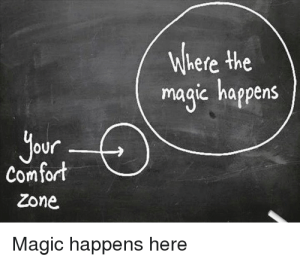
When we take steps outside our comfort zone, assumptions – and beliefs – are challenged and often adjusted.

WE often reach conclusions based on what we experience. So the more limited your experiences, the less-informed and potentially more biased your assumptions will be. When we meet new people and experience new ways of seeing the world, we are forced to re-examine and maybe even readjust our beliefs.


When we take steps outside our comfort zone, learning combats frustration born of stagnation.

Humans get bored. Just watch a modern queue and take notice of how many people are engaged in their phones to avoid a few minutes of idle and purposeless time. The same thing happens on a larger scale. We thrive on novelty, on challenge. When there is nothing left to learn, we become stagnant and then frustrated. The space outside a comfort zone offers unlimited opportunities for learning.

images-35


When we take steps outside our comfort zone, curiosity dominates and inspires wonder.

Have you ever watched a kid in a new environment? A place that is known to you suddenly becomes alive with possibility when seen through their eyes. Our brains have literally evolved to disregard that which is too ordinary. And when your life is spent entirely within a comfort zone, you risk having your brain ignore it all. Newness encourages our brains to wake up and pay attention, bringing with it a childish sense of exploration and wonder.


When we take steps outside our comfort zone, we allow space for authenticity and purpose.

We all-too-often become our labels – mother, father, caretaker, employee, etc. We forget who we really are and what really inspires us and drives us. When we leave our comfort zone, we often discard those labels for a period of time, allowing us the the opportunity to discover what is really important to us.


images-37


How We Act When We’re Afraid of Losing Someone

fear of losing

I remember that day vividly.

My then-husband was in Brazil, supposedly on a work trip. I was at home and unable to reach him when he failed to return to Atlanta at the anticipated time. As the panic rose, I alternated between frantically looking for information on the internet (Was there a plane crash? A tourist attacked in San Paulo? A car crash leaving the Atlanta airport?) and uselessly pacing the upstairs hallway.

I called his employer and received a non-answer. It was only later that I learned that they thought he was still in Atlanta since he wasn’t dispatched on a job.

I saved the number for U.S. Embassy in Brazil, telling myself to hold off until the next day before I made that call.

I contemplated driving to the airport, where at least I would be little closer to any news.

At some point, the anxiety and powerlessness reached untenable levels and I set out for a run, the brick of my flip phone clutched in my hand. I uttered desperate pleas for information as I hit the pavement, the movement a poor substitute for meaningful action.

He came home the next day.

He left for good three months later.

That wasn’t the first time that I was afraid of losing him. In fact, from the moment I “had” him, I worried about the loss of him. 

There was the time when we first started dating that he showed interest in another girl and I pretended that it wasn’t happening until the situation resolved itself. Then, there was the 1969 Ford truck whose headlights had a propensity to cut out while he driving the back roads in the Texas Hill Country. I pleaded with him not to drive that vehicle, convincing myself that he was safe as long as he operated another car. There was a cross-country move while I still remained in Texas for the semester with the unknowns inherent in a long-distance relationship. I compensated that time by planning for our upcoming wedding; surely talk of our futures would keep the plan on track. That was followed by a car accident where his small car ended up underneath an eighteen wheeler. Up until that moment, that was the closest that I had knowingly come to losing him. I responded by breaking down in the living room of my apartment, our pug nervously burrowing into my neck which was wet with tears. Interestingly enough, the fears I should have heeded never even crossed my mind.

Over the course of our sixteen years together, I carried a fear of losing him. And in so many ways, that fear kept me from actually seeing him. I allowed fear to be my chauffeur.

That’s the thing when we’re afraid of losing someone – we take a rational fear (after all, death and divorce are a part of life) and we respond to it in irrational ways – 


Fear of losing someone can present as: Denial

Apparently this was my favored approach during my first marriage (although I would have denied it vehemently at the time). Even while my general sense of anxiety built, I refused to examine the little inconsistencies that hinted at something going on behind my back. I was worried about losing him to death (especially as his hypertension continued to worsen); I never imaged that he would leave.

We all have a propensity to shove the unthinkable out of our minds as though if we don’t allow it mental space, it cannot manifest into existence. “It is impossible,” we declare. “They would never…” we insist. “It just can’t happen,” we recite, until we believe it to be true.

I’ve learned since to look more closely whenever I have strong feelings of dismissal arise. It may be that there is something hiding behind those feelings.


Fear of losing someone can present as: Bargaining

We know of bargaining as one of the “stages” of grief. What we don’t often consider is that the bargaining begins well before the loss. This often takes the form of, “If you stay, I’ll change.”

Bargaining can feel like a rational approach with its exchange of services. Yet underneath the transaction is an overwhelming aversion to loss, which means the promises made may be too big to deliver and the promises looked for in exchange may not be kept.


Fear of losing someone can present as: Control

Sometimes, the attempt at control is overt – the partner that keeps tabs on their spouses whereabouts in an attempt to prevent them from straying. Others are more subtle, operating with a clinginess that limits movement. “I love yous” turned into bindings.

Rarely does this method work. Not only are many things outside of our control, but there is no surer way to push someone away than to tell them they’re not allowed to go.


Fear of losing someone can present as: Indulging

I see this one sometimes as a teacher. When I encounter children that are overindulged and encouraged to remain needy, I often learn about a history of miscarriages or infertility or even the death of an older child. The parents, understandably so, are so afraid of losing this child that they hold them in a childlike state even as they grow.

A variation of this presents in adult relationships. The one who is afraid of loss tries to fulfill every need of the other in an attempt to make themselves invaluable. “If you need me, you can’t leave me,” the inner voice insists as they continue to turn themselves inside out to carry out even the unspoken requests.

I found myself starting to do this towards the end of my marriage. It was a subconscious, yet desperate attempt, to keep him with me.


Fear of losing someone can present as: Begging

“Please don’t do this this way,” my initial email to my absent husband begged. I still had the fantasy that if only I could talk to him, I could somehow change his mind (this was before I knew the extent of the betrayals).

I felt increasing powerless as my pleas were ignored. The reality is that I had no hope of changing his decision. As an independent creature, he had every right and ability to act as he saw fit.

Begging is the brain’s way of delaying the inevitable. It’s a stall tactic, and nothing more.


Fear of losing someone can present as: Panic

This is the most irrational of them all and also the most powerful. This is the death grip on the rope, the worst of the “what ifs” manifested all at once. Sometimes this can be triggered by an event and sometimes it can arise solely from internal worries. Once we’re in this state, it’s difficult to return to reality.

Tiger, the world’s best pit bull, taught me so many things. Not the least of which was how to say goodbye without fear. We loved that dog and were devastated to learn suddenly that he had a fatal bleed from a tumor on his heart. He was only eight.

As the day progressed after the initial veterinary appointment, the news grew worse. We accepted the truth – the end was imminent. My husband and I took him home for a few hours of loving attention before we laid him down on the floor at the vet’s and surrounded him with our bodies.

We weren’t ready to say goodbye. But it was his time to go. Any attempt to keep him with us would have not only been ineffective, it would have cruel and selfish. All we could do is thank him for the time we shared.

Loss is an inevitable part of life. Fearing it does not stop it. Resisting it only serves to make the release that much harder. We rarely get to decide when the end comes. We’re not often offered a choice in the nature or circumstances of the loss.

But what we can alter is how we live between losses.

We can lead with fear, anticipating the end well before it comes.

Or we can lead with love, finding gratitude for what we have.

The Life You Had is Gone

life gone divorce

“The life you had is gone.”

I would tell myself as a lament and in an attempt to force acceptance.

“You now have the opportunity to create a new life.”

I would continue, in a hope that optimism also operated on the “fake it until you make it” principle.

“You can now build a life you want. A better life.”

I was desperately trying to see the good in the devastation that had become my existence.

“But I don’t want a new life! I want my old life. With my husband. I want our imagined and planned-for future. I want what I had!”

The pain of loss and the fear of starting over challenged my resolution to move forward with the energy of an obstinate child.

I didn’t want anything new. Anything else. Anything different.

I wanted what I had. Or at least, what I thought I had.

When I tried to picture a new life, a life without him, my brain responded with the muscle memory of a comic artist who has drawn only a single character. All I could picture was him. I would see myself older and he, changed as well by the years, would be by my side. Like watching a silent movie, I envisioned the life experiences we would daydream about on long car rides or late nights on the deck. I saw things changing around me – new jobs, new homes, new friends. But always, he was the constant.

Even as I reminded myself that it was gone, I resisted letting go. I wanted what was known. Comfortable. I railed against the unfairness of it. The theft of my dreams among the obliteration of his promises.

“But it’s gone,” I reminded myself throughout these visions. “You’re wasting your energy. Throwing good money after bad.” I became my own drill sergeant. “Move on! Drop it! Let it go!”

“But if I let it go, I have nothing,” I whispered back at myself.

I tried to force a new identity on the man in my life vision, but it was like trying to fit a child’s mask on a grown man – it couldn’t block it all. I tried to blur his face in my mind, to smudge him enough that he could be anyone. If my inner voice and I had been female characters in a movie, we would have surely failed the Bechdel Test because all we talked about was a man.

“It’s gone. It’s gone. It’s gone,” became the words that punctuated my footfalls as I ran countless miles in an attempt to purge him from my body. At night, I filled the pages of my journal with both memories and pleas.

I held no love for the man I battled in court. He was a stranger. A monster. I wept for the man that I thought I wed. I cried for the loss of an illusion. But damn, it sure felt real.

But illusions rarely stand the test of time. Like most apparitions, it began to lose it opacity with time. I started to accept the delusions inherent in the former life I pined for. The old existence with its new blemishes no longer held the familiar appeal.

“I can’t build anything new until I release the old,” I was mouthing as I woke up from a dream. A dream where I was alone. Alone and happy.

“The life you had is gone.”

I reminded myself again. Only this time the words had lost their dreadful weight and were infused with a sense of curiosity.

“The life you had is gone.”

“And I wonder what will come next.”

Taking Responsibility: How to Tell When It’s Your Stuff to Own

It can be challenging to determine when something falls on somebody else’s shoulders and when it it is ultimately your responsibility to bear. Here are four ways to tell if it’s your stuff to own –


1 – A pattern keeps repeating.

When I first started casually dating post-divorce, I had guys start to pull back after a few days. At first, I brushed it off, lamenting the poor manners and hook-up culture in today’s world. But it kept happening and I eventually admitted that I was the common denominator. With just a brief amount of reflection, I soon embarrassingly realized that they withdrew because I was acting like their wife. Oops. It wasn’t intentional on my part, but since I had been married so long and dated so little, I was an expert in the first arena and a novice in the second. Once I identified the issue, I quickly corrected it and the pattern came to an abrupt halt.

When we repeatedly find ourselves in the same situations or with the same sort of subpar relationships, we often point the finger, blaming anything and everything we can. Yet when the same pattern keeps happening to you, I’m afraid there is a reason and you’re likely the source of it.


Here’s your stuff –

Identify any patterns that have a tendency to occur in your life.

Look for the commonalities between the situations and identify how you contribute to the pattern.

Consider how you can alter the pattern. Can you change the antecedent, your behavior or your response?

Enlist the help of a professional, if needed.


2 – It’s an issue you have now because of something that somebody else did to you.

My ex-husband certainly did not set me up for success with future relationships. By leaving with a text message, he primed me for fearing abandonment going forward and by committing bigamy, he set me up for worrying about future betrayals. Blaming him is futile, as he didn’t seem fazed about the repercussions of his decisions and besides, he couldn’t alter the impact that it had on me. I could also try to shuttle this to my now-husband’s shoulders, dictating his actions because of my past experiences. But not only is that not fair to him, it also won’t undo the damage from my ex.

It’s tempting to state that we need people to treat us a certain way or to do (or not do) certain things because it easily triggers us. And yes, we can (and should) communicate these preferences to others. But ultimately, our responses (or overreactions) are our responsibility because we are the only people that we can control.


Here’s your stuff –

Know yourself and your triggers.

Set yourself up for success by avoiding or limiting certain situations until you are able to handle them.

Communicate your preferences clearly yet without expectations.

Actively work to discharge the energy around your triggers.

Refrain from blaming people that come into your life after the event for what happened.


3 – It is not something that another person can fix for you.

I stress. Big time. My ex-husband learned how to soothe me when I got worked up when we were teenagers. I grew to depend upon his help to calm down when I would become overwhelmed. And then he left, and I was left stressing even more. When my now-husband came into the picture, I assumed that he would also take on the role of professional stress tamer. He refused, rightly pointing out that managing my stress was ultimately my job. I pouted, but I learned. And the techniques that I have in place now are far more effective than anything that my ex could do for me.

We often try to pass off our unwanted struggles on others. After all, it’s easier if we can outsource the things that we don’t want to get our hands dirty with. Life rarely works that way, however. We can – and should –  ask for help. But all others (including therapists) can do for us is offer guidance, support and encouragement. Ultimately, nothing changes until we do.


Here’s your stuff –

Know what you normally struggle with.

Ask for help when you can’t make progress or you are unsure where to begin.

Accept the limits of helping and be prepared to do the heavy lifting.


4 – You find yourself complaining about the issue repeatedly.

I used to have a really hard time going back to school at the end of the summer. I would feel the envy rise as I heard about the amazing vacations that other teachers took while I reflected on my time spent working or looking for somebody available to do something with. This happened more years in a row than I would like to admit. Finally, I realized that the other teacher’s trip weren’t likely to change and neither was my financial status. But I could still shift my summer focus from work to adventure-on-a-budget. And now, when I return, I hear others exclaim over my summer stories and pictures.

We all can fall into pattern of complaining. It’s easy and it can also feel productive since we are actually doing something (even if that something is only moving our mouths). There are two possibilities with the issue you’re complaining about. Either it’s out of your control and so you need to change your mindset or it’s something you can change and it’s time to get busy.


Here’s your stuff –

Be aware of the issues or situations that you frequently complain about.

Release any defensiveness around the issue; it’s only holding you back.

Identify if the issue is within your locus of control or not.

If you cannot change the situation, reframe how you view it.

If you do have some influence, come up with (and initiate) an action plan.


Related: What If it IS Your Circus and They ARE Your Monkeys?