

Join me on a little thought experiment as we consider two different situations…
Situation 1 – You go on a blind date, knowing nothing at all about the person before you meet. The date went well, not great but also not terrible. You had some good conversation and you think they’re a quality person, but you doubt you’ll ever see them again.
Situation 2 – You meet somebody on an online dating site. Due to your schedules, you are unable to meet in person for several weeks. During that time, the two of you have been texting and messaging constantly. The texts are flirtatious and even begin to tiptoe into some deep territory. “Maybe they’re the one,” you think to yourself as you excitedly get ready for your first date. The date goes well, not great but also not terrible. You had some good conversation and you think they’re a quality person, but you’re just not feeling it.
Even though the dates themselves are identical, how would your feelings about them differ? I would expect that the first situation would be easily shrugged off, whereas the second situation may well knock you down a bit, possibly even prompting worries about being alone forever.
What is the difference between the two?
Expectations.

As anyone with a dog around dinnertime knows, expectations are a powerful force. Unless you live a life without any predictability or patterns, expectations are necessary to navigate efficiently in a complex world. We expect the sun at the beach to be intense, so we respond by bringing an umbrella and sunscreen. We expect a toddler to become irritable on a long car ride, so we stash snacks and toys in anticipation.
But expectations are not always so benign. They have a way of sneaking up on us, whispering temptations into our ears and then running away unrestrained. We follow, only to end up face-planted as we trip over our own predictions when they fail to materialize. Other times, past trauma has primed the pump for expecting the worst, even when the worst is no longer the reality.
We cannot eliminate expectations from our lives. They’re innate and needed. But we can also learn to understand them better and we can become better at managing them so that we don’t continually break our own hearts.
Expectations can be trip wires in all areas of life – relationships, work, health, etc. I’m going to focus on expectations in relationships, although much of this applies to expectations in other arenas as well.
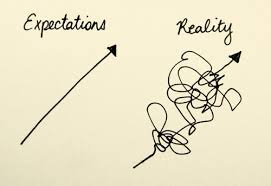
Expectations
The Good
Since we often face counsel to “let go of expectations,” we rarely take the time to reflect upon their benefits –
Opportunity to Gain Self-Awareness
We all develop our own personal narrative, stories that pass through our brains, spinning yarns and asserting beliefs. All too often, those personal narratives become tainted, as drops of fear or insecurity bleed throughout the story, altering and staining it without enough external influence to right the path. And expectations can come from those painful places. After all, a fear of abandonment is really an expectation of abandonment sparked from some prior experience.
We are not always aware of our internal narrative. It’s too close, too much a part of us. But disappointment is a handy way to recognize when our expectations are out of alignment. So let those times when you feel let down by someone become an opportunity to look within. What were you expecting? Where did that expectation come from? The answers to those two questions can give you some great insight into yourself.
Keeps Us From Settling For Less
Sometimes expectations act to inform us what we deserve. This is especially true when we come from a healthy and loving family and we anticipate others to treat us in the same way.
Expectations can act like a minimum fill line in a pool, alerting us to behaviors that fall below a certain threshold. In a relationship, it is perfectly appropriate to expect to feel safe, to feel loved much of the time and to have an atmosphere of honesty and respect.
Allows Relationships to Operate Efficiently
Expectations and habit allow us to shift some of our daily lives to autopilot. This isn’t always ideal, but in a busy world, it’s often necessary. When we have an idea what to expect from our partner, we can shift our own choices accordingly. For example, if you want an opportunity to reconnect with your spouse over a meal and you know they’re not a morning person, you propose a dinner date as opposed to brunch. Expectation and adaptation.

The Bad
Of course, expectations have their downsides –
We Are Set Up for Disappointment
We recently received a widespread lesson in the danger of unchecked expectations. I don’t think any series finale has been so widely anticipated as that of Game of Thrones. After years of a wild – and emotional – ride, the expectations of fans were at an all-time high. And the disappointment after the ending was almost palpable.
No matter what happens in reality, it will never align perfectly with our expectations. So when we become too wedded to a particular outcome, we are guaranteeing our own disappointment.
Related: Are Expectations Dooming Marriage?
Other’s Actions Are Outside Our Locus of Control
Sometimes we act as though our internal narrative is script and others should be reading the lines and following the stage directions we have prepared for them.
But of course that’s not true.
We can have expectations all day long, but unless it’s something within ourselves, we have little influence on what actually happens.
We Confuse Boundaries and Expectations
Expectations say, “I’m assuming that you’re going to…”
Boundaries say, “If you do …, then I will…”
Note the difference. The first isn’t giving the person a choice. It’s guilty until proven innocent. Whereas the latter gives the other permission to act and then provides information about the consequences.
Letting go of expectations is not the same as permitting others to treat you poorly. If they act badly, let them face the consequences. But also give them the opportunity to make that choice before you enact the repercussions.

The Ugly
And then there’s this. Expectations can cause worse effects than disappointment. They can set us up for catastrophe –
When Expectations Are Too High, We Are Always Chasing Contentment
I have been outspoken in my disdain for the concept of a single soulmate. I mean, talk about a high expectation! I have to somehow manage to find the one, single person that is perfect for me. And then once I have them, everything will be easy because we are meant to be together. So then what happens when you first face discord in your relationship? Does that mean that they were the wrong person and you need to resume the search?
We are constantly bombarded with images of perfection. And so we can easily find ourselves lacking. When expectations are unrealistic, we will never be happy because the bar is set at infinity and we’re mere mortals.
Expectations Can Influence Reality For the Worse
I love the studies that have been done in schools where the teachers of two comparable classes were given different – and false – information about their students. One teacher was told that their students were exceptionally bright and they could expect great things from them. The other educator was informed that their students were slow learners and have never really shown much promise.
Same types of students. Different expectations. And VERY different results.
I bet you can guess which class did better.
People have a way of acting as we expect them to act. After all, even if we say nothing, our unconscious interactions will reveal some of our internal beliefs. This chicken-and-egg dance often happens with infidelity. We often assume that the cheating happens first, followed by the suspicions. Yet it is not rare for the distrust to enter first with the infidelity following behind.
When expectations are too rigid, we fail to give others the space to change. And if we’ve inadvertently set the bar too low, we may just find that it’s met.
When we lead with expectations, we are not truly seeing or hearing the other person. Instead, we’re interacting with the mental construct we have of them. We’re in an echo chamber, seeing and hearing only what we expect. Confirmation bias is a powerful force.
Toxic People Can Hide Behind Our Expectations
Sometimes our expectations of people are too high. We start from a belief that they are kind and operate with integrity and then we assume that their actions will be in accordance with those characteristics.
And if they’re not honest and kind? They very well may take advantage of those expectations, manipulating things behind the scenes like a magician’s assistant behind a screen.
Expectations can blind us to truth as we confuse desire with belief. And that’s a dangerous road to travel.


Learn to Work With Your Expectations Instead of Fighting Against Them
First, let me state that I am by no means an expert when it comes to managing expectations. I struggle with it on a frequent basis. But I HAVE gotten better at keeping them in check. Here’s what has worked for me:
Awareness of Expectations
Expectations can become so ingrained, so knee-jerk, that we often take them for granted and hardly even notice them. In order to become more aware of my own expectations, I’ve committed to paying attention to my disappointments and where they are coming from.
It’s been an interesting and eye-opening exercise. I’ve learned that my expectations anchored in trauma have all-but-disappeared, yet I still struggle with plenty of other maladaptive expectations. And as I become aware of them, I’m better able to adjust them to the actual circumstances.
Shift Your Expectations Within Your Locus of Control
When I first started dating post-divorce, I did one smart thing in a great big tangle of not-so-smart things.
I decided that my expectation for every date was that I would learn something. Here’s the beauty of that expectation – it had a 100% chance of being met every single time because I was the one in control of it. I was even able to learn something on the times I was stood up:)
In contrast, if I had expected for every date to go well or every man to be attracted to me (or me to him), I was guaranteed to fall short.
Practice Being Flexible
Sometimes when my expectations aren’t met, I don’t become disappointed.
I become irritable.
This happens when I’m knee-deep in my planned tasks (thanks, anxiety!) and I’m having trouble shifting gears when my predictions go awry.
As with everything, practice makes better. So the more I practice being flexible and trusting that it will be okay even if it doesn’t go to plan, the easier it becomes.
Keep Your Expectations Realistic
I love to travel and I love to travel with my husband. However, he is not as enamored of trips as I am. So whenever he mentions a possible trip, I get excited.
I used to get too excited.
I would research, plan and dream. Then, I would present him with the information and he would be all, “Eh.” I took his rejection hard, feeling like my hopes had been machete-cut like a coconut on some tropical beach.
But here’s the bigger picture. My husband is an extrovert with ADD. That combination means that many of his thoughts are shared aloud, even the impulsive, not fully-matured ones. So he may want to go on a trip, but the casual mention doesn’t mean that he has fully thought through all of the time and financial repercussions. And that’s who he is, not something I can ask him to change.
As an analytical introvert, I fully think (okay, overthink) anything through before I speak it. And I was listening to him as though he was me. Which of course, he’s not.
So I’ve learned. Now, when he mentions a trip, before I do anything else I ask a few questions – What sort of timeline are you thinking of? Where are you with commitment to this on a scale of 1 to 10? And with just those questions and any needed follow-ups, I know where my expectations should be.
Result? I don’t get disappointed and I thoroughly enjoy the trips I do take – with or without – him.
The best bet is to keep your expectations high, but also realistic.
Communicate Your Expectations
If birthdays are important to you, you might get your hopes up as the first birthday approaches in a new relationship. After all, it’s easy to assume that what is important to you is also important to someone else. And then when the day comes, if their excitement isn’t on par with yours and they either fail to appreciate the celebration you created for them or didn’t meet your expectations for the recognition of your birthday, you feel dismissed and unimportant.
Yet it’s also not fair to expect others to meet our expectations if we don’t communicate them. Until Elon Musk develops some sort of implantable mind-reading device, we have to express both our expectations and the importance of them to others.
If we don’t say anything about the expectation, the resulting disappointment is on us.
Try to Replace Expectations With Curiosity
Some of my favorite yoga teachers are consistently good, yet I never know what to expect from them since every class is good in its own way. They have helped me shift my thinking before class from, “I hope we do some hip-opening today” to “I wonder what goodness we are going to do in class today.”
When we’re curious, we are not wed to any certain outcome. Instead of closing our minds and sealing the cracks with conclusions, we are throwing the doors wide open to see what might show up.
Give to Give, Not to Receive
It feels good to have your efforts recognized and affirmed. But if that’s the only (or at least, a major) reason you’re giving, you will be disappointed. Whether from a lack of awareness or a lack of caring, you will not always be validated for your efforts. Give because you want to give, not because you expect something in return.
Distinguish Between Needs and Expectations
Needs are requirements. Expectations are hopes.
Sometimes I confuse those, feeling as though not having my expectations met is a personal attack that causes great damage.
Yet I’ve survived every disappointment that has ever come my way.
We don’t always get what we want.
Yet sometimes as a result, we end up with exactly what we need.
Good Ol’ Gratitude to the Rescue Again
When I do feel disappointed because my expectations have not materialized, I like to pause for a moment to think about the good that has come from the situation. And usually, it’s surprisingly easy to find once I let go of the image of how things are supposed to be.
Ultimately, it comes down to this –
You have a right to your expectations. You have a right to feel disappointed. You have a right to not accept behaviors. But you don’t have a right to expect others to act the way that you want them to act. And the sooner you accept that, the more at peace you’ll be.

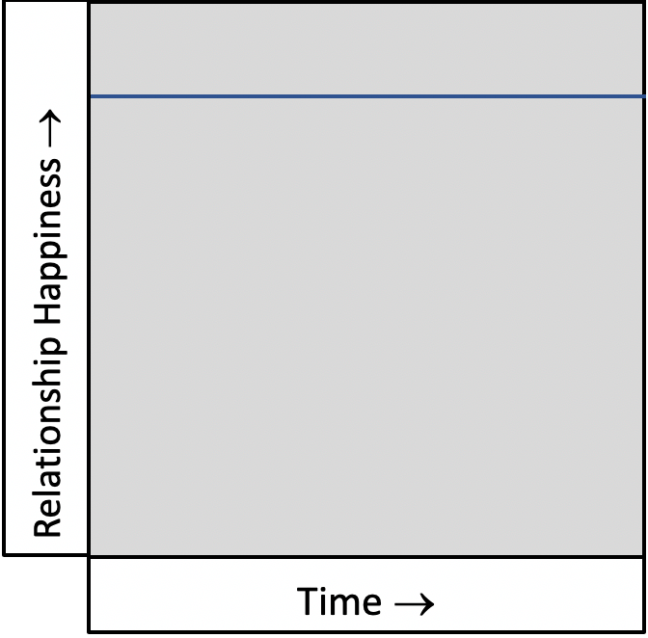
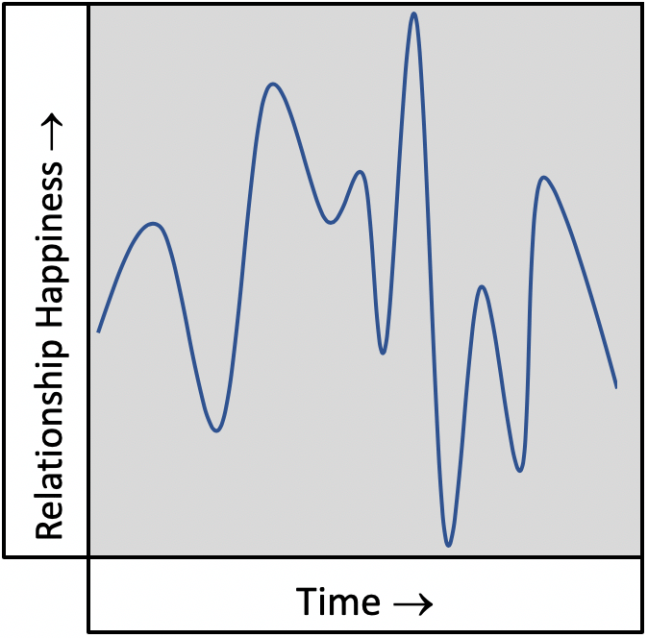







 Lessons From the End of a Marriage