We don’t come with emotion-handling software already installed. As young children, we were pure, unrestrained emotion. Any disappointment resulted in a red and tear-stained face and joy over the smallest delight would result in spontaneous and unselfconscious giggles.
And then, over the years, we received guidance on how to handle our emotions. Some of us heard the message that emotions are a sign of weakness and should be avoided at all cost. Others grew up in environments where emotions were a form of currency, used to get what you want from those around you.
Regardless of our particular emotional education, few of us mastered the curriculum by adulthood.
So here’s a little guidebook, a brief refresher on how to handle your emotions. Don’t worry if you still struggle with these reminders. Learning how to be human takes a lifetime.
Do Be Curious…Don’t Judge
It always breaks my heart a little when I hear someone say, “I shouldn’t feel that way.” Because they DO feel that way. And that is entirely okay. Judgment doesn’t make the emotion go away. All it does is frost it with a layer of self-criticism. Instead of judging the emotion, try asking yourself, “I wonder why I’m feeling this way?”
Do Approach…Do Not Attach
We are busy. And with so many tasks and people and apps always demanding our attention, our own internal emotional landscape often takes the back burner. Yet even if we don’t take the time to look, it’s still there, influencing everything that comes into our sphere. Slow down. Take a moment to notice how you’re feeling. Name it. But don’t become too comfortable. Emotions, like clouds, often pass. If you attach too much with a certain feeling, you’re interrupting this natural cycle.
Do Moderate…Don’t Bury
It’s a good thing that most of us have gotten better at handling emotions over time. An entire office building of tantruming workers would be a little awkward. We need to be able to dial down our emotional intensity and filter our emotions through perspective and rationality. Yet sometimes we take this too far, stuffing down our emotions and locking them away. Of course, they are still there. Only now instead of whispering, they’re going to start screaming.
Do Accept…Don’t Enable
You feel the way you feel. That’s okay. What’s NOT okay is to cater to those feelings like they are some sort of monarch. For example, if you feel sad, feel sad. But you don’t need to work to become the best iteration of sadness that ever existed. Instead, feel sad and also hold yourself to your goals. And remember, you are not your feelings.
Do Direct…Don’t Control
Have you ever told a hyper toddler to just sit still in a restaurant? How did that work out for you? Obviously, you can’t just let them unleash the beast within the establishment, but you can take them for a walk around the parking lot before dinner. Our emotions respond in much the same way. If you try to order them to sit and stay, disaster will ensure (and you may be thrown out of the restaurant), but you can channel your emotional energy in acceptable ways.
Do Listen…Don’t Believe Everything They Say
Our emotions are worth listening to. Our rational brains may be smart, but they are also prone to all sorts of fallacies and delusions (confirmation bias, anyone?). Our emotions operate a different level and are often able to pick up on things that our thinking selves are trying to talk us out of seeing. So listen. But also verify. Because much like the dog that sometimes barks at a falling leaf, our emotions sometimes get a little confused about what constitutes an actual threat. Feelings are not facts.
Do Share…Don’t Expect a Certain Response
We are emotional beings. It’s okay to show your feelings. Yet so often when we do share, we do so with an expectation of how the other person will respond. And then if our expectations are unmet, we blame the emotion. When really the fault is with the unrealistic expectations. Emotions are uniquely personal. Although we all feel the same ones, we don’t always feel them in the same way or in response to the same things.
Before I had been on the receiving end of infidelity, I imagined that I would respond to the news that someone had cheated on me with anger, misery and a deep sense of betrayal. And when I did eventually encounter infidelity, those anticipated feelings were definitely present. But they weren’t alone.
These four emotions caught me by surprise after I was cheated on:
Relief
When evidence of a jewelry purchase appeared on the account activity, the first emotion I experienced was one of relief. For months, I had been experiencing an undercurrent of anxiety, a low-level hum that indicated that something in my life wasn’t calibrated correctly. My then-husband’s sudden exit with a brusque text message confirmed that my subconscious was indeed onto something. Yet, it was only with the discovery of the affair in the days after the text, that the pieces began to fall into place.
Relief is the last emotion I would have expected to feel upon the discovery that my husband was cheating. Yet the sense of release was unmistakable. I felt reassured that I wasn’t going crazy; the cause of my anxiety was finally revealed. Even as I struggled to accept the horrific truths, I found comfort in the fact that they had been brought to light. After all, an adversary you can see is less frightening than the one hiding in the shadows.
It is often the case that the betrayed partner has a sense that something is wrong in the marriage. However, due to the cheating partner’s efforts to keep their transgressions hidden and the betrayed spouse’s fear of facing the truth, it can be difficult to pinpoint exactly what is amiss. The discovery of the affair is conformation that something is wrong and it helps to provide an explanation for the words and actions that may have been misaligned.
The discovery of an affair is sickening, a sucker-punch to the heart that may well bring you to your knees. Yet alongside the grief and anger, you may just find yourself relieved to finally know the truth. There is pain, but now it is in the light.
Sympathy
I had no reason to feel sorry for him.
He had been lying for years, stealing my money, my heart and my trust. He ended the marriage in the most cruel and cowardly manner possible and then led a fabrication-fueled offensive against me in court. One the one hand, I hated him, this man who had turned from my protector to my persecutor. Yet at the same time, I felt sympathy for him, the man whom I had loved and wanted to see happy.
I envisioned him lost, hurting and confused. I wanted to provide comfort, reassurance. I simply couldn’t shut off all of the concern that I held for him; caring for him was a deeply-ingrained habit if nothing else. And then reality would intrude again, and the empathy and compassion would be replaced with indignation and a desire for justice.
As is common with cheaters and abusers, he tried to cultivate sympathy, both from me and from others. His hand held several victim cards, and he played them carefully, both to distract from his actions and to gain favor for his benefit. Interestingly, this “poor me” act had the opposite effect on me; the more he tried to garner commiseration, the less I felt sorry for him.
Many cheaters cry crocodile tears and make pleas of “needing to find their happiness” in an attempt to continue their actions and to continue to avoid the consequences. They may bring up stories of childhood trauma, times they have been betrayed or claim misery at work or home. If these appeals for sympathy are unaccompanied by a claim of responsibility for their choices, they are using your kindness and tendency to nurture against you.
From an outsider’s perspective, sympathy for the betrayer makes no sense. Yet from the inside, the emotional response is often not so clear-cut. After all, this was a person whom you loved. You’re probably struggling to understand how they could do these things to you and you may see them as operating under extreme duress, as though their own mind was holding a gun to their back, ordering these out-of-character actions. They may even be using your sympathy to manipulate you, knowing that if you feel compassion towards them, you’ll be less likely to enforce consequences.
In the beginning, you may find yourself swinging between a need to make them pay and a desire to soothe their pain. In the long run, you can find a balance between sympathy and rage. From a place of detached compassion, you can begin to find peace and some sense of understanding while maintaining the necessary boundaries that will keep you safe.
Self-doubt
“Living with her was impossible,” my then-husband expressed about me in an email to my mother. “She was always negative and nothing was ever enough for her.” Even though I knew his words were woven from fabrications and projections, they still filled me with a sense of doubt. Was I always negative? Was I impossible to live with?
I learned that he had long ago paved the way for his friends to believe his version. At work, he told outrageous (and completely invented) stories of my transgressions and irrational demands. Further complicating matters, upon learning about his rapid and covert exit, others assumed that I must have done something terrible in order for him to act in such an extreme manner.
I knew all of these claims were false. I had years of emails, notes and photos to counteract many of the lies and countless friends and coworkers that fully had my back. His lies rose to absurd levels and often contradicted each other.
Yet still I wondered. Somehow still believing his self-serving lies even in the face of evidence to the contrary.
Because that’s the power of gaslighting. It turns your world upside down while you’re simultaneously being told that you’re just seeing things. It plants seeds of doubt deep within your brain that spread their tenacious tendrils of uncertainty months and even years into the future.
Gaslighting is frequently used as a manipulation tactic to try to distract from and excuse an affair. In addition to the self-confidence blow delivered by being rejected, gaslighting can lead to a major crisis in your ability to trust yourself and your perceptions. So you can find yourself in the crazy-making place of questioning your own character when it was your spouse that made the decision to betray the vows.
Mania
I pursued the facts with the tenacity of a dog attempting to reach the last bit of peanut butter from the bottom of the jar. Nights found me at my computer instead of my bed, diligently building a case against my husband until it filled the better part of a large plastic bin.
As the court process slowly made its way to a conclusion, I transferred my energy to running. Then, to dating. And once I found a groove there, I focused my endless energy on moving into an apartment and creating my new space.
Others questioned where I found the reserves to keep moving. I questioned if I would ever be able to stop. I felt consumed by this manic and all-consuming energy, an unexpected side effect of the betrayal and abandonment.
Post-divorce mania is characterized by an increase in energy accompanied by an intensity of focus. It’s a compelling drive, a sense of being propelled by an internal motor that refuses to idle. It often has an obsessive quality, focusing on one thing to the exclusion of all else.
This mania is initiated by a fear of slowing down and feeling too much. It’s maintained because it’s compulsive nature feeds our dopamine receptors, keeping us coming back for more. It’s a side effect of the need for action, the gas pedal to the floor and the steering misaligned.
Like with any mania, it’s hard to see the bigger picture while you’re in it. Especially because it feels better than being sad and powerless. And also like any mania, it’s unbalanced. Too much yang and not enough yin.
Ultimately, there is no “right” way to feel after betrayal. The emotions will be strong and sometimes unexpected. They will tumble over each other and trip you up in the process. You’ll have moments of overwhelming pain and glimpses of radiant hope. And most importantly, no matter how overwhelming or surprising those emotions are, you WILL make it through.
Those were some of the emotions that I experienced when I discovered that my first husband had been having an affair. None of those feelings surprised me; they were the emotions I would have expected to follow the gut-wrenching discovery of betrayal.
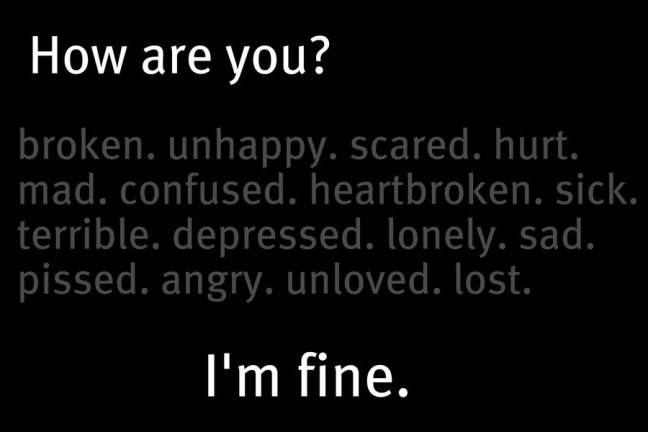
And how many times were those utterances accurate, describing your well-being as exceptional? Thriving? Or, in the more modern use of the term, simply satisfactory?
And how many times were they offered in reflex, in deflection or even as an outright lie?
__________
Here are some of the true feelings that can hide behind “I’m fine.” Do you relate to any of them?
“I’m afraid that if I start talking, I’ll start crying.”
My world is a mess right now and I’m trying to just get through. I may look okay, but I’m really just going through the motions.
“I’m trying very hard to pretend that I’m fine. Please don’t intrude on my delusion.”
If I really paid attention to my intuition, I would probably know that something is not right. But I’m not ready to face it yet so I’m going along with the idea that I’m fine.
“I’m not fine, but I don’t feel safe sharing that with you.”
Things are really hard right now and I wish I could talk about it but I’m afraid that you’ll ridicule me or somehow add to the pain. So I’d rather play it safe and keep my feelings tucked inside.
“I don’t know how I’m doing, to be quite honest with you. I don’t really give it much thought.”
I haven’t allowed myself to slow down enough to be aware of how I’m doing. I stay busy and pretend that as long as I’m doing, I am fine.
“I’m afraid that if I admit to not being fine, you’ll see me as weak.”
I know you see me as the strong one. The one that holds it all together. And I don’t want to be seen as weak or have you think that I can’t be counted on.
“I’m not fine and that’s my problem.”
I don’t want to burden you with my troubles. You have enough on your plate.
“I believe that I should be fine, so I play the part to the world.”
It’s been a long time since the event. I have so much going for me. I have nothing to complain about. I feel guilty for not feeling fine when so many others have it much worse.
“I don’t have the energy to explain my not-fineness to you.”
I’m tired. Defeated. And even just the thought of trying to explain how I feel is exhausting. So I give you the two syllables needed to stop you from probing further.
“I’m frustrated or upset with you, but I don’t want to rock the boat.”
I’m not fine, but I’m afraid that if I tell you how I feel, you’ll be angry or disappointed. And my fear of your reaction is greater than the pain of holding back. For now.
“I was taught that my feelings aren’t valid. So I suppress them.”
My parents taught me that feelings were stupid. I learned that nobody will listen or respect my emotions. So they stay hidden. Even from me.
“I want to be left alone.”
I really just want to crawl into bed and hide under the covers until this fades. Please don’t come in after me.
“I need time to process my feelings and put words to them.”
I want to open up, but I need to do it at my own pace once I wrap my brain around what I’m feeling.
“I need someone who will just listen. Not try to fix things.”
I’m not fine. But I’m also not helpless. I want to be able to share my feelings without you trying to step in and fix everything.
__________
I’m not suggesting that the next time the cashier at the grocery store asks you how you’re doing, you should respond with a truthful unloading of your current worries. Unless you want to be the one they all try to avoid when you walk through the door, that is.
After all, many of our daily interactions are superficial and that’s okay.
But not all of them are.
And when “I’m fine” becomes a habit, a reflex, that we apply to our friends, family, therapists, doctors and even ourselves?
We’re robbing ourselves and our relationships of the vulnerability and connection that comes from the courage to respond with authenticity.
So next time somebody asks how you’re doing, respond consciously.
Here are some words to choose from:
sad nervous excited anxious lonely energized confused frazzled aroused irritated content elated angry lost melancholy fatigued overwhelmed engaged hurt fabulous frightened playful relieved embarrassed awed vulnerable relaxed jealous unsure apathetic curious grief-stricken grateful rough around the edges better every day making progress happy to be here
You find an uninvited man standing in your living room.
He’s not saying or doing anything.
Just standing there.
What do you do?
Do you pretend that there is no man standing in your living quarters as you go about your daily life denying that he is there?
Do you insist that there shouldn’t be a man there and persist in your assertions even as he stands there?
Do you try to convince yourself that there isn’t a man there, that maybe it’s just a trick of the light?
Do you talk yourself into believing that it’s not a man even if it looks and acts just like one?
Do you consciously ignore the man hoping that he will get the message and just go away?
Do you distract yourself from thinking about the man with an afternoon cocktail or endless work?
Do you attack the man in anger, trying to beat him into oblivion?
Or, do you approach the man and engage in conversation to determine who he is and what he wants?
Which approach do you think will lead to the most favorable outcome?
Now, go through that same exercise again only, this time, the man is your negative feelings – your pain, your anger, your shame, your guilt. He embodies it all.
Do you pretend that there are no feelings as you go about your daily life denying that they are there?
Do you insist that there shouldn’t be feelings there and persist in your assertions even as they stand there?
Do you try to convince yourself that there are no feelings there, that maybe it’s just a trick of the mind?
Do you talk yourself into believing that it’s not pain/anger/shame/guilt even if it looks and acts just like it?
Do you consciously ignore the feelings hoping that they will get the message and just go away?
Do you distract yourself from thinking about the feelings with an afternoon cocktail or endless work?
Do you attack the feelings in anger, trying to beat them into oblivion?
Or, do you approach the feelings and engage in conversation to determine what they are and what they want?
Which approach do you think will lead to the most favorable outcome?
Approach your negative feelings with curiosity.
Shake hands with them.
Learn where they come from and what they need to go away.
And once they’ve served their purpose, feel free to show them the door.



 Lessons From the End of a Marriage