Marriage and the Fear of Missing Out

marriage fear scared

Do you have a fear of missing out on life if you commit to marriage? You’re not alone.

In some ways, I skipped my twenties.

Most teenagers were rapid cycling through partners, trying on and discarding potential pairings like jeans in a dressing room. I had been committed to my then-boyfriend since the age of sixteen.

While my classmates were spending weekends getting wasted at frat parties, I was spending the days running errands and maintaining a home with my then-fiance.

Others in my age group spent their earnings on clothing, concerts and travel. I carefully saved in order to purchase a house with my then-husband at the age of twenty-two.

I laughed about these contradictions at the time; I never regretted the decisions I made and I was happy in my life. When asked about my feelings about entering the next decade on my thirtieth birthday, I responded by saying that I didn’t anticipate anything different since I had been living as a thirty-something for the previous decade.

And then divorce happened. And with it, some regret for missing out on the “normal” experiences of the young. I was married when most of my friends were busy partying and then I was thirty-two and dumped soon after I attended those same friends’ weddings.

I reflected back on the boys or young men that I’d met and turned down. I thought about the alternate life I might have had if I had lived a more traditional college experience. I considered the freedoms that I had exchanged in the name of security Β (a false trade as it turned out).

I like to compare myself in the period post-divorce to one of those spring-loaded snakes released from a canister. I exploded into the world, determined to recapture the life I had missed in my twenties.

Some of it was fun. I dated casually without concern for the future. I sometimes neglected sensible saving for fun-in-the-moment. I embraced the positives of losing everything and enjoyed the flexibility of having few responsibilities and fewer belongings. I said “yes” to most everything and tried to view challenges as adventures.

But it wasn’t all good.

Even though I went on dates every night, I returned to my cold and lonely bed at night without someone to hold me through my nightmares. I socialized nonstop, yet few really knew or understood me. The adventures were fun and I enjoyed playing around with my persona, but I often felt like I was playing a part instead of being true to myself.

What I thought I was missing turned out to be not all that. Just like being married, it had its own benefits and its own downsides.

FOMO (Fear of Missing Out) is really nothing more than viewing the distant grass as greener than the lawn you’re standing on. The married envy the flexible and free life of the singletons while those that are single often yearn for the intimacy and stability of partnership.

I met my now-husband when I was still in the throes of manically attempting to live a decade in a few short months. And almost from the beginning, he felt different. I realized that this could be a long-term thing instead of simply another fun fling. I considered my options. A relationship was appealing, yet I still didn’t feel purged of my need to not act my age.

He handled it perfectly. A couple months in, he told me that he was committed and also said that he knew that I wasn’t ready to yet. He gave me the time and space to figure out which side of the grass I wanted to be on. A few weeks later, I took the step.

At the time of the divorce, I thought that I had missed out on dating. On being young and stupid. On experiencing life with people other than my spouse.

What I realized was that my regrets really weren’t tied to my marital status. I wasn’t afraid of missing out on kissing some random guy or the mobility assisted by a single status. What I was really afraid of was living too small. Of allowing fear to limit my choices and denying myself the ability to question. I was afraid of marriage being an end rather than an addition.

I’ve kept some of what I started during my months of Match Madness (dubbed because of my activity on the dating website). I’m still more likely to say “yes,” I try to maximize my adventures and I’m not as afraid of being irresponsible or breaking the rules. I took some of that green grass from the other side and replanted it where I stand.


DSC_8192
Married…and definitely not missing out πŸ™‚


Understanding Projection

My ex husband accused me of cheating.

Never to my face, maybe because he feared my response or because on some level he knew the claim was baseless, but to his friends and coworkers. After he left, I learned that others had been hearing graphic and disturbing stories of my supposed infidelity for years.

He then went on to detail my irresponsible spending in his “suicide” letter to his other wife and to my mom (he made a suicide attempt when he was released from jail). He described how I wouldn’t take “no” for an answer and I always needed the latest and greatest things.

My initial reaction to my discovery of these accusations was one of unmitigated horror. You see, I trusted him so much and had slowly been groomed to accept his description of reality, that I initially believed that his claims must be true.

And then I grew confused. Because none of the facts, which I obsessively detailed to those who surrounded me in the aftermath of the tsunami, matched his claims. I struggled to understand what was real as the oil of his accusations failed to blend with the water of my recollection.

Finally, it became clear. He was charging me with the exact misconduct that he was guilty of. He was projecting and I was the screen.


What is Projection?


Projection is a common cognitive dance where self attributes or actions are shifted to another person. Much of the time, it is relatively harmless. Yet in the hands of an addict or abuser, projection can be used in a more detrimental way to distract or to transfer blame.

We all engage in some amount of projection. In some cases, projection allows us to empathize with others when we superimpose how we believe we would feel in a given situation over their stated experience. Other times, we may assume that someone feels the way we do or that they have the same aptitudes or perspectives. You see this when people caught behaving badly offer up the excuse that “everybody does it.”

Projection is also used as a defense mechanism. When there is some aspect of your beliefs or behavior that does not align with your view of yourself, you experience something called cognitive dissonance, where you either have to alter your view or amend your behaviors. One “solution” to the discomfort caused by this misalignment is to assign the disallowed characteristics to somebody else in the classic, “It’s not me, it’s you” move.

Often times, projection occurs when we are aware of something, yet we’re not yet ready to see it in ourselves (an example of this would be the claim that, “You don’t love me” when the reality is that we’re starting to doubt our own love). After all, it takes quite a bit of courage to look within.


Projection As a Weapon


I’ll never know to what extent my ex husband was aware of his projections. It’s possible that he was so deluded that he accepted his lies as truth (in fact, he actually told my mom after the suicide attempt that he had started to believe his own bullshit). But it’s also likely that his projection was largely conscious, distilled and aimed in order to cause the maximum damage.

By accusing me of horrific misdeeds, he excused his own undeniable choice of abandonment. When he projected his deceptions on me, he painted himself as the victim. His indictments acted as a slight of hand, keeping me distracted from looking too closely at what was happening on the other side of the stage. And finally, he used projection as a form of gaslighting, blurring and altering my view of reality.

If you’ve been in a situation where you have endured emotional abuse or faced the helplessness and frustration that comes from living with an addict, you’re vulnerable to believing the displaced accusations. Your self-image and confidence are likely low and you’re prone to assume responsibility for another’s well-being. When these accusations arise, refrain from blind acceptance. Ask yourself first if those claims are actually a better fit for your accuser.

As the divorce proceedings progressed, I found my new awareness of his tendency to project helpful. Whenever he accused me of something (withholding information, lying on a discovery document, etc.), I knew what to expect from him. Because even though his projections were aimed at me, they were simply a reflection of him.

I’ve Been There

Guest Post: Five Ways to Make Your Divorce Less Stressful

It’s taken as a given that our lives are getting more and more stressful by the day. In all honesty, it’s not hard to see why: we’re busier than we’ve ever been, the cost of living keeps rising and we’re frequently bombarded with conflicting information.

With modern life being so stressful and divorce being one of the most taxing things that we can experience, the need to destress and take care of yourself during this difficult period cannot be overstated. Failing to do so is likely to have significant and adverse long-term effect on both our physical and mental wellbeing.

Here are five things you should do to make your divorce less stressful:


  1. Stick to email

As you’re probably going to need to communicate with your spouse at some point, it’s best you do it via a medium you can easily step away from if you feel yourself starting to get angry. That’s why we recommend communicating via email until your divorce is finalised and you’re both feeling a bit calmer.

β€˜But text messages are easier’ you may argue and, you’d be right – but that’s the problem. As your phone is omnipresent, it’s all too easy to give in to temptation/frustration/anger and send an inflammatory message. Now, we know that you can probably send an email from your phone but the lengthier nature of these messages, coupled with the fact you’ll need to do that little bit more to send them, means you’re much more likely to come to your senses before hitting β€˜send’.


  1. Allow yourself to feel how you feel

In my experience, it’s divorcees that actively fight the inevitable negative feelings that do themselves the most psychological damage. Battling against emotions that are completely natural is going to do little more than make the process of divorce harder and, ultimately, leave you feeling guilty for feeling the way you do. This, in turn, will create a very unpleasant and damaging cyclical process.

If you feel sad, angry or anything else, you have every right to – just let it be.


  1. Take advice with a pinch of salt

Sometimes, the advice you’ll receive from friends and family will be excellent, but sometimes it’ll be counter-productive, overly emotional and, well, just bad.

Sadly, all of the people who are close to you will be well-intentioned, but they’ll also often provide advice and insist you should follow a course of action without having really considered the potential consequences. Just think about that for a second and I’m sure you’ll be able to think of a time you did something similar; like when you were speaking to that friend who was considering resigning to setup a restaurant, for example. We often tend to tell our friends what we think they want to hear rather than what we actually believe to the best course of action and forgetting this can lead you to make bad decisions which could make your divorce very stressful indeed.


  1. Be aware of your needs

This can be a tough one as, often, we’re wholly unaware of what our needs are at any given time. That said, when we feel upset, stressed, anxious or any of the other negative emotions that come bundled up with a divorce, it’s worth taking a moment to see if we can determine what we need at that time.

It could be some company, your favourite meal or anything – if you’re unsure of what you need, don’t worry, just be kind to yourself and give yourself the time you need to work it out.


  1. Exercise

This is certainly the most conventional piece of advice on this list, but it’s also undoubtedly the most effective. When we feel stressed our boy releases the stress hormone cortisol and it remains in our bodies promoting negative feelings until we burn it off through physical exertion.

So, by regularly partaking in exercise, you’ll not only help your self-esteem, but will go a long way towards averting the negative emotions brought on by a divorce, too!


Author Bio:

Jay Williams has worked with divorcing individuals for more than a decade with Quickie Divorce, one of the UK’s largest providers of online divorce solutions. He lives in Cardiff with his wife and two-year-old daughter Eirys.


Diving for Pearls

There are times when Truth is important –

When my students use verified geometric theorems to prove triangles congruent.

When my husband tells me where he’s going on a Tuesday night.

When my doctor asks about my family history of cancer.


And then there are times when Truth really doesn’t matter.


A person reached out to me yesterday with the concern about their place in their former partner’s view – did they love me or did they use me?

As I sat on the bench in the gym locker room typing out a response, I was transported to a time when that same question consumed me. As the details of my husband’s other life began to surface, I couldn’t help but contrast what I was feeling at that time (loved) with what he was doing at the time (anything but loving). There was no doubt that he was acting without concern for me towards the end, but did that mean that he never cared for the entire sixteen years?

I was obsessed with answering this question. I would consider evidence in the form of memories or discovered facts and dutifully enter a mental tally mark in either the “He loved me” or the “He loved me not” column. And yet, I never seemed able to settle on a true answer. For every indication that he loved me at some time, I could find a counterclaim that I was merely a pawn in his game.

I was looking for definite proof. For Truth.

But what I really wanted was for the pain to stop.

And Truth, assuming it could even be ascertained, really didn’t matter.


I made a conscious decision to retire my search for Truth. I accepted that he had used me Β in the final few years of the marriage and I chose to believe that the love I felt prior to that was real. Maybe I’m right and he did have the capacity for love until he collapsed under the pressure of shame and addiction. Or, I may be completely off base and he may have been a manipulative sociopath from the beginning.

It doesn’t matter.

The marriage is over. I don’t need this information to make any decisions in the present moment. My views don’t impact my ex one way or the other. I’m not presenting this conclusion as definitive and I’m not deceiving anyone. There are no judges evaluating the evidence for my claim and no real-world repercussions either way.

It only matters within me.

So I choose to believe the truth that brings me peace and allows me to hold onto some of the good memories instead of throwing sixteen years of my life away.


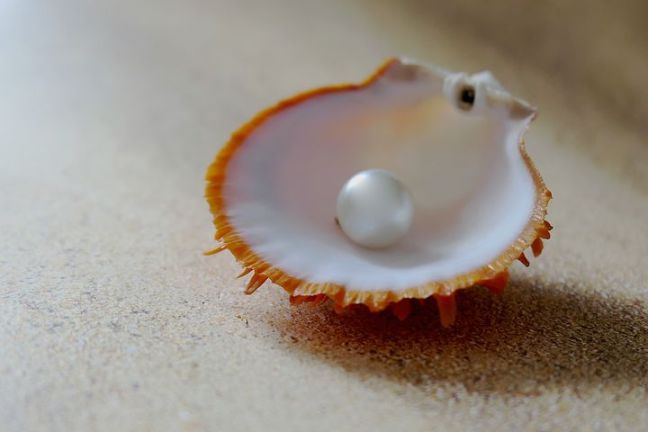
Oysters developed a resourceful strategy for handling unwanted and irritating invaders. In order to reduce the pain from a wayward grain of sand or grit, they surround the unwanted particle with smooth coating of calcium carbonate.

That’s how I see my resolution to conclude that I was once loved by him – a pearl enveloping and softening the pain.

And it may not be Truth in any real sense, but it’s real enough to me.