A Guidebook to Handling Your Emotions

We don’t come with emotion-handling software already installed. As young children, we were pure, unrestrained emotion. Any disappointment resulted in a red and tear-stained face and joy over the smallest delight would result in spontaneous and unselfconscious giggles.

And then, over the years, we received guidance on how to handle our emotions. Some of us heard the message that emotions are a sign of weakness and should be avoided at all cost. Others grew up in environments where emotions were a form of currency, used to get what you want from those around you.

Regardless of our particular emotional education, few of us mastered the curriculum by adulthood.

So here’s a little guidebook, a brief refresher on how to handle your emotions. Don’t worry if you still struggle with these reminders. Learning how to be human takes a lifetime.


Do Be Curious…Don’t Judge

It always breaks my heart a little when I hear someone say, “I shouldn’t feel that way.” Because they DO feel that way. And that is entirely okay. Judgment doesn’t make the emotion go away. All it does is frost it with a layer of self-criticism. Instead of judging the emotion, try asking yourself, “I wonder why I’m feeling this way?”


Do Approach…Do Not Attach

We are busy. And with so many tasks and people and apps always demanding our attention, our own internal emotional landscape often takes the back burner. Yet even if we don’t take the time to look, it’s still there, influencing everything that comes into our sphere. Slow down. Take a moment to notice how you’re feeling. Name it. But don’t become too comfortable. Emotions, like clouds, often pass. If you attach too much with a certain feeling, you’re interrupting this natural cycle.

Do Moderate…Don’t Bury

It’s a good thing that most of us have gotten better at handling emotions over time. An entire office building of tantruming workers would be a little awkward. We need to be able to dial down our emotional intensity and filter our emotions through perspective and rationality. Yet sometimes we take this too far, stuffing down our emotions and locking them away. Of course, they are still there. Only now instead of whispering, they’re going to start screaming.


Do Accept…Don’t Enable

You feel the way you feel. That’s okay. What’s NOT okay is to cater to those feelings like they are some sort of monarch. For example, if you feel sad, feel sad. But you don’t need to work to become the best iteration of sadness that ever existed. Instead, feel sad and also hold yourself to your goals. And remember, you are not your feelings.


Do Direct…Don’t Control

Have you ever told a hyper toddler to just sit still in a restaurant? How did that work out for you? Obviously, you can’t just let them unleash the beast within the establishment, but you can take them for a walk around the parking lot before dinner. Our emotions respond in much the same way. If you try to order them to sit and stay, disaster will ensure (and you may be thrown out of the restaurant), but you can channel your emotional energy in acceptable ways.


Do Listen…Don’t Believe Everything They Say

Our emotions are worth listening to. Our rational brains may be smart, but they are also prone to all sorts of fallacies and delusions (confirmation bias, anyone?). Our emotions operate a different level and are often able to pick up on things that our thinking selves are trying to talk us out of seeing. So listen. But also verify. Because much like the dog that sometimes barks at a falling leaf, our emotions sometimes get a little confused about what constitutes an actual threat. Feelings are not facts.


Do Share…Don’t Expect a Certain Response

We are emotional beings. It’s okay to show your feelings. Yet so often when we do share, we do so with an expectation of how the other person will respond. And then if our expectations are unmet, we blame the emotion. When really the fault is with the unrealistic expectations. Emotions are uniquely personal. Although we all feel the same ones, we don’t always feel them in the same way or in response to the same things.



Should You Believe Your Triggers?

I could feel it washing over me like a great wave trying to pull me under, both blinding me and choking me. My body went into full-on fight or flight mode, any rational thinking put on hold until the emergency passed.

What was the emergency, you ask?

My now-husband mentioned wanting to build a home theater in the basement.

I know, it’s a terrifying image.

This happened over six years ago and now I can laugh at the absurdity of my (over)reaction. But at the time, I truly was convinced that this was a serious threat to my well-being. I was responding to something in the present – my husband wanting to build a theater – with the emotions born from past experiences – my ex-husband building a home office in the basement that became the center of operations for his deceptions.

On the day of this particular melt down over the proposed theater, I remember being aware that the intensity of my response in no way matched the reality of the situation. But there was another part of me that was whispering, “What if this reaction is because you’re picking up on some real threat in the present?”

And I didn’t know which voice to believe.

And that’s the problem, isn’t it? We never know know for sure if what we’re feeling is a misplaced echo from the past or our intuition picking up on a real threat in the present.

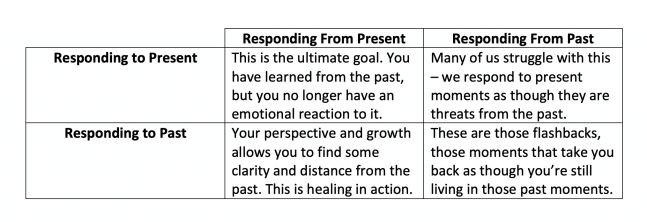
There are four basic categories between our reactions and what triggers them – Snip20191103_6.png

Responding to the Present From the Present

Your past experiences have taught you what to look for. You are better able to see actions that are misaligned to what you’ve been told and you’re more aware of unhealthy patterns. When something concerning happens, you use what you have learned to analyze it to decide if there are any real threats within.

You no longer have much emotional reaction from the past, so you trust that any you’re feeling now is an appropriate response to what is actually happening in the here and now. Furthermore, your reactions are on par with the behavior or sign you’re responding to. The response would be considered a reasonable one for anybody to have in similar circumstances.


Responding to the Present From the Past

Your past experiences are still living just beneath the surface. They have left you fragile, fearful. When something concerning happens in the present, it reignites those past concerns, an alarm sounding at full-blast, warning you that danger has arrived. Only the alarm is often false.

The emotional response is powerful, overwhelming, its intensity way out of line to what you’re responding to. You may even be aware that you’re overreacting, yet you feel powerless to stop it. Panic sets in. You become convinced that this is a sign that the past is about to repeat itself. You may respond with plans to flee, an instinct to fight or the desire to curl up and hide from the perceived threat. It’s best to take a time-out to allow some space for the body to calm before deciding to take any action.


Responding to the Past From the Present

This response comes when you encounter a reminder from the past, but you do not have an emotional response to it. Instead, you are able to look back with some clarity, applying what you know now to what you experienced then.

These are healing moments that provide valuable insight into what threats are real and which ones are born from a fear of being hurt again. This is learning – and healing – in action.


Responding to the Past From the Past

These are perhaps the most terrifying moments, when it’s as though a wormhole has transported you back to where you were with the same intensity of emotions and lack of perspective that you had when you were in the midst of it all.

When in the throws of a flashback, rational thinking and self-control is pretty much an impossibility. It becomes about survival, riding it out until it abates. Reminding yourself that it’s not real, that you are safe.


Should you believe your triggers?

Our emotional reactions are important, they provide us with information about our fears and about what is happening around us. Yet emotions are not always an accurate source of information. So listen to them, but don’t always believe everything they have to say.

Gratitude Without the Bullsh*t

Gratitude.

It’s become quite the buzzword, hasn’t it. It’s right up there with kale and yoga in the perpetual quest for wellness and happiness.

We are told we should buy gratitude journals or download the latest app that will send us reminders that we should be grateful. Ads pop into our feeds with t-shirts emblazoned with, “Thankful, Grateful, Blessed.” And we hear everyone from scientists to pop stars lecture us about the importance of gratitude.

And some days we’re feeling it. The sun is shining and we actually have the bandwidth to appreciate it.

Other days?

The pressure to feel grateful just feels like one more burden and the inability to reach that goal simply feels like one more failure.

Which kinda defeats the purpose, doesn’t it?

_____

The problem with the constant push for gratitude is that it begins to feel forced. As inauthentic as a carefully posed and filtered Instagram image. We do it, but we don’t feel it. And even worse, when gratitude is feigned, we feel a dissonance as we deny what we are really feeling in the moment.

An intentional relationship with gratitude has been important in my healing process from my tsunami divorce. I’ve found a way that works for me to practice gratitude without feeling forced or denying that sometimes life is just hard. Maybe these strategies will work for you too.

Gratitude Without the Bullsh*t

1 – What Are You Looking Forward To?

I try to start every day with this question – “What are you looking forward to?” I take a moment and think about what is coming on that day as well as what is on my calendar for the coming weeks and months. Some of the anticipations are small – a cup of tea brewing on the counter, a pleasant weather forecast or wearing my favorite shirt. Others are more exciting, like an upcoming visit with friends or a planned trip.

When I find that I’m struggling to find things to look forward to, I make a concerted effort to schedule some smiles. Those are just as important to have on the calendar as any meetings or appointments.

There is a caveat to this strategy – you have to keep your expectations in check. There will be times when the looked-forward-to-thing doesn’t happen and if you’re too wedded to a particular outcome that is outside of your control, it’s easy to become disappointed or even defeated. The point of this exercise isn’t to place your happiness on a certain event, but rather to simply recognize that there are always good things on the horizon and to celebrate that excitement that comes with anticipation.


2 – Both And

When we suddenly lost our very special dog Tiger two years ago, it was very hard. The grief was intense and the loss overwhelming. My husband and I dedicated the weekend to remembering him and his impact on our lives. Interwoven with the grief was a gratitude that we had 8 years with this very special dog along with the awareness that the reason the pain was so great was because he was so great.

Finding gratitude through life’s hardest moments is powerful. But if artificially applied like a pigmented lacquer to try to hide peeling wood, it only leaves you feeling worse. It’s important to acknowledge the hard stuff, to be honest with yourself that sometimes life sucks and there are no silver linings.

And it’s also not allowing this great pain to block out all light, to eclipse all awareness of the joys in life. It’s not denying the loss; it’s feeling the loss and leaving room to see the joys. We cannot force ourselves to be grateful for everything, but we can also make an effort to keep our eyes open and look for the opportunities to be grateful.


3 – Reflect On the Totality

I start the day looking forward and I end the day looking back. I spend a few moments (and yes, with a gratitude journal) reflecting back on the day. I acknowledge those little moments to celebrate and I see if I can reframe any annoyances or struggles to see the other side.

Like many of you, my days are busy. Chaotic even. And I find it challenging to be too mindful during much of it as I focus on getting things done and meeting everyone’s needs. This time for reflection at the end of the day acts like a deep breath at the top of a hill where I look back on the path that brought me there, taking note of the moments of the journey.


4 – Give Yourself Permission to Have Bad Days

Guess what? You’re not always going to be grateful. There are going to be days (or weeks or even months) where you can’t see anything but the clouds. Times when the mere suggestion of gratitude feels like an unwanted embrace and leaves you feeling violated and coerced.

And that’s okay.

Bad days happen. 

Horrible days happen.

But you know what?

Good days and good moments within bad days happen too.

Gratitude is about seeing both.


What We All Want

When it comes down to it, we all want the same things.

We want to feel safe, to trust that the world is what it seems and that there is at least some predictability or sense to what happens in it.

We want to feel seen, to know that we matter and that even once we’re gone, we will continue to leave some sort of legacy.

We want to be accepted, to be loved and welcomed as we are.

And we want to be appreciated, our gifts and contributions recognized and valued.

Of course, there are both positive and negative ways that we seek to meet these needs.

Those seeking safety may strive to control every outcome, even extending to trying to control those around them. A need to be seen can lead to negative attention-seeking behaviors that cause harm even while meeting the requirement. Taken too far, a drive for acceptance twists into people-pleasing, morphing into a form that others want. And a need for appreciation can slide into narcissism, where recognition is demanded no matter the cost.

We can have those same needs met in positive and healthy ways. A need for safety comes not from trying to control outcomes, but in building trust in yourself to meet those outcomes, no matter what they may be. The desire to be seen can be met from actively working to spread some lasting change in the world so that you can see your ripple on the planet. A need for acceptance comes from surrounding yourself with the right people or, if that fails, the right furry companion. And the best appreciation comes not from somebody saying “thank you,” but from within when you give from a place of generosity and selflessness.


I’m Not Going to Change Your Mind

So often we approach a conversation with the intention of trying to change somebody’s mind. We prepare to argue, to fight. To prove that we are right and, by extension, they are wrong.

What if instead, we approached with the intention of opening somebody’s mind? Of offering a different perspective. Adding to the dialog instead of trying to dominate the conversation.

And what if we had that same intention for ourselves? A shift from defending our views to expanding our minds. When listening becomes an act of curious investigation instead of gathering of evidence.

I don’t want to change your mind. I want to open it. And I want you to open mine in turn.