Fear of the Future

My many years of teaching 8th grade has offered a unique perspective. The entire year is a crossroads, a place where childhood and independence meet and often vie for dominance. The kids are excited for their increased freedoms and new opportunities.

But they’re also scared.

They seem to recognize that the life, the relationships and the security that they have known has a deadline.

And that soon, they will have to face a future that they worry they’re not prepared for.

As adults, we watch them grapple with these realizations and we offer words of advice and comfort that come from our additional years of living and navigating change. We smile at their naiveté and their assurances that they will manage to control all elements of their life path.

And yet even while we offer them guidance, we often struggle with similar fears.

Because, let’s face it.

The future, with its infinite possibilities and endless opportunities for challenges, can be downright terrifying. And just like with my students, these fears are at their most vocal during times of transition.

There are five primary fears that can contribute to an apprehension about the future:


1 – “I don’t know what’s coming.”

There’s a reason we often talk through what’s going to happen at a doctor’s visit or on Halloween with young children – once we know what’s coming, it loses some of its power to scare us.

We tend to be most afraid of the future when it seems to stretch out into darkness, when we have to summon the faith to take blind steps not knowing what lurks in the shadows. And the problem with an unknown future is that we view it as a threat and so we go in armed, more apt to attack than explore.

We don’t need to have a crystal ball or an approved life script to prepare ourselves for what’s coming. Energy spent planning and preparing can go a long way towards easing your fears, even if those fears never come to fruition.


2 – “I won’t be able to handle it.”

Much like with any new challenge, we are uncertain with our abilities as we learn to adapt to the new demands. And since the future is a challenge we haven’t faced before, we worry that we won’t pass muster and that we will ultimately fail to rise to the test.

And at first, it may feel like it’s too much. Life often has a way of presenting us with a 200-lb barbell when we’re still struggling to lift a 20-lb dumbbell. But then, a little at a time, you get stronger. And what was once impossible is now completely doable.

When we peer off the cliff edge down into the unknown future, we’re picturing the person we are today trying to handle the challenges of tomorrow. What we often fail to appreciate is the wisdom, strength and training that we gain along the way.


3 – “The future won’t be as good as what I have known.”

The only thing certain is the past. So if you want certainty, that’s where you’ll have set up camp.

We have this way of rose-tinting the past and coal-smudging a future that we fear. And we know what we have treasured in our lives. Those memories gain prominence and importance over the years, developing a shine as we take them out and run over them again. Any grit that accompanied those memories has been worn away in time.

And the future, with its jagged edges, threatens to never be able to compete with those treasured times.

Yet one day, that future that you now fear will provide more memories that you treasure.


4 – “Change means losing what I have.”

We’re hardwired to fear change. We have more aversion to loss than we do anticipation for what might be gained.

And so we often, we freeze. Thinking that if we just stay still, stay quiet, that the status quo will continue. Anticipatory grief and regret keeping us locked in inaction.

Yet the scary – and also freeing – truth is this.

Even if you change nothing, everything will will change.

That’s just how life works.

Some people and things come in and others move out.

Which if you think about it, is as natural as breathing.


5 – “I can’t control the future.”

No, you can’t.

But you do have some say in the control that future has over you.

If you can’t stop what’s coming and you can’t prevent change, why allow a fear of the future to dictate your life now?



Should You Believe Your Triggers?

I could feel it washing over me like a great wave trying to pull me under, both blinding me and choking me. My body went into full-on fight or flight mode, any rational thinking put on hold until the emergency passed.

What was the emergency, you ask?

My now-husband mentioned wanting to build a home theater in the basement.

I know, it’s a terrifying image.

This happened over six years ago and now I can laugh at the absurdity of my (over)reaction. But at the time, I truly was convinced that this was a serious threat to my well-being. I was responding to something in the present – my husband wanting to build a theater – with the emotions born from past experiences – my ex-husband building a home office in the basement that became the center of operations for his deceptions.

On the day of this particular melt down over the proposed theater, I remember being aware that the intensity of my response in no way matched the reality of the situation. But there was another part of me that was whispering, “What if this reaction is because you’re picking up on some real threat in the present?”

And I didn’t know which voice to believe.

And that’s the problem, isn’t it? We never know know for sure if what we’re feeling is a misplaced echo from the past or our intuition picking up on a real threat in the present.

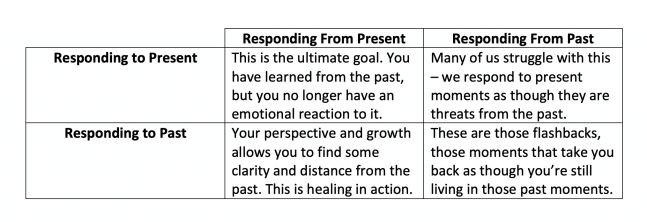
There are four basic categories between our reactions and what triggers them – Snip20191103_6.png

Responding to the Present From the Present

Your past experiences have taught you what to look for. You are better able to see actions that are misaligned to what you’ve been told and you’re more aware of unhealthy patterns. When something concerning happens, you use what you have learned to analyze it to decide if there are any real threats within.

You no longer have much emotional reaction from the past, so you trust that any you’re feeling now is an appropriate response to what is actually happening in the here and now. Furthermore, your reactions are on par with the behavior or sign you’re responding to. The response would be considered a reasonable one for anybody to have in similar circumstances.


Responding to the Present From the Past

Your past experiences are still living just beneath the surface. They have left you fragile, fearful. When something concerning happens in the present, it reignites those past concerns, an alarm sounding at full-blast, warning you that danger has arrived. Only the alarm is often false.

The emotional response is powerful, overwhelming, its intensity way out of line to what you’re responding to. You may even be aware that you’re overreacting, yet you feel powerless to stop it. Panic sets in. You become convinced that this is a sign that the past is about to repeat itself. You may respond with plans to flee, an instinct to fight or the desire to curl up and hide from the perceived threat. It’s best to take a time-out to allow some space for the body to calm before deciding to take any action.


Responding to the Past From the Present

This response comes when you encounter a reminder from the past, but you do not have an emotional response to it. Instead, you are able to look back with some clarity, applying what you know now to what you experienced then.

These are healing moments that provide valuable insight into what threats are real and which ones are born from a fear of being hurt again. This is learning – and healing – in action.


Responding to the Past From the Past

These are perhaps the most terrifying moments, when it’s as though a wormhole has transported you back to where you were with the same intensity of emotions and lack of perspective that you had when you were in the midst of it all.

When in the throws of a flashback, rational thinking and self-control is pretty much an impossibility. It becomes about survival, riding it out until it abates. Reminding yourself that it’s not real, that you are safe.


Should you believe your triggers?

Our emotional reactions are important, they provide us with information about our fears and about what is happening around us. Yet emotions are not always an accurate source of information. So listen to them, but don’t always believe everything they have to say.

Moments of Vulnerability After Divorce

There are things about divorce that nobody tells you ahead of time.

This is one of them.

Before my tsunami divorce, I felt like a capable adult.

After?

There were moments where I felt like a complete badass.

And moments where I felt like a weak and vulnerable child.

Those feelings of vulnerability have a tendency to pop up at the most unexpected times.


When Somebody Shows You Kindness

I felt a strange mixture of relief and vulnerability when I first talked to the officer that arrested my then-husband. Relief because I had somebody who knew what they were doing to take control for a bit. And vulnerability because his kindness revealed both how in need I was and helped prevent me from an “everybody sucks and I’m going to become a hermit” mentality.

For months, every act of kindness extended my way was met with tears. Of gratitude and also from a feeling of powerlessness. Because apparently I wasn’t as good as hiding my vulnerability and pain as I liked to think I was.


During an Uncontrolled Reaction to Something Small

Every time my phone would buzz, I would jump. I feared more bad news from the attorneys or police. I dreaded yet another fruitless and scary conversation with a creditor. And I secretly hoped it was my still-husband, full of apologies and regrets.

I hated the power that damn phone had over me. I wanted to be in control of my feelings and it was such a humbling admission that this little brick of metal and plastic had more sway with my emotions than I did.


When You’re Sick or Injured

It was just a run-of-the-mill stomach bug. But on top of feeling miserable, I felt completely helpless. Not only was my body useless, my mind was as well. And this time, I didn’t have my husband to lean on and act as my protector while I healed. More than ever before, I related to animals that hide in their burrows whenever they’re sick or injured. It’s simply too scary to face the world when you’re less than a hundred percent.


When You Need Help With a Task

It’s funny in hindsight. I was shoving things in my car to take them from my marital home turned mausoleum to the friend’s house where I would be staying. At one point, I needed three hands to both carry things, open a door and shoo away a pernicious yellow jacket.

Only there were no hands nearby to help.

I set down the things I was carrying with the intention of swatting at the insect and opening the door. Instead, I ended up sitting on my driveway (only it wasn’t really mine anymore) sobbing for the next several minutes. In that moment, everything seemed impossible.


When You Realize You’re Alone

It was just a stupid form.

Yet it was so much more.

“Emergency contact” stared back at me with accusing eyes, as though taunting me that I didn’t have anyone to put in the blank.

I could put in one of my parents, yet they both lived across the country, so that seemed somewhat silly. I could pencil in the friend I lived with, but she was completely overwhelmed with being the emergency contact for her new baby. I sifted through other friends, yet I kept picturing them confused when they received a call as my emergency contact. “Why did she pick me?” they would think.

And so I left it blank.

Realizing that ultimately, I had to take care of myself.

When You Meet Someone New

I was supposed to be happy.

And I was.

But I was also scared sh*tless.

Because if I developed feelings for this guy, it meant I would have to open up.

And if I opened up, I risked being hurt all over again.

But if I stayed curled up in my protective burrow, I knew I would never live again.


What Anxiety Can Look Like

From the inside, anxiety is pretty easy to identify – a tightness in the chest or stirring in the belly, overactive thoughts that tend towards the, “What if?” and an underlying sense of fear or dread.

But from the outside?

Anxiety can take many different forms, some of which may resemble a different root cause entirely.


Anxiety can look like aloofness.

When someone is anxious, they’re not living in the world; they’re living in their head. To others, it can seem like they’re withdrawn, not interested in engaging. Yet the reality is that they’re so busy battling the thoughts in their head that they don’t have the attention to spare towards those around them.


Anxiety can look like pessimism.

It’s not that those that struggle with anxiety only see the negative; it’s that they believe that they have to anticipate all of the possible outcomes so that they can be prepared for any eventuality. When good things happen (or seem about to happen), anxious people have a hard time accepting it because their brains are still telling them that things can change in an instant.


Anxiety can look like perfectionism.

Anxiety likes to have things in order. It’s a lie the anxious brain likes to use, “If you can do everything right, you’ll be okay.” And so the drive towards perfectionism is strong and the fear of falling short (which of course, is inevitable), is equally as powerful.


Anxiety can look like having trouble committing.

“Am I doing the right thing?” anxiety questions before agreeing to something. “What if there’s a better option?” the mind asks. Those that are anxious often spend substantial time researching and weighing options before making a decision. And even once a decision is made, the doubts may persist.


Anxiety can look like high achievement.

Anxiety has an energy to it and often that energy acts like a motor that drives achievement. The anxious mind has trouble relaxing, which combined with a fear of failure can lead to some impressive achievements. Not that the anxious person will ever relax and enjoy their successes.


Anxiety can look like a need for control.

An anxious brain tries to anticipate every potential outcome. And of course, those outcomes are limitless. So to improve the odds, an anxious person will often try to control the situation and steer the outcomes a certain direction.


Anxiety can look like struggling with time.

Those with anxiety often have a dysfunctional relationship with time – they either believe there is not enough or they avoid thinking about it altogether. As a result, they will either be too early late, believe they will never get it done or put it off until the last possible minute.


Anxiety can look like a failure to begin.

“Am I doing the right thing?” “Am I qualified to do this?” “What if I fail?” These thoughts mean that the anxious person can spend an inordinate amount of time on the starting block, scared of taking that first step. This can lead to unfulfilled promises of action.


Anxiety can look like an entertainer.

For some, the anxiety is channeled into performance. They are always “on,” often the center of the party. By playing a role, they are able to find some distance from their unease. And by shifting the attention towards their performance, they are able to hide their anxiety.


Anxiety can look like a calm exterior.

Many people with anxiety hide it very well. While they may be panicking inside, their demeanor doesn’t even register the slightest elevation of pulse.


Whether you experience anxiety yourself or have someone in your life that struggles with it, once you recognize its disguises, you are better prepared to handle it appropriately.

Progress and Room to Grow

Because of the nature of my first marriage (conflict-less because of a deadly combination of his tendency to lie about everything and my inclination to avoid anything too anxiety-provoking) and the way that it ended (suddenly and without warning), I have struggled at times with my now-husband.

In the beginning, I alternated between being totally flooded and in a panic about being abandoned again at the slightest sense of conflict or withdrawal to an “I’m out of here” conclusion as my traumatized brain assumed the worst about a situation. Additionally, my f’ed up brain decided that if I wasn’t the “perfect wife,” I would again be dropped. Of course, that doesn’t lead to good things because I could never do enough to calm the anxiety and none of this was stuff my husband asked for (or expected) anyways. And then for the cherry on top, I had a hard time bringing up the difficult conversations, my years of avoiding anything anxiety-producing had trained me well.

It’s been years of work learning how to change these patterns. I can now initiate the difficult conversations and I’m more able to stay present during them instead of disappearing into an emotional whirlpool. I trust that my now-husband is in it for the long haul and that he is not a quitter or a coward. As I process a disagreement or issue, I’m finding less and less that it directly has more to do with my past than my present.

Which is good.

But of course, the past is still imprinted on my being. I still have a tendency to take everything too personally and respond at a level ten to something that should be counted on one hand’s worth of fingers. I get in my head too much, thinking when I should be being. And it’s a vicious cycle. Because when I get this way, I become more convinced that I’ll be left again. Which then leads me right back to where I started.

There’s obviously room to grow.

I think part of my recent anxiety is tied to my upcoming trip (I leave in the morning!!!). It’s been almost ten years to the day since I left to go visit my father in Seattle. On that trip, like with any trip, I expected to return to Atlanta and my life at its conclusion.

But that life disintegrated while I was gone.

I returned to an empty home. A missing husband. A depleted bank account. A gutted heart and a shredded soul.

There is nothing in my life now that suggests that scene will ever be repeated. But I think it’s there in my subconscious mind, softly whispering, “what if?” and making me more needy, more sensitive and yes, more anxious.

I’ve come a long way in the last ten years. But I still have a ways to go.