Love Is Only Blind When Your Head Is In the Sand

Do you ever look back at a former relationship and wonder what you saw in your one-time flame?

Or do you ever question a friend or family member’s choice in partners?

It’s easy when you’re outside of a relationship to view the bigger picture, the distance providing perspective while damping emotions.

But when you’re in it?

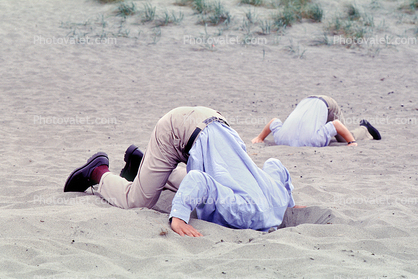
It’s all too easy to bury your head in the sand.


We stick our heads in the sand in relationships for a variety of reasons:

Avoidance

A wife sees a suggestive text on her husband’s phone from an unknown female. Her heart begins to race and panic floods her system. The hint of an affair is overwhelming to her; she cannot face the thought that her marriage is in trouble and that she may lose her husband. She turns away from the text and tries to pretend that she never saw it. That it didn’t happen.

When we see something that frightens us, we have two choices: approach or hide. In a relationship, the latter can cause problems as the truth is not faced because of the anxiety of losing the partnership. Of course, the fear persists even when the truth is not faced head-on. This state is usually temporary when either the truth becomes too big to avoid or the anxiety becomes too high to tolerate and the evidence is finally challenged. Burying your head out of fear may make you blind but it leaves you even more vulnerable to attack.

Mindlessness

A husband is busy at work, long hours and stressful clients have kept him away from home both physically and emotionally. He prides himself on providing for his family and doesn’t really have the time or energy to consider the status of the marriage as a whole. His wife, meanwhile, appreciates his efforts but feels isolated and lonely as her partner has become a husband in name only.

Heads can end up in the sand even without intentional digging. Stay still long enough and the tides will conspire to bury you. This is a blindness born of inattentiveness and busyness rather than willful evasion. Regardless of the motivation, the outcome is still a relationship in danger due to a lack of clarity and communication.

Willful Ignorance

A wife is pretty sure that her husband has a mistress. She intentionally chooses to turn a blind eye to his affair because he is a good father and stable husband. So she decides not to confront him and, even more, chooses to avoid situations that may reveal evidence of the infidelity. She knows something is there but chooses not to look.

This blindness is born more of pragmatism than fear. The reality is known to an extent and even quietly accepted. It’s a desire to pretend that life isn’t messy and emotions can be subjugated to reason. It’s a carefully edited and narrated form of the relationship. Although often dismissed, there is a sadness in this buried head that comes from lack of vulnerability and associated intimacy.

Bargaining

Prior to the marriage, a husband knows that his wife has problems with anger. He is uncomfortable with her temper and it raises red flags for him. However, he wagers her temperament against her other qualities and decides that the good outweigh the bad. When others bring up her outbursts out of concern, the husband responds by dismissing the concerns and tallying the pros that she brings to the table.

This is a common approach when a partner has issues with violence and/or substance abuse. There may be several very good qualities that are only occasionally accompanied by the bad. It’s a dangerous game; however, as the blinded partner slides into enabling the poor behaviors and choices.


A healthy relationship is one where both partners have their heads tall, looking out for problems on the horizon and addressing them as they approach. Burying your head may make you feel safe for a time but it’s no way to live.

Have the courage to lift your head.

Trust that you can handle whatever you see.

True love isn’t blind.



Affair-Proof

Whenever I stumble across the words “affair-proof,” my mind responds like the Incredible Hulk — raging and ready to rip. Now, don’t get me wrong, I wish I could find solace in those words and place my faith in their sanctity.

But I can’t.

Because there is no such thing as an affair-proof relationship.

It simply doesn’t exist. And pretending that it does only causes additional pain and heartbreak.

Implied in those words is the understanding that if an affair occurs, the betrayed obviously did not perform his or her duties effectively to affair-proof the marriage. It places the blame for the infidelity squarely on the shoulders on the one who was cheated upon. Read the rest here.

The Grass Isn’t Greener

grass isn't greener

greener

For some reason I have been receiving quite a few messages lately from people who are looking for my validation of their decision to a) have an affair, b) continue an affair, c) abandon their unsuspecting spouse or d) all of the above.

Umm…do they realize who they’re messaging? Do they honestly expect that I’m going to give them a stamp of approval and send them on their merry, marriage-detroying ways? I mean, yes, I’m in a better place than I’ve ever been after facing my husband’s infidelity and abandonment, but that doesn’t mean I endorse that as a life-affirming event. Honestly, I would have preferred a cruise.

I usually take a little time to breathe before composing my responses. Ultimately, I want to ensure that I’m not coming from a place of my personal experience or reacting defensively. After all, even though these folks are looking for approval, they may also be asking for help. And there’s a chance that what I say may register.

There are some common themes in all of the messages I receive in this category. Many all tell me that their spouse would be better off without them. They all speak of interest in another man or woman. And perhaps most telling, they all seem hesitant to speak to their spouse.

And most of all, the attention is focused outside of the marriage.

Well, then, it’s no wonder the marriage is floundering. How can you expect a marriage to flourish when your efforts are spent elsewhere? Before you diagnose your marriage with a fatal case of failure to thrive, feed it. Nurture it. Give your marriage the attention you’re giving your escape plans.

Your intentions drive your attentions. If you’re committed to leaving, your focus will be on your exit.

So, before you call it quits, make staying your intention. At least for a while.

Now, attention is no Miracle Grow. Your marriage may have fatal defects or may have been starved for too long to ever thrive. But, at least give it a try before you leave it for dead.

One person asked me if he owed it to his wife to stay.

No. That’s just a breeding ground for resentment and contempt.

But he does owe it to his wife to at least try to nurture the marriage before making the decision. He does owe it to his wife to end things in a kind and mature manner, if it comes to that. And, he does owe it to his wife to not use her for excuse or blame.

The grass isn’t greener on the other side. It’s greener where you water it.

So, stop blaming your spouse, stop pretending that you’re doing this to help him or her and pick up the damn watering can and water your marriage.

Okay, public service announcement over. Now back to our regularly scheduled program:)

Sides Effects of Betrayal

When you have been betrayed, your world view forever shifts. Motives are questions. Secrets are assumed. Nothing is as it seems.

You want to trust but you don’t know how. You feel victimized and either accept that role in defeat or desperately search for control and assurance that you will never be a victim again.

It’s oh-so-easy to keep moving beyond the betrayal without fully addressing its impact. To attribute future struggles to something (or someone) else when it is really your soul still keening from the lies and the loss.

When I first saw this article on Psychology Today, When Disappointment Feels Like Betrayal, I was skeptical.

And then I read it.

And I related.

When you have been betrayed, the pump has been primed to assume betrayal.

Even when it is just life with its usual ups and downs.

Be on alert for the monster but don’t go stabbing at every creak on the stairs.


Passionate Protection

One of the most common complaints in a relationship that has gone the distance is the lack of excitement. Of passion.

The spark fades and is replaced by a sense of comfort.

Of predictability.

It’s natural to look for stability in our relationships. We want to feel safe. We want to limit that oh-so-scary feeling of vulnerability. We may be willing to trade some of that early excitement for the comfort of knowing that our partner will be there and that we will be safe. We exchange passion for security.

The problem with this transaction is that security is merely an illusion. There is no such thing as a relationship that is divorce-proof. There are no guarantees. We are trading real goods for the promise of a return that may never come.

It makes sense to take certain precautions. Much like most pay their rent on time so they don’t have to live with the daily fear of being evicted, it makes sense to be cautious in love. But not so cautious that you trade all excitement for the false promise of invulnerability. Even perfect rent payments do not protect your home from burning down around you.

There are problems inherent with assuming too much security. You become complacent. Bored, even. You may begin to seek excitement and novelty outside of the the relationship. Eventually, your internal narrative regarding your spouse changes to match your perceptions, reinforcing the idea that the lack of passion is par for the course with him or her. The very assumption of stability can erode away the foundations of a relationship.

You can maintain passion. You can draw out excitement. But it does mean letting go of the illusion of security. It means protecting your passion even when it can be scary.

Try listening to your partner with an open mind rather than leading with assumptions. He or she will surprise you if you allow it. When you believe you know all there is to know about someone, you begin to fill in the gaps automatically. But if you listen, really listen, you may discover something you didn’t know. Of course, that something may also be against your preferences. There’s the trade-off.

Look at your partner as an individual. Watch them in their element. See the best side of them come alive. It may or may not be a characteristic that you normally witness in them. See it. Appreciate it. Recognize that you are a team but not a single entity. Your partner is his or her own person. As you are yours. Maintain some separation, some mystery. In that way, you always leave room for discovery.

Be proactive about maintaining experiences as a couple outside of routine. Routines allow us to function but they also become suffocating if you never deviate. Try new things. The excitement will transfer to the relationship. Embrace a certain amount of unpredictability. Don’t restrain laughter. Be willing to try and look foolish.

Don’t depend upon your partner to create passion. Find it yourself.  Explore the things that bring you joy, that give you purpose and allow you to create. Your partner may not share your interest in gardening or ju-jitsu, but you can share the energy that  it brings you. Take responsibility for your joy. Passion has a way of being contagious. Pass it on.

Amusement parks have created an entire industry around the balance of security and excitement. They know how to give you the feeling of vulnerability, with its associated joy when you emerge unscathed,  without too much of the risk. You can find that balance in a relationship as well.  Let go of the illusion of security. Actively seek excitement and novelty within the relationship. Protect your passion as diligently as you protect your heart.

Related: Of Teddy Bears and Security Systems