Why It’s Time to Stop Googling Your Ex!

Googling your ex

I am a recovering Google addict.

For eight months, typing the names of my ex or his other wife into that tempting little search bar was my drug of choice.


I was Googling my ex, but what I really wanted to find was respite from the pain. 


Of course, what I was hoping to find was a full-page ad taken out in the New York Times where he proclaimed that I was the best wife ever and that he made in the biggest mistake in the history of the world when he decided to cheat on and abandon me. I would have also been rewarded by the news that his new wife stole all of his money and abandoned him with a hastily-written sticky note.

Or, at the very least, the news that he had contracted rabies from the monkeys he was showering with in Uganda.

But none of that ever happened.

I mean, the showering with monkeys part happened. Thanks to my sleuthing, I was gifted with the pictures from his other wife’s blog. But as far as I know, there was no rabies, no sticky note and no full-page spread in the New York Times.

And from my perspective now, I realize that even if I had found evidence that he was miserable or regretful, it really wouldn’t have changed anything. Sure, I might have felt a little “zing” of pleasure at his misfortune (probably immediately followed by a jolt of guilt for feeling that way), but then I would have been set on a path of looking for more evidence of his struggle. Like a little breadcrumb trail feeding shots of dopamine to distract from my own pain. As you can imagine, that’s a path that is destined to lead to nowhere good.


Maybe you feel as though your ex took your happiness. So why are you gifting them your attention?


When you’re Googling your ex, you’re basically going to come across one of three things –


You discover that they’re doing great.

And, in turn, you feel like shit. Their endless pictures of smiling faces only serve to make you feel more alone. The upbeat nature of their posts makes it seem like they moved on from you without hesitation.

Intellectually, you know that you’re comparing your reality to their carefully curated presentation, but your heart doesn’t listen. For every good thing in their life, you find a negative counterpoint in your own.

Yet you can’t stop watching. It’s like a train wreck of happiness. It is unbearable to look, but you can’t look away.


You learn that they’re miserable.

Which is what you secretly want, right? You want them to feel the pain you’re experiencing. You want validation that you were important to them and that your loss has impacted them negatively. Maybe this urge is coming from a need for things to feel “fair” or perhaps you’re desperate for them to understand what they’ve put you through.

But the result is the same.

You learn about their misfortune and indeed, you may feel a little pleasure at the news of their pain. But then, you feel a little dirty. After all, that’s not like you, to want others to hurt. And, as you soon realize, that their pain doesn’t actually eliminate yours at all.


You are bombarded with pictures and information that show that they’re human, with both good days and bad.

This is the most likely result of your internet sleuthing. You see some utopian pictures of your ex with a new partner and later learn of a loss that they’ve experienced. Your brain thrives on these intermittent rewards, which are just as addictive as a slot machine in Vegas. You feel an intoxicating mixture of highs and lows depending upon the nature of what the day’s search reveals.

It’s a distraction from your own life, as you convince yourself that you need to know what they’re up to. Much like reading a daily horoscope, you allow this information to shape your day and shift your perspective.

Your ex let you go, but you’re still holding on. Tying your happiness to theirs.


Ask yourself this – How does your ex’s life REALLY matter to yours?


It’s not as though there are a limited number of “happiness tokens” available and you and your ex are fighting over the same cache.

Nor are you playing some sort of sport where one person is deemed the “winner” and the other has to accept the moniker of “loser.”

And, there is ultimately nothing that you can discover that will make your pain disappear or undo the past.


It’s time. Time to stop directing your attention into the endless chasm of Googling your ex. And time to start spending your time and energy on something far more valuable –

you.

Important Lessons You Learn From Living Alone

living alone

Nothing had changed.

It was the strangest sensation.

I left the apartment just before 6:00 am for work and when I returned that night, nothing  had changed in the intervening hours. The coffee cup was still by the side of the sink with its cold contents beginning to separate. The selected – and then rejected – outfit was still spread out over the surface of the bed. The blinds hadn’t moved, no new footprints were visible in the thick and dense carpet and the single throw pillow remained on the floor where it had fallen the night before.

Nothing had changed.

And yet, everything was different.

After more than a decade living with my husband followed by the better part of a year strung with my friend’s family while I navigated the divorce, I was now living alone.

And, I quickly realized, I still had a lot to learn:


Surrounded by Silence

Largely due to financial constraints, I had no television in my apartment. I did pay for internet coverage so that I would have access to my computer, but the AT&T in my building proved about as reliable as a flight time in a torrential thunderstorm. And thanks to my ex’s thefts, I was down to a $20 stereo and a literal handful of CDs.

I was surrounded by silence.

So the voices of my inner thoughts came through loud and clear.

It was uncomfortable at first, being left with my own thoughts without anything to distract. Scratch that. It was terrifying. Especially at night, when my thoughts seemed to reverberate around the mostly-empty space. I was forced to listen to my fears, questioning my decision to stay in Atlanta and wondering if I could actually alone.

But in time, my inner thoughts became more like friends. I began to relish the quiet that would settle in around me once I closed my door against the rest of the world. I began to recognize their cries of panic for the wolf cries that they were. And, surprisingly, I found that the worries faded after they were given the floor. Perhaps the only reason they were speaking so loudly before is that they had to scream to heard above the distractions that surrounded me before I lived alone.

Living alone provides the opportunity for you to become comfortable with yourself without distractions.


Taking Care of Business

I almost didn’t get approved for my apartment. The mandatory background check revealed outstanding utility charges that had my name attached, courtesy of my ex who had been awarded the house. I had to scrape together the funds to cover the unexpected expense and collect more court documents to show that my ex was the one responsible for accruing – and ignoring – the debt.

It was petrifying. Not only was my future independence called into question, I was having to take care of this on my own. And I had serious doubts that I could do it.

By transferring items that I intended to buy from the “need immediately” column to the “need soon” list, I was able to cover the past-due utility bills (with only a moderate amount of cursing about the unfairness of it all) and since the divorce paperwork was still easily accessible, it was easy to locate the papers that assigned this responsibility to my ex.

The apartment was mine.

I felt accomplished. In many ways, even more than when my ex and I managed to buy – and remodel – a house at the ages of 22 and 23. Because this time, I did it completely on my own.

It’s daunting to be the only own responsible for everything, but there is a sense of accomplishment and pride that can only come from taking care of business all by yourself.


Unearthed Preferences

Over the sixteen years with my ex, I had inadvertently allowed my husband’s preferences to become my own. Sometimes to a scary degree. 

Since I left my former life with only my clothes and my computer, I had to purchase everything from a bath towel to a bed for my new space. It was strange, as I was pursuing the IKEA catalog, I was initially discouraged because none of the pieces fit my ex (either literally, as he was a tall man, or stylistically). I had to remind myself, this was MY space. I could furnish it like I wanted without any consideration for anyone else. (Although, in retrospect, maybe I should have considered my then-boyfriend and his dog when I selected a white slipcover!)

For the first time in almost two decades, my opinion mattered not at 50% (or less), but at 100%. As long as I could pay for it and could wrangle it up three flights of stairs, I could have it.

When we live with others, especially if we have a tendency to people-please, we can subvert our own preferences in an attempt to keep the peace or appear laid back. Living alone provides an opportunity for you to really learn what you like without the fear of someone else’s preferences taking priority.


Self-Soothing

My ex-husband was quite skilled at calming me down. Whenever I would enter the house after a challenging day at work, he knew exactly what to say or do to bring down my anxiety and stress. Then, once he was the cause of the stress, the friend I lived with never failed to lend a patient ear or compassionate look.

I’ll never forget my first emotional breakdown in my apartment. It was triggered by a letter from a debt-collection agency. I had been trying unsuccessfully to track down the current owner of the $30,000 credit card debt that my ex accumulated in my name (that included painful items like part of his honeymoon with his other wife). This letter confirmed the ownership and meant that I was soon going to have to begin the literal paying for my ex’s other life.

My body was wracked with painful sobs that echoed off the walls. Part of me was embarrassed at the thought that my neighbors might hear me.

And part of me secretly hoped that they would hear me and that someone would come to check on me.

Nobody did.

I was alone.

And it was up to me to take care of myself.

Once the sobs receded enough that I could stand, I put my running clothes and hit the pavement despite the rain. I ran hard and I ran long, first down the road in from of my apartment then across a bridge where I could access a 6-mile trail along the river. Once I returned, I could barely make it up the steps to my apartment, my legs were spent with the effort. Luckily, my brain was too.

I drew a warm bath and collected a pile of library books for company. Later, in bed, I piled my winter coat on top of me for extra weight and tucked the throw pillows from the living room around me like a quilted hug.

I was still scared and I was still feeling pretty hopeless, but I was also feeling good that I had managed to make a dent in my emotional reaction.

When you’re living alone, you have to learn how to take responsibility for your own stuff.


The Value of Therapy

value of therapy

“What is the value of therapy?” the email continues, after the writer has detailed her struggles moving through divorce.

Another message contains the statement, “I’ve been in therapy for years and I’m wondering if it’s working.”

“How do I know if therapy is for me?” implores a man who has been blindsided by his wife’s infidelity.


What is the value of therapy?


People generally turn to therapy when they are struggling with negative emotions or having trouble processing something in their past or present.  Therapy can serve different purposes depending upon the needs of the person and the specialization of the therapist.

In general, therapy can assume one or more of these roles:


Highlighter

It’s hard to see the forest for the trees. Therapists can offer valuable perspective and insight when we’re all-too-easily distracted by the details cluttering up our lives. A skilled therapist can listen to twenty minutes of unloading about a difficult situation and can sum up the core issue(s) in a couple of sentences. Then, once the challenges have been highlighted, you are better able to focus your energy in the areas where you can best effect change.


Skill Developer

Many therapies are designed to give people access to a variety of tools that they can then apply on their own in order to improve relationships or personal well-being. A therapist will identify your needs and work with you to develop and practice a variety of coping strategies. As part of this process, you will also learn to recognize the precursors that indicate a need for a particular strategy.


Neutral Third Party

Relationships are by definition, emotional. As a result, it can be difficult to work through certain situations within the context of a relationship. The stakes are simply too high to avoid either withdrawal in an attempt to avoid vulnerability or becoming too intense and prompting flooding in the other person. A therapy session offers a safe space and an uninvested third party to work through issues or to practice better communication.


Interpretor

What we’re feeling isn’t always an indication of how we feel. As an example, fear often manifests within one or more of these fifteen disguises. Therapists are trained to recognize the emotion behind the presentation. They are adept at naming and describing what you’re feeling. And naming it is often he first step to regaining control over it.


Guide

Therapists often act as trail guides. This may be unfamiliar terrain for you, but they have been down this path many times and are familiar with the hazards and the milestones. They will help to prepare you for the upcoming climbs, cheer you on when you become frustrated and will ensure that you don’t stray too far off the path.


Affirmer

If you are currently in or were raised in an environment that is abusive or rife with criticism, your therapist can be a vital source of affirmation and acceptance. When you’re feeling cut down, beat down or judges by those around you, therapy can help you see the good within yourself.


Why might therapy be ineffective?


One of the critical factors that makes it difficult to assess the value of therapy is that the results are highly subjective: Do you feel better? Has your functioning improved? Are you having more good moments and fewer bad ones?

And sometimes the answer to those questions is, “No.” The following are some of the reasons that therapy may be ineffective:


You waited too long.

You can’t ignore signs of cancer for months and then expect a doctor to immediately cure your stage 4 malignancy. In the same manner, if you have ignored mental health issues for years, there may be limits to what therapy can accomplish. That doesn’t mean that it’s useless, but early intervention often favors better results.


You have unrealistic expectations.

No matter how skilled the therapist, they cannot undo the damage caused by a parent’s abandonment. They don’t possess magic wands that can immediately make everything better. If you show up to marriage counseling and you’re spouse has already given up, the therapist can’t force them to change their minds. If your expectations are unrealistic, you will never achieve your goals, therapy or not.


You’re seeing the wrong therapist or using the wrong technique for you.

You wouldn’t go to a grill master to learn how to improve your baking, so why go to a therapist who specializes in psychodynamic therapy to learn strategies for dealing with the daily symptoms of anxiety? Before you enter therapy, make sure you know what you’re looking for and that you can communicate those goals to someone who can help you navigate your options.


You’re being defensive.

If you’re always looking to defend yourself and/or prove your therapist wrong, you will get nowhere. It’s important to recognize that your therapist is there to help you. And part of that help is challenging your assumptions and ways of interacting. You’re there because you want change and the first step of any transformation is admitting that you can do things differently.


You’re not applying the tools.

If the only practice you’re getting with the strategies and skills your therapist is teaching you in in their office, you’re undermining yourself. Changing habits and patterns takes practice. Lots of practice. If you don’t implement what they’re teaching you, your investment is pretty useless.


You’re failing to address the underlying issues.

Childhood traumas often present themselves throughout life until we have addressed the initial problem. If you present the current situation to your therapist but neglect to delve into the childhood traumas that primed the pump for your present struggles, your work will have limited success. You have to identify and neutralize the cause.


You’re not being honest or transparent.

Your therapist can only work with the material that you give them. If you’re hiding, you are not allowing them to help you. It’s natural to feel ashamed or embarrassed about certain things; however, a therapist’s job is to listen without passing undo judgment. Trust me, they’ve probably heard worse than what you’re holding back. Ultimately, they cannot help you shine light on your problems if you refuse to open the door.


Your therapist is retaining the power.

Like with parenting, the role of a therapist is to ultimately put themselves out of a job. Unfortunately, there are therapists out there that like being needed and so they want to ensure that you remain dependent upon them. If you sense that this is your therapists, please look for someone new.


Is therapy for you?


If you identify with any of the following, therapy may be a good option for you:


You’re having suicidal thoughts.

You are having trouble with basic life functions.

Your feelings – sadness, anxiety, anger, etc. – seem overwhelming and difficult to control.

You’re struggling to communicate with somebody in your life.

What you’re trying isn’t working.

You know there’s a problem, but you can’t seem to identify it.

You need a “jump start” to get you on the right track.

You’re feeling isolated and as though you don’t have a strong support system.

You want to increase the tools that you have to deal with life’s challenges.

You’re feeling “stuck” or you are fixated on something in your past.

You want some support and guidance to navigate a life transition (marriage, divorce, death, childbirth, retirement, etc.).

You’re looking for a professional’s opinion on something in your life.


Ultimately, therapy is a tool. It can be a valuable opportunity for you to make critical and vital changes to your life or your mindset. Yet, as with any tool, it’s only valuable if it’s the right one for the job and you use it effectively and in a timely manner.


Won’t You Take Me Out of Funky Town?

funk

I’m gonna be real here.

Real real.

I’ve been in a bit of a funk since this school year started. And I’m in the South, so that was two months ago. I’m doing that thing that I used to do in my old life that I promised myself I wouldn’t do anymore. I’m waiting. Promising myself that it will be better as soon as…

Except some of those milestones have passed and I’m still waiting. And still funky.

I can enumerate the reasons I’ve been funkified:

  1. I’m feeling overwhelmed and overworked. Yes, I know I say this every fall. Yet this year feels worse (even though I know I say that every year too). I’m needed more by some of the other teachers this year and I’m struggling to balance their needs with the needs of my students (along with trying to remember that I have needs too and these are just as valid). I keep waiting for the groove to come, but I’m not sure it will.
  2. My husband underwent cervical fusion at the end of August. It was stressful waiting for the surgery (there was a minimal but very real risk of paralysis if there was any impact to the neck before the fusion). And of course, surgery itself is scary. The procedure went well and healing is progressing nicely. But it’s still hard. I’ve had to take on more and he’s without his normal martial arts outlet, which takes a toll on both of us.
  3. I haven’t had much social connection since school started. I do best with social contact about once a week or so. I’ve had only two encounters with friends in the past month. Definitely not sufficient, especially because I’m pretty isolated from adult contact at work.
  4. Many of my favorite podcasts are still on summer hiatus. Trivial, I know. except it’s not. Between my morning dog walk, my commute and my monotonous teacher tasks (like collating and stapling unit summaries), I can easily consume about three hours of audio content a day. So when it’s limited, I notice.
  5. This one is 100% my fault. I slipped on the daily gratitude journal again. It’s been easy to claim that I’m too busy. Except it takes less than 60 seconds, so that’s utter bullshit. I’m not too busy. I’m too IN the busy. And still stuck on the mindset that if I just keep my head down and keep pushing, I’ll push through and have space to breathe.
  6. And probably the hardest part – when I’ve shared with others that I’m struggling, they seem to dismiss it. Minimize it. It could be that I’m overly sensitive to this, but I think it’s because they have the perception that I don’t fall apart (or haven’t in the last nine years, at least). So they assume that I’m okay, even when I try to say that I’m not. It’s a key problem of being one of the “strong ones.”

I haven’t been all-bad though. I’ve prioritized yoga. I’ve been taking some time to read and I even joined a book club (a first ever for me). I have committed to and maintained a hard 8:00 pm deadline to put work aside no matter how unfinished it is. I sought out some new-to-me podcasts (thank you By the Book; you’ve made this week much better!) and made the trip to renew my library card so that I can again download audio books. I switched gyms to one that is closer, cheaper and has the most bad-ass treadmill-ish contraption that allows me to do sprints inside. And I love coming home to a puppy that insists that play is important no matter how much work there is to do.

I need to do better though. To find a way to breathe within this chaos instead of waiting for the chaos to end. Because it won’t. Chaos is a part of life. All that changes is the particular tone and texture of it.

I keep coming back to the book my club discussed earlier this month – 29 Gifts. It describes a woman’s resolution to give – and document – 29 gifts in 29 days. I liked the idea, especially since I’ve been feeling somewhat resentful over the amount of myself I’m having to give right now. I’m not ready to do the full challenge right now, but I’m really working on shifting my thinking around what I’m doing – seeing my time as a gift rather than something being taken from me. It’s a small step, but it is a step. After all, how many times do I tell people that we have limited control over what happens to us, but a lot of say in how we respond to it?

Next week is fall break. I’m viewing it as an opportunity for a big ol’ reset. Do some self-care, visit with friends, get some sleep and put some things in place to keep me grounded and sane when the intensity (which just aptly auto-corrected to “insanity”) picks up again.

Because I refuse to allow this funk to follow me into October.

Please hold me accountable.

Benefits of Traveling Outside Your Comfort Zone

comfort zone

images-33

I had two choices for my morning run today – the relative comfort of a treadmill in my dry and air-conditioned gym or the muddy trails of a nearby park in the rain and oppressive mugginess that blankets the east coast in the warm months.

I debated for a few moments, considered how miserable I would likely be on an outdoor run as I struggled to breathe in air that was more water than oxygen and how tempting it was to remain in the manufactured comfort of air-conditioned space.

After swallowing the last of my coffee, I went downstairs and selected my trail-running shoes, opting for the less comfortable option. At the beginning of the trail, I questioned my choice. The sweat was already soaking through my shirt, my lungs were threatening to wheeze and a strange guy on the relatively empty trail caused me to grip the mace I carry just a little tighter.

But then after the first mile, I began to find my stride. The moisture in the air became less noticeable, my breathing began to acclimate and the weird guy stayed weird, but also stayed back. And by the time I made it back to my car, looking like I had just completed a mud run complete with a culminating dunk in a body of water, I was happy that I chose the less comfortable route.

images-36


Which are you more likely to regret – the step that takes you out of your comfort zone or the inaction that keeps you there?


We all like to be comfortable. All of us fear the unknown and to some extent, shudder at the thought of potential failure. We shy away from experiencing any sensation that could be labeled as unpleasant. All of us have become experts at crafting and disseminating excuses that give us permission to maintain the status quo, telling ourselves stories to justify our inaction and our conclusions.

images-34

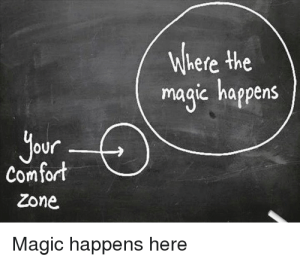
Life – real life – happens outside your comfort zone.


When we take steps outside our comfort zone, we are granted permission to fail.

Once you’ve been labeled “good” at something, you are expected to perform at a certain level every single time. In contrast, when something is brand new to you, any failure is somehow less personal and more situational. That makes it much easier to face.


When we take steps outside our comfort zone, we are allowed to be unsure.

I don’t know about you, but I always feel pressure to appear confident about my decisions and my actions. I feel like this is one of the great lies of adulting. When we were little, we assumed that adults knew what they were doing. Only now, we’re the grown ones and we’re just faking it. When you’re doing something new, you’re allowed to reveal that insecurity.


images-32

When we take steps outside our comfort zone, small achievements are recognized and celebrated.

When you were a baby, your every “first” was marked and even memorialized. That recognition of small successes often fades as we age. When you’re outside your comfort zone, you are far more aware of those “firsts” and mark them of signs of growth.


When we take steps outside our comfort zone, we have fewer expectations from ourselves or from others.

Expectations can be powerful limiters. Just look at those studies where teachers of completely average classes were either told that their children were brilliant or behind. The children performed not based on their ability, but according to their teacher’s expectations. And in our day-to-day lives, we are just as likely to limit ourselves with claims of, “I can’t.” When we take that step outside of our comfort zone, we are instead asking, “But what if I can…?”

our-comfort-zone-where-the-magic-happens-magic-happens-here-18784279


When we take steps outside our comfort zone, assumptions – and beliefs – are challenged and often adjusted.

WE often reach conclusions based on what we experience. So the more limited your experiences, the less-informed and potentially more biased your assumptions will be. When we meet new people and experience new ways of seeing the world, we are forced to re-examine and maybe even readjust our beliefs.


When we take steps outside our comfort zone, learning combats frustration born of stagnation.

Humans get bored. Just watch a modern queue and take notice of how many people are engaged in their phones to avoid a few minutes of idle and purposeless time. The same thing happens on a larger scale. We thrive on novelty, on challenge. When there is nothing left to learn, we become stagnant and then frustrated. The space outside a comfort zone offers unlimited opportunities for learning.

images-35


When we take steps outside our comfort zone, curiosity dominates and inspires wonder.

Have you ever watched a kid in a new environment? A place that is known to you suddenly becomes alive with possibility when seen through their eyes. Our brains have literally evolved to disregard that which is too ordinary. And when your life is spent entirely within a comfort zone, you risk having your brain ignore it all. Newness encourages our brains to wake up and pay attention, bringing with it a childish sense of exploration and wonder.


When we take steps outside our comfort zone, we allow space for authenticity and purpose.

We all-too-often become our labels – mother, father, caretaker, employee, etc. We forget who we really are and what really inspires us and drives us. When we leave our comfort zone, we often discard those labels for a period of time, allowing us the the opportunity to discover what is really important to us.


images-37