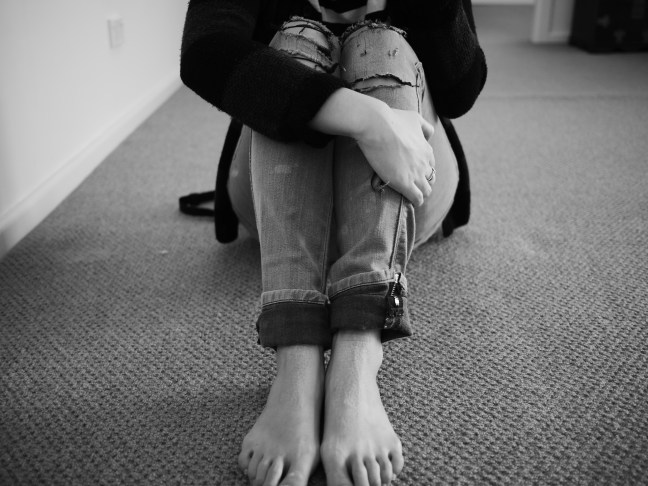
Moments of Vulnerability After Divorce

There are things about divorce that nobody tells you ahead of time.

This is one of them.

Before my tsunami divorce, I felt like a capable adult.

After?

There were moments where I felt like a complete badass.

And moments where I felt like a weak and vulnerable child.

Those feelings of vulnerability have a tendency to pop up at the most unexpected times.


When Somebody Shows You Kindness

I felt a strange mixture of relief and vulnerability when I first talked to the officer that arrested my then-husband. Relief because I had somebody who knew what they were doing to take control for a bit. And vulnerability because his kindness revealed both how in need I was and helped prevent me from an “everybody sucks and I’m going to become a hermit” mentality.

For months, every act of kindness extended my way was met with tears. Of gratitude and also from a feeling of powerlessness. Because apparently I wasn’t as good as hiding my vulnerability and pain as I liked to think I was.


During an Uncontrolled Reaction to Something Small

Every time my phone would buzz, I would jump. I feared more bad news from the attorneys or police. I dreaded yet another fruitless and scary conversation with a creditor. And I secretly hoped it was my still-husband, full of apologies and regrets.

I hated the power that damn phone had over me. I wanted to be in control of my feelings and it was such a humbling admission that this little brick of metal and plastic had more sway with my emotions than I did.


When You’re Sick or Injured

It was just a run-of-the-mill stomach bug. But on top of feeling miserable, I felt completely helpless. Not only was my body useless, my mind was as well. And this time, I didn’t have my husband to lean on and act as my protector while I healed. More than ever before, I related to animals that hide in their burrows whenever they’re sick or injured. It’s simply too scary to face the world when you’re less than a hundred percent.


When You Need Help With a Task

It’s funny in hindsight. I was shoving things in my car to take them from my marital home turned mausoleum to the friend’s house where I would be staying. At one point, I needed three hands to both carry things, open a door and shoo away a pernicious yellow jacket.

Only there were no hands nearby to help.

I set down the things I was carrying with the intention of swatting at the insect and opening the door. Instead, I ended up sitting on my driveway (only it wasn’t really mine anymore) sobbing for the next several minutes. In that moment, everything seemed impossible.


When You Realize You’re Alone

It was just a stupid form.

Yet it was so much more.

“Emergency contact” stared back at me with accusing eyes, as though taunting me that I didn’t have anyone to put in the blank.

I could put in one of my parents, yet they both lived across the country, so that seemed somewhat silly. I could pencil in the friend I lived with, but she was completely overwhelmed with being the emergency contact for her new baby. I sifted through other friends, yet I kept picturing them confused when they received a call as my emergency contact. “Why did she pick me?” they would think.

And so I left it blank.

Realizing that ultimately, I had to take care of myself.

When You Meet Someone New

I was supposed to be happy.

And I was.

But I was also scared sh*tless.

Because if I developed feelings for this guy, it meant I would have to open up.

And if I opened up, I risked being hurt all over again.

But if I stayed curled up in my protective burrow, I knew I would never live again.


Critical Signs That Your Emotional Walls Are Too High

emotional walls

After experiencing heartbreak, it’s natural to take a protective stance, to build emotional walls in an attempt to head off any additional pain and loss. These precautionary barricades serve an important purpose at first, as they help to shield us from additional assaults while we’re still tending to the wounds that require immediate attention and we are too fragile to withstand any further insults.

Yet left unchecked, these emotional walls that were initially constructed to provide security inadvertently become our own self-built prison. The possibility of connection exchanged for an illusion of safety. Left too long or built too high, we languish behind those emotional walls. Reassuring ourselves that at least we won’t get hurt again while at the same time allowing loneliness to slowly infect from within.

It’s difficult to accept that we’ve inadvertently walled ourselves in, depriving ourselves of the very things that nourish a heart and soul. It can be downright terrifying to take the risk to open up and again be vulnerable when the memory of the pain is still screaming in your ear.

Yet often the best places can only be reached by taking a leap of faith.


The following are signs that your emotional walls may be too high:


You Panic When You Become Vulnerable

It’s often referred to as flooding – that physical sense of overwhelming emotion. Your stomach churns. The blood rushes. And you’re filled with either an immediate need to escape or a total and complete shut-down.

This fight-or-flight reaction is completely normal when you’re in actual danger. However, when the response is this intense just because somebody saw through your defense, it’s an indicator that your emotional walls are too impenetrable.

Pay attention to those physical signs. Are they appropriate for the situation or are they an overreaction? If you find that you frequently panic or flood when emotions are present, it may be a sign that it’s time to learn how to live with these emotions (instead of simply trying to keep them at bay).


You Cut People Out As Soon As They Get Too Close

In general, there is an emotional dance that happens as you get to know somebody. Over time, the boundaries are renegotiated as trust is built and further access is allowed.

When the emotional walls are too high, this dance becomes interrupted as soon as the hidden tripwire is activated. And once this alarm sounds, the perceived interloper is immediately removed from the premises. Often for good.

There are certainly times when it is completely appropriate and healthy to remove somebody from your life. But if you have a history of cutting people out of your life, it may be a sign that you are afraid of letting them in. Examine your reasons for eliminating others from your life. Are they justified, or do they come down to excuses?


You Continually Choose Unavailable Partners

Do you know the best part about choosing unavailable partners? You always have a ready-made reason for the relationship not working out.

Consider who you are attracted to. Are they already in a relationship? Or are they hiding behind their own walls after facing heartbreak? Perhaps they are physically unavailable due to their location or the demands on their time?

When you’re staying in your comfort zone behind too-high emotional walls, unavailable partners are attractive because they will not try to get too close and they won’t challenge your duck-and-cover strategy. At the same time, accepting these partners is a guarantee that you will remain alone behind your walls.


You Become Defensive Whenever Somebody Questions Your Emotional Walls

“I’m not closed-off!” you insist when somebody notes your unwillingness to be vulnerable and authentic. “It’s just that I haven’t met the right person,” you continue, in an attempt to redirect the attention elsewhere. Or, perhaps you bring up your previous heartbreaks to justify your stance, “You would understand if you had felt pain like I have.”

A defensive response is often indicative of two things – 1) somebody is pushing against an area of tenderness and 2) they are uncovering some truth that you’re not ready to hear. Pay attention to who is hightailing your emotional walls. Are these people who are coming from a place of genuine concern (if so, it may behoove you to listen) or they predatory-types who want you to let them in (bye, Felecia)?


You Strive to Keep Areas of Your Life Completely Separated

It is completely normal to act differently with different people and to have distinct groups of friends related to areas of your life. But if you’re overly concerned about any overlap between these groups, it may be a sign that you’re trying to prevent any one person or group from getting to know you too well.


You Use Projection to Assume What Others Are Feeling

“They wouldn’t want to know,” you tell yourself as you bite your lip to avoid opening up. We all have a tendency to assume that others feel the way we do and to tell ourselves what we want to hear. Taken together, this means that when your emotional walls are too high, you are going to unconsciously reinforce that decision by assuming the intentions of those around you.


You Try to Control the Outcome

Ultimately, the construction and maintenance of emotional walls comes down to control. After experiencing the excruciating pain of loss, you strive to never feel it again. And since you cannot prevent others from leaving, you instead keep them from getting in.

And, of course, that is your choice. Letting down the walls carries with it some real risk. You may be invaded by those intending to do you harm. Or, you may find love only to suffer its end. Whenever we open ourselves to another, we are giving them the opportunity to cause pain.

The problems arise when we are not happy or fulfilled and we don’t recognize that ultimately we are the cause of our discontent. Or, more specifically, our self-made walls are. That those barricades that provided needed protection from the elements for healing to occur have now become obsolete or even detrimental.

At the end of the day, only you can decide for yourself –

Is love worth the risk?


Related: 9 Reasons You’re Struggling to Find Love Again


Forced Vulnerability

We had to have our hardwood floors re-redone earlier this week. No, that’s not one of my typos. There was basically a typo during the first redoing of the floors.

So again, we moved all of the furniture from the first floor (I swear next time I’m the market for furniture, everything will be made of bean bags!). And again, we boarded Tiger and rented a hotel room for the night.

My brain was half on moving stuff and half on ramping up for the first day back at school with a third half (impossible, I know, but that’s what my brain feels like right now) stubbornly trying to stay in vacation mode.

And I screwed up.

I made a special stop for Brock to get some of his essentials. I gathered Tiger’s food to take to the vet. I packed everything I needed for the single-night hotel stay.

With one exception.

My glasses.

I only realized my error when I pulled out my contact case that night. And I panicked. I haven’t been without my glasses at night in well over a decade. And at that point, I could still sort of see.

Now?

Nothing.

I visually inspected the route from the bathroom to the bed, removed my sight and used the wall to get myself to the safety of the bed. At least it felt like a bed.

Where I promptly began to freak out.

Strange environments and sudden blindness are not amicable companions.

“If there’s an emergency, I’m completely dependent upon you,” I told Brock, anxiety bleeding into my words.

He immediately had me navigate the path to the bathroom – and my contacts – several times before he was confident I could do it quickly.

Somewhat relaxed, I felt for my Kindle, closed my left (really bad) eye and tried to read since that is how I fall asleep. My nose kept changing the pages.

Thank goodness for podcasts.

I realized that night that there is a huge difference between choosing to be vulnerable (as I have done with my writing and my now-husband) and forced (and surprise) vulnerability. I much prefer the former.

And I am ever-so-grateful that I was with somebody that I could depend upon completely, even though I hated the feeling of being so helpless.

And maybe most importantly, I have promised myself to never, never forget my glasses again!


Opportunities

purple crocuses with closed bloom Français : D...

The best lessons can be found when we are facing unanticipated change and loss. It is a moment between moments where we are lost and searching, broken and vulnerable, wanting and open. In those moments between moments we learn who we really are and what we are capable of.

When you find yourself in that moment created in the space after a sudden change, try to see the opportunities wrapped within the loss. Growth is so much easier when we are unencumbered by our usual habits and assumptions. Rather than immediately seeking protection from the pain, be with it and be vulnerable. It is in those moments between where our potential resides.