Understanding Relationship Happiness Over Time

There are certain patterns that relationships tend to take over time in regards to overall happiness and satisfaction. In order to truly understand your relationship, it’s best to take a broader view, rather than examine a small slice of time that may not be representative of the whole. Which of the following patterns do you relate to?


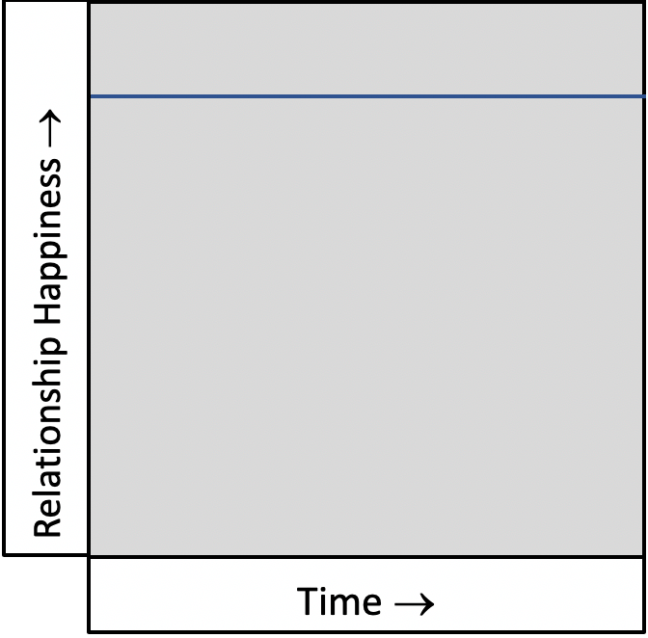
The Idealized Relationship

Snip20190712_14

This is the relationship that Hollywood tells us to expect. We are conditioned to believe that once we find “the one,” the relationship will be easy and happiness will be guaranteed and omnipresent.


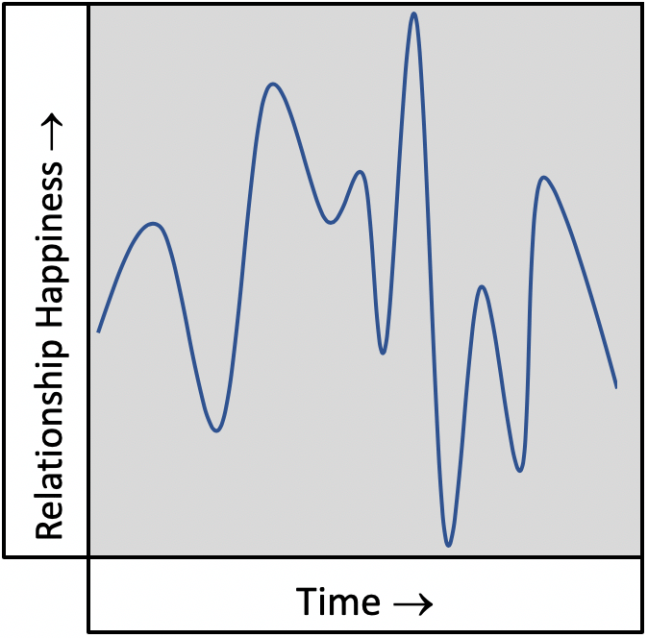
The Volatile Relationship

Snip20190712_10

This pattern can be addictive because when it’s good, it’s REALLY good. On the other hand, when it’s bad, it’s horrid. The highs keep you in it and hope that it will smooth out keeps you from leaving.

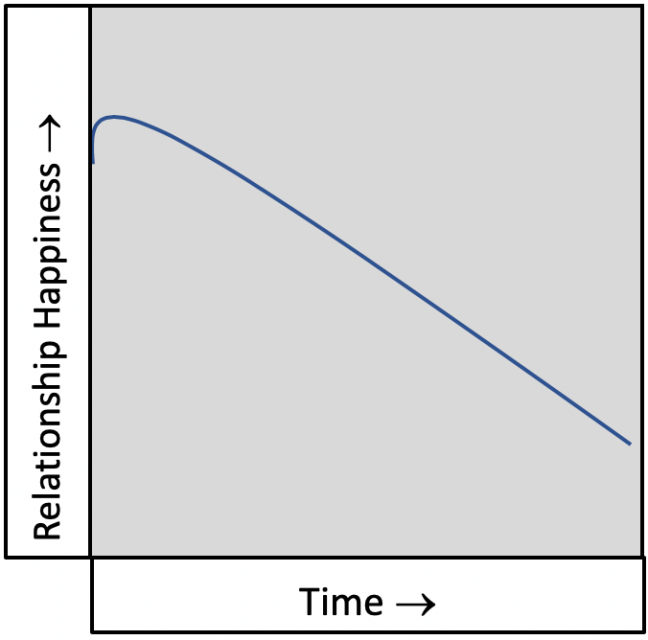
The What Goes Up Must Come Down Relationship

Snip20190712_17.png


This is the relationship that is on fire in the beginning and then settles down into a more sedate happiness and contentment over time. It’s far from bad, but the partners may find themselves craving the intensity of the beginning.


The Slowly Declining Relationship

Snip20190712_11

It WAS good, but it seems to be trending further and further away from that place. The connection is waning and you may feel like you love them, but you’re no longer “in love” with them.

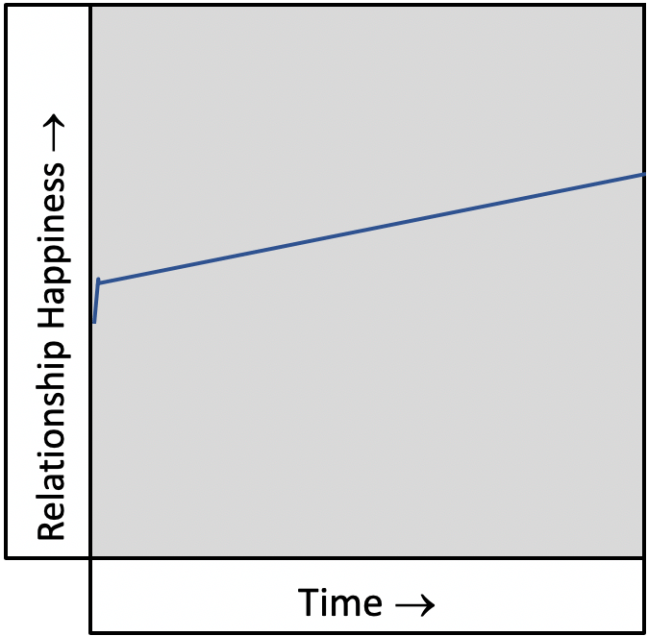
The Gradually Improving Relationship

Snip20190712_12

This is the relationship between two people that are growing together. Over time, they have learned to temper their expectations and to accept the other as they are.


The Devil You Know Relationship

Snip20190712_15

It’s not good, but for now, it’s better than being alone. Strangely, the consistency of this relationship can be comforting; you know exactly what to expect.

The Life is a Highway Relationship

Snip20190712_13

This is different from the volatile pattern because the ups and downs are less extreme and balance each other out. This is the marriage that is happy overall with some good days and some not-so-good ones.

Putting the Lessons Into Play

My husband discussed some hard stuff with me the other day. I’m proud of him for his self-awareness and courage and I’m also proud of me. Because my response, both in moment and in the days after, truly reveals how much I’ve grown since my first marriage.


I didn’t overreact, so I could be a safe place for him.

In my first marriage, I would have overreacted to something similar. I would have instantly gone to defcon 1 with my fears leading the charge. And my reaction would have been the furthest thing from a safe space. In fact, it would have announced, “I can’t handle this, so you need to protect me from it.” Ugh.

A few years ago, my insides probably would have thrown a panic party while I worked to maintain a calm exterior. An improvement, for sure, but still not ideal.

But now? I not only responded in a calm manner. I felt calm. I didn’t try to catastrophize or worry about what could, maybe, possibly happen. I just listened. Instead of being in my own fear, I could be with him.


I feel more compassion instead of a need for perfection.

In my first marriage, I was afraid of any potential blemishes. They were threatening, something to be feared. And so I felt a sense of disgust at any sign of imperfection in myself and in my first husband. Of course, since neither one of us could uphold this charge, there was a constant low-lying tension between my expectations and reality.

It’s different now. Which is especially good since my now-husband and I have officially reached the age of mammograms and colonoscopies. It’s hard to maintain that veneer of perfection when a nurse half your age is squishing your boobs against a metal plate.

I have so much more tolerance – and compassion – for the struggles that we all have. I no longer see the struggle as a sign of weakness and I enthusiastically celebrate the courage and discipline evident in those that don’t shy away from their particular battles.


My boundaries are both more forgiving and more robust.

Before, I expected perfection but would put up with a lot as long as I didn’t have to look too closely.

Now, my boundaries are set further back. They allow for mistakes and the opportunity to  be human and messy. But at the same time, they are less tolerant of bullshit and will no longer be consoled with pleasing words that are spoken in place of action.


I have confirmation that I chose MUCH better this time around.

We are not defined by how we handle the easy times. Instead, character is truly revealed in how someone handles the hard stuff.

My first husband’s response to struggle was to hide, lie and act out of shame. After experiencing the brutal conclusion of that approach, I intentionally sought out someone with courage who’s default setting is in revealing rather than concealing.


Yet again, I’m filled with gratitude for what I endured ten years ago. It may have been a conflagration, but it was one that prepared me for the growth that needed to happen.


You Can Be Right or You Can Be Married

When it comes to marriage, the opposite of “right” isn’t “wrong.” It’s “happy.”

Because when we’re too focused on being right within a marriage, we’re losing focus on what’s really important:

– reaching shared goals, even when you differ on the choice of the path to get there

-managing overlapping lives

-and, perhaps most importantly, constantly learning from and encouraging each other.


You can be right or you can take this opportunity to learn about a different perspective.

I had to laugh when my friend’s husband complained to me that my friend doesn’t load the dishwasher the “right” way. “I didn’t realize there was a universally agreed upon correct method,” I joked.

And that’s true in many areas, not just dishwashers. There may be strategies that are more efficient. Or more effective. Or easier. Or more familiar. That doesn’t necessarily mean that one is more “right” than the others. They’re just different ways of looking at the same thing.

I love the famous parable about the elephant and the six blind men. Each one, feeling a different region of the animal, reaches a different conclusion. “It’s a snake!,” exclaims the man running his hands along the trunk. “No, it’s a rug!” insists the one running the hair on the tip of the tail through his hands.

One elephant. Six men. And six different – and equally valid – conclusions.

blind-men-1458438__480.png

So often the things we disagree about within a marriage fall into this category where there really is no right and wrong, simply different ways of looking at things. And so when we fixate on proving that our way is best, we pass by an opportunity to learn how to see something differently. And that something includes our spouse.

It’s strange how learning that our partner has a different view from us can be threatening. But it can. We all-too-easily begin to believe that they feel the same way about things as we do and it can be a little disorienting when we learn that they have a different perspective. And sometimes, a little shake-up is a good thing:)


You can be right or you can focus on solving the problem.

Most of the time, you and your spouse are on the same side. You both want a good environment to raise a happy and healthy family. You both want to make sure that you have financial stability and that you can purchase the things you need. You want time together and also time to maximize your own potential.

Yet when problems arise, it’s easy to take sides, you on one side of the ring and your spouse on the other. When your focus shifts to proving that you’re right (or proving that your partner is wrong), you forget about the expanse of the agreed-upon area between you, instead focusing only on the differences.

When you need to be right, the other person by default has to be wrong. There is a winner. And there is a loser. And perhaps the marriage is the biggest loser of all when you forget the magic that happens when you realize that you’re on the same side. Even when you disagree.

Put your energy on solving the problem. Not on disproving your partner.


You can be right or you can allow your spouse to prove your expectations wrong.

Have you ever had a full-on conversation with your spouse about something, only the entirety of the dialog took place within your head? *Sheepishly raises hand*

I know for me, when I finally do have that conversation for real, the actual words coming from my husband’s mouth are usually much more supportive than the imagined ones. Yet, and this has unfortunately happened, if I’ve already convinced myself that my conclusions are right, it’s hard for me to actually hear the words he’s saying.

It’s tricky with spouses. They have a track record. And so we think we know how they’re going to respond before we give them a chance to.

Sometimes, we neglect to have the hard conversations because we believe we already know the answers and so the exercise seems futile. Yet doesn’t it make more sense to ask your spouse the questions and give them enough respect to provide space for their answers.

You can be right or you can admit that sometimes you’re wrong.

It’s not easy to admit when we’re wrong. The ego sees this as a personal attack and any insecurities like to act like school-yard bullies (“You’re so stupid! You’re so stupid!). This is especially true when admitting the wrong threatens our view of ourselves (For example, as a math teacher, I would be more threatened by an error in my mathematical reasoning than I would be by my ignorance about the location of a particular country).

It’s okay to be wrong. It’s okay to make mistakes. It’s okay to change your stance on something as you have gained more wisdom and experience. When we admit we’re wrong, we’re making space to learn how to do better. How to be better. When we hold too tightly to the need to be right, we’re ultimately holding ourselves back from being the best we can be.


You can be right or you can be married.

This phrase is often used to imply that in order to remain married, you have to constantly bite your tongue. But that’s no recipe for a happy marriage. When you hold back on saying the important things, resentment and distance grows.

Instead, what we can take from the phrase is this – there are things that are more important to a marriage than being right.

It is more important to act as a team.

It is more important to listen teach other with an open mind.

It is more important to treat each other with respect, even when you disagree.

It is more important to focus on the shared goals than the details.

And if it’s important to you to stay married, sometimes you’re going to have to let go of being right.


How Being Cheated On Impacts Your Next Relationship

It’s not fair.

That instead of following the promise to have and to hold, your spouse made the decision to crumple up and throw away those vows. That your partner chose to forsake you in the pursuit of others. That your other half replaced intimacy with lies and betrayal, eroding the marriage from within.

And now you’re left dealing with the consequences of those choices.

It’s not fair.

You’re angry that you’ve been put in this position and maybe even wondering if relationships are worth the potential pain. You’re worried that you may struggle to trust again and that if you do, betrayal may find you yet again. You’re embarrassed that you were defrauded and you doubt your own perceptions and choices. You’re tired of being the responsible one, the one who cleans up the mess that is left behind.

And it’s not fair.

The unfortunate fact is that your partner’s infidelity not only impacted your marriage, it will also continue to impact you moving forward. The good news is that with awareness and intention on your part, you can limit and even learn to benefit from some of that influence.

And it all starts with recognizing the impacted that being cheated on has on your next relationship.

Trust is Replaced With Doubt

Most people confide that the realization of the ongoing deception was the most painful part of being cheated on. It’s so difficult to integrate what you now know about your partner with what you thought you knew.

At the minimum, lies of omission were carefully maintained in an attempt to conceal the truth of the affair. Half-truths were delivered and excuses offered up in order to buy opportunity for indiscretion. As a result, you now have trouble taking people at their word. Is he really staying late at the office, or is that just the story you’re being fed?

It’s easy to get carried away with truth-finding, veering into the dangerous territory of obsessive snooping and interrogation, punishing a new partner for the sins of the old. It’s natural to want to control things. To pursue lies like a cat hunting down its prey. Yet the reality is that no amount of searching will uncover everything and that operating from a place of assuming deception will ruin everything. There’s a balance that must be reached between trusting everything and believing nothing. And you reach that point, you will be miserable in every new relationship and you will make your partner miserable as well.

In the worst cases of infidelity, gaslighting tactics were used against you, causing you to have trouble trusting even the most basic of perceptions. Gaslighting is a type of emotional abuse where careful and crafty manipulations are used to make you doubt your sanity and your observations. The impact of gaslighting is more persistent and more nefarious than that of the garden-variety lie because your trust issues are less with others and more with yourself. Recovering from this type of abuse takes time, persistence and a constant awareness of its impact.

Finding the Sweet Spot Between Naiveté and Panic

Insecurity Can Run Wild 

You thought your partner had your back when instead they were cheating behind it. You expected your spouse to be there for you only to discover they were trying to free themselves of you. When the affair came to light, you felt powerless. Worthless as you concluded that somehow you weren’t enough for your spouse. Your partner made the decision to have an affair and all you can do is react as your marriage slips out of your hands.

And the natural reaction when we lose our grip is to grasp even tighter.

It’s not unusual for those that have been cheated upon to smother their new relationships. It can be an attractant at first. After all, you doesn’t like to receive attention? However, the insecurity behind those actions will eventually make itself clear and have the unintended consequence of pushing people away.

Insecurity can also lead to an uptick in perfectionist and people-pleasing qualities in an effort to be the “perfect partner” and to avoid future infidelity. Those strategies will also backfire as they have a tendency to slide into resentment or martyrdom.

The remedy for insecurity isn’t found in holding tighter or in the illusion of perfection. Security is found within, in trusting yourself, your instincts and your decisions. When you seek validation outside of yourself, you will never find it. When you find validation within yourself, you will never lose it.

Defenses Are Fortified

“I will never allow myself to be hurt like that again!”

I get it. The pain of betrayal is so piercing. So all-encompassing that all you want is for the agony to end and to never take the risk of feeling it again.

And so you build walls. Allow people in, but only so far. You rationalize your choices by claiming that they are smart. Prudent. That when you went all-in before it was out of a foolishness of youth.

You may find that when discord does strike, you have a sudden and intense impulse to cut your losses and end the relationship. You’d rather be the one leaving rather than again being the one left behind.

It’s tempting to try to build a relationship in such a way to mitigate risk. But relationships don’t work that way. Without vulnerability, there is no chance of connection. Of intimacy. Of all of the things that make love worthwhile.

Responsibility May be Shifted

Are you caught up in blaming the other woman for seducing your hapless husband? Or are you convinced that your wife’s flaws are the reason for the affair and that if you have a different partner that all of the problems will disappear?

There is a temptation to believe that if we just had the right partner, that infidelity will be held at bay. There is an instinctual reaction to lay all of the blame at the feet of the betrayer and their affair partner(s) while avoiding the difficult work of looking within.

While you are by no means responsible for your partner’s transgressions, the truth is that an affair is a wake up call that you shouldn’t sleep through. Maybe you need to work on your own courage and assertiveness so that future problems can be addressed rather than swept away. You may realize that you had been inadvertently abandoning the marriage by directing all your attention to work or to children.

At the very least, reflect on why you chose this person and/or chose to stay with this person who responded to difficulty or discontent with dishonesty. Were you afraid of being alone? Did you feel unworthy of someone better? Were you operating on fairytales and blind hope?

This is important work and work that cannot be outsourced to another. Ultimately, you and you alone are responsible for your happiness and well-being no matter your relationship status.

Taking Responsibility: How to Tell When It’s Your Stuff to Own


Confidence is Built

At first, your confidence will most likely take a hit. Especially if you feel as though you were traded in for a younger/prettier/smarter/richer model. But in time? As you begin to conquer obstacles that once seemed insurmountable and you realize that you are stronger than you ever imagined?

You start to trust that you can handle anything that crosses your path.

That newfound confidence will impact your next relationship. Those on the dating scene that are looking for malleable and controllable partners will pass you by. You will begin to see your worth and seek out those that see it too.

You are no longer afraid of being alone. You enter and maintain relationships out of desire to be paired rather than a fear of being solitary. You are less likely to stay in a toxic relationship and have more courage to address issues in a strained one.

That’s not to say that you will never flounder, never fear. You will. But following that slide will be a little whisper from the back of your mind, “You have been through so much and survived. You can handle this.” And that little voice is right.

How Conquering Divorce Gives You Confidence

Acceptance is Reached

Love is all or none.

If you try to hold it at a distance, you end up pushing it away.

If you attempt to control it, you will inevitably strangle it.

If you build walls and hang back out of a fear of being hurt, you are avoiding the very intimacy that is the foundation of a relationship.

If you punish your new partner for the sins of the old, you are wrapping the new in the cloak of the past.

If you assume that this partner will also hurt you, you are more likely to be hurt again. After all, the dog that you expect to bite often does.

Love is always a risk. Whether you’ve been hurt before or not.

It’s just that those of us who have felt the anguish of betrayal know exactly what it is we are risking.

And you may decide that it’s not for you. That you’re happier alone and don’t want the risk or the compromises again.

That’s okay. Life is not one size fits all. Tailor your life to your specifications.

But if you do decide you want to let love in, you have to be ready to embrace it. Risks and all.

Critical Signs That Your Emotional Walls Are Too High

emotional walls

After experiencing heartbreak, it’s natural to take a protective stance, to build emotional walls in an attempt to head off any additional pain and loss. These precautionary barricades serve an important purpose at first, as they help to shield us from additional assaults while we’re still tending to the wounds that require immediate attention and we are too fragile to withstand any further insults.

Yet left unchecked, these emotional walls that were initially constructed to provide security inadvertently become our own self-built prison. The possibility of connection exchanged for an illusion of safety. Left too long or built too high, we languish behind those emotional walls. Reassuring ourselves that at least we won’t get hurt again while at the same time allowing loneliness to slowly infect from within.

It’s difficult to accept that we’ve inadvertently walled ourselves in, depriving ourselves of the very things that nourish a heart and soul. It can be downright terrifying to take the risk to open up and again be vulnerable when the memory of the pain is still screaming in your ear.

Yet often the best places can only be reached by taking a leap of faith.


The following are signs that your emotional walls may be too high:


You Panic When You Become Vulnerable

It’s often referred to as flooding – that physical sense of overwhelming emotion. Your stomach churns. The blood rushes. And you’re filled with either an immediate need to escape or a total and complete shut-down.

This fight-or-flight reaction is completely normal when you’re in actual danger. However, when the response is this intense just because somebody saw through your defense, it’s an indicator that your emotional walls are too impenetrable.

Pay attention to those physical signs. Are they appropriate for the situation or are they an overreaction? If you find that you frequently panic or flood when emotions are present, it may be a sign that it’s time to learn how to live with these emotions (instead of simply trying to keep them at bay).


You Cut People Out As Soon As They Get Too Close

In general, there is an emotional dance that happens as you get to know somebody. Over time, the boundaries are renegotiated as trust is built and further access is allowed.

When the emotional walls are too high, this dance becomes interrupted as soon as the hidden tripwire is activated. And once this alarm sounds, the perceived interloper is immediately removed from the premises. Often for good.

There are certainly times when it is completely appropriate and healthy to remove somebody from your life. But if you have a history of cutting people out of your life, it may be a sign that you are afraid of letting them in. Examine your reasons for eliminating others from your life. Are they justified, or do they come down to excuses?


You Continually Choose Unavailable Partners

Do you know the best part about choosing unavailable partners? You always have a ready-made reason for the relationship not working out.

Consider who you are attracted to. Are they already in a relationship? Or are they hiding behind their own walls after facing heartbreak? Perhaps they are physically unavailable due to their location or the demands on their time?

When you’re staying in your comfort zone behind too-high emotional walls, unavailable partners are attractive because they will not try to get too close and they won’t challenge your duck-and-cover strategy. At the same time, accepting these partners is a guarantee that you will remain alone behind your walls.


You Become Defensive Whenever Somebody Questions Your Emotional Walls

“I’m not closed-off!” you insist when somebody notes your unwillingness to be vulnerable and authentic. “It’s just that I haven’t met the right person,” you continue, in an attempt to redirect the attention elsewhere. Or, perhaps you bring up your previous heartbreaks to justify your stance, “You would understand if you had felt pain like I have.”

A defensive response is often indicative of two things – 1) somebody is pushing against an area of tenderness and 2) they are uncovering some truth that you’re not ready to hear. Pay attention to who is hightailing your emotional walls. Are these people who are coming from a place of genuine concern (if so, it may behoove you to listen) or they predatory-types who want you to let them in (bye, Felecia)?


You Strive to Keep Areas of Your Life Completely Separated

It is completely normal to act differently with different people and to have distinct groups of friends related to areas of your life. But if you’re overly concerned about any overlap between these groups, it may be a sign that you’re trying to prevent any one person or group from getting to know you too well.


You Use Projection to Assume What Others Are Feeling

“They wouldn’t want to know,” you tell yourself as you bite your lip to avoid opening up. We all have a tendency to assume that others feel the way we do and to tell ourselves what we want to hear. Taken together, this means that when your emotional walls are too high, you are going to unconsciously reinforce that decision by assuming the intentions of those around you.


You Try to Control the Outcome

Ultimately, the construction and maintenance of emotional walls comes down to control. After experiencing the excruciating pain of loss, you strive to never feel it again. And since you cannot prevent others from leaving, you instead keep them from getting in.

And, of course, that is your choice. Letting down the walls carries with it some real risk. You may be invaded by those intending to do you harm. Or, you may find love only to suffer its end. Whenever we open ourselves to another, we are giving them the opportunity to cause pain.

The problems arise when we are not happy or fulfilled and we don’t recognize that ultimately we are the cause of our discontent. Or, more specifically, our self-made walls are. That those barricades that provided needed protection from the elements for healing to occur have now become obsolete or even detrimental.

At the end of the day, only you can decide for yourself –

Is love worth the risk?


Related: 9 Reasons You’re Struggling to Find Love Again