
Understanding Projection

My ex husband accused me of cheating.

Never to my face, maybe because he feared my response or because on some level he knew the claim was baseless, but to his friends and coworkers. After he left, I learned that others had been hearing graphic and disturbing stories of my supposed infidelity for years.

He then went on to detail my irresponsible spending in his “suicide” letter to his other wife and to my mom (he made a suicide attempt when he was released from jail). He described how I wouldn’t take “no” for an answer and I always needed the latest and greatest things.

My initial reaction to my discovery of these accusations was one of unmitigated horror. You see, I trusted him so much and had slowly been groomed to accept his description of reality, that I initially believed that his claims must be true.

And then I grew confused. Because none of the facts, which I obsessively detailed to those who surrounded me in the aftermath of the tsunami, matched his claims. I struggled to understand what was real as the oil of his accusations failed to blend with the water of my recollection.

Finally, it became clear. He was charging me with the exact misconduct that he was guilty of. He was projecting and I was the screen.


What is Projection?


Projection is a common cognitive dance where self attributes or actions are shifted to another person. Much of the time, it is relatively harmless. Yet in the hands of an addict or abuser, projection can be used in a more detrimental way to distract or to transfer blame.

We all engage in some amount of projection. In some cases, projection allows us to empathize with others when we superimpose how we believe we would feel in a given situation over their stated experience. Other times, we may assume that someone feels the way we do or that they have the same aptitudes or perspectives. You see this when people caught behaving badly offer up the excuse that “everybody does it.”

Projection is also used as a defense mechanism. When there is some aspect of your beliefs or behavior that does not align with your view of yourself, you experience something called cognitive dissonance, where you either have to alter your view or amend your behaviors. One “solution” to the discomfort caused by this misalignment is to assign the disallowed characteristics to somebody else in the classic, “It’s not me, it’s you” move.

Often times, projection occurs when we are aware of something, yet we’re not yet ready to see it in ourselves (an example of this would be the claim that, “You don’t love me” when the reality is that we’re starting to doubt our own love). After all, it takes quite a bit of courage to look within.


Projection As a Weapon


I’ll never know to what extent my ex husband was aware of his projections. It’s possible that he was so deluded that he accepted his lies as truth (in fact, he actually told my mom after the suicide attempt that he had started to believe his own bullshit). But it’s also likely that his projection was largely conscious, distilled and aimed in order to cause the maximum damage.

By accusing me of horrific misdeeds, he excused his own undeniable choice of abandonment. When he projected his deceptions on me, he painted himself as the victim. His indictments acted as a slight of hand, keeping me distracted from looking too closely at what was happening on the other side of the stage. And finally, he used projection as a form of gaslighting, blurring and altering my view of reality.

If you’ve been in a situation where you have endured emotional abuse or faced the helplessness and frustration that comes from living with an addict, you’re vulnerable to believing the displaced accusations. Your self-image and confidence are likely low and you’re prone to assume responsibility for another’s well-being. When these accusations arise, refrain from blind acceptance. Ask yourself first if those claims are actually a better fit for your accuser.

As the divorce proceedings progressed, I found my new awareness of his tendency to project helpful. Whenever he accused me of something (withholding information, lying on a discovery document, etc.), I knew what to expect from him. Because even though his projections were aimed at me, they were simply a reflection of him.
Diving for Pearls

There are times when Truth is important –

When my students use verified geometric theorems to prove triangles congruent.

When my husband tells me where he’s going on a Tuesday night.

When my doctor asks about my family history of cancer.


And then there are times when Truth really doesn’t matter.


A person reached out to me yesterday with the concern about their place in their former partner’s view – did they love me or did they use me?

As I sat on the bench in the gym locker room typing out a response, I was transported to a time when that same question consumed me. As the details of my husband’s other life began to surface, I couldn’t help but contrast what I was feeling at that time (loved) with what he was doing at the time (anything but loving). There was no doubt that he was acting without concern for me towards the end, but did that mean that he never cared for the entire sixteen years?

I was obsessed with answering this question. I would consider evidence in the form of memories or discovered facts and dutifully enter a mental tally mark in either the “He loved me” or the “He loved me not” column. And yet, I never seemed able to settle on a true answer. For every indication that he loved me at some time, I could find a counterclaim that I was merely a pawn in his game.

I was looking for definite proof. For Truth.

But what I really wanted was for the pain to stop.

And Truth, assuming it could even be ascertained, really didn’t matter.


I made a conscious decision to retire my search for Truth. I accepted that he had used me  in the final few years of the marriage and I chose to believe that the love I felt prior to that was real. Maybe I’m right and he did have the capacity for love until he collapsed under the pressure of shame and addiction. Or, I may be completely off base and he may have been a manipulative sociopath from the beginning.

It doesn’t matter.

The marriage is over. I don’t need this information to make any decisions in the present moment. My views don’t impact my ex one way or the other. I’m not presenting this conclusion as definitive and I’m not deceiving anyone. There are no judges evaluating the evidence for my claim and no real-world repercussions either way.

It only matters within me.

So I choose to believe the truth that brings me peace and allows me to hold onto some of the good memories instead of throwing sixteen years of my life away.


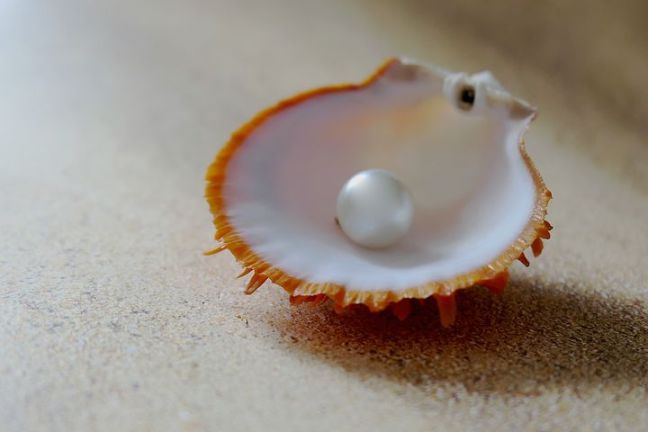
Oysters developed a resourceful strategy for handling unwanted and irritating invaders. In order to reduce the pain from a wayward grain of sand or grit, they surround the unwanted particle with smooth coating of calcium carbonate.

That’s how I see my resolution to conclude that I was once loved by him – a pearl enveloping and softening the pain.

And it may not be Truth in any real sense, but it’s real enough to me.


Was Divorce What You Expected?

Why Self Awareness is Critical for a Healthy Marriage

When asked to enumerate the critical components of a healthy relationship, most people appropriately include “communication” on their list. Communication certainly is critical to a healthy marriage; partnerships that depend upon mind-reading or are characterized by either raised or silenced voices rarely allow for intimacy and mutual support to develop.

Yet something is often missing from the discussion about communication – no matter how skilled a person is at delivering information in a clear and kind manner, they cannot convey what they do not know.

And so when it comes to relationships, self awareness is a vital precursor to communication. Before you can help somebody else understand you, you have to first know yourself.


What is Self Awareness?

Self awareness is an ability to observe and reflect upon ones feelings and responses. Anybody can feel an emotion; a self-aware person can name or describe the emotion. When somebody is self-aware, they are able to take a step back and describe themselves from a more objective viewpoint.

As with most things, self awareness exists on a continuum. Rather than being entirely present or entirely absent, it’s something that we all have to some extent. It begins when the infant first recognizes themselves in the mirror and continues when they learn to identify their agitation as “mad” or “sad.” Some people never advance much beyond those simplistic labels while others become quite adept at being able to describe their inner landscape and motivations. And for all us, self awareness tends to be easier in some areas than others.

Self awareness takes courage; you have to be willing and able to see the negative traits in addition to the positive ones. It requires curiosity, a willingness to ask questions and explore your reactions and assumptions. There is a certain humility that often accompanies self awareness because the imperfect nature of humanity is on full display whenever you look inward.

Awareness is separate from the ability to control an emotional response or make healthy decisions, but it is the first step. A self-aware person may not always act in their best interests, but with some effort, they will likely be able to identify the underlying cause of their behaviors. For example, two people may respond to a break up by drinking too much. The self-aware person will be able to identify that their fear and isolation from the break up is prompting them to look for an escape whereas the person who lacks this insight will fail to understand the reason for their imbibing.

Knowing yourself is never a perfect science. We all change (often below the conscious level) and we are all subject to the myriad fallacies of the human brain. We may reach conclusions that are not valid or neglect to face more undesirable characteristics. Self awareness is not about perfection. It’s not a goal to be reached and forgotten. It’s the consistent attention of a curious and questioning eye turned inwards.


Why Do Some People Lack Self Awareness?

One of the more common reasons that people may lack self awareness is from exposure to a traumatic experience. Trauma teaches people that their body, their self, is not a safe place to be. So after trauma, people often try to distance themselves from themselves. Looking too closely means having to face some painful and difficult truths, so instead they turn away. A knowledgeable therapist can be invaluable here in helping to reunite the person with themselves.

Others may have never been provided the instruction in developing a language to describe the inner working of their mind. And language is powerful. Without the words to describe what you’re feeling, there is a limited capacity to fully explore it, much less express it to others. The good news is that this language can be mastered no matter your age.

Some personality disorders also impact an ability to develop self awareness. Consider the classic narcissist whose inflated outer ego is a shield for a wounded and delicate inner self. They rarely seek therapeutic assistance because they cannot bear to see – or admit – the underlying pathology.


Why is Self Awareness Important in Relationships?

We all want to be seen and accepted for who we are. But first, it’s critical that we fully understand – and can communicate – who we are. A self-aware person has the tools to choose an appropriate partner, has the ability to reflect upon their own strengths and weaknesses and has the capacity to explore their role in the relationship dynamics.

Self awareness is key in boundary setting. Without an understanding of your own needs, it’s all-too-easy to subjugate them to others. You can’t stand up for yourself if you don’t know yourself.

You can equate a relationship to a dance between two people, an interplay of moves that requires a certain amount of cooperation and anticipation. Self awareness in a relationship is the equivalent of a dance partner knowing where their own body is in space; without this information, it is impossible for the couple to move in synch.


When You Don’t Want to Go Home

One of the most painful sentences that I have ever been on the receiving end of was, “I didn’t want to come home.”

Those words were a cannonball to the gut, a sharp exhale followed by a tremulous and hesitant inhale.

Because home should be a place where you want to go. A sanctuary where you can recover from the bruises that the world inflicts upon you. Ideally, home is the welcoming hug. The safe space where your armament can be removed along with your shoes.

And so to be told that I was contributing to a home environment that brought dread instead of relaxed anticipation? Ouch.

And yet, I can understand this feeling of not wanting to come home. As I expect most of us can.

Relationships, even the best ones, are challenging. And there are times when having to take somebody else’s emotions and needs just feels overwhelming. Perhaps you’ve fallen into a cycle of negativity and you need some space to untangle the interactions. Or maybe you’re not feeling accepted as you are, which is ever more painful when it happens at home than in the broader world. And sometimes, we outgrow our home, the rigid shell binding when we crave expansion.

Pay attention to that feeling of not wanting to return home. What is it telling you?

In my old life, I always looked forward to coming home. Until that home transformed into an empty shell, a life’s vessel without its lifeblood. The floors echoed, sending out reminders of the years they had been traversed together. The walls seemed to taunt me, speaking of better times. I only managed one night there after he left, an endless darkness spent pacing the living room with a persistent hope that I would soon hear the garage door rumble open. The reminders proved too much for me to bear.

The next day, I escaped to a friend’s home. Which immediately became my home. One I wanted to return to at the end of each day. When it came time for me to establish my own space, I chose the apartment and its furnishings carefully in an attempt to cultivate a space that welcomed me back. Little from my old life occupied the space. It was a blank slate, ready to accept the imprint of a new life.

My home now welcomes me each day. It offers both reminders of the best times and the shared laughter and it also holds the impressions of loss and tears. It’s a place where I feel both accepted and challenged. And on those days when everything is just a little too much, it offers comfort and consolation.

Home holds so much power over us. It is where many of the best and the worst memories are formed. The most important relationships of our lives play out upon its floors. It receives our greatest hopes and dreams and sometimes surrounds us as we say our goodbyes.

It said that you can’t go home again. Yet as long as you accept that home changes with the years and you can rebuild at will, you can always find your way back.