“I’m Fine.” (But What Are You Really?)

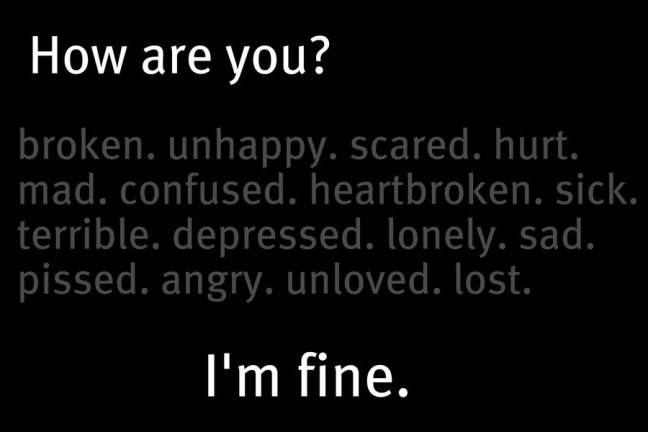
I'm fine

“I’m fine.”

How many times have you declared those words?

Hundreds?

Thousands?

Maybe more?

And how many times were those utterances accurate, describing your well-being as exceptional? Thriving? Or, in the more modern use of the term, simply satisfactory?

And how many times were they offered in reflex, in deflection or even as an outright lie?

__________

Here are some of the true feelings that can hide behind “I’m fine.” Do you relate to any of them?

“I’m afraid that if I start talking, I’ll start crying.”

My world is a mess right now and I’m trying to just get through. I may look okay, but I’m really just going through the motions.

“I’m trying very hard to pretend that I’m fine. Please don’t intrude on my delusion.”

If I really paid attention to my intuition, I would probably know that something is not right. But I’m not ready to face it yet so I’m going along with the idea that I’m fine.

“I’m not fine, but I don’t feel safe sharing that with you.”

Things are really hard right now and I wish I could talk about it but I’m afraid that you’ll ridicule me or somehow add to the pain. So I’d rather play it safe and keep my feelings tucked inside.

“I don’t know how I’m doing, to be quite honest with you. I don’t really give it much thought.”

I haven’t allowed myself to slow down enough to be aware of how I’m doing. I stay busy and pretend that as long as I’m doing, I am fine.

“I’m afraid that if I admit to not being fine, you’ll see me as weak.”

I know you see me as the strong one. The one that holds it all together. And I don’t want to be seen as weak or have you think that I can’t be counted on.

“I’m not fine and that’s my problem.”

I don’t want to burden you with my troubles. You have enough on your plate.

“I believe that I should be fine, so I play the part to the world.”

It’s been a long time since the event. I have so much going for me. I have nothing to complain about. I feel guilty for not feeling fine when so many others have it much worse.

“I don’t have the energy to explain my not-fineness to you.”

I’m tired. Defeated. And even just the thought of trying to explain how I feel is exhausting. So I give you the two syllables needed to stop you from probing further.

“I’m frustrated or upset with you, but I don’t want to rock the boat.”

I’m not fine, but I’m afraid that if I tell you how I feel, you’ll be angry or disappointed. And my fear of your reaction is greater than the pain of holding back. For now.

“I was taught that my feelings aren’t valid. So I suppress them.”

My parents taught me that feelings were stupid. I learned that nobody will listen or respect my emotions. So they stay hidden. Even from me.

“I want to be left alone.”

I really just want to crawl into bed and hide under the covers until this fades. Please don’t come in after me.

“I need time to process my feelings and put words to them.”

I want to open up, but I need to do it at my own pace once I wrap my brain around what I’m feeling.

“I need someone who will just listen. Not try to fix things.”

I’m not fine. But I’m also not helpless. I want to be able to share my feelings without you trying to step in and fix everything.

__________

I’m not suggesting that the next time the cashier at the grocery store asks you how you’re doing, you should respond with a truthful unloading of your current worries. Unless you want to be the one they all try to avoid when you walk through the door, that is.

After all, many of our daily interactions are superficial and that’s okay.

But not all of them are.

And when “I’m fine” becomes a habit, a reflex, that we apply to our friends, family, therapists, doctors and even ourselves?

We’re robbing ourselves and our relationships of the vulnerability and connection that comes from the courage to respond with authenticity.

So next time somebody asks how you’re doing, respond consciously.

Here are some words to choose from:

sad  nervous  excited  anxious  lonely  energized  confused  frazzled  aroused  irritated  content  elated  angry  lost  melancholy  fatigued  overwhelmed  engaged  hurt  fabulous  frightened  playful  relieved  embarrassed  awed  vulnerable  relaxed  jealous  unsure  apathetic  curious  grief-stricken  grateful       rough around the edges   better every day      making progress     happy to be here

Or even just fine.

Understanding and Addressing Loneliness After Divorce

It has been postulated that loneliness is one of the primary epidemics of our age. Loneliness is much more complex then it may seem; the single person living alone may not be lonely while the married person constantly surrounded with others might be. Teenagers today, never far from their countless social media feeds, report feeling lonelier than generations past. Loneliness comes not from the quantity of our social connections, but from the quality.

Loneliness is so much more than the ache of being isolated. It is associated with a greater risk of depression and an increased chance of death though all means. We are a social species; like Maslow’s young monkeys proved, we have evolved to form relationships. And we only thrive when those relationships thrive.

Understanding Loneliness After Divorce

Your spouse probably knew you better than anybody. Even if the final years of the marriage were filled with conflict, just the fact that he or she knew exactly how to push those buttons is a sign that you were known. And then at some point, either before or after the split is made official, you became persona non grata in his or her eyes. And that’s the door sliding shut on your solitary confinement.

If you do not have children or your children spend time visiting their other parent, you are facing the haunting echoes of an empty home. The barren space mirroring the chasm in your heart. It’s a strange feeling, being alone, when you’re used to another person being there. Even if your spouse traveled frequently leaving you home, you may find that the finality to this emptiness gives it more weight.

The end of a marriage is the end of so much more. Like the ripples from a stone thrust rudely into the waters, the impact of the divorce carries far and wide. You may lose friends. And many of the friendships will certainly change. It’s a cruel joke – when you need connections the most, they fall apart.

Some of loneliness after divorce is inevitable. There is a void that takes time to fill. There are changes to adapt to and a curve to learn.

But you don’t have to sit idly by. You may feel as though you’re in solitary confinement, but the only locks on that door are the ones you secured yourself.

Addressing Loneliness After Divorce

The first step in combating loneliness is understanding your social and relationship needs. Are you an introvert that thrives on alone time and only needs a few close connections? Or, are you happier when you are surrounded by people? It’s an important distinction. The introvert can feel lonely and stressed if in the center of the action, whereas an extrovert can feel painfully isolated even in the company of a single close companion. Know thyself. And create a world that matches your needs.

So many rebound relationships are entered into in an attempt to patch that intimacy void left by a departing spouse. It never works, at least at first. It takes time to form connection; a new relationship, no matter how exciting, does not yet have that vulnerability and intimacy of an established one. Instead of looking to new partners to fill that gap, turn to existing relationships. This is a great time to nurture that bond with a close family member or your best friend. Those relationships tend to take a back seat when you’re married. Invite them to sit shotgun.

In divorce, you lose people. So go find more. Invite a coworker to lunch. Accept the invitation to a party. Join Meetup.com and sign up for a group that interests you. Get to know your local grocery clerks; a smile and some brief chatter from a friendly face can change your entire day.

Cultivate your passions. What did you used to enjoy doing as a child or young adult that you no longer do? This is your opportunity. Pick up that paintbrush again. Brush the dust off that guitar. Sign up for the soccer league. When you’re engaged in what you love, you don’t feel lonely. Even if you’re the only one in the room.

One of the most devastating elements of loneliness is the feeling that you don’t matter. That you could exit the world today and no one would even notice. So make an impact. Join a volunteer organization. Become a Big Brother or Big Sister. Spend time with the elderly at a retirement home and gain wisdom from their stories. Or, register to rock newborns in the nursery and gain hope from their innocent eyes.

Ultimately, loneliness is a choice. And inaction is choosing to remain isolated.

So if you’re feeling lonely, do something.

Reach out.

Nurture connections.

And get busy.

Divorce can make you lonely.

But you don’t have to stay there.

Unmoored: Emotional Free Fall After Divorce

Brock and I watched the movie Gravity several months ago.

Unusually for me, it gave me nightmares. Recurring nightmares.

Several times a month, I would wake up after dreaming of myself in Sandra Bullock’s position – untethered, floating freely through space. Although my body was safely on the bed, my heart would be racing as though I was in mortal danger and it took several minutes for my brain to accept the idea that I was not alone and unmoored.

And that’s really the root of the nightmare, isn’t it?

My fears have nothing at all to do with being lost in space and everything to do with being lost in life.

In those early days, I struggled to find the words to explain how I was feeling. Nothing seemed strong enough. Encompassing enough. But one word kept floating to the surface.

Unmoored.

With the receipt of that text, my ties to most everything in my life had been severed. Those things that defined me, anchored me, were gone and I felt like I was floating uncontrollably away from myself. It was a panicky helpless feeling as my attempts to get back to myself seemed to occur in the dead space of a vacuum. I felt detached with a limited life support system and my oxygen quickly running out.

And in so many ways, that feeling of being unmoored was the scariest of all of the post-divorce emotions.

Because you have to fully let go of what you know in order to grasp on to your future.

I wasn’t free-floating for long. I started to feel anchored once my clothes were placed in the dresser in my friend’s spare bedroom, where I would spend the next year. Another tie came when my mom purchased a gym membership for me and that facility became my home away from my-home-for-a-year. School started up again and even though it was a stressful year due to administration, if felt reassuring to be back in the classroom, even as I answered to a name I no longer identified with. Yoga reconnected body and mind and I learned how to breathe again on a soft carpet on a therapist’s floor. Pen went to paper, and I started to explore the emotions that were within, the anger especially giving me purpose.

I realized only recently that some of the unmoored feeling persisted for quite some time. It was only this past spring, when I tucked plants into the soil in my yard (in an area that feels like home) with a ring again on my finger that I realized I felt anchored again. Not settled, but relaxed into where I want to be with anchors of my choosing.

After divorce, some people find they enjoy the freedom that comes from being unmoored; they design their new life with minimal ties and restraints to allow maximum flexibility. Others crave the feeling that comes from multiple ties to people and places, giving a sense of security and belonging.

Being unmoored alters you. It helps to build your confidence in your ability to survive. It carries a freedom that may frighten or awaken. It confirms who your true friends are and alerts you to the ones that need to be jettisoned. It whispers truths about you and your desires, uncluttered by the wishes of your ex. It’s a moment in time. A flash of clarity with clutter removed.

Because in free fall, you have no limits.

Related: Take Me to the Other Side

Only possibility.

I Feel Alone

On the day I met my soon-to-be-ex husband in court, I was asked by the judge to wait in the hallway while she and attorneys consulted with my husband.

I have never felt so alone.

I sat trembling on that austere bench in that impersonal hall with tears streaming down my face. My past was in the courtroom, embodied in the man that had gone from lover to stranger, protector to persecutor. My future was unknown and unknowable. And my present was hell.

A hell that I felt like I was facing alone.

Because it felt like nobody could understand.

No one could relate.

photo 4-51

Eventually, I learned that I wasn’t alone. I realized that others had been through similar situations and managed to survive and even thrive.

photo 4-49

If you’re currently feeling alone, here are some posts for you:

It’s funny how freeing it can be to realize that you’re not special. There is a comfort to be found in accepting that we are more alike than we think.

Understanding and addressing loneliness after divorce is critical to your well-being.

accept help

I started sharing my story in the hopes that no one else would ever have to feel alone, no matter the details of their divorce. Here’s my personal message for you. 

photo 5-41

One of the ways that we feel alienated after divorce is when people start to say that we should be feeling a certain way. There is no right way to feel.

photo 3-59

Divorce is a major loss. It’s shocking to the system. This analogy may help you find acceptance and clarity of where you are.  And give you some ideas how to rebuild.

photo 3-61

We all need support during divorce. From old to new, these are the types of friends you need during your separation.

The holidays can be a stressful time for anyone. And that goes double for those dealing with the end of a marriage. There are ways to make it more tolerable.

photo 2-68

I never wanted to be a member of the divorce club. I’d wager you didn’t want to join either. Here are the FAQS for new affiliates.

I couldn’t relate at all to stories of conscious uncoupling. My story was more Stanley Kubric than RomCom.


photo 5-42

This post really doesn’t have much to do with being alone, but it is a reminder of how we can change our divorce experience. Even if our exes don’t cooperate.

photo 2-70

Affair-Proof

Whenever I stumble across the words “affair-proof,” my mind responds like the Incredible Hulk — raging and ready to rip. Now, don’t get me wrong, I wish I could find solace in those words and place my faith in their sanctity.

But I can’t.

Because there is no such thing as an affair-proof relationship.

It simply doesn’t exist. And pretending that it does only causes additional pain and heartbreak.

Implied in those words is the understanding that if an affair occurs, the betrayed obviously did not perform his or her duties effectively to affair-proof the marriage. It places the blame for the infidelity squarely on the shoulders on the one who was cheated upon. Read the rest here.