Let That Sh*t Go

When I walked into my yoga studio this past Monday evening, I saw a woman with the most amazing shirt. Under a simple image of a figure in a pose, were the words:

Let that shit go.

I laughed. I smiled. And I reflected back on my day, the first day back at school after spring break. A day filled with tired, yet nervous kids, as we all prepared for the upcoming standardized testing season.

I felt my shoulders kissing my ears as they still were still struggling to carry the load of the day, recognizing that my mind hadn’t left the school and was still busy tweaking the lesson for the following day. I sensed a current of anxiety coursing through my body, fearful that I would somehow mess up the testing in some critical and unforgivable way. Looking inward, I realized that I was already anticipating what I needed to accomplish after the yoga practice instead of making preparations for my yoga class.

And then I made a decision and with my next exhale, I followed the advice of her shirt and I let that shit go.

As we go through our days, we collect worries and troubles like a young child collects pebbles on a walk through the park. We stuff our pockets, line our shoes and fill our hands with as much as we can carry. Consequently, we become overloaded, burdened, with the weight we carry. We curse it, we complain about it. Yet we rarely follow a form of the advice we would give to the child overloaded with collected treasures on a walk –

Let that shit go.

Mistakes

When I was in kindergarten, I got in trouble for talking in class. My consequence for the misdeed was a missed recess. The talking was a simple mistake, a lapse in judgment rather than a lapse in character, yet I internalized the mistake. Instead of merely sitting along the wall with the other kids who made a mistake that day, I had to be consoled by my teacher because I was so hard on myself.

Mistakes are inevitable. Mistakes are opportunities. Making a mistake doesn’t make you any less of a person.

Let that shit go.


A Bad Day

Have you ever noticed that once you label a day as “bad,” there seems to be no shortage of ever-compiling evidence to justify that moniker? Every slight, no matter how small, is a sign the world is against you. Every stressor becomes a mountain, every trigger detonates an explosion.

Days aren’t good or bad. They’re simply a measurement of time. And what happens in one fraction of a day doesn’t have to impact the remaining parts.

Let that shit go.


Expecting Things to Be Different

I receive questions and pleas for help on a daily basis where the writer inquires how to go about changing their spouse’s or ex’s behaviors. They enumerate the lies and the irresponsibility. They express their frustrations about the lack of accountability and the absence of emotional intelligence. Sometimes, they lament the circumstances rather than the person, begging for a way to alter their current reality.

But reality is as it is. There are circumstances we cannot change and people beyond our influence. To believe otherwise is maddening and self-limiting.

Let that shit go.


Childhood Wrongs

I once heard a psychologist say that our twenties are the time for facing and addressing any childhood traumas and points of contention. After that, it’s time to take responsibility for the direction of your life.

Some people have had horrible childhoods, filled with insults and assaults upon a vulnerable frame. Childhood ends and with it, the lack of choice and agency that comes from being young. At some point, your life becomes your responsibility.

Let that shit go.


Control

Getting pneumonia 6 weeks before my first – and only – marathon was the best thing that could have happened. Until that infection left me bedridden, I was carefully controlling every bite of food and every step run. The pneumonia was a reminder that I couldn’t control the outcome. (It turned out okay; I still “won” the marathon.)

You can control your responses. You have influence over the process. But the outcomes?

Let that shit go.


An Apology That Never Came

I spent years hoping for an apology from my ex husband. I believed I needed it so that I would know that he felt remorse and so that I could receive closure. It was a life on hold. A wish with no action. I put more faith in the apology than I did in my ability to move on.

Never put the responsibility for your well-being in the hands of the one who hurt you.

Let that shit go.


Fixing Everything

Not everything is a problem. Not everything has a solution. Sometimes things are broken beyond repair and sometimes what we see as flawed, someone else views as perfect. And other times, the fixing may need to be done, but it is not our job to do it.

When we act as “fixer,” we are taking on too much and often hurting others in the process.

Let that shit go.


Perfection

I remember erasing my drawings in art class to the point where I rubbed holes through the paper. In an attempt to make them perfect, I inevitably ruined them.

Life is about being present, not perfect.

Let that shit go.


What Ifs

It’s an easy mental game to play – what would have happened if I chose a different path? It can be entertaining and educational, playing around with the options and outcomes.

Yet what ifs can also be a trap, a way of spending time in manipulated past and an imagined future instead of being where you are.

Let that shit go.


The Need to Be Right

When we listen to respond rather than understand, we’re allowing our need to be right to dominate our interactions. When we lead with the ego, we shortchange others their right to be understood and we limit our own ability to grow.

It’s funny. The more we need to right, the more rarely we are.

Let that shit go.


Outrage

I heard an interesting podcast the other day that had an expert in social media discuss how the big players – Google, Facebook and Instagram – manipulate us into spending time on site and interacting with the content. The types of posts that receive the most investment of time and energy are not the feel-good ones, not the informational ones, but the ones that cause a feeling of outrage.

It’s not just the social media big boys that bully us with outrage. Think of others who provoke you, push your buttons and get under your skin. What’s your typical response? We are all prone to reactions. Outrage short circuits our rational minds and prompts irrational responses even while it serves as fuel for the ones prompting it.

Let that shit go.


Occasional Hurt Feelings

Sometimes I wish I had a bad memory, that painful things that had been said to me would blur over time and fade into the backdrop. But that’s not the case. I have to be very deliberate about releasing the hurt that has come from words spoken without thought or said when emotionally flooded.

We all unintentionally hurt others sometimes. We say the wrong thing. Forget an important milestone. Neglect to respond in the right way. And feelings get bruised. And bruises heal.

Let that shit go.


Self-Flagellation

Guilt serves a purpose. Much like the inflatable gutter guards in children’s bowling, it helps to guide us along our intended path. Yet guilt has a propensity for growing outside its allotted space, suffocating us in the process.

When you mess up, own it and then either change it or apologize. And once you learn from it, the guilt and self-punishment serve no further purpose.

Let that shit go.


Excessive Judgment

Some behaviors deserve judgment. Intentionally harm a child or an animal and I’m going to judge you all the way to prison. Yet most behaviors require less judgment and more curiosity.

It’s easy to think that your way is the right way and that when you don’t understand somebody’s beliefs and decisions, it means they’re wrong. Yet different isn’t necessarily wrong, it’s just different. Judgment won’t change their mind, but it will keep you from expanding yours.

Let that shit go.


Comparisons

Have you every felt good about an accomplishment only to feel incompetent and jealous when you measured them against another person’s.

Comparisons are empty. You’re holding your inner life up against somebody else’s outer one. You’re allowing somebody else’s achievements to have an influence on your own. What somebody else has earned has no bearing on what you have attained. Let them be and you do you.

Let that shit go.


Busyness

I struggle with feeling guilty and lazy when I take some for myself. I find it all-too easy to identify with my accomplishments and view my worth through my deeds.

You are not defined by the number of events on your calendar and the number of items crossed off your to-do list. It’s okay to step away from doing and allow yourself to simply be.

Let that shit go.

 

let that shit go

Four Things You DON’T Need to Move On After Divorce

We often get in our own way after divorce, desperately wanting a way out from the pain while at the same time telling ourselves stories that only serve to hold us in the flames. I convinced myself myself that I needed everything from a jail sentence for him to an apology for me, all while ignoring the power that I held within myself.


In Order to Move On, You DON’T Need –


Justice

Justice looks differently for all of us. It may center on a certain ruling from the court or a visit from karma, putting your ex in a position similar to the one you’ve faced. Regardless of the specifics, a desire for justice is really a need for fairness. We’ve been knocked down and we want the fulcrum to shift the other way.

Chasing fairness is a form of chasing the dragon; no matter what you score, it will never be enough to meet the need. No consequence will undo the pain you feel and no repercussions will satisfy. And here’s the brutal truth – if they escape without a scratch, it does not prevent you from moving forward. But if you fixate on waiting for them to pay, you’re tethering your future happiness to their circumstances.

Instead of wishing them ill, shift your focus to being the best you. After all, there is no better revenge than living well. And if your ex happens to notice how awesome you’ve become and regrets their decision? Even better:)


An Apology

Those of us that have been cheated on or abandoned without so much as an insincere “sorry” casually tossed out over a departing shoulder have a tendency to give apologies almost a mythical standing. They become the holy grail of divorce, convincing us that once secured, we will find everlasting life.

I used to feel this way. And then I talked to a woman who got an apology. Several, in fact. And they were insightful and sincere, as her ex took full responsibility for hurting her and expressed true remorse for his actions. And you know what? She was still stuck. She got what she thought she needed and then when it didn’t work to relieve the pain, she became even more distraught.

It gave me pause. And then it made me angry. At myself. Why was I still allowing him to have this much power over me? I made up my mind in that moment to learn how to accept the apology I never received. 


Understanding

One of the most powerful realizations I had when healing from divorce – I’ll never be able to understand what my ex did because it is not something I could ever do. That single thought released months of anguished questioning and searching for answers that remained elusive.

Divorce is not a class in university. There is no final exam where you have to correctly identify the motivations behind your ex’s actions before you’re allowed to move on with your life. It’s okay to say, “I have no idea” and close the book on that chapter.


Closure

There’s no finish line. No “done” stamp. No graduation ceremony. We have this image of there being a defined end to the pain once we collect all of the missing pieces. As though divorce is some sort of video game quest where the end credits roll once you have located the last of the items.

Spoiler alert – it isn’t.

Closure isn’t a destination. It’s more of a choice. A choice that has to be made every day when you decide where you’re going to put your energy. Whatever you nurture, grows.

Here’s What You ACTUALLY Need to Move On –


Belief in Yourself

If you believe you can’t, you’re right. It all starts with your belief that you can be happy again. That there is more meaningful life ahead and, this is the most important part, that you have what you need to make that happen. You are not responsible for what happened to you, but where you go from here is up to you.


Time

You can’t force healing. It will take time for you to stand up again, much less take those first steps as am independent person. Give yourself the time and space needed. Divorce is a major loss of the past that is now in question, the present that has become unfamiliar and the future which is now erased. Be patient with yourself.


Processing

Time isn’t enough on its own. If you avoid your emotions, you are simply delaying the healing. In order to move on, you have to first move through. Face your pain. Become familiar with your feelings. Work through any unhealthy responses and beliefs you’ve developed and put in the effort to learn how to do better. To have a better life, you have to first understand and accept yourself.


Determination

One of the reasons that we tell ourselves that we need these things from others is because the work to heal after divorce is so. damn. hard. It feels impossible and so we assume that we must be missing some critical piece to make it happen. And that’s where the determination comes in. You have to want it. And you have to be willing to work for it. And if you are, nothing can stop you.

Unraveling Expectations: The Good, the Bad and the Ugly

Join me on a little thought experiment as we consider two different situations…

Situation 1 – You go on a blind date, knowing nothing at all about the person before you meet. The date went well, not great but also not terrible. You had some good conversation and you think they’re a quality person, but you doubt you’ll ever see them again.

Situation 2 – You meet somebody on an online dating site. Due to your schedules, you are unable to meet in person for several weeks. During that time, the two of you have been texting and messaging constantly. The texts are flirtatious and even begin to tiptoe into some deep territory. “Maybe they’re the one,” you think to yourself as you excitedly get ready for your first date. The date goes well, not great but also not terrible. You had some good conversation and you think they’re a quality person, but you’re just not feeling it.

Even though the dates themselves are identical, how would your feelings about them differ? I would expect that the first situation would be easily shrugged off, whereas the second situation may well knock you down a bit, possibly even prompting worries about being alone forever.

What is the difference between the two?


Expectations.


images-45


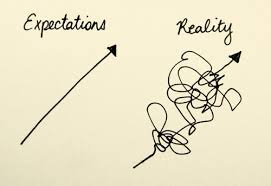
As anyone with a dog around dinnertime knows, expectations are a powerful force. Unless you live a life without any predictability or patterns, expectations are necessary to navigate efficiently in a complex world. We expect the sun at the beach to be intense, so we respond by bringing an umbrella and sunscreen. We expect a toddler to become irritable on a long car ride, so we stash snacks and toys in anticipation.

But expectations are not always so benign. They have a way of sneaking up on us, whispering temptations into our ears and then running away unrestrained. We follow, only to end up face-planted as we trip over our own predictions when they fail to materialize. Other times, past trauma has primed the pump for expecting the worst, even when the worst is no longer the reality.

We cannot eliminate expectations from our lives. They’re innate and needed. But we can also learn to understand them better and we can become better at managing them so that we don’t continually break our own hearts.

Expectations can be trip wires in all areas of life – relationships, work, health, etc. I’m going to focus on expectations in relationships, although much of this applies to expectations in other arenas as well.


images-44

Expectations


The Good

Since we often face counsel to “let go of expectations,” we rarely take the time to reflect upon their benefits –

Opportunity to Gain Self-Awareness

We all develop our own personal narrative, stories that pass through our brains, spinning yarns and asserting beliefs. All too often, those personal narratives become tainted, as drops of fear or insecurity bleed throughout the story, altering and staining it without enough external influence to right the path. And expectations can come from those painful places. After all, a fear of abandonment is really an expectation of abandonment sparked from some prior experience.

We are not always aware of our internal narrative. It’s too close, too much a part of us. But disappointment is a handy way to recognize when our expectations are out of alignment. So let those times when you feel let down by someone become an opportunity to look within. What were you expecting? Where did that expectation come from? The answers to those two questions can give you some great insight into yourself.


Keeps Us From Settling For Less

Sometimes expectations act to inform us what we deserve. This is especially true when we come from a healthy and loving family and we anticipate others to treat us in the same way.

Expectations can act like a minimum fill line in a pool, alerting us to behaviors that fall below a certain threshold. In a relationship, it is perfectly appropriate to expect to feel safe, to feel loved much of the time and to have an atmosphere of honesty and respect.


Allows Relationships to Operate Efficiently

Expectations and habit allow us to shift some of our daily lives to autopilot. This isn’t always ideal, but in a busy world, it’s often necessary. When we have an idea what to expect from our partner, we can shift our own choices accordingly. For example, if you want an opportunity to reconnect with your spouse over a meal and you know they’re not a morning person, you propose a dinner date as opposed to brunch. Expectation and adaptation.


IMG_1276

The Bad

Of course, expectations have their downsides –

We Are Set Up for Disappointment

We recently received a widespread lesson in the danger of unchecked expectations. I don’t think any series finale has been so widely anticipated as that of Game of Thrones. After years of a wild – and emotional – ride, the expectations of fans were at an all-time high. And the disappointment after the ending was almost palpable.

No matter what happens in reality, it will never align perfectly with our expectations. So when we become too wedded to a particular outcome, we are guaranteeing our own disappointment.

Related: Are Expectations Dooming Marriage?


Other’s Actions Are Outside Our Locus of Control

Sometimes we act as though our internal narrative is script and others should be reading the lines and following the stage directions we have prepared for them.

But of course that’s not true.

We can have expectations all day long, but unless it’s something within ourselves, we have little influence on what actually happens.


We Confuse Boundaries and Expectations

Expectations say, “I’m assuming that you’re going to…”

Boundaries say, “If you do …, then I will…” 

Note the difference. The first isn’t giving the person a choice. It’s guilty until proven innocent. Whereas the latter gives the other permission to act and then provides information about the consequences.

Letting go of expectations is not the same as permitting others to treat you poorly. If they act badly, let them face the consequences. But also give them the opportunity to make that choice before you enact the repercussions.

IMG_1333

The Ugly

And then there’s this. Expectations can cause worse effects than disappointment. They can set us up for catastrophe –

When Expectations Are Too High, We Are Always Chasing Contentment

I have been outspoken in my disdain for the concept of a single soulmate. I mean, talk about a high expectation! I have to somehow manage to find the one, single person that is perfect for me. And then once I have them, everything will be easy because we are meant to be together. So then what happens when you first face discord in your relationship? Does that mean that they were the wrong person and you need to resume the search?

We are constantly bombarded with images of perfection. And so we can easily find ourselves lacking. When expectations are unrealistic, we will never be happy because the bar is set at infinity and we’re mere mortals.


Expectations Can Influence Reality For the Worse

I love the studies that have been done in schools where the teachers of two comparable classes were given different – and false – information about their students. One teacher was told that their students were exceptionally bright and they could expect great things from them. The other educator was informed that their students were slow learners and have never really shown much promise.

Same types of students. Different expectations. And VERY different results.

I bet you can guess which class did better.

People have a way of acting as we expect them to act. After all, even if we say nothing, our unconscious interactions will reveal some of our internal beliefs. This chicken-and-egg dance often happens with infidelity. We often assume that the cheating happens first, followed by the suspicions. Yet it is not rare for the distrust to enter first with the infidelity following behind.

When expectations are too rigid, we fail to give others the space to change. And if we’ve inadvertently set the bar too low, we may just find that it’s met.

When we lead with expectations, we are not truly seeing or hearing the other person. Instead, we’re interacting with the mental construct we have of them. We’re in an echo chamber, seeing and hearing only what we expect. Confirmation bias is a powerful force.


Toxic People Can Hide Behind Our Expectations

Sometimes our expectations of people are too high. We start from a belief that they are kind and operate with integrity and then we assume that their actions will be in accordance with those characteristics.

And if they’re not honest and kind? They very well may take advantage of those expectations, manipulating things behind the scenes like a magician’s assistant behind a screen.

Expectations can blind us to truth as we confuse desire with belief. And that’s a dangerous road to travel.


images-46


Learn to Work With Your Expectations Instead of Fighting Against Them


First, let me state that I am by no means an expert when it comes to managing expectations. I struggle with it on a frequent basis. But I HAVE gotten better at keeping them in check. Here’s what has worked for me:


Awareness of Expectations

Expectations can become so ingrained, so knee-jerk, that we often take them for granted and hardly even notice them. In order to become more aware of my own expectations, I’ve committed to paying attention to my disappointments and where they are coming from.

It’s been an interesting and eye-opening exercise. I’ve learned that my expectations anchored in trauma have all-but-disappeared, yet I still struggle with plenty of other maladaptive expectations. And as I become aware of them, I’m better able to adjust them to the actual circumstances.


Shift Your Expectations Within Your Locus of Control

When I first started dating post-divorce, I did one smart thing in a great big tangle of not-so-smart things.

I decided that my expectation for every date was that I would learn something. Here’s the beauty of that expectation – it had a 100% chance of being met every single time because I was the one in control of it. I was even able to learn something on the times I was stood up:)

In contrast, if I had expected for every date to go well or every man to be attracted to me (or me to him), I was guaranteed to fall short.


Practice Being Flexible

Sometimes when my expectations aren’t met, I don’t become disappointed.

I become irritable.

This happens when I’m knee-deep in my planned tasks (thanks, anxiety!) and I’m having trouble shifting gears when my predictions go awry.

As with everything, practice makes better. So the more I practice being flexible and trusting that it will be okay even if it doesn’t go to plan, the easier it becomes.


Keep Your Expectations Realistic

I love to travel and I love to travel with my husband. However, he is not as enamored of trips as I am. So whenever he mentions a possible trip, I get excited.

I used to get too excited.

I would research, plan and dream. Then, I would present him with the information and he would be all, “Eh.” I took his rejection hard, feeling like my hopes had been machete-cut like a coconut on some tropical beach.

But here’s the bigger picture. My husband is an extrovert with ADD. That combination means that many of his thoughts are shared aloud, even the impulsive, not fully-matured ones. So he may want to go on a trip, but the casual mention doesn’t mean that he has fully thought through all of the time and financial repercussions. And that’s who he is, not something I can ask him to change.

As an analytical introvert, I fully think (okay, overthink) anything through before I speak it. And I was listening to him as though he was me. Which of course, he’s not.

So I’ve learned. Now, when he mentions a trip, before I do anything else I ask a few questions – What sort of timeline are you thinking of? Where are you with commitment to this on a scale of 1 to 10? And with just those questions and any needed follow-ups, I know where my expectations should be.

Result? I don’t get disappointed and I thoroughly enjoy the trips I do take – with or without – him.

The best bet is to keep your expectations high, but also realistic.


Communicate Your Expectations

If birthdays are important to you, you might get your hopes up as the first birthday approaches in a new relationship. After all, it’s easy to assume that what is important to you is also important to someone else. And then when the day comes, if their excitement isn’t on par with yours and they either fail to appreciate the celebration you created for them or didn’t meet your expectations for the recognition of your birthday, you feel dismissed and unimportant.

Yet it’s also not fair to expect others to meet our expectations if we don’t communicate them. Until Elon Musk develops some sort of implantable mind-reading device, we have to express both our expectations and the importance of them to others.

If we don’t say anything about the expectation, the resulting disappointment is on us.


Try to Replace Expectations With Curiosity

Some of my favorite yoga teachers are consistently good, yet I never know what to expect from them since every class is good in its own way. They have helped me shift my thinking before class from, “I hope we do some hip-opening today” to “I wonder what goodness we are going to do in class today.”

When we’re curious, we are not wed to any certain outcome. Instead of closing our minds and sealing the cracks with conclusions, we are throwing the doors wide open to see what might show up.


Give to Give, Not to Receive

It feels good to have your efforts recognized and affirmed. But if that’s the only (or at least, a major) reason you’re giving, you will be disappointed. Whether from a lack of awareness or a lack of caring, you will not always be validated for your efforts. Give because you want to give, not because you expect something in return.


Distinguish Between Needs and Expectations

Needs are requirements. Expectations are hopes.

Sometimes I confuse those, feeling as though not having my expectations met is a personal attack that causes great damage.

Yet I’ve survived every disappointment that has ever come my way.

We don’t always get what we want.

Yet sometimes as a result, we end up with exactly what we need.

Good Ol’ Gratitude to the Rescue Again

When I do feel disappointed because my expectations have not materialized, I like to pause for a moment to think about the good that has come from the situation. And usually, it’s surprisingly easy to find once I let go of the image of how things are supposed to be.


Ultimately, it comes down to this –

You have a right to your expectations. You have a right to feel disappointed. You have a right to not accept behaviors. But you don’t have a right to expect others to act the way that you want them to act. And the sooner you accept that, the more at peace you’ll be.


Three Questions to Ask Yourself to Extinguish Your Divorce Anger

The anger bubbled to the surface, blistering under the broiler that was the financial mess my first husband gifted to me in the divorce. Every month, as I made payments I struggled to afford towards debt that he had accrued, my body would respond with a vicious energy and my mind would rail against the unfairness of it all.

That anger was poison roiling inside me, its caustic nature wearing away at me, in some ways causing even more damage than he had done with his reckless spending and deliberate betrayals.

Whenever somebody pointed out that my anger was only hurting me, I grew defensive and, yes, angry. “I’m justified to feel this way!” I would insist. “He did these things and left me to clean up his mess. It’s not fair!”

And I was right.

But so were they.

He may have initiated my anger through his actions, but it was now my responsibility to eradicate my own rage.

Here are the questions I asked myself along with the answers I arrived at that finally allowed me to release my anger:

Why do I feel angry?

I feel foolish.

We all like to think of ourselves as smart, as aware. When we hear about incidents befalling others, we find comfort in the idea that it couldn’t happen to us because we’re too perceptive. So when it does happen to us, we feel like a chump.

Maybe you’re embarrassed about your mate selection, only now realizing how poorly you picked. Perhaps you were betrayed and you didn’t pick up on the signs of the infidelity. Or now you believe you married too young, or didn’t heed the red flags or made choices that led to the derailment of your marriage.

There’s a reason that public embarrassment provides the spark for many grade school fights  – we don’t like the vulnerability and shame that feeling foolish provokes, so we respond by turning the tables and attacking back.

Six Reasons Smart People Are Dumb in Love

It’s not fair.

“After all that I did for him, this is how he repays me???”

But there are no scorecards in life, no playground monitors ensuring that everybody gets their turn or Hollywood directors carefully crafting an ending. And so most things don’t fall into our vision of “fair.”

The anger here comes from the disconnect between our expectations (that if we do good, good should come back) and reality (both good and bad happen to us all).

I wasted my time.

When a marriage ends, it’s easy to get caught up in the idea that all of the time and energy that went into the relationship was a waste, thrown out like milk turned sour.

And that is time that you can never recoup.  Opportunities that were passed by that may never come around again.

When my ex left, I found myself questioning all of the major decisions I made while we were together and blaming him for all of my choices. Choices I would have made differently if I had known the end result.

Is the Time Spent in a “Failed” Marriage Wasted?

Why did they act this way?


He acted to protect himself rather than to try to wound me.

This realization was probably the single most important factor in my ability to finally let go of the anger. I had been envisioning him as some sort of malevolent conductor, carefully orchestrating my undoing.

It took time for me to depersonalize it all and to see it from his perspective. He was acting to try to alleviate his own pain and in turn, carelessly caused mine.

Selfish? Absolutely.

But not a targeted attack.

He was too cowardly to face things.

I certainly would have preferred a sit down talk about the state of our finances and marriage to abandonment and embezzlement, but he wasn’t capable of that kind of honesty at that point.

It takes courage to face hard truths and to have difficult conversations. Often when people behave poorly in a marriage, they lack that courage and instead express themselves in a more passive-aggressive (and often more destructive) manner.

He was damaged and may have been coping the best he knew how.

I started to see him as a scared and wounded child, putting together the pieces I knew of his past and his family.  I saw the shame that drove him deeper into the shadows. I learned of the depth of the addictions that drove his lies. I saw the overwhelming darkness that he became lost in, choking on the very cloak he tried to hide behind.

And I softened towards him. It didn’t excuse his actions, they were still unpardonable and it didn’t lessen the damage he caused. But it did help to take away some of the sting that stirred the anger.

How can I release the anger?


Be grateful.

With every payment I made towards the debt he amassed, I wrote down one thing I was grateful for in my current life. At the beginning, this exercise was a challenge, sometimes requiring more than an hour for one positive entry to cross my mind.

But in time, it became easy. Faced with that tangible list of positives every month, I could see my new and better life growing in front of my eyes. It was still a high price to pay, but I was determined to make sure the payments weren’t going to be made in vain.

Compose a letter.

I started journaling the week my ex left, the pages a silent receptacle for the pain and anger welling up inside me. At the same time, I composed letters to him, alternately screaming and crying. I sent two of those, the rest I kept.

The purging felt good. Necessary.

But it didn’t alleviate the anger.

Until I wrote a very particular one – the letter that I wanted to receive from him.

As you can imagine, it felt strange at first writing this. But soon, the awkwardness faded and the tears came. Healing tears, tears of mourning and yet acceptance.

I read that letter frequently the first year, the words feeling real. And isn’t that what matters?

Work to right the wrongs. 

Anger demands action.

I identified the primary sources of my anger towards the situation and actively worked to address each in turn.

I felt foolish, so I decided to counteract that embarrassment by sharing my story and helping others know that they were not alone.

I felt like it was unfair, so I found ways to earn money out of the experience and used those resources to help pay for the debt he incurred.

I felt angry about the time spent with him and the decisions I made with the marriage in mind, so I focused on celebrating the positives that came out of those times and choices.

I was justified in my anger.

But that didn’t mean I needed to keep it.

Let That Sh*t Go

let that shit go

When I walked into my yoga studio this past Monday evening, I saw a woman with the most amazing shirt. Under a simple image of a figure in a pose, were the words:

Let that sh*t go.

I laughed. I smiled. And I reflected back on my day, the first day back at school after spring break. A day filled with tired, yet nervous kids, as we all prepared for the upcoming standardized testing season.

I felt my shoulders kissing my ears as they still were still struggling to carry the load of the day. I recognized that my mind hadn’t left the school and was still busy tweaking the lesson for the following day. I sensed a current of anxiety coursing through my body, fearful that I would somehow mess up the testing in some critical and unforgivable way. I realized that I was already anticipating what I needed to accomplish after the yoga practice instead of making preparations for my yoga class.

And then I made a decision and with my next exhale, I followed the advice of her shirt and I let that sh*t go.

As we go through our days, we collect worries and troubles like a young child collects pebbles on a walk through the park. We stuff our pockets, line our shoes and fill our hands with as much as we can carry. We become overloaded, burdened, with the weight we carry. We curse it, we complain about it. Yet we rarely follow a form of the advice we would give to the child overloaded with collected treasures on a walk –

Let that sh*t go.

Mistakes

When I was in kindergarten, I got in trouble for talking in class. My consequence for the misdeed was a missed recess. The talking was a simple mistake, a lapse in judgment rather than a lapse in character, yet I internalized the mistake. Instead of merely sitting along the wall with the other kids who made a mistake that day, I had to be consoled by my teacher because I was so hard on myself.

Mistakes are inevitable. Mistakes are opportunities. Making a mistake doesn’t make you any less of a person.

Let that sh*t go.

A Bad Day

Have you ever noticed that once you label a day as “bad,” there seems to be no shortage of ever-compiling evidence to justify that moniker? Every slight, no matter how small, is a sign the world is against you. Every stressor becomes a mountain, every trigger detonates an explosion.

Days aren’t good or bad. They’re simply a measurement of time. And what happens in one fraction of a day doesn’t have to impact the remaining parts.

Let that shit go.

Expecting Things to Be Different

I receive questions and pleas for help on a daily basis where the writer inquires how to go about changing their spouse’s or ex’s behaviors. They enumerate the lies and the irresponsibility. They express their frustrations about the lack of accountability and the absence of emotional intelligence. Sometimes, they lament the circumstances rather than the person, begging for a way to alter their current reality.

But reality is as it is. There are circumstances we cannot change and people beyond our influence. To believe otherwise is maddening and self-limiting.

Let that sh*t go.

Continue to read the rest.