

I’m a big believer in filling your virtual self-care toolbox with as many strategies as possible. Different situations call for different approaches and some situations call for pulling out every trick and technique available.
Divorce is often one of those situations that calls for utilizing every conceivable tool: counseling, medication, exercise, supportive structure and people, mindfulness, intentional socialization, support groups, good nutrition, sleep.
And journaling.
I find that journaling is often misunderstood, seen as a self-indulgent activity that fosters wallowing in misery or perceived as an activity that requires a certain aptitude for writing or reflection.
But those misconceptions could not be further from the truth. Journaling is perhaps the single most powerful tool that you can use to resolve negative feelings that arise from divorce while fostering attitudes and perspectives that will serve to amplify your happiness and well-being.
Not convinced yet? Here are twelve reasons you should add journaling to your post-divorce toolbox:
Letting It Out Is the First Step Of Letting It Go
Divorce often hits like a truck. A truck that’s towing a whole trailer full of negativity – anger, fear, sadness, shame, guilt. And it’s easy to take the position of denial; turning away from those feelings and shoving them down. But that approach only works for so long. Because the only way to release those feelings is to first face those feelings.
A journal is a safe place to purge those intense emotions. It will not judge you or shame you. The page will absorb your tears and accept the pressure of your angry hand. One of the early benefits of journaling is found in the release. Just by letting it out, you’ll find that you’re a little closer to letting it go.
With Each Exposure, the Pain Becomes a Little Less
The more we do something, the easier it becomes. And that’s as true for working through painful emotions as it is for learning to play the piano. Journaling is great for repetition. You’ll likely find that you naturally revisit certain topics or themes that are particularly difficult or distressing for you. With each go-round, the emotions involved become a little less piercing and a little less scary. You’re teaching your brain that you’re strong enough to face it and tough enough to move past it.
Your Journal Will Never Judge You
There is so much blame and shame associated with divorce. It’s often perceived as occurring because of some character deficit and those of us in the trenches are often showered with “shoulds” and assumptions, especially when it comes to getting over it. And being the recipient of society’s rotten tomatoes wears thin.
It’s easy to turn the judgment inward, feeling broken or defective because the process is taking longer than imagined or because the bad moments still arise. And judgment is contrary to healing. Your journal will never shame you for missing the ex that mistreated you. Your journal won’t tell you that you should be over it and reentering the dating scene already.
Your journal will simply listen as you say what you need to say. Not what others want to hear.
Exploring All Sides Provides Perspective
When you write about a situation, you naturally circle around the topic, exploring different ideas and possibilities while challenging assumptions. This investigative quality helps to introduce some rationality into the hotbed of emotion while providing some distance from the pain. In time, journaling through divorce helps you to see the picture bigger and decide how you want this chapter to fit within your life’s story.
The Act of Writing Facilitates Processing
It’s so easy to become stuck during divorce, negative thoughts circling around each other like a rabid dog chasing its tail. If applied correctly (see description at the end of this post), journaling discourages rumination and aids in the processing of emotions and situations. It is possible to process without journaling, but seeing your thoughts and goals in writing is extremely powerful and encourages a more rapid and thorough healing.
A Record of Your Feelings Allows You to See Your Progress
Healing after divorce is often slower than we would wish and certainly much less linear than we would like. When you only consider how you feel from moment to moment or day to day, it’s difficult to see your progress and it’s easy to become frustrated and defeated.
A journal provides a record of your progress. It allows you to turn back to your early entries and compare them to your current thoughts. And this juxtaposition is often encouraging, as you realize just how far you’ve come.
Seeing Your Problems Encourages Finding Solutions
Journaling serves as a brainstorming activity. When you explore your problems without concern of censorship or judgment, you often arrive at solutions that were elusive before. Additionally, journaling helps you to become aware of cause and effect patterns in your life. And once you recognize the connection, you can alter the pathways.
Journaling is Accessible
Many tools to help at the end of a marriage are expensive in time and.or money. Journaling is a welcome exception. At the very least, journaling requires no more than a pen and a notebook. Those couple dollars and the commitment of a few minutes a day can literally change your life. There’s literally no excuse.
Writing Your Thoughts Reconnects You With Your Intuition
For many of us, divorce causes us to doubt ourselves and our own perceptions and conclusions. Perhaps you were played for a fool by a cheating spouse or discovered that the marriage you had was far from the one you thought you had. Journaling encourages you to listen to your inner voice. To respect your intuition and trust your gut. It is a powerful way to reconnect with your core self and while teasing out the noise that comes from outside.
Journaling Fills the Void and Encourages Healthy Coping
There will be moments when you’re in crisis. When the tears threaten to drown you and the anger threatens to ignite. It’s easy to turn towards unhealthy coping strategies – alcohol, drugs, isolation, excessive sexual escapades, etc. But if you’ve developed a habit of writing, your journal can become your refuge, your sanctuary in the storm.
Rewriting Your Story Gives You Opportunity
You’ve already created a narrative around your divorce even if you’re not aware of it. Journaling is an opportunity to be intentional in the story that surrounds your divorce. It allows you to rewrite the situation, thereby changing your assumptions about it. The words you say to yourself have power. Use them wisely.

Journaling is Empowering
Finally, there is nothing like the feeling of picking yourself up by your own bootstraps. Journaling is a process done for you, by you. And when that effort results in reduced pain and increased happiness? Well, that feels pretty darn amazing!
…………………………………………………………………………………………………….
What does journaling look like?
Journaling can take many forms – public blog or private diary, handwritten or digital, one sentence or long-form, daily or as-needed. Play around with the options and see what works for you.
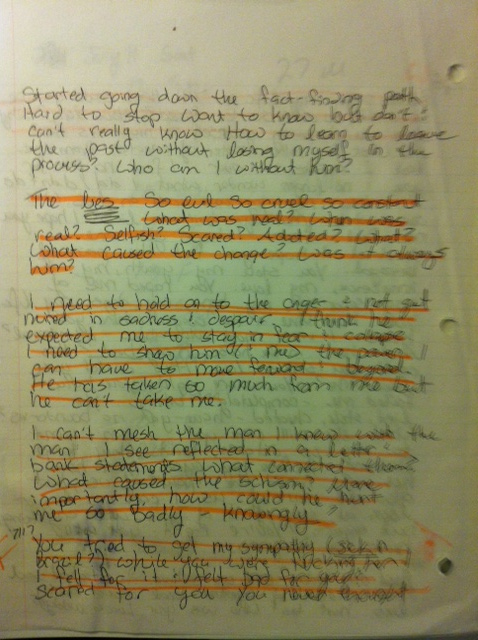
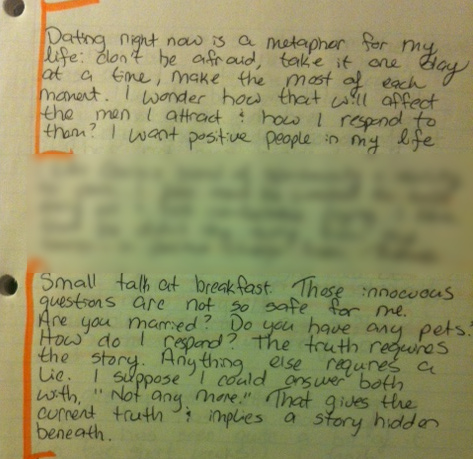
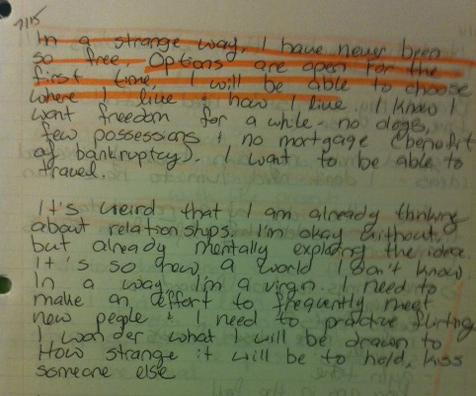
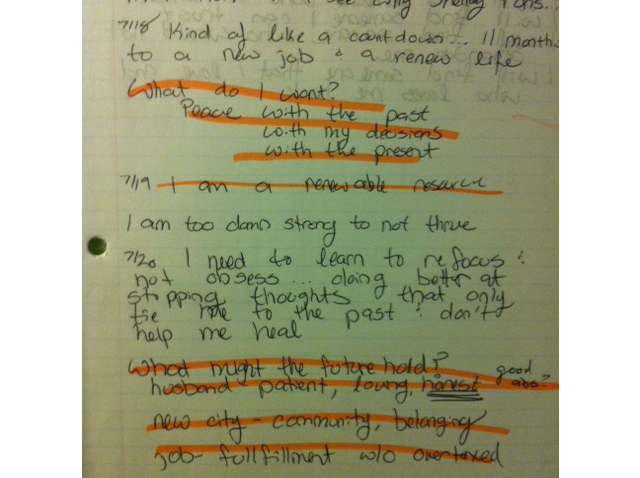
My personal favorite form is one I developed during my own divorce. It consists of three sections – past/pain, present/problem-solving and future/hope. Read more about this structure here. I find that this format provides a balanced blend of purging the negative emotions, processing the situation and documenting the areas of gratitude and hope.
Need help getting started?
In my complete and self-paced Thriving After Divorce course, I provide 84 different journal prompts in the three-section structure described above that are specifically designed to help you move through divorce. Along with the prompts, you will receive inspiration as well as a multitude of ideas that you can add to your personal post-divorce toolbox. You’ve put your life on hold long enough. Start living today!










 Lessons From the End of a Marriage