A Tale of Two Marriages

Today is our 6th wedding anniversary.

That number has some meat to it. It feels substantial. Like we’re past the appetizer and into the main meal.

For some reason, I’ve been particularly reflective this year, looking at this marriage and my first one from the perspective of today.

I don’t remember my 6th anniversary in my first marriage. But that’s not surprising. Not only did we not make a big deal out anniversaries, but both time and trauma have significantly dulled my memories of much of the sixteen years I was with him.

Even without specific memories or knowledge, I suspect that he started living a double life in earnest around our 6th anniversary. It was around that time that he was laid off from his latest job and he decided to go solo. And as I learned later, the company that he started never was profitable. Of course, he worked hard to hide that from me at the time and shared extensive details about projects that he was working on. Projects that I don’t think ever existed.

I can’t help but contrast that with my now-husband. He’s had a couple down years at work due to certain accounts. And I’ve known about it every step of the way. He’s been frustrated about the cuts, but instead of hiding the finances, he’s strategized and worked harder. All while being open with me about what has been happening.

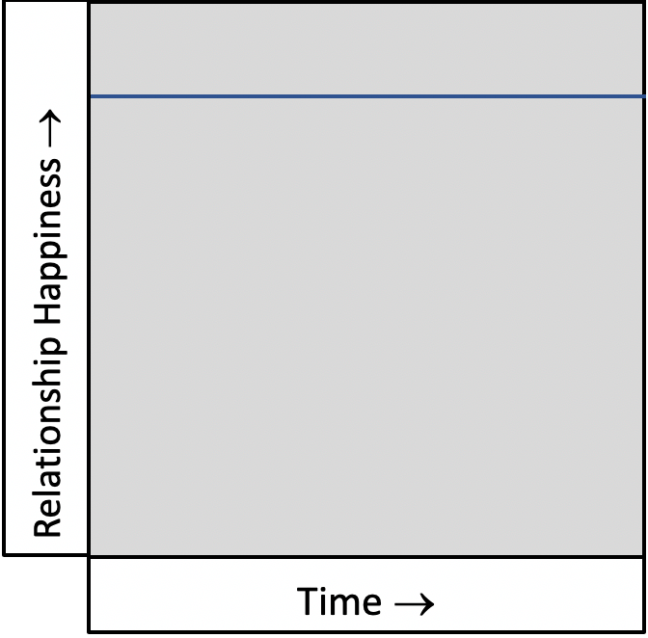
From my perspective at the time, my first marriage was good. If I was to graph its happiness and our connection over time, it would be a horizontal line with only the most minor of deviations. The marriage was steady and we were consistent.

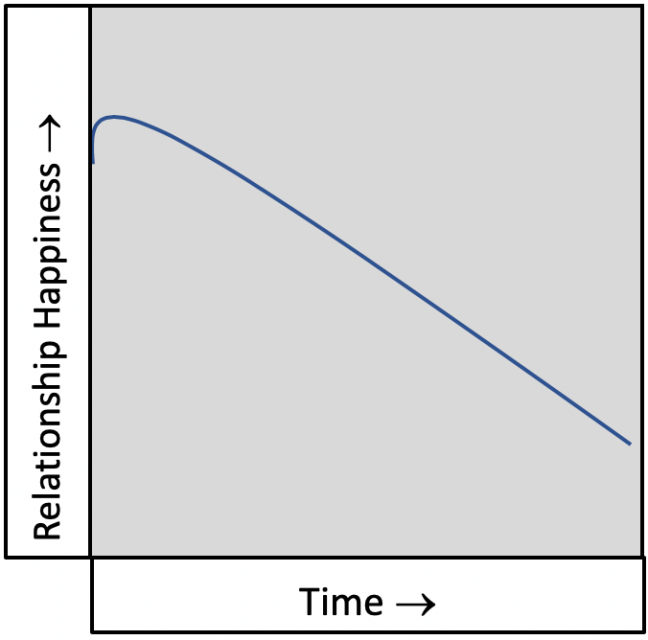
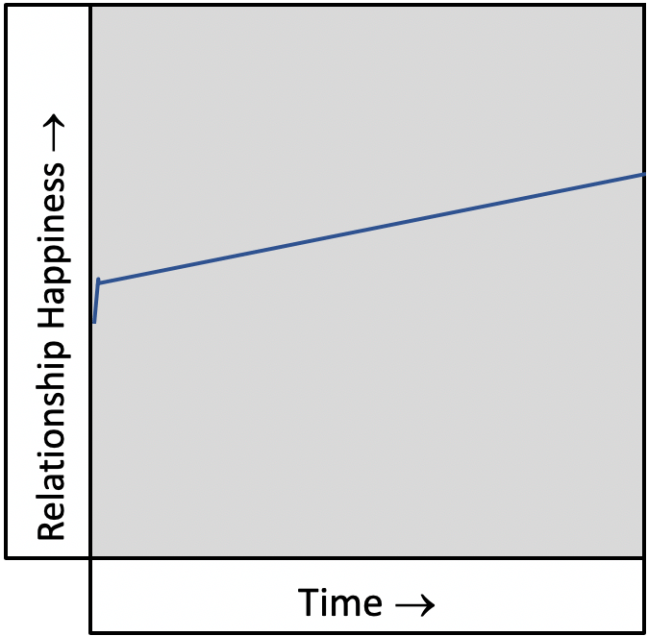
My marriage now is different. When I look back over our 9+ years together, it’s been a positive trajectory. We’re closer now than we were when we married. There’s more intimacy. Better teamwork and communication. More awareness of our own triggers and baggage, which we’ve both made major strides on addressing.

There’s been some hard times, but ultimately, we have both grown as individuals (with the support and encouragement of the other) and the marriage has grown as well.

In my first marriage, we never talked about the marriage. It just was. Something as certain and inevitable as the sunrise.

In contrast, my now-husband and I talk about our marriage quite a bit. What’s working. What’s not. What we appreciate and what we observe. It’s not something we take for granted; it’s something that we make an effort to nurture and grow every single day.

I used to worry that I would never have love like my first husband again. What I couldn’t have imagined was that I would find better. Realer. This love is more challenging and also so much more rewarding. And I would trade this for anything.


How Do You Make Your Partner Happy?

Short answer?

You can’t.


But that doesn’t mean that you have to sit by helplessly while they’re miserable.


Snip20190712_8


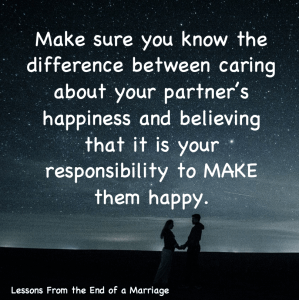
It all starts with understanding the distinction between caring about your partner’s happiness and taking responsibility for their happiness. The former is hopefully a keystone in every supportive relationship. If you care about someone, you obviously want the best for them. You want to do things that bring a smile to their face and mitigate the circumstances that bring them down.

Yet it is beyond your ability to MAKE them happy. Period. End of story. No matter what you do (or what they say), it is simply impossible for you to make another person happy.

That is an inside job.


Encourage Them When They’re Down

Remind them of their strengths. Of their previous successes. Without dismissing their concerns, highlight the more positive aspects of the situation. Express your belief and confidence in them – “I know you have this and I’ll have your back while you get through.”


Support Their Outlets

Accept that you cannot meet all of your partner’s needs. Actively encourage them to seek out their preferred outlets for release and support, whether that be time with a group of friends or alone time on a trail.


Distinguish Between Their Wants/Needs and What You Want For Them

It’s easy to get these two things confused and feel frustrated when our efforts are not appreciated because we’re working towards the wrong goal. Even if you disagree with their approach, your role is to act as a sounding board, not a dictatorial advisor.


Listen Without Judgment or Trying to Fix

One of the most important roles a marriage can provide is a place of sanctuary when it feels like the world is out to get you. Strive to be that safe place where they can speak without immediately facing unwanted advice or criticism. It doesn’t mean that you cannot disagree, just do it with intention and save it for the important things.


Respect Their Boundaries

For some of us, the sight of someone in distress is like a beacon, summoning us to be the rescuers. But they are an autonomous adult. When we swoop in, we’re sending the message that they are not capable of handling things on their own. You can hold their hand, but you can’t do the work for them.


Look For Ways to Bring in Delight

Actively seek ways to brighten your partner’s day. It can be as simple as a flirty note or funny GIF sent through text. This focus also helps to shift your mood if you have a tendency to get caught up in their unhappiness.


Spread Your Burdens

It’s natural to unload our biggest burdens on our partners. Yet it can also be a lot to bear. So make sure that you have more people than just your partner to share your own fears and struggles with. Even if you have to hire a listening ear.


Bring Your Best Self

And this means taking care of yourself. If you find that your partner’s unhappiness is increasing your own, address your own well-being. Do more of the things that make you happy. One of the best things you can do to increase their happiness is to take care of your own.


Accept Your Limitations and Respect Your Own Boundaries

Sometimes our partner’s unhappiness is more than a passing phase. If you suspect your spouse is depressed, it’s time to bring in professional help. And if they continually resist intervention, you have to make the decision how long you’re willing to wait. I often hear, “don’t leave your partner in a fire,” yet you also have to decide if you’re willing to burn if they continually deny the flames. You cannot fix them. All you can do is love them and support them while they fix themselves.


Riding the Rollercoaster of On Again, Off Again Relationships

One day, you’re madly in love and you can’t imagine your life without this person. And then the next day, you’re storming out of the house and blocking their number on your phone. Only to find yourself back in their arms a few weeks later.

Your relationship feels like a rollercoaster. When it’s good, it’s great. But it never seems to stay great for long. Every high is followed by a corresponding low. And even though you promise yourself that things are going to be different this time, you can’t seem to get off the endless ride of on again, off again.


Why Does the On Again, Off Again Relationship Pattern Occur?


Strong Chemistry

In relationships that follow this rollercoaster pattern, there is often an intense physical connection. This primal response is powerful and can easily overwhelm the more rational side of the brain that is cognizant of the areas where there is frequent discord.


A Focus on the Potential

It’s easy to fall for someone’s potential. You see what they can be and think that if you give it enough time, that is what they will be. You’re pulled back in time and time again because you’re hoping that this time they’ve become what you want them to be.


Never Allowing for Detox

There is a dopamine rush that accompanies the start (or restart) of a relationship. It’s a heady – and addictive – feeling. The end of a relationship comes with a corresponding withdrawal. Without time to fully detox from this cycle, it can be easy to keep looking for that next hit.


Exaggeration of Both the Good and Bad

When you’re apart, you find yourself fixating on what made the relationship good and so you’re pulled back in. But once there, the negative aspects of the relationship begin to wake from dormancy and again overwhelm what works.


Responding to Loneliness

Sometimes we respond to the inevitable loneliness that follows a break up by reaching out for the person that last filled that void. Only to realize – again – that it is possible to be lonelier with somebody that doesn’t see than to be on your own.


Return to the Familiar

We do what we know. And this relationship, even with its problems, is a known entity. As comfortable and familiar as an old sweatshirt. We put it on not because it fits, but because we’re used it.


Believing the Promises

Sometimes your ex is the one who is reaching out in an attempt to reestablish the relationship. That make promises that things will change. And you believe their words because you want so badly for them to be true. But the actions never follow.


Wanting Things to Be Different

You believe that maybe you just didn’t try hard enough the last time. And that if you just tried a little harder, you can make it work this time around. You believe that if you want it to be true, you can make it true.


Falling For the Sunk Cost Fallacy

You have a history with this person. Shared memories and all of the effort that goes into building a relationship. You don’t want to throw all of that away and so you become determined to try again.


Fear of Starting Over

The thought of dating someone new is scary or overwhelming. You wonder if there is anyone else who is any better than this one. After all, doesn’t every relationship have its problems?


Lack of Self-Esteem

You secretly worry that nobody else is going to want you. Perhaps you’re internalizing harsh words that your on again, off again partner has uttered in the downswings of the relationship or you’ve always struggled with not feeling good enough.


Pattern Becomes Normal

You’ve been on this ride for so long that the extreme swings from up to down to up again just feel normal. Whenever you’re in a relationship that is more steady, you become anxious or bored as you crave the stimulation you’ve become accustomed to.


How Can the On Again, Off Again Relationship Hurt You?


For most people, this relationship pattern is agonizing. A sense of safety in the relationship and secure attachment is all-but-impossible when the bottom seems to fall out on a regular basis.

Additionally, this pattern can occur when one or both partners are running from or hiding their issues instead of addressing them in an attempt to heal past traumas. As a result, personal growth doesn’t happen.

And finally, when you’re stuck in this cycle, all of your energy is funneled either into the intoxicating highs or into the all-consuming lows. There is nothing left over to do any real work.

You deserve a real relationship. One that is there on the good days. And the bad. You deserve someone that loves you and is committed to you. And that may be this person. Or, it may be time to let them go to create space for someone new.


Signs That it May Be Worth Another Ride


Enough Time Has Passed

If the time since you were together can still be measured in weeks, nothing has changed. That is simply too short of a window for any significant reflection and growth to occur. Additionally, you are both still operating from a place of scarcity, wanting to fill that void left from the breakup and you may still be susceptible to that chemical urge.

If, however, significant time has passed without significant contact and you still find yourself drawn to this person, it may be worth a try.


Each Person Has Taken Responsibility and Taken Action Towards Their Own Stuff

Both partners share responsibility for the on again, off again relationship pattern. In order for it to transition into a more mature and lasting relationship, both people have to own their own stuff AND take action to address it. This also takes time and if you rush back into things, the changes may only be superficial and temporary.


You Are Ready to Build Again From the Beginning Instead of Picking Up Where You Left Off

The foundation that your relationship was built on had some malformed parts. If you try to keep building from that point, it will always be shaky. In order to have a different relationship, you have to build a new relationship, starting from the beginning and using what you’ve learned to do it differently this time.


Signs That It’s Time to Get Off the Ride


You Replay the Same Pattern Repeatedly

If your relationship has begun to feel like the movie Groundhog Day, where every cycle through feels exactly the previous, it may be time to call it quits. Those patterns have become well-worn grooves and trying to change them with the same person will be very difficult if not impossible.


Words Are Not Supported With Actions

The right words are said. Promises are made. And then they are followed with the same old actions. Words alone are not enough to bind a relationships. If the good is all talk and the actions are all bad, it’s a relationship made of smoke and mirrors.


Your Happiness is Tied to the State of the Relationship

If you find that your well-being is on the same up and down cycle of the relationship, it’s time to step away. You can’t build a happy relationship when you’re depending on that relationship to make you happy. Figure out your happiness first and only then find someone to share it with.


Understanding Relationship Happiness Over Time

There are certain patterns that relationships tend to take over time in regards to overall happiness and satisfaction. In order to truly understand your relationship, it’s best to take a broader view, rather than examine a small slice of time that may not be representative of the whole. Which of the following patterns do you relate to?


The Idealized Relationship

Snip20190712_14

This is the relationship that Hollywood tells us to expect. We are conditioned to believe that once we find “the one,” the relationship will be easy and happiness will be guaranteed and omnipresent.


The Volatile Relationship

Snip20190712_10

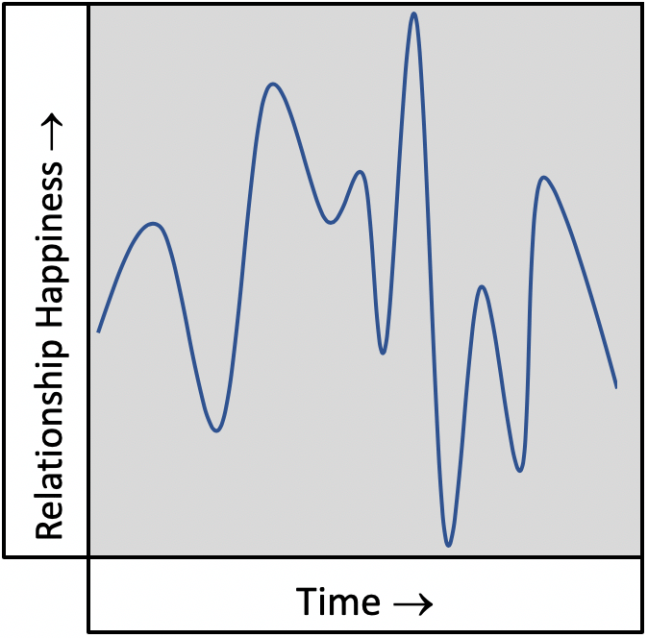
This pattern can be addictive because when it’s good, it’s REALLY good. On the other hand, when it’s bad, it’s horrid. The highs keep you in it and hope that it will smooth out keeps you from leaving.

The What Goes Up Must Come Down Relationship

Snip20190712_17.png


This is the relationship that is on fire in the beginning and then settles down into a more sedate happiness and contentment over time. It’s far from bad, but the partners may find themselves craving the intensity of the beginning.


The Slowly Declining Relationship

Snip20190712_11

It WAS good, but it seems to be trending further and further away from that place. The connection is waning and you may feel like you love them, but you’re no longer “in love” with them.

The Gradually Improving Relationship

Snip20190712_12

This is the relationship between two people that are growing together. Over time, they have learned to temper their expectations and to accept the other as they are.


The Devil You Know Relationship

Snip20190712_15

It’s not good, but for now, it’s better than being alone. Strangely, the consistency of this relationship can be comforting; you know exactly what to expect.

The Life is a Highway Relationship

Snip20190712_13

This is different from the volatile pattern because the ups and downs are less extreme and balance each other out. This is the marriage that is happy overall with some good days and some not-so-good ones.

Anxiety After Divorce

The dictionary defines anxiety as, “a feeling of worry, nervousness, or unease, typically about an imminent event or something with an uncertain outcome.” Well, it’s no wonder then that anxiety becomes a constant companion for many facing divorce, which certainly epitomizes an “imminent event…with an uncertain outcome.”

It’s normal to feel anxious before, during and after divorce. You’re experiencing a period of loss and transition at the same time you may be struggling to reconnect with your very identity and purpose. That’s stressful no matter how you look at it.

Anxiety around divorce can be focused on one or more specific areas, or it may be more generalized and diffuse. The feeling may be clear-cut and easy to recognize or it can manifest in more subtle ways. Regardless of the particular nature of your divorce-related anxiety, the more you understand it, the better you can learn to navigate – and eventually curtail – it.

tumblr_oaur2mrNGU1tn5y36o1_400


What You’re Anxious About


The Practical Concerns

These are often the first worries that manifest – How will I pay the bills without their income? Where will I live? How will we manage custody? What will the legal process be like?

There are so many important details of daily life that divorce impacts. And most of these have to be dealt with yesterday. Add the very real financial costs of divorce and it’s no wonder you’re losing sleep.


Personal Strength and Fortitude

I’m not strong enough to get through this” is one of the first thoughts that many people have when they realize that divorce is imminent. The emotions threaten to drown you and the sheer amount of tasks you have to complete is completely overwhelming.

Maybe you’ve never been tested like this before and so you have no track record with which to reassure yourself of your tenacity. Or maybe you’re worried about the duration of this transition – how can you keep going when the finish line isn’t even marked?


The Impact on the Kids

From the first moment you gazed into your newborn’s eyes, a need to protect them from all harm has permeated your every cell.   Yet no matter how deftly you wield your shield, you cannot block all of life’s slings and arrows from reaching your child. And for many children, their parent’s divorce is the first major emotional injury they face.

It’s difficult to watch your child suffer. Their pain ricochets through you like an unreturned racquetball in an empty court. You feel helpless as your normal platitudes and kisses fail to sooth this particular wound and guilty that you failed to protect them in the first place.

from 7 Vital Lessons Divorce Teaches Children

It’s no wonder you’re anxious. You worry about the impact that this family transition will have on your children. You agonize over the pain they’re facing. You stress about how this might affect them moving forward. You lose sleep over the relationship they have with their other parent. And most of all, you constantly question if you’re doing the right thing, making the right decisions.


Emotional Reactions

I remember being so afraid of my emotional response. It felt like being pulled along by some powerful riptide, threatening to drown me at any moment.

The emotional reactions after divorce are strong, variable and unpredictable. You never know if you’re going to break down crying in the middle of a work presentation, burst into inappropriate laughter in a meeting your attorney or fly of the handle in a fit of rage because a form asked for you to indicate your marital status.

And this uncertainty combined with a feeling that you no longer have control over your inner world, leads to a great deal of anxiety.


Things-we-said-683x1024


Future Happiness

“Will I ever be happy again?” you wonder. And your anxious brain is ready with a reply – “No.”

You worry that the best years have already happened and that it’s all downhill from here. You wonder if this divorce will always be your defining moment. And you stress as you contemplate the thought that maybe you’re broken and that you cannot be repaired.


The Views of Others

You feel like those around you are judging you, labeling you as a “quitter” or quietly assuming that you failed as a person in order to have a failed marriage. Their voices – real or imagined – join your own, doubts and criticisms circling around your head like tubes in a lazy river.

This anxiety may extend to your general social standing and connections. Maybe you are now losing the family that you’ve grown to love and cherish. Perhaps you worry that you no longer fit into the “couples only club” that is your primary friend group. Or, in your cultural or religious group, divorce may be viewed as a sin and you’re shunned for your circumstances.


New Relationships and Finding Love Again

You worry that your ex was your soulmate and that you somehow screwed up your only chance for love. The thought of dating again is downright terrifying and you wonder if anybody will love the older, more jaded, and less tolerant version of you. And that’s of course assuming that there are even people out there that you’d be interested in.

Finding love is only the starting place for your anxiety. Then comes the question of keeping it. After all, you don’t have such a great track record right now. You worry that you’re going to end up in this same place again.


I-am-exhausted-from-trying-to-be-stronger-than-I-feel.-Unknown


How the Anxiety Manifests


A Feeling of Being “Driven”

Anxiety has energy. It is an accelerant. A propellant. The focus of this drive can vary, turning towards everything from your performance at work to finding out every detail possible about the person your ex cheated on you with. Sometimes anxiety feels like you’re being driven by a motor but you’re spinning your wheels.


Obsessive Thoughts

You may be obsessively wondering how your ex could have acted the way they did. Or maybe you’re fixated on something you did that contributed to the collapse of the marriage. Anxiety often causes our thoughts to become trapped like the water above a blocked drain, as we desperately sift through them looking for a way to control the outcome.


Avoidance and Distractions

Anxiety is not a comfortable feeling. So when something causes undo stress, we often avoid it in order to eliminate that discomfort. This can manifest by intentionally or subconsciously avoiding locations or situations that you know will trigger an emotional reaction. Others may turn to distractions (everything from dating to work) in an attempt to give a wide berth to anything that may cause anxiety to spike.


Quotes-About-Anxiety


A Sense of Futility

Anxiety is the world’s greatest pessimist. It will always tell you that not only is the glass empty, but the glass is cracked and will never hold anything of substance again. If you’re feeling defeated and assuming that it’s a permanent state, that may be your anxiety talking.


Restlessness

Are you feeling a need to redecorate your entire home? Or maybe move to a new home – or country – altogether? Do you have trouble staying still and you seem to always find something to keep you busy? Anxiety has its own fear – a fear of stillness and quiet. So when you’re anxious, you’re often restless.
 

anxiety-quote-hp-41-1


How to Handle Your Anxiety


Call in the Professionals

Get help if you need it! There is no shame in asking for help. In fact, admitting a need for and accepting help are great signs of strength.

How do you know if you need help with your anxiety? Here are some signs that it’s time:

  • Your anxiety is interfering with your ability to carry out the basic functions of daily life
  • The divorce is history, yet your anxiety still remains
  • Symptoms of depression are present along with the anxiety
  • You’re turning to substances to help you manage your anxiety
  • Your children are being impacted by your anxiety
  • You want to improve your anxiety but you don’t know how


Quotes-about-Anxiety-12


Incorporate Exercise

Exercise won’t cure anxiety, but if you exhaust the body, it has a tendency to tire out the mind as well. And when it comes to worrying, a tired mind is a happier mind.

Play around with different types of exercise. Perhaps you do best with yoga and its emphasis on breathing through discomfort. Or maybe running helps you process your thoughts and gives you a sense of progress. You may find that you’re drawn to martial arts, where your anxiety can be funneled into strikes and you gain a sense of power and strength.

The what doesn’t matter here. The regularity and commitment does. Figure out what works for you and practice it frequently.


Learn to Recognize Anxiety

Be aware of how anxiety manifests in your mind and body. Does your chest get tight? Your stomach upset? Your brain on overdrive?

Just being aware of these signs can 1) give you a sense of control over your anxiety and 2) provide you with an opportunity to do something about it. You’ve heard about love languages. This is the time to become fluent in your own fear language.


Inspirational-Quotes-About-Depression-and-Anxiety


Face Your Fears

When we avoid situations that cause us discomfort, we allow them to grow in size and power. Think about all of the times you’ve been afraid to do something, from jumping into a pool as a child or having a difficult conversation as an adult. How many times did you discover that the anticipation was worse than the reality? Quite a bit, I expect.

And also think about your mindset before and after you faced that fear. Before, you were fixated on the situation, playing out all of the possible outcomes and worrying about every one. After? Well, it no longer seemed so important and all of that mental energy no longer had to be allocated its direction.

It’s pretty simple, really. Not easy, but simple.

Avoidance makes your anxieties grow. Facing your fears diminishes their power.


Chart Your Progress

When it comes to healing from divorce, progress is so slow that it’s often imperceptible from your viewpoint. So document your journey. Bring awareness to your progress.

Journaling is one way to accomplish this. You can go back at any time and read your earlier entries to get a feeling of how far you’ve come. This serves to both help you recognize your strength and also gives you hope that things will continue to improve.


107f3c70d5b502882c7cfcdb74dff897


Question Your Conclusions

Anxiety lies. Just think about it – when you’re sifting through all of the possible outcomes,  how many of them or positive or even neutral? Not very many, I expect. Yet, the reality is that many outcomes fall into these categories. But anxiety always assumes the worst.

So learn to question your conclusions. Where is this assumption coming from – facts or fears? If it’s the latter, you have permission to ignore the advice.


Implement a Gratitude Practice

When you’re grateful, you’re in the moment. When you’re anxious, you’re living in the future. Take some time every day to focus on those things that bring you joy and appreciation. Write them down in a place where you can return time and time again to literally count your blessings.


Listen to Others

We don’t do well when we live only within the echo chamber of our own minds. So allow other voices in. Hear their perceptive and their wisdom.

From others, we gain insight into ourselves and inspiration to keep trying.


Accept Anxiety as a Natural Response

We have evolved to experience anxiety as nature’s way of keeping us safe. We are primed to feel fear and uncertainty around novel situations to help guide our decisions in a safe direction.

Anxiety is natural. However, modern life doesn’t present us with the simple dilemmas our ancient ancestors faced. The question about whether the meat gained from hunting the large game is worth the risk has been replaced with the constant worry about your child’s ability to navigate the emotional fallout from divorce.

So it’s important to both accept your anxiety as a natural response to a potentially threatening and new situation and also expend effort to lessen your anxiety since the potential triggers are ongoing.

And always remember – you may feel anxious at any given moment, but YOU are not your anxiety.

coolnsmart-21321