What to Expect In Your Teenager When You’re Divorcing

teenager

I had someone ask me earlier if I had any resources on kids during divorce. My first reaction was to say that, although I’m a child of divorce, I don’t really have any experience as the adult in that situation.

But then I asked what grade the kid in question was in.

And once I received the answer of 8th, I realized that I do have some insight. Even though they’re not my kids and it’s not my divorce impacting them, I have 15 years of witnessing the ways that teenagers deal with their parents’ divorce.

It is so difficult to tease out any acting out caused by the divorce from normal teenage behaviors. Well, as normal as they can be when their prefrontal cortex is not completely formed.

Teenagers are not in their right minds. Literally.

But I do see patterns of behavior that often signal that a divorce has occurred or is in process. Many of these patterns are more common in one gender than the other, although the gender lines are by no means firm. In some ways, divorce can amplify the normal teenage behaviors and other times it completely alters them.

The behaviors are usually the most extreme when the parents are in the middle of the legal process (especially if the kid is being used as bait) but can also appear well after a divorce that occurred in elementary, where the child seemed fine at the time. They can be brief and mild or longer lasting and more severe.

Here are the top behaviors I see in teenagers having trouble trying to process divorce:

The boys are…

Oppositional

The boys can get angry. Very angry. Sometimes it’s directed at a particular person (especially if they see one parent as being at fault), but often it is scattered and nondiscriminatory. They get into fights. They challenge authority at school. Often, when I am able to get them to open up, they are feeling pressure to be the “man of the house” and are trying to toughen up before their time.

These kids need a safe outlet for their anger (martial arts comes to mind), a safe place to be vulnerable, consequences for their misbehavior and reassurance that they are still kids and not responsible for the household.

Withdrawal

Instead of acting out, some boys draw in. Their hair becomes longer and rarely washed. They seem to curl inside themselves at their desks. Their schoolwork suffers as they fail to complete and turn in assignments. Some turn to cutting or other self-harming behaviors. Many turn to video games as an escape. Sometimes I learn of a diagnosis of depression.

These kids need patience, persistence and intervention. If you’re at all concerned about their mental health, seek help sooner rather than later. And try to engage them in life outside the screen.

Using

I can usually tell which of my students drink or use drugs on a regular basis. And many of those are boys with divorcing parents. Some see it as an escape. Some take advantage of a distracted single parent. Some are trying on adulthood. And some are just lost.

These kids need tough love. And soon. Don’t try to handle this one alone. Call on the professionals, for you and your kid.

The girls are…

Perfectionists

These are the ones that often slip under the radar. They’re pleasant. They perform well in school. You may think you have lucked into the perfect teenager, even after going through the breakup of a family. Yet under the guide of perfection is an overwhelming anxiety; some of these girls are trying to do it all out of a fear that they must be perfect to be lovable and accepted. And at some point, they will burn out.

These kids need consistency, reassurance and a way to build confidence (martial arts comes to mind here as well). Encourage play and discourage excessive time on schoolwork. Refrain from associating value with performance.

Mean

The anger in the girls usually presents differently than the boys. They are more covert. Manipulative, perhaps out of a desire to try to exert control when they feel they have none. Their anger is more pointed, either at classmates or at a parent (or often at a new boyfriend or girlfriend of a parent). They develop this “nobody else will ever hurt me” armor and they attack with their words and actions.

These kids need boundaries and they need to face the natural consequences when they’re crossed. The key to softening the armor is usually a relationship with a trusted, non-parent adult – a teacher, a family member, a counselor, who can help them face the pain under the anger.

Acting Out Sexually

Most teenage girls are boy (or girl) -crazy. But most are doing more talking than anything else. For girls going through a family divorce, especially when the father is absent, some start dating older boys and acting on that talk. They want to know they are pretty, special and desired. And they’ll take it any way they can get it. Some of these girls feel abandoned. Others neglected. And some just feel ignored.

These kids need structure to limit their unsupervised access to technology and a watchful eye on their interactions. They also need attention, so strive to provide the attention in positive areas. Most of all, they need love. They are still kids regardless of what behaviors they’re engaged in.

And all teenagers of divorce are…

All of the kids I see with divorce in their story are working through trust issues; they’re often slow to establish bonds. Most look for attention, some by being the “teacher’s pet” and others by being the “class clown.” They’re often a little more on the extremes of the “needy” to “leave-me-alone” curve.

And they’re teenagers. 100-pound hormonal two-year-olds, as I affectionately call them. They’re still learning who they are, how the world works and figuring out their place in it.

Love on them even when they’re irritable. Uphold the rules no matter how many times they’re broken. Give them support when they need it and let them struggle when they don’t. And see them as they are and help them see who they will become.

And be thankful that they’re not teenagers forever.

If I Had Known This One Thing, I Would Have Divorced Differently

When I first hired my attorney, I was pursuing a divorce through publication (not that I even knew what that was until I was left with a text message and a husband that then disappeared). At that time, mere days after the tsunami, I had no idea what happened and no evidence other than the empty accounts and maxed-out credit. My only option at that juncture was to seek a “no fault” divorce.

And then I found the email. And discovered the affair. And the bigamy.

I learned where he was and contacted the police to report the dual marriage.

Even though that first email, which indicated that band hired for his wedding had not yet been paid, sent me through a dark tortuous path that seemed to birth more questions than answers, I not regret the search for information. The drive for information was too strong. The need for some sort of understanding was too overwhelming to simply walk away.

I contacted my attorney with the updated information.

And that’s when I made my mistake.

In Georgia, you have two options when it comes to divorce – fault or no fault. In order to file a fault divorce, there has to be some concrete evidence that one person’s actions directly led to the divorce.

And with the copy of his second marriage license in hand, I had that proof.

So when my attorney asked me if I wanted to continue with a no fault divorce or if I wanted to alter my approach, I responded immediately that I wanted to change course.

But I didn’t really understand what that meant.

Here’s what I thought at the time –

No fault makes it sound as though we simply grew apart. As though the divorce was a mutual decision made over time and with both party’s well-being in mind.

No fault excuses him of his (criminal and otherwise) actions and makes me (since I was the one filing) look like the one responsible.

No fault made me physically ill. It made me feel like he could spit on me, ground my heart and my finances into dust, abandon his family and responsibilities and that I publicly acknowledging that all of those things just happened.

That they weren’t really his fault.

And at a time when what I wanted more than anything was for him to acknowledge the destruction and pain he caused, a public absolution (as I saw no fault indicating), caused the smouldering anger to flare.

I believed that the word “fault” directed at the defendant on the top of the pages would alert the judge that he or she was dealing with somebody unscrupulous.

I thought that placing him at fault would earn me the favor of the courts and positively influence any rulings in my direction.

And I hoped that having the finger-pointing at him would make my then-husband feel guilty for what he done. And maybe even prompt him to apologize.

And here is what I learned –

The. Courts. Don’t. Care.

About the reasons for the divorce. About infidelity. About blindsiding. About abandonment. About financial betrayal.

They don’t care.

My attorney was more than happy to switch gears to a fault divorce. Because proving fault takes time.

And therefore money.

And I’m not even sure the judge noticed the fact that there wasn’t a “no” before fault on the paperwork submitted to her that day. She proceeded as though my almost-ex was a rational and rule-following man as she divvied up responsibilities.

I didn’t receive any favors for not being the at-fault party and I certainly didn’t receive any empathy.

And I didn’t feel validated in the slightest my the fact that the records showed that my ex was at fault.

Because he never accepted responsibility.

And that was what I really wanted.

Something that the courts could never provide.

In the end, removing those two letters – n o – from my suit for dissolution of marriage cost me added months of stress and thousands of dollars.

And brought me nothing.

A note about the legal process – I am by no means an expert in the legal proceedings of divorce. In my state and in my situation, the difference between fault and no fault was negligible. This is not always the case. Make sure you take the time to fully research the path you’re taking. And don’t make assumptions that legal terms have anything to do with the real world.

It is so incredibly difficult to separate the emotional separation from the legal, especially when you have not been preparing for divorce. And even though from my current standpoint, I say that I wish I had not filed a fault divorce, I can’t promise that I would have listened to that advice at the time.

Make the best decisions that you can. And then forgive yourself for any mistakes.

Divorce is one of things that you don’t really understand until you’ve been through it. And I don’t think anyone wants to practice it enough to get better at it.

One Event Does Not Define You

It was parent conference week at my school this past week. It’s a week I always look forward to (even while I dread the long hours required). I love getting a chance to talk with the parents after I have been able to see their child’s strengths, weaknesses, celebrations and struggles. Most of the conversations and strategies are pretty run-of-the-mill. Helping middle schoolers learn to prioritize, time-manage and organize is an on-going and ever-present task.

But every year since my first in the classroom, I have had a handful of conferences that are anything but run-of-the-mill. Some of the kids that come through my classroom have been through tragedy. Loss. Trauma. And as the teachers sit around the table and learn the information, the missing assignments suddenly become less important than the missing childhood. The focus shifts from succeeding in school to creating a support system to help the child succeed in living.

Once I learn of the background, there is one talk I always make sure to have with any student that went through too much far too soon.

I call it my “defining speech.” And it goes something like this:

———-

“Make a line through this point,” I ask, drawing a dark mark in the center of a blank white sheet of paper.

point“Where should I make the line?,” some students inquire, while others simply follow my command and draw a line on the paper. The perfectionists make themselves known by insisting upon a ruler.

line

“Is that the only line you can make through that point?” I ask.

“Well, no. I could make a bunch of different lines.” I gesture for them to show me.

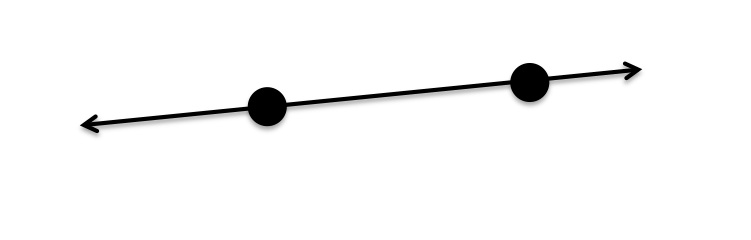
linesssI then turn the paper over and draw two points.

pointsss“Make a line through these.”

line2“Is that the only line you can make through these two points?”

I usually get a “Is my teacher crazy?” look at about this point.

“Well, yeah? I mean, two points make a line, right?”

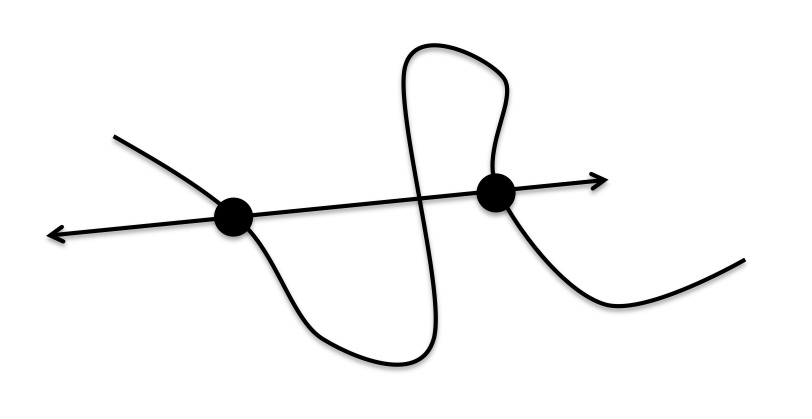
“True. If it’s straight,” I say with a slight smile. “Try connecting them with something that isn’t linear.”

This is where I can tell who is willing to take risks. But they all manage to create some sort of nonlinear path through the two points.

curve“Is that the only curve you can make that can connect these two points?” I continue.

“No. Do you want me to draw more? I mean, there are infinite ways!”

“No, it’s okay. I just want you to see that there are multiple paths to get from one of those points to the next.”

The shoulders relax as the brow rises, wondering about the point of this exercise.

“Almost done. I just have one more for you.”

scatter“Connect ALL of these points any way you want to.” If I do this after our lessons on scatter plots, it drives them crazy not to simply draw a line of best fit 🙂

Once they’ve completed the task, I bring the point home. Yes, pun intended.

“I want you to think of these points as events that happen in life. When you have a single point or event, it does not define your path. There were many routes you could take. When there were two points, there was only one way if you chose to see it that way. If you were more creative, you could find many more. But life doesn’t consist of just one or two events, even though certain ones may stand out more than others. Life is a series of events. And it is your choice how you move through them. Look at how you connected your points here on your last picture. You had to include the outliers, but it didn’t completely change the general shape of the graph.”

“I know you’ve had some stuff in your past that makes you feel like you’re stuck on a predetermined path. But you’re not. You had to walk through that point. That event or series of events. And now you decide what direction you go.”

“One event does not define you. YOU define you by the choices you make and the path you choose.”

Okay, class dismissed 🙂

What Makes a Marriage Successful? (And Why Divorce Does Not Mean Failure)

marriage successful

What REALLY makes a marriage successful? I’ve always found it funny/sad how we classify marital success purely by its duration. I mean, imagine if we applied this same metric to other areas of our lives –

She was a really great student – she was in school for fifty years!

He was an amazing dog, but he was a failure as a pet because he died before he turned ten.

It was a wonderful dinner. The service was so slow that the meal lasted for hours!

I’m afraid I have to give the book only one star because it ended.

Pretty crazy, huh?

So why do we then so easily apply this faulty logic to marriages? Classifying them as failures if they end and successes if they persist?

I think we all have seen (either from within or from the outside looking in), marriages that go the duration yet are filled with contempt, isolation and misery.

And we have all witnessed relationships that were once strong and fulfilling come to a premature end as the individuals or the circumstances changed.

Yet in our cultural lexicon, the first couple is heralded as a success (and sometimes even asked for their marital wisdom) while the latter is written off as a failure.

IMG_4361

Perhaps it’s time to reevaluate what makes a successful marriage.

Because it is certainly both more complex and more challenging than simply managing to hold on to one another for a lifetime of journeys around the sun.

In a successful marriage,

You both play for the same team. You know that there will be disagreements about how things should be done. But rather than view your spouse as your opponent in these arguments, you see him or her as your ally in life.

The good interactions outweigh the bad. There will be rolled eyes and hurt feelings. And they will be smothered by hugs and positive words.

You share common goals and values. Even when you take different paths to get there.

IMG_4359

Support is given freely and challenges are presented. You don’t seek to change your partner; you want to enhance the best parts of your partner.

A growth mindset is present. Both for the marriage and for the individuals that comprise the union. Each person learns and grows in response to struggle and success.

Mistakes are perceived as opportunities. And the actions are condemned. Not the person.

There is a balance of independence and interdependence.

IMG_4360

The difficult conversations happen. And problems are perceived as a challenge to overcome together.

Each person takes responsibility for his or her own stuff. And each person is willing to carry more than his or her share when the situation demands. Because there will be days when the commitment to the marriage is greater than your commitment to your spouse.

A legacy is left, either by the children born from the union or the others inspired or influenced by the couple. A successful marriage is greater than itself.

And here’s the hard part –

A successful marriage accepts when it is no longer successful. It is willing to make the agonizing decision to pull the plug rather than condemning both people to live in the diminished world of a marriage on life support.

IMG_4362

Now it is true that no good marriages end in divorce.

But it is also true that the marriage that ended may not be the same marriage that existed for some time before.

It’s not just about the number of years.

It’s more about what you do with those years.

And if that marriage brought a smile to your face and eased your burden,

If that marriage challenged you to learn and grow,

If that marriage taught you what it was like to share a common dream and common goals,

If that marriage opened your heart and made you feel seen and understood,

If that marriage made an impact on others,

If that marriage pushed you and tested you,

If that marriage made you realize that nobody else can make you happy,

If that marriage taught you what you don’t want,

If that marriage inspired you to never again allow anyone else to reduce your worth,

If that marriage taught you how strong you are,

Then that marriage was successful.

No matter how long it lasted.

Or how it ended.

Take the lessons and move on.

Because the only failed marriage is one that you refuse to learn from.

Related:

Why I Don’t Want a Perfect Marriage

10 Contradictory Qualities of a Good Marriage

9 Reasons You’re Struggling to Find Love Again

love struggling

Are you struggling to find love again after divorce?


“I’m never going to find anybody else.”

“I’m doomed to die an old cat lady.”

“Nobody else is ever going to love me like he/she did.”

“My ex was the one. And now he/she is gone and I’m alone.”

I hear it all the time. Variations on a theme. A composition of loneliness and longing that often settles into bitterness and resolve.

After divorce or a break up, most people enter a phase of chosen singlehood. It is a period to regain sanity, re-establish self and start the steps into a new life. If kids are in the picture, this swearing-off of partnership may last until the children are grown and gone.

Yet at some point, most people decide (or, even if it is not a conscious choice, start to respond to a pull towards) to enter a new relationship. To entertain the thought of dating and be open to the idea of love.

Some people are happy and fulfilled single and make a thoughtful decision to stay solo. This is not for them.

This is for those that want love but cannot seem to find it.

Those who sign up for online dating and never seem to get past the first coffee date. Those who think they found somebody only for the nascent relationship to spectacularly explode before its first anniversary. Those who only seem to attract the broken or seem to always end up with the sh*tty people. Those that are tired of watching everybody else pair off while they’re afraid they will never again be picked.


If you want love,

you want a partner

but you feel like giving up,

This is for you.

You’re Scared of Being Vulnerable

Relationships are hard. Damned hard. And anyone who tells you differently is selling something. After experiencing the anguish at the end of a relationship, it is so tempting (and so easy) to keep others at an arm’s distance. But that never works; love is all or none. If you have walls built around your heart (even if you didn’t intentionally construct them), you are keeping love away.

In order to love, you have to be willing to accept the very real risk of loss of love. Personally, I think trade-off is well worth it (even when I’m feeling overly vulnerable), but you will have to decide for yourself if and when it’s worth it in your own life.


You’re Looking to Fill Your Ex’s Shoes

When something or someone slides into our pasts, it can be easy to look back with rose-tinted glasses. Smoothing over the rough spots and settling on the good. Additionally, when we are with someone for a period of time, we grow accustomed to their particular strengths and can easily take them for granted and assume they are universal traits.

This can combine to creating an ex-shaped hole in your life that you are looking to fill exactly by seeking a doppelgänger. Perhaps you might find someone that seems to fit the gap, but then you discover some characteristic that causes discord in your assumptions. Or, you find that potential partners sense that they are replacements and they leave in search of somebody who wants them as they are.

A new relationship will never be the same as your former one. It will be different. And be open to the idea that different can be better. It means that you will have to accept the lack of some things you used to take for granted and it means you will be surprised by new benefits you didn’t have before.

And most importantly, it means that you have to take responsibility for filling that ex-shaped hole before you go looking for love. Be a partner to love. Not a cavity to fill.


You’re Seeking Perfection

Sometimes when a relationship ends, we assign its failure to its imperfection. And so we seek the ideal. The guaranteed. This time, we want the real thing. The soul mate and the fairy tale. Because if we can just find the perfect person, it will all work out.

And there is truth in some of that. At its most basic, your marriage did fail because of imperfection. Not just with the situation. And not just with your spouse. But also with you. Because nothing and no one is flawless and faultless.

Real love, lasting love, doesn’t begin with perfection. It begins with the acceptance (and open discussion) of imperfection. Perfection assumes you say, “I do” and then you’re done. You just sit back for the ride. Acceptance of the idea that we are all always learning creates the foundation for a growth mindset marriage. Not perfect, but fulfilling.


Your Actions Don’t Align With Your Intentions

It’s easy to say you want love. It’s easy to complain about the quality of the people on dating sites or the lack of options in your environment. Words take little energy. Wishes even less.

Love doesn’t come to the lazy. Especially love after loss.

If you want a relationship, ensure that your actions match your intentions. Get out and meet people. Lead with curiosity rather than judgement. Say “yes” to experiences and opportunities.

If you want a relationship, don’t act like you’re on the prowl. Act with integrity. Be trustworthy. Show that you can be committed. Don’t claim you want stability while you’re refusing to stand still. And most importantly, be the person you hope to attract.


You Are Sending Out Warning Signals

We are often unaware at the subtle signals that we are constantly receiving from others and sending out to those around us. And even those these signals are often subtle and below conscious awareness, they are powerful.

Do you keep attracting broken people that seem to need fixing or parenting? Perhaps you’re unwittingly sending out the message that you need to be needed in order to feel okay about yourself.

Do you keep attracting control-freaks that at first want to “save” you only to later try to dictate your life? Maybe your damsel-in-distress call has been heard by someone that needs to feel powerful.

Do you continually have people abandon you? Is it possible that you come across as too clingy, your intense neediness inadvertently pushing others away?

It’s hard to see these signals head-on; it’s often easier to spot them in the patterns of our relationships. If you always seem to end up in the same position, look to your own insecurities to learn why.


You’re Looking For Too Much Too Soon

When you’ve been married or in a long-term relationship, you acclimate to the intimacy of a well-known person. You become comfortable. Safe. And it’s easy to except to find that same feeling again.

But that’s impossible.

Because relationships are formed, not found.

It takes time and effort to develop a partnership. Instead of looking for insta-intimacy (which is usually just lust and/or desperation), look for someone that has the raw materials that you want that you believe you can build a relationship with.


You’re Still Anchored to the Past

It’s easy to be so done with the past that you try to move on too soon. There is a reason that the saying, “The best way to get over a man is to get under another” exists. There is nothing wrong with post-divorce flings, but don’t confuse them with love.

When you’re still enmeshed in your past, either situationally or emotionally, you are not creating the space or providing the nourishment for a new relationship.

Maybe you just need time. Or maybe you need some help.

But you have to let go before you can move on.


You Are Not Happy With Yourself

This is especially common with people who have been subjected to abuse, abandonment or infidelity. It is so easy to internalize your partner’s actions. To take them personally. To assume that unloving actions and words were directed at you because you are somehow flawed. Unlovable.

And when you believe that, others will begin to believe it as well.

Finding love with and for another has to begin with finding love for yourself. With forgiving your own mistakes and seeing your own beauty.

And the first step is realizing that when somebody treats you poorly, they are telling you more about their character than about your worth.


You Tell Yourself, “I’m Never Going to Find Love Again”

When you prime the pump for failure, don’t be surprised when you fail. Yes, learning to be open and vulnerable again is hard. Yes, finding somebody that meets your needs and puts up with your flaws is hard. Yes, relationships are harder when we are older have have more complications in our lives. And yes, getting a relationship past the early dates and into love is hard.

And hard doesn’t mean impossible.

Never say never.