After the Affair: The Dreaded Doctor’s Appointment

It took a few days for the realization to dawn on me.

“I need to make a doctor’s appointment,” I muttered half to myself and half to my mom, who was helping me sift through the rubble of my life. “I need to make sure that on top of everything else, he didn’t infect me with anything.”

The thought was horrifying. Mortifying. Infuriating.

I had only been with one man my entire life. This was not something I ever thought I would have to face.

Yet there I was.

Two weeks after the collapse, I walked into my doctor’s office. I was lucky. My provider, technically a nurse-midwife, had taken care of my annual visits for years. She knew me and I felt comfortable with her. It helped a little to counteract the immense humiliation I was feeling at being thrown into this situation without my knowledge or permission.

When she saw my drawn face, my trembling limbs and my emaciated figure, her mothering instinct took over. “Oh Lisa,” she sighed, pulling me in for a hug. Then, mother to mother, she hugged my mom, who (by my request) had accompanied me to a pelvic exam for the first time since middle school.

While my parts were checked and my blood was drawn, my provider kept talking to me in a soothing voice and kept a comforting hand on my arm or hand the entire time.

And then the waiting game really began. And along with it, the anger. Because it was easier to feel than the fear. Finally, I got the call.

“Everything looks good,” she said.

I felt relieved. At least my body would be okay. If only my heart could be cleared so quickly.


The dreaded doctor’s appointment is one more thing in an endless list of what is unfair about being cheated on. It’s yet one more way that we are left to clean up the mess they made.

The emotions involved run the gamut from confused (after all, if you’ve been monogamous for awhile, you tend to lose touch with what diseases are out there and what the implications are) to anger (how could they act with such reckless abandon when it comes to my health?!?). In between are often shame (because for some reason, we feel humiliated by their actions even when they don’t) and fear (are they going to curse me with a lasting physical reminder on top of everything else?). I know I also felt violated. This was not something I had consented to.

It’s a lonely feeling. An isolating one.

Yet it’s familiar to everyone who has ever discovered an unfaithful spouse.

It’s not fair. But it’s a necessary step.

Even though your partner didn’t take care of you, YOU need to take care of you.

I hope that your medical providers are as compassionate as mine were.

The Many Faces of the Affair Partner

I saw a question posed on Twitter yesterday asking if anyone had written to the affair partner and, if so, what the outcome was.

The responses were interesting and quite diverse. It soon became clear that the type of communication (not to mention its aftereffects) with the affair partner were very much dependent on the relationship that person had to the wayward spouse prior to the affair and their role in the infidelity.


The Relationship of the Affair Partner Prior to the Infidelity


The Stranger

This is definitely the easiest of the horrible options to stomach. When the affair partner is a stranger, they become a blank canvas where you can easily project your own insecurities. However, there is little betrayal felt from them; after all, you’re a stranger to them as well. Additionally, if there is an attempt to salvage the marriage, this is the easiest relationship to cease all contact with and there are not likely many ties that make the disentanglement difficult.

The Acquaintance

We’re venturing into more difficult territory here. You’re likely to replay countless encounters with this person, wondering what was simmering beneath the surface that you failed to notice. There is probably an additional level of betrayal since this person knows who you are and knows who they were hurting in the process. As an acquaintance, it’s more likely that you’ll run into them and there may be mutual connections that lead to difficult or awkward situations.


The Coworker

This relationship is especially difficult if you’re trying to save the marriage. After all, your spouse can go “no contact” with a former friend, but generally bosses don’t look too kindly on that. They have to navigate the transition back to a professional relationship (which may be next-to-impossible if the affair partner has other ideas) and you have to fight the feelings of panic every day when they begin their morning commute.


The Friend

Your spouse and your confidant have been playing you. What a devastating discovery that throws your whole world into question. Who can you trust? The fractures caused by this type of infidelity travel far and wide, splintering friend groups and causing people to take sides. If you decide to try to salvage one or both relationships, building trust again will be especially difficult because everybody seems like a potential threat.


The Family Member

It doesn’t get any worse. We expect that family will always be there for us. And so the betrayal by a family member is equal to or even greater than the betrayal by a partner. You may be facing divorce and family estrangement at the same time, leaving you feeling orphaned and adrift.


The Role of the Affair Partner in the Infidelity


The Victim

They didn’t know that they were having an affair. They were told their partner was single, divorced or in the process of divorcing. Although they may not have been married, they are feeling betrayed as well once they learned that you were still very much in the picture.


The Willing Participant

This affair partner knows about your marriage, although they may have been incorrectly informed that your marriage is awful and that a divorce is inevitable. They may be married themselves or they may be attracted to those that cannot fully commit. In order to justify the affair, they may downplay its importance, minimize the marriage or compartmentalize the areas of their life.


The Instigator

This person set their sights on your spouse and then deliberately set out to win their attentions. They were not afraid to manipulate or lie in order to get what they want. If your spouse tried to set boundaries, this affair partner would attempt to bulldoze them over. They are unlikely to end the affair themselves and may make it difficult for your spouse to end it as well.


The Saboteur

Have you received disturbing messages from the affair partner? If so, this may be what you’re dealing with. These are the people that will not rest until they have left a path of destruction in their wake.


So What Does This Mean?


No matter the role of the affair partner, it’s natural to want to reach out – either to scream or to question. Or perhaps both. You want your pain to be heard and you want your questions answered.

Keep in mind who you’re dealing with. You can have a conversation with a victim, but not with a saboteur. The questions you’re going to pose to a stranger are very different than those you may ask a friend.

In my case, the affair partner was a stranger and a victim. I spoke to her on the phone for several hours while my (actually, our) husband was in jail. I wanted to warn her, protect her. She was never somebody that I had ill will towards. In fact, I desperately hope that she is okay. However, if she had been in a different role, I cannot promise that I would feel the same.

If you do attempt contact, wait until your emotional state is out of the red zone. By all means, scream or write those words you need to release, but release them into a safe space that will not have repercussions. Also, be aware of your expectations going into the contact. You most likely will not receive the response or answers you crave. There is no magic balm that comes from confrontation. No answers that illuminate everything. You’re not going to find healing from them.

So have your say. Ask your questions. Set your boundaries. And then let it go.

Should You Believe Your Triggers?

I could feel it washing over me like a great wave trying to pull me under, both blinding me and choking me. My body went into full-on fight or flight mode, any rational thinking put on hold until the emergency passed.

What was the emergency, you ask?

My now-husband mentioned wanting to build a home theater in the basement.

I know, it’s a terrifying image.

This happened over six years ago and now I can laugh at the absurdity of my (over)reaction. But at the time, I truly was convinced that this was a serious threat to my well-being. I was responding to something in the present – my husband wanting to build a theater – with the emotions born from past experiences – my ex-husband building a home office in the basement that became the center of operations for his deceptions.

On the day of this particular melt down over the proposed theater, I remember being aware that the intensity of my response in no way matched the reality of the situation. But there was another part of me that was whispering, “What if this reaction is because you’re picking up on some real threat in the present?”

And I didn’t know which voice to believe.

And that’s the problem, isn’t it? We never know know for sure if what we’re feeling is a misplaced echo from the past or our intuition picking up on a real threat in the present.

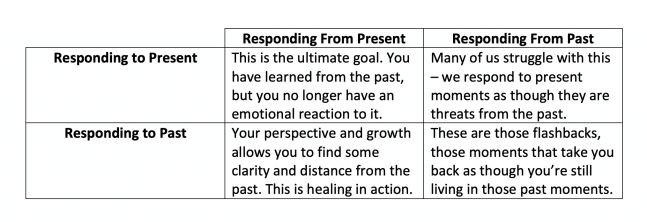
There are four basic categories between our reactions and what triggers them – Snip20191103_6.png

Responding to the Present From the Present

Your past experiences have taught you what to look for. You are better able to see actions that are misaligned to what you’ve been told and you’re more aware of unhealthy patterns. When something concerning happens, you use what you have learned to analyze it to decide if there are any real threats within.

You no longer have much emotional reaction from the past, so you trust that any you’re feeling now is an appropriate response to what is actually happening in the here and now. Furthermore, your reactions are on par with the behavior or sign you’re responding to. The response would be considered a reasonable one for anybody to have in similar circumstances.


Responding to the Present From the Past

Your past experiences are still living just beneath the surface. They have left you fragile, fearful. When something concerning happens in the present, it reignites those past concerns, an alarm sounding at full-blast, warning you that danger has arrived. Only the alarm is often false.

The emotional response is powerful, overwhelming, its intensity way out of line to what you’re responding to. You may even be aware that you’re overreacting, yet you feel powerless to stop it. Panic sets in. You become convinced that this is a sign that the past is about to repeat itself. You may respond with plans to flee, an instinct to fight or the desire to curl up and hide from the perceived threat. It’s best to take a time-out to allow some space for the body to calm before deciding to take any action.


Responding to the Past From the Present

This response comes when you encounter a reminder from the past, but you do not have an emotional response to it. Instead, you are able to look back with some clarity, applying what you know now to what you experienced then.

These are healing moments that provide valuable insight into what threats are real and which ones are born from a fear of being hurt again. This is learning – and healing – in action.


Responding to the Past From the Past

These are perhaps the most terrifying moments, when it’s as though a wormhole has transported you back to where you were with the same intensity of emotions and lack of perspective that you had when you were in the midst of it all.

When in the throws of a flashback, rational thinking and self-control is pretty much an impossibility. It becomes about survival, riding it out until it abates. Reminding yourself that it’s not real, that you are safe.


Should you believe your triggers?

Our emotional reactions are important, they provide us with information about our fears and about what is happening around us. Yet emotions are not always an accurate source of information. So listen to them, but don’t always believe everything they have to say.

What You Don’t Understand About Being Cheated On Until You’ve Lived Through It

After the Affair: When Does the Pain End?

We think of it like a finish line.

Or a wall.

Some clearly defined boundary, delineating pain from not-pain.

After all, that’s how this all started.

You had that moment before the discovery of the affair when everything was okay and the world was as it seemed.

Then, you had that awful moment, that image or those words, that turned your world upside down. And every moment since has felt like a slow water torture of realization and grief, choking you while you somehow still manage to breathe.

And so we dream of that day when the pain will end, when the tortuous thoughts will cease and we can again sit up and breathe fully.

We place faith in the calendar, thinking that we can simply out-wait the pain as though we are in some staring contest.

Yet grief does not speak calendar.

We tell ourselves that once we receive an apology or altered behavior or a divorce decree that the pain will realize that it’s closing time and will make a dignified exit.

Yet pain does not leave when asked to do so.

We spend hours delving into our emotions, dissecting and processing, in the hope that eventually we can turn them into something of substance.

Yet betrayal leaves a lasting stain.

No matter how much time passes, what the person who betrayed you said or does, or how much you process what happened, you will always remember that you were betrayed. It is now part of you, woven into your very fiber.

Yet that doesn’t mean that you will hurt in the same way forever.

The pain of betrayal comes from two places – the treachery itself and the impact that it has on your ability to feel safe and loved again.

As you begin to trust again, in others, but even more importantly, in yourself, you will begin to heal some of that secondary wound.

As you begin to understand that the betrayal was not a rejection of you but an act of cowardice and selfishness, you will begin to restore your self-worth.

The pain doesn’t end.

It changes. It recedes. It quiets.

You will always remember.

But you will not always be submerged.

As slowly as the tide pulling away, you will again surface.

With the salt of your tears still clinging to your skin.

And the strength of survival encouraging you forward.