5 Things We Hold On To After Divorce

Divorce requires letting go – of the marriage, the dreams, the regrets and even the promises. Yet we often struggle to let go. If feels wrong. Scary. Unfamiliar and untested.

So instead, we grip, holding on even when the thing we’re holding on to only causes us harm.


We Hold On to An Image Of Our Former Partner

Maybe you still see them as they were in the beginning of the relationship. Or, you see them as you want them to be. Regardless, you’re holding on to an image of them, a picture that is more in line with your wishes than their reality.


We Hold On to Our Dreams of What the Relationship Should Have Been

If only the affair hadn’t happened. Or the addiction. Or the growing distance after having children. Then, we tell ourselves, the marriage would still be okay. We cultivate this image of what our lives are supposed to be like and even when life trajectories change, we have a hard time letting go of Plan A.


We Hold On to Our Anger and Blame

We rail against our ex-partner, or their affair partner or some other factor that we blame for the relationship’s demise. We feel powerful in our anger, righteous and also purposeful. As long as we are angry, we at least have something.


We Hold On to Our Pain and Victimhood

It’s scary facing the world alone. And so we curl up in our cloak of “wronged one,” prompting others to render aide and support. Our pain becomes our identity. It’s proof that the relationship was important. That we were important.


We Hold On to a Need For Fairness

We place our faith in the courts. Or God. Or karma. Thinking that bad things come to exes for those who simply wait long enough. We hold on to the idea that in order for us to be okay, we need for them to not be okay. We just want them to feel the pain too.

IMG_2033

Bouncing Back

My ex was right. Well, partially right, at least.

In the typed letter (which, for some strange reason, was in duplicate) he left on the kitchen counter after leaving me via text message, he wrote this –

“I know that once you recover from the shock of this you will bounce back and live a happy and satisfying life – a life better and more honest than I could ever hope to offer you.”

I was livid the first time I read those words, almost 24 hours after receiving the text and with no other communication from him. My world was completely shattered. I was honestly afraid that this would literally be the end of me, as the shock and trauma were so all-encompassing. I was fighting to breathe and at the starting line for the fight of my life.

And those two little words – “bounce back” – seemed to minimize and dismiss everything he had done. As though embezzling from, cheating on and abandoning your wife is on par with recovering from the flu and I would “bounce back” and be as good as new after some rest and perhaps some soup.

Needless to say, that’s not what happened.

Well, not exactly.

I collapsed.

I cried.

I shook.

And grieved.

Learned to breathe.

Opened my eyes.

I crawled.

I took some wobbly steps.

And fell again.

I got back up.

Took some more steps.

Got a little stronger.

Went the wrong direction.

Cried again.

Got angry.

Tried to climb.

Too soon.

Declared I would make it.

Secretly doubted it.

Put on a brave face.

Hid a terrified heart.

Started to trust again.

Built a wall.

Started to love again.

Felt foolish.

And hopeful.

Had good days.

And terrible moments.

Wondered if I was broken.

Too damaged.

Tried climbing again.

Fingers bloodied from the effort.

Heart pounding.

But felt good.

Alive.

I hit rock bottom.

And I made it back.

But I never bounced.

I fought like hell for every inch.

Every breath.

Every step.


Yet he was right.

I am now living a happier and more satisfying life than I ever did with him.

And I may not have bounced back, but I got there. And that’s the part that matters.


3 Lies Your Brain Tells You After a Breakup

After Divorce: What Are You Grieving?

Divorce is a type of death. The end of the life you had and the life you expected. And as with any death, grief follows closely behind. After divorce, which of these are you grieving?


Grieving the Person You Thought They Were

For some of us, divorce is preceded by a revelation that our partner was not the person we thought they were. In a moment, we realize that we have been in love with a mirage, a projection of our hopes and that behind this image was a person who perhaps was acting in very unloving ways.

It’s a particularly painful loss. Although the person is still breathing, the one you thought you were married to no longer exists. And maybe they never did.

Part of what makes this grief so complicated is that it’s often punctuated with moments of hope. Hope that maybe they will return to the person they were or become the person you believed them to be.


Grieving the Future You Imagined and Planned For

You believed you were going to grow old together. Go on that much-anticipated vacation, experience those milestones and enjoy a shared future. And now all of those planned-for, talked-about and dreamed-of events will not happen. At least not together.

And letting go of expectations is hard. Damned hard. Especially when you’ve made decisions and even sacrifices for that imagined future. It leaves a sense of unfairness and incompleteness, a story only partly told.


Grieving the Family and Life You Wanted For Your Children

Maybe you grew up with divorced parents and you promised yourself that you would provide a different experience for your own children. Or maybe you had close parents and wanted to provide the same for your offspring. Either way, few people would choose to give their kids the experience of growing up with divorced parents.

And so you grieve for them. Mourning the life you wanted them to have while worrying that this is going to cause them harm.

If this resonates with you, take a moment to learn about what kids can learn from divorce. There are silver linings here, I promise.


Grieving Who You Were Before the Relationship

Maybe you lost yourself during the relationship and you’re grieving who you were before. Or perhaps betrayal or abuse has fundamentally changed you and you’re forced to say goodbye to the person you were before that pain branded you.

Of course, we change and grow throughout life as we’re impacted by both people and experiences. Yet divorce, with its very distinct before and after, can highlight these changes in a profound and often painful way.


Grieving The Companionship and Shared History

You’ve been through so much together. Have so many shared experiences and inside jokes. And now it’s over. The house is empty. There’s no one to call when your shared show has a surprise moment. And you feel so alone.

Even if the marriage had soured and you no longer enjoyed time together, you may find that you still miss them simply being there.


Grieving the Lifestyle That Accompanied Your Marriage

Maybe you miss the evenings with the shared friends. Or going to the kids’ softball games as a family. Or the financial freedom that duel incomes and a joint household provided.

When the marriage ended, so did many of the day-to-day traditions, habits and events. And especially before you’ve established your new life, you’re going to feel that void left by their loss.


Grief after divorce is normal. Like with any grief, it does no good to try to rush through it or avoid it. The only way through is through. Acknowledge the losses. Mourn them. Honor them. Give them space. And then give yourself permission to let them go.


Should You Believe Your Triggers?

I could feel it washing over me like a great wave trying to pull me under, both blinding me and choking me. My body went into full-on fight or flight mode, any rational thinking put on hold until the emergency passed.

What was the emergency, you ask?

My now-husband mentioned wanting to build a home theater in the basement.

I know, it’s a terrifying image.

This happened over six years ago and now I can laugh at the absurdity of my (over)reaction. But at the time, I truly was convinced that this was a serious threat to my well-being. I was responding to something in the present – my husband wanting to build a theater – with the emotions born from past experiences – my ex-husband building a home office in the basement that became the center of operations for his deceptions.

On the day of this particular melt down over the proposed theater, I remember being aware that the intensity of my response in no way matched the reality of the situation. But there was another part of me that was whispering, “What if this reaction is because you’re picking up on some real threat in the present?”

And I didn’t know which voice to believe.

And that’s the problem, isn’t it? We never know know for sure if what we’re feeling is a misplaced echo from the past or our intuition picking up on a real threat in the present.

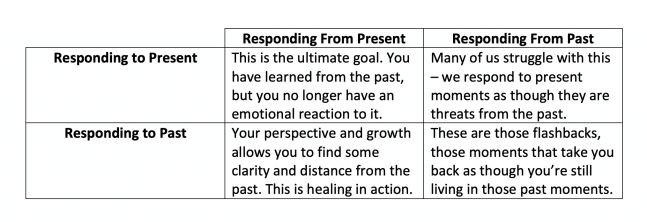
There are four basic categories between our reactions and what triggers them – Snip20191103_6.png
Responding to the Present From the Present

Your past experiences have taught you what to look for. You are better able to see actions that are misaligned to what you’ve been told and you’re more aware of unhealthy patterns. When something concerning happens, you use what you have learned to analyze it to decide if there are any real threats within.

You no longer have much emotional reaction from the past, so you trust that any you’re feeling now is an appropriate response to what is actually happening in the here and now. Furthermore, your reactions are on par with the behavior or sign you’re responding to. The response would be considered a reasonable one for anybody to have in similar circumstances.


Responding to the Present From the Past

Your past experiences are still living just beneath the surface. They have left you fragile, fearful. When something concerning happens in the present, it reignites those past concerns, an alarm sounding at full-blast, warning you that danger has arrived. Only the alarm is often false.

The emotional response is powerful, overwhelming, its intensity way out of line to what you’re responding to. You may even be aware that you’re overreacting, yet you feel powerless to stop it. Panic sets in. You become convinced that this is a sign that the past is about to repeat itself. You may respond with plans to flee, an instinct to fight or the desire to curl up and hide from the perceived threat. It’s best to take a time-out to allow some space for the body to calm before deciding to take any action.


Responding to the Past From the Present

This response comes when you encounter a reminder from the past, but you do not have an emotional response to it. Instead, you are able to look back with some clarity, applying what you know now to what you experienced then.

These are healing moments that provide valuable insight into what threats are real and which ones are born from a fear of being hurt again. This is learning – and healing – in action.


Responding to the Past From the Past

These are perhaps the most terrifying moments, when it’s as though a wormhole has transported you back to where you were with the same intensity of emotions and lack of perspective that you had when you were in the midst of it all.

When in the throws of a flashback, rational thinking and self-control is pretty much an impossibility. It becomes about survival, riding it out until it abates. Reminding yourself that it’s not real, that you are safe.


Should you believe your triggers?

Our emotional reactions are important, they provide us with information about our fears and about what is happening around us. Yet emotions are not always an accurate source of information. So listen to them, but don’t always believe everything they have to say.