5 Surprisingly Comforting Truths

-1-

The hard truth – Knowing everything is an impossible goal.


Why it’s comforting –

Ever fall prey to analysis paralysis? Where you become so focused on trying to gather all of the information that you find it difficult to make a decision and take a step? This hard truth highlights the fruitless nature of that obsessive drive. Once you realize – and accept- that it is impossible to know everything, it’s easier to set a focus AND a limit on what you need to know. And then once that is reached, you move forward.


-2-

The hard truth – Mistakes are inevitable.


Why it’s comforting –

It’s stressful and exhausting trying to achieve perfection in everything that you do. When you give yourself permission to make mistakes, you free your energy towards better pursuits. Furthermore, when mistakes are seen as natural and inevitable, it becomes easier to avoid an emotional reaction to the mistake and take full advantage of the opportunity to learn to do better.


-3-

The hard truth – You will be disappointed and you will disappoint others.


Why it’s comforting –

Sometimes being disappointed can feel very personal, especially for those of us that have experienced betrayal. On the flip side, disappointing others when you sincerely tried can be a brutal gut punch with a heavy dose of guilt and shame. Yet when you consider those together, it helps to show that the occasional disappointment is normal and not a big deal. Keep your expectations in line with reality, handle disappointment with grace and act in accordance with your beliefs. And then let go of worrying about disappointment.


-4-

The hard truth – No number of people can make you feel loved if you don’t love yourself.


Why it’s comforting –

Guess who you always have by your side?

You!

You don’t need to be famous or have a ton of Instagram followers to feel loved and valued. You don’t even need a significant other. All you need to fully accept, embrace and celebrate yourself. The rest is gravy.


-5-

The hard truth – Certainty – and safety – is an illusion.


Why it’s comforting –

We make so many choices out of the fear or loss or the fear of the unknown. We stay with what we know and what seems like a sure bet even when it’s not the right bet for us. Once you realize that even the “safe” choice doesn’t protect from harm, it becomes easier to do what is right for you instead of what appears to have the least amount of risk.


5 Things You Don’t Understand About Divorce Until You’ve Lived Through It

I thought I knew about divorce. When I was in elementary school, I weathered my own parents’ divorce, observing their reactions from the sidelines. I felt the loss, the change in family structure. I experienced the strange vacancies of a split – the blank spots on the walls where my dad’s pictures once hung and the empty seat in the family camping van.

I thought I knew about divorce. I read my mom’s seemingly endless supply of self-help books, important resources for her career as a marriage and family therapist. I digested countless case studies and thumbed through endless nuggets of wisdom and advice for an enduring marriage.

I thought I knew about divorce. So I chose a husband that showed me copious amounts of affection and seemed at ease communicating about emotional matters. After we weathered various storms, I was convinced that divorce was something that could never happen to us. Until it did.

I thought I knew about divorce. Until it happened to me. And I realized how little I knew. Because there are some things you only learn about divorce once you’ve lived through it.

1. Divorce Leaves No Stone Unturned

Before living it, I had always viewed divorce as analogous to a friend moving away – there’s the initial loss, the lingering loneliness and the need to fill the newly-formed void. What I neglected to understand is the sheer vastness of the impact of divorce.

It touches everything.

It’s the friend moving away, the home being destroyed by a rogue forest fire and the loss of health and sanity. A stranger jettisoned in a strange land, unable to speak the language. All while you’re losing your closest confidant and doubting your own decisions. And that’s not even addressing the shame of failure and the judgment of others.

Your family is fractured, perhaps alliances formed and relationships severed. Children are unsure and needy or defiant and acting out. Divorce changes your body as the signs of stress show on your face and your appetite is affected by the strain. Your routines alter as they reform around the missing person and even something as innocuous as an evening Netflix show takes on a greater meaning. Your job is impacted as your mind wanders and you have to spend your lunch break emailing your attorney. Your home, if you’re still in it, is at once sanctuary and mausoleum.

Divorce is far more than simply a change in family structure. It’s a reorganization of your entire life. Your entire self. It’s a massive transformation. A time when everything is called into question and nothing is certain.

It’s also an opportunity. A crack in the bedrock allowing a change in course, an alteration of spirit. You can stay at rock bottom. Or you can choose to build.

2. Your Emotions Will Be in Conflict

Your spouse cheats, you’re angry. They leave, you’re sad. They move on with somebody else, you’re jealous. It all seemed so straightforward until I experienced it myself.

When I received the text that ended my first marriage, my first response was disbelief. Then shock. Then concern for him. Followed by blind rage. Then pragmatism took hold. Until the uncontrollable sobbing started.

And that was only the first ten minutes.

The reality of the emotional onslaught is much messier and much less predicable than anyone can imagine. Overwhelming loss enters the ring against an unspoken sense of relief. Blinding rage battles with compassion and a memory of love once shared. Moments of sheer joy rise unexpectedly like the opening of a shaken soda only to be trailed by a sudden jolt of reality.

The reality is that there is no one way you’re supposed to feel. All of these strong and conflicting emotions are normal when enduring divorce. And they’re all valid. It’s possible to hate someone and still miss them. We’re capable of feeling anger and empathy. It’s okay to have moments of bliss even while the tears are still drying on your face.

3. You Cannot Prepare For or Control Everything

If you had asked me prior to my divorce how one should approach the process, I would have been full of pragmatic (and naïve) advice. It seemed pretty clear cut – talk things out with your ex and make decisions that are fair to both, limit the legal counsel sought and seek to be friendly throughout the entire ordeal.

Which is not how things happened.

Throughout the entire divorce process, I felt like a tennis shoe thrown into the washing machine, being tossed about at will and completely submerged in the process. I was accustomed to being in control of my life and my surroundings and the divorce was a rude awakening to how little influence I really had.

You can try to anticipate how you, your ex or your children will respond. You can make plans for how you think the process will proceed. You can spend months researching your options and making informed decisions.

But at the end of the day, you have no control over the outcome and limited skills in predicting the future. And that can be a difficult – yet freeing – truth to accept.

4. Some Days You Will Feel Like a Failure

Even though my rational brain does not interpret divorce as a failure, my emotional self still experiences shame around the end of my own marriage. I find that I am quick to offer the extenuating circumstances that made divorce the only logical solution and absolve me of the bulk of the responsibility.

When I hear people claim that “divorce is not an option,” I feel both angry and foolish that I allowed myself to be put into a situation where it became the only option. Even though it became the best thing that ever happened to me.

No matter your circumstances and your larger feelings surrounding your divorce, there will be days where you feel like a failure, like you’ve been branded as someone who gives up too easily or perhaps doesn’t know how to compromise. Sometimes these feelings spontaneously arise from within and sometimes they’re compounded by external judgment.

Instead of allowing the guilt and shame to tell you you’re a failure, funnel them into learning how you can do better going forward. You’re not a failure for getting divorce; you’re only defeated if you allow it to get the better of you.

5. It Will Be All-Consuming….Until It Isn’t

I kind of feel like I need to send an apology note to everyone I came in contact with during my divorce –

“I’m sorry that I told you way too much of my personal business and probably made you uncomfortable in the process.”

But at the same time, I’m not sorry. It was a brief period where all sense of political correctness and social niceties were shed and real, although brief, connections were formed over my shared intimacies.

For months, my divorce – and my ex’s shenanigans – were my defining characteristics. It was the first thing friends enquired about and the first thing on my mind when I awoke. Everything reminded me of him or what I had lost in the process.

And then a day came where I didn’t think about the divorce, my ex or my losses. And then another day followed shortly after. Instead of being the most important feature in my life, it became simply part of my backstory.

When you’re in the midst of it, divorce feels never ending. Yet eventually, it omnipresence wears thin as it overstays its welcome. New experiences and new people begin to layer new memories atop the old and the pain fades into the distance. Divorce will always be a part of your story, but it will no longer be your defining feature.

Separating Facts From Stories

There are the facts. And then there are the stories we weave from the facts.

Fact: My ex-husband had an affair with a woman he met on a business trip. He married her three months after they met and abandoned me with a text message.

Story: There must be something wrong with me for my husband to fall so quickly for another woman. She must have something that I don’t. I’m not even worthy of a conversation, that’s how inconsequential I am. If the man that professed his love to me for sixteen years and pledged his commitment could leave me so easily, any other man would obviously do the same. If I was unworthy before, I’m broken now. There’s no way that I will ever be able to recover from this damage.

It starts with the facts – sometimes harsh, but bare. Often devoid of any motivations or intentions. And then our brains industriously fill in the details, weaving stories that surround and connect the facts.

The problem is that once we tell ourselves these stories, we become unable to separate them from the facts. And so we begin to believe the words we tell ourselves. The words that are often anchored in insecurities, fears and trauma.

Sometimes, we even take it a step further and assimilate these stories as a core truth of about ourselves. We confuse what happened to us with who we are, applying labels with superglue and operating under those assumptions.

What stories are you telling yourself?

Take a few moments and consciously examine the stories you tell yourself. What are the facts and what are your interpretations and speculations about the facts? What if some of your conclusions are incorrect? Could there be another way to view these same facts?

The facts are irrefutable. The stories are what we create.

When we become too wed to a story, we become stuck within a singular narrative. Change your story and your life will follow.

Related:

Edit Your Personal Narrative

Your Story Matters

The (Unspoken) Truth About Marriage

When asked about the state of their union, people often feel like they have to defer to one of two responses:

“It’s all good,” or, “It’s over.”

Yet the reality is that most marriages spend much of their time between these two extremes. Where some things are good, some areas are taut with tension and loving thoughts are interspersed with feelings of frustration or even disengagement. And by neglecting to talk about the reality of marriage, we leave those in completely-normal-and-not-always-ideal marriages feeling unsure and isolated.


Even the best marriages have bad days.

Or weeks. Even months. Whether from external pressures or changes prompted by internal struggles, there will be times when things are not good. There may be spans of silence, a lingering sense of tension in the air after a difficult conversation or nights spent lonely in separate beds.

When these bad days occur, it can be easy to catastrophize. To assume that a bad day indicates a bad marriage and that this is a sign that the end is near. One partner may be more prone towards panicking, attempting to grasp on in a desperate attempt to stop the imagined slide downhill. This often has the opposite effect, as the one who is latched upon feels increasingly trapped and becomes desperate for escape.

Some bad days pass on their own, especially if their cause is largely centered outside the marriage. Others are a cry for help, a sign that the marriage needs some attention and perhaps modification. And others are just part of the natural ebb and flow of life, expansion followed by contraction. This is one of the reasons that the first year of marriage is often deemed to be one of the most challenging – it follows after the excitement of wedding planning and establishing the relationship. The day-to-day of normal marriage simply can’t live up to that level of expectation.


Even the closest couples need time apart.

In the beginning of a relationship, the excitement and novelty leave you counting the minutes until you can be with your newfound love again. It seems impossible that there will ever be a day where you look forward to a trip that takes them out of the home for a few days. But it will happen.

I hear whispered confessions from friends, deeming me a safe receptacle for their secrets, admit to feeling guilty when they let out a little cheer when their spouse pulls out the driveway for a few days of absence. “That’s totally normal,” I reassure them and the relief is palpable.

Too much of anything – or anyone – can easily become too much. With overexposure, appreciation is easily replaced by irritation and small problems begin to accumulate. I like to relate it to ice cream. The stuff is amazing. You maybe even want some every day. But if you have a gallon of it in one sitting, your body is going to rebel. That doesn’t mean that there is anything wrong with you or the refreshing treat; it simply means that you need a break before you can enjoy it again.


Even the most compatible couples can struggle to find connection.

When my now-husband and I were first dating, we lived across town from each other. And in the Atlanta metro area, that’s quite the commute. Since we couldn’t see each other more than once or twice a week, we would spend evenings on the phone, chattering on about anything and everything.

It was easy to find things to talk about – not only did we live our days in largely separate worlds, we were still in the process of learning about the other person. Now, eight years later and sharing the same bedroom on most nights, we can go days without a meaningful conversation. The reasons are multifold. Our lives are more overlapping so there is less to share about the day-to-day. At this point, we’ve divulged and discussed our pasts, our passions and our perspectives and since we’re not yet old enough to be forgetful, there simply isn’t a need to cover the same material again. And we’re busy. The activities that were pushed to the side in those early months of the relationship have again found their place, leaving us with little time to connect during an average week.

As a result, there are times when we can feel disconnected. Like we’re crawling in bed with a virtual stranger, who both knows everything about us and yet we have nothing to talk about. And then, we carve out some time to do something new together, even if it’s as simple as dinner at an untried restaurant. The new environment inevitably sends a current through the relationship, reigniting the spark of connection.


Even the most agreeable people will have differences of opinion. 

I love my husband, but there are times I think he must be a visitor from another planet. After all, surely no reasonable adult human could actually think that??? In my first marriage, I let those differences of opinion bother me. I would either take it personally (seeing an attack on my viewpoint as an attack on me), allow my mind to be changed or feel threatened by the disparate stances.

It no longer bothers me so much (Unless it’s about school; I get pretty sensitive when people who are not in the academic sphere try to tell me about modern-day school issues.) when we have opposing viewpoints. In fact, I’m more likely to find it interesting (Why do you think that way?) or humorous than threatening. I have learned that it is possible to both love and support someone even while disagreeing with them.

There are some things that are so important that dissent is a sign of trouble, but for most everything else, a difference of opinion is simply a sign that you are two different people. And that’s a good thing.


Even the strongest marriages have periods of renegotiation and transition.

There is an immense about of negotiation and compromise that occurs when a relationship first becomes serious. The amount of togetherness is determined, acceptable interactions with the opposite sex are established and relationship patterns are initiated. That period is widely accepted as a precarious one. Some relationships emerge on the other side, stronger and established, while others fail to effectively negotiate a path.

What is less discussed are the inevitable transitions that occur throughout a marriage. As children come and go, job responsibilities shift and health crises seemingly come out of nowhere, the established roles and routines may longer be appropriate. And because we’re creatures of habit and we universally fear loss, these renegotiations are often even more difficult than the initial shift into commitment.

These times of transition are stressful and we often struggle to find the words to describe them adequately. We are uncomfortable with change and with making space for the unknown, especially when our most intimate relationship is threatened. Yet those same uncertain times that scare us also provide us with the most opportunity for growth.


Even the most reasonable parters will sometime respond irrationally. 

I am normally a very rational, even analytical, woman. Unless I’m poised at the top of a hill. At which point, I turn into a blubbering child. My husband knows this about me, and so he lovingly becomes extra-patient with me in those moments. My thoughts on a hilltop are not rational, but they are real. At least to me and in that moment.

Most people aren’t as afraid of downhills as I am (thank goodness, or whole industries would be wiped out), but we all have our particular triggers that cause us to behave irrationally and emotionally. And when you’re married to that overreacting person, it’s hard to suppress the urge to declare, “Just what in the hell is wrong with you?” and to respond instead with a combination of compassion and encouragement.

And here’s the hard part – unless we share the same emotional triggers as someone else, it is difficult (if not impossible) to understand where that person is coming from. And when that person is your spouse, that is a frustrating pill to swallow.


Even the most loving unions will have times where love is dormant. 

Love is more about action than feeling. There will be times when you don’t feel an overwhelming sense of love or affection for your partner. Some days, irritation and annoyance speak so loudly that they drown out the soft utterances of fondness. The love isn’t gone, but it’s quiet.

It’s important how couples respond to each other in these difficult times. There can be respect even without understanding. Kindness even in the absence of fondness. Tolerance when cooperation is lacking. And above all, a willingness to listen for the sleeping love and the patience to wait for it to stir once again.


Related:

Why I Don’t Want a Perfect Marriage

A Growth Mindset in Marriage

A Facebook Marriage: Keep the Smile On Or Else


Diving for Pearls

There are times when Truth is important –

When my students use verified geometric theorems to prove triangles congruent.

When my husband tells me where he’s going on a Tuesday night.

When my doctor asks about my family history of cancer.


And then there are times when Truth really doesn’t matter.


A person reached out to me yesterday with the concern about their place in their former partner’s view – did they love me or did they use me?

As I sat on the bench in the gym locker room typing out a response, I was transported to a time when that same question consumed me. As the details of my husband’s other life began to surface, I couldn’t help but contrast what I was feeling at that time (loved) with what he was doing at the time (anything but loving). There was no doubt that he was acting without concern for me towards the end, but did that mean that he never cared for the entire sixteen years?

I was obsessed with answering this question. I would consider evidence in the form of memories or discovered facts and dutifully enter a mental tally mark in either the “He loved me” or the “He loved me not” column. And yet, I never seemed able to settle on a true answer. For every indication that he loved me at some time, I could find a counterclaim that I was merely a pawn in his game.

I was looking for definite proof. For Truth.

But what I really wanted was for the pain to stop.

And Truth, assuming it could even be ascertained, really didn’t matter.


I made a conscious decision to retire my search for Truth. I accepted that he had used me  in the final few years of the marriage and I chose to believe that the love I felt prior to that was real. Maybe I’m right and he did have the capacity for love until he collapsed under the pressure of shame and addiction. Or, I may be completely off base and he may have been a manipulative sociopath from the beginning.

It doesn’t matter.

The marriage is over. I don’t need this information to make any decisions in the present moment. My views don’t impact my ex one way or the other. I’m not presenting this conclusion as definitive and I’m not deceiving anyone. There are no judges evaluating the evidence for my claim and no real-world repercussions either way.

It only matters within me.

So I choose to believe the truth that brings me peace and allows me to hold onto some of the good memories instead of throwing sixteen years of my life away.


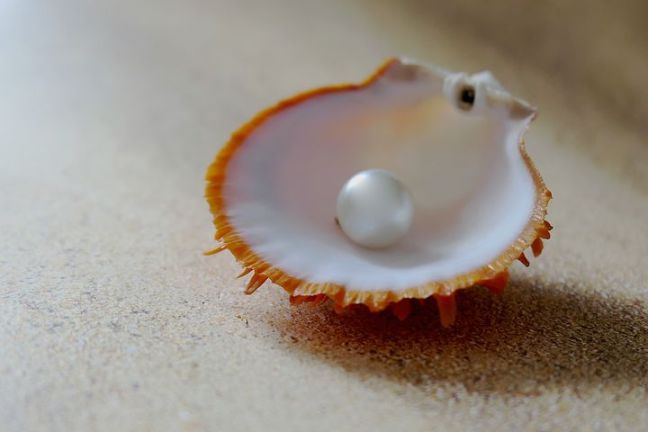
Oysters developed a resourceful strategy for handling unwanted and irritating invaders. In order to reduce the pain from a wayward grain of sand or grit, they surround the unwanted particle with smooth coating of calcium carbonate.

That’s how I see my resolution to conclude that I was once loved by him – a pearl enveloping and softening the pain.

And it may not be Truth in any real sense, but it’s real enough to me.