The Second Time Around

I am as familiar with the statistics as anyone – two thirds of second marriages are expected to end in divorce. There are many factors often cited for this depressing outcome. The family unit is more diverse and less cohesive. The children tend to be older and more independent, thus staying together for the sake of the kids is less of an issue. The ghosts of spouses past can continue to haunt the new marriage. Perhaps one or both partners moved too quickly into a new relationship rather than allowing sufficient time to heal from the divorce or to address underlying issues. Or, maybe they spent so much time single that partnered life with its compromises and complexities is no longer a fit. And, of course, there is the fact that once you have been divorced and survived, it may be easier to tread that path again.

Regardless of the reasons, the numbers are clear. Second marriages are more likely to fail than first unions. But, when it comes to relationships, I don’t care about statistics. I care about individual marriages, including my own. And, rather than focus on the added challenges that can impact subsequent marriages, I choose to acknowledge the ways that a marriage can be better the second time around.

Value

I took my first marriage and my first husband for granted. He was always there and I assumed he would always be there. It wasn’t that I treated him poorly or neglected the marriage, I just didn’t understand the fragility of it and that it could disappear so easily. Read the rest on The Huffington Post.

Inside Out

I made the mistake in my prior marriage of attributing too much to outside factors.

(Side note: I think our words of choice are quite telling. I’ve gone from saying “my marriage” to “my first marriage” or “my prior marriage.” without any thought. Interesting. On a side side note, only 2 1/2 weeks until the wedding!)

And there were plenty of external factors to blame in the final year of my marriage. On my side, I was dealing with a horrific work environment and working long additional hours doing math tutoring. It was easy to understand why I was stressed and burned out; I allowed myself no time to relax. On my ex’s side, he was facing a scary health crisis, uncontrolled hypertension, that was defying an underlying diagnosis and treatment. He had experienced several episodes of losing consciousness and frequently felt ill.

When he seemed “off,” I blamed it on his fear and his illness.

When I seemed anxious, I blamed it on my borderline-abusive situation at work and the associated stress.

It made sense that he would be scared of his medical condition and what it might mean. It made sense that I would be carrying stress about work.

But those were merely scapegoats for the trouble within. I believe his illness was caused by the tension of maintaining the facade he created. I think I wouldn’t allow myself to relax because some part of me was scared of what I would see if I did.

The problems were inside of each of us but it was so much easier to point fingers at the outside.

But that’s not to say that the outside not impact what happens in a marriage. After all, no relationship occurs in a vacuum. I’ve been reminded of this recently (luckily in a good way!) with Brock.

When we first moved in together, I joined him in his town home. There was some stress involved. First, I was the new one in his established space – never an easy transition. Additionally, the place was on the market and so we knew that our time there was limited. The next house, the rental we just left, allowed us to jointly establish space, yet the general disrepair of the place as well as his mourning the loss of a home that he had personalized, added some negative energy. And, now for the first time, we are in a home together that we both feel good about and can establish from the beginning.

And it’s changed us.

There were certain behavior patterns or traits with both of us that I had viewed as innate, internal. But now that we are happy in our space, those patterns are changing after only a week. For the better. Although we both have generally positive attitudes about temporary situations, the stress of unsatisfactory housing had its impact.

I had been blaming the inside when this time, the fingers should have been pointed outwards.

So what’s the lesson in this?

Relationships are built upon a complex interplay between internal and external factors. It makes no sense to discount the impact of either when trying to understand or improve a situation. The outside influence can be used to your advantage, thus the often-heard recommendation to take a vacation to reinvigorate a flagging relationship. It can also harm a relationship as it applies external stressors. Don’t be too quick to place all blame on the outside but also don’t neglect its influence. The reality is that most issues in a relationship have internal and external factors. Pay attention to both.

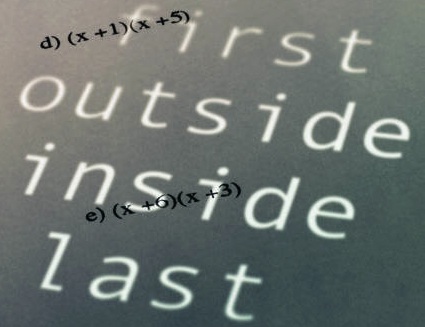
In math, we use the acronym “FOIL” to teach the multiplication of binomials. It stands for first, outside, inside, last. This same acronym can be modified for relationships:

First, outside

Inside, last.

Meaning, first look to outside influenced on your relationship. Often times, just recognizing their impact can make a difference. Other times, you can actively work to change your environment. But then, look inside and make sure that you’re aligned there as well. If you only take one perspective, you’re only looking at half the picture.

As for me, I’m happy to be on the far side of 2 1/2 years of housing stress and I’m enjoying where we are in this moment. Both inside and out:)


Passionate Protection

One of the most common complaints in a relationship that has gone the distance is the lack of excitement. Of passion.

The spark fades and is replaced by a sense of comfort.

Of predictability.

It’s natural to look for stability in our relationships. We want to feel safe. We want to limit that oh-so-scary feeling of vulnerability. We may be willing to trade some of that early excitement for the comfort of knowing that our partner will be there and that we will be safe. We exchange passion for security.

The problem with this transaction is that security is merely an illusion. There is no such thing as a relationship that is divorce-proof. There are no guarantees. We are trading real goods for the promise of a return that may never come.

It makes sense to take certain precautions. Much like most pay their rent on time so they don’t have to live with the daily fear of being evicted, it makes sense to be cautious in love. But not so cautious that you trade all excitement for the false promise of invulnerability. Even perfect rent payments do not protect your home from burning down around you.

There are problems inherent with assuming too much security. You become complacent. Bored, even. You may begin to seek excitement and novelty outside of the the relationship. Eventually, your internal narrative regarding your spouse changes to match your perceptions, reinforcing the idea that the lack of passion is par for the course with him or her. The very assumption of stability can erode away the foundations of a relationship.

You can maintain passion. You can draw out excitement. But it does mean letting go of the illusion of security. It means protecting your passion even when it can be scary.

Try listening to your partner with an open mind rather than leading with assumptions. He or she will surprise you if you allow it. When you believe you know all there is to know about someone, you begin to fill in the gaps automatically. But if you listen, really listen, you may discover something you didn’t know. Of course, that something may also be against your preferences. There’s the trade-off.

Look at your partner as an individual. Watch them in their element. See the best side of them come alive. It may or may not be a characteristic that you normally witness in them. See it. Appreciate it. Recognize that you are a team but not a single entity. Your partner is his or her own person. As you are yours. Maintain some separation, some mystery. In that way, you always leave room for discovery.

Be proactive about maintaining experiences as a couple outside of routine. Routines allow us to function but they also become suffocating if you never deviate. Try new things. The excitement will transfer to the relationship. Embrace a certain amount of unpredictability. Don’t restrain laughter. Be willing to try and look foolish.

Don’t depend upon your partner to create passion. Find it yourself.  Explore the things that bring you joy, that give you purpose and allow you to create. Your partner may not share your interest in gardening or ju-jitsu, but you can share the energy that  it brings you. Take responsibility for your joy. Passion has a way of being contagious. Pass it on.

Amusement parks have created an entire industry around the balance of security and excitement. They know how to give you the feeling of vulnerability, with its associated joy when you emerge unscathed,  without too much of the risk. You can find that balance in a relationship as well.  Let go of the illusion of security. Actively seek excitement and novelty within the relationship. Protect your passion as diligently as you protect your heart.

Related: Of Teddy Bears and Security Systems

Surprising Fun

A few weeks ago, I was a guest on the Frank Relationship radio show. It was quite a fun show to do; I loved the dynamic between the host, Frank, the psychologist, Gail and myself. It was also I sign of how far I have come in my healing. When Frank stated that he didn’t see anything wrong with the way my husband left the marriage (via text), I didn’t take it personally. In fact, I found that it led to interesting dialog and led me to ask Frank a rather pointed question:)

Here’s the link to the audio and transcript from the show. Check it out and let me know what you think!

Two questions I wish I would have posed: would you view this differently if there had been kids involved and would you feel the same with a business parter who embezzled from the company and then left as you would with a partner who just disappeared.

Oh well, missed opportunities:)

The Four Agreements in Marriage

As a homework assignment for my recent girl’s weekend, I was asked to read The Four Agreements. I was fully willing, but somewhat skeptical, since as the only child of a counselor, I was raised on a steady diet of self-help. I think I overdosed.

After the first few pages, my skepticism was replaced with excitement and understanding. This was one book that made sense to me.

The premise is simple: four agreements that, if followed, will change your life. The book is short and the agreements are extremely simple but nowhere near easy. They are applicable to every area of life and manage to be general and still useful all at once. They are interconnected; one always leads to another.

As part of my own work with The Four Agreements, I am drilling down and applying them to various areas of life. Here is my take on The Four Agreements in marriage:

Be Impeccable With Your Word

In essence, this agreement is your promise to say what you mean and to avoid speaking against yourself or others in fear, pain or blame. In a marriage, this means to refrain from using words such as “always” or “never” when referring to your partner’s actions. The agreement suggests that speaking in blame is not being impeccable since the underlying motivation does not match the message. When speaking to others about your spouse, avoid endless complaining, as this only serves to reinforce those beliefs. Also, avoid speaking against yourself, saying words that diminish your value and worth.

I am working on this agreement in my current relationship. When I get frustrated, I find myself running an internal (sometimes it slips out!) dialog cataloging his wrongs and missteps. Or, I berate myself endlessly for my role in some screw up. To be impeccable, however, is to speak in love and kindness, forgiving both he and I in the interest of a better relationship. To help with this, whenever I am frustrated with him, I intentionally catalog his gifts and blessings or my own, if I am speaking against myself. In this way, the words and the intent match.

Don’t Take it Personally

No spouse enters into a marriage as a blank slate. They have a lifetime of hurts and fears that they carry with them. Any reaction they have is filtered through their unique experiences and views. It is so easy to react to every word or action as being directed to you, but the reality is that they are operating from their own place. You are not the center of their world; they are. It’s strange, it’s easy for us to identify the multitude of factors that influence our own thoughts yet we seem to think that our partners somehow don’t posses that complexity. When you feel attacked by your partner, don’t take it personally. Try not to be defensive by realizing that they are projecting their own fears and wounds. If you can remain open, it is possible to work down to the root cause of the verbal strike.

I’ve shared my struggle with this issue with Brock. I am learning not to take it personally when he needs distance; it is not about me. Likewise, he does not take it personally when I need time alone to decompress and recharge.

Taking things personally has been my biggest challenge of all of these. As life so often does, it is making sure that I get repeated lessons here. By choosing to share my writing (and my life) publicly, I have been the target of many attacks. I have come to learn that when someone (especially a stranger) is so threatened or incensed by my words, that they are really a trigger of some other event in their life. It’s not about me.

Don’t Make Assumptions

My 8th grade social studies teacher had the following bumper sticker posted on his board: “Never assume because all you do is make an ass out of u and me.” I’ve never forgotten that message, although, like all of the agreements, it is easier said than done:)

In a marriage, assumptions allow us to feel judged and can keep us in a victim role (not exactly an attractive trait in a partner). It’s easy to assume you know your partner’s motivations and to assume that they understand yours. Before you respond, ask. Find out their perspective. And then listen. The worst part of assumptions is that they prevent us from really listening to our partners. It’s amazing how much your attitude can be transformed once you release assumptions and become open to possibilities.

I find at times that I will predict Brock’s response to something before I even bring it up. Then, I respond to these assumptions, at times getting upset before I’ve ever given him a chance. Crazy, right? But does it sound familiar?

Do Your Best

One of my favorite aspects of yoga training is that you are encouraged to do your best on that day; it recognizes that “best” is subjective and movable. In a marriage, be gentle yet firm with yourself. Expect your best and accept where you are in that moment. Recognize that your spouse is doing his or her best, even when it may not feel that way. Part of doing your best is to do things for your spouse without any expectations. You do your best for you, not for recognition.

This is an area where Brock has really helped me. I used to be too hard on myself and not forgiving of periods of anger or sadness. He helped me accept that I was doing what I could at that moment and that the moment would eventually pass.

So, don’t take it personally, but do your best to check out the book (don’t assume you know what it says) and see if I’ve been impeccable with my word:)

Next up, the four agreements in divorce (that’s gonna be fun!) and in health/wellness. Okay, maybe I’m a little obsessed at the moment:)