Let That Sh*t Go

When I walked into my yoga studio this past Monday evening, I saw a woman with the most amazing shirt. Under a simple image of a figure in a pose, were the words:

Let that shit go.

I laughed. I smiled. And I reflected back on my day, the first day back at school after spring break. A day filled with tired, yet nervous kids, as we all prepared for the upcoming standardized testing season.

I felt my shoulders kissing my ears as they still were still struggling to carry the load of the day, recognizing that my mind hadn’t left the school and was still busy tweaking the lesson for the following day. I sensed a current of anxiety coursing through my body, fearful that I would somehow mess up the testing in some critical and unforgivable way. Looking inward, I realized that I was already anticipating what I needed to accomplish after the yoga practice instead of making preparations for my yoga class.

And then I made a decision and with my next exhale, I followed the advice of her shirt and I let that shit go.

As we go through our days, we collect worries and troubles like a young child collects pebbles on a walk through the park. We stuff our pockets, line our shoes and fill our hands with as much as we can carry. Consequently, we become overloaded, burdened, with the weight we carry. We curse it, we complain about it. Yet we rarely follow a form of the advice we would give to the child overloaded with collected treasures on a walk –

Let that shit go.

Mistakes

When I was in kindergarten, I got in trouble for talking in class. My consequence for the misdeed was a missed recess. The talking was a simple mistake, a lapse in judgment rather than a lapse in character, yet I internalized the mistake. Instead of merely sitting along the wall with the other kids who made a mistake that day, I had to be consoled by my teacher because I was so hard on myself.

Mistakes are inevitable. Mistakes are opportunities. Making a mistake doesn’t make you any less of a person.

Let that shit go.


A Bad Day

Have you ever noticed that once you label a day as “bad,” there seems to be no shortage of ever-compiling evidence to justify that moniker? Every slight, no matter how small, is a sign the world is against you. Every stressor becomes a mountain, every trigger detonates an explosion.

Days aren’t good or bad. They’re simply a measurement of time. And what happens in one fraction of a day doesn’t have to impact the remaining parts.

Let that shit go.


Expecting Things to Be Different

I receive questions and pleas for help on a daily basis where the writer inquires how to go about changing their spouse’s or ex’s behaviors. They enumerate the lies and the irresponsibility. They express their frustrations about the lack of accountability and the absence of emotional intelligence. Sometimes, they lament the circumstances rather than the person, begging for a way to alter their current reality.

But reality is as it is. There are circumstances we cannot change and people beyond our influence. To believe otherwise is maddening and self-limiting.

Let that shit go.


Childhood Wrongs

I once heard a psychologist say that our twenties are the time for facing and addressing any childhood traumas and points of contention. After that, it’s time to take responsibility for the direction of your life.

Some people have had horrible childhoods, filled with insults and assaults upon a vulnerable frame. Childhood ends and with it, the lack of choice and agency that comes from being young. At some point, your life becomes your responsibility.

Let that shit go.


Control

Getting pneumonia 6 weeks before my first – and only – marathon was the best thing that could have happened. Until that infection left me bedridden, I was carefully controlling every bite of food and every step run. The pneumonia was a reminder that I couldn’t control the outcome. (It turned out okay; I still “won” the marathon.)

You can control your responses. You have influence over the process. But the outcomes?

Let that shit go.


An Apology That Never Came

I spent years hoping for an apology from my ex husband. I believed I needed it so that I would know that he felt remorse and so that I could receive closure. It was a life on hold. A wish with no action. I put more faith in the apology than I did in my ability to move on.

Never put the responsibility for your well-being in the hands of the one who hurt you.

Let that shit go.


Fixing Everything

Not everything is a problem. Not everything has a solution. Sometimes things are broken beyond repair and sometimes what we see as flawed, someone else views as perfect. And other times, the fixing may need to be done, but it is not our job to do it.

When we act as “fixer,” we are taking on too much and often hurting others in the process.

Let that shit go.


Perfection

I remember erasing my drawings in art class to the point where I rubbed holes through the paper. In an attempt to make them perfect, I inevitably ruined them.

Life is about being present, not perfect.

Let that shit go.


What Ifs

It’s an easy mental game to play – what would have happened if I chose a different path? It can be entertaining and educational, playing around with the options and outcomes.

Yet what ifs can also be a trap, a way of spending time in manipulated past and an imagined future instead of being where you are.

Let that shit go.


The Need to Be Right

When we listen to respond rather than understand, we’re allowing our need to be right to dominate our interactions. When we lead with the ego, we shortchange others their right to be understood and we limit our own ability to grow.

It’s funny. The more we need to right, the more rarely we are.

Let that shit go.


Outrage

I heard an interesting podcast the other day that had an expert in social media discuss how the big players – Google, Facebook and Instagram – manipulate us into spending time on site and interacting with the content. The types of posts that receive the most investment of time and energy are not the feel-good ones, not the informational ones, but the ones that cause a feeling of outrage.

It’s not just the social media big boys that bully us with outrage. Think of others who provoke you, push your buttons and get under your skin. What’s your typical response? We are all prone to reactions. Outrage short circuits our rational minds and prompts irrational responses even while it serves as fuel for the ones prompting it.

Let that shit go.


Occasional Hurt Feelings

Sometimes I wish I had a bad memory, that painful things that had been said to me would blur over time and fade into the backdrop. But that’s not the case. I have to be very deliberate about releasing the hurt that has come from words spoken without thought or said when emotionally flooded.

We all unintentionally hurt others sometimes. We say the wrong thing. Forget an important milestone. Neglect to respond in the right way. And feelings get bruised. And bruises heal.

Let that shit go.


Self-Flagellation

Guilt serves a purpose. Much like the inflatable gutter guards in children’s bowling, it helps to guide us along our intended path. Yet guilt has a propensity for growing outside its allotted space, suffocating us in the process.

When you mess up, own it and then either change it or apologize. And once you learn from it, the guilt and self-punishment serve no further purpose.

Let that shit go.


Excessive Judgment

Some behaviors deserve judgment. Intentionally harm a child or an animal and I’m going to judge you all the way to prison. Yet most behaviors require less judgment and more curiosity.

It’s easy to think that your way is the right way and that when you don’t understand somebody’s beliefs and decisions, it means they’re wrong. Yet different isn’t necessarily wrong, it’s just different. Judgment won’t change their mind, but it will keep you from expanding yours.

Let that shit go.


Comparisons

Have you every felt good about an accomplishment only to feel incompetent and jealous when you measured them against another person’s.

Comparisons are empty. You’re holding your inner life up against somebody else’s outer one. You’re allowing somebody else’s achievements to have an influence on your own. What somebody else has earned has no bearing on what you have attained. Let them be and you do you.

Let that shit go.


Busyness

I struggle with feeling guilty and lazy when I take some for myself. I find it all-too easy to identify with my accomplishments and view my worth through my deeds.

You are not defined by the number of events on your calendar and the number of items crossed off your to-do list. It’s okay to step away from doing and allow yourself to simply be.

Let that shit go.

 

let that shit go

3 Lies Your Brain Tells You After a Breakup

Gratitude Without the Bullsh*t

Gratitude.

It’s become quite the buzzword, hasn’t it. It’s right up there with kale and yoga in the perpetual quest for wellness and happiness.

We are told we should buy gratitude journals or download the latest app that will send us reminders that we should be grateful. Ads pop into our feeds with t-shirts emblazoned with, “Thankful, Grateful, Blessed.” And we hear everyone from scientists to pop stars lecture us about the importance of gratitude.

And some days we’re feeling it. The sun is shining and we actually have the bandwidth to appreciate it.

Other days?

The pressure to feel grateful just feels like one more burden and the inability to reach that goal simply feels like one more failure.

Which kinda defeats the purpose, doesn’t it?

_____

The problem with the constant push for gratitude is that it begins to feel forced. As inauthentic as a carefully posed and filtered Instagram image. We do it, but we don’t feel it. And even worse, when gratitude is feigned, we feel a dissonance as we deny what we are really feeling in the moment.

An intentional relationship with gratitude has been important in my healing process from my tsunami divorce. I’ve found a way that works for me to practice gratitude without feeling forced or denying that sometimes life is just hard. Maybe these strategies will work for you too.

Gratitude Without the Bullsh*t

1 – What Are You Looking Forward To?

I try to start every day with this question – “What are you looking forward to?” I take a moment and think about what is coming on that day as well as what is on my calendar for the coming weeks and months. Some of the anticipations are small – a cup of tea brewing on the counter, a pleasant weather forecast or wearing my favorite shirt. Others are more exciting, like an upcoming visit with friends or a planned trip.

When I find that I’m struggling to find things to look forward to, I make a concerted effort to schedule some smiles. Those are just as important to have on the calendar as any meetings or appointments.

There is a caveat to this strategy – you have to keep your expectations in check. There will be times when the looked-forward-to-thing doesn’t happen and if you’re too wedded to a particular outcome that is outside of your control, it’s easy to become disappointed or even defeated. The point of this exercise isn’t to place your happiness on a certain event, but rather to simply recognize that there are always good things on the horizon and to celebrate that excitement that comes with anticipation.


2 – Both And

When we suddenly lost our very special dog Tiger two years ago, it was very hard. The grief was intense and the loss overwhelming. My husband and I dedicated the weekend to remembering him and his impact on our lives. Interwoven with the grief was a gratitude that we had 8 years with this very special dog along with the awareness that the reason the pain was so great was because he was so great.

Finding gratitude through life’s hardest moments is powerful. But if artificially applied like a pigmented lacquer to try to hide peeling wood, it only leaves you feeling worse. It’s important to acknowledge the hard stuff, to be honest with yourself that sometimes life sucks and there are no silver linings.

And it’s also not allowing this great pain to block out all light, to eclipse all awareness of the joys in life. It’s not denying the loss; it’s feeling the loss and leaving room to see the joys. We cannot force ourselves to be grateful for everything, but we can also make an effort to keep our eyes open and look for the opportunities to be grateful.


3 – Reflect On the Totality

I start the day looking forward and I end the day looking back. I spend a few moments (and yes, with a gratitude journal) reflecting back on the day. I acknowledge those little moments to celebrate and I see if I can reframe any annoyances or struggles to see the other side.

Like many of you, my days are busy. Chaotic even. And I find it challenging to be too mindful during much of it as I focus on getting things done and meeting everyone’s needs. This time for reflection at the end of the day acts like a deep breath at the top of a hill where I look back on the path that brought me there, taking note of the moments of the journey.


4 – Give Yourself Permission to Have Bad Days

Guess what? You’re not always going to be grateful. There are going to be days (or weeks or even months) where you can’t see anything but the clouds. Times when the mere suggestion of gratitude feels like an unwanted embrace and leaves you feeling violated and coerced.

And that’s okay.

Bad days happen. 

Horrible days happen.

But you know what?

Good days and good moments within bad days happen too.

Gratitude is about seeing both.


A Tale of Two Marriages

Today is our 6th wedding anniversary.

That number has some meat to it. It feels substantial. Like we’re past the appetizer and into the main meal.

For some reason, I’ve been particularly reflective this year, looking at this marriage and my first one from the perspective of today.

I don’t remember my 6th anniversary in my first marriage. But that’s not surprising. Not only did we not make a big deal out anniversaries, but both time and trauma have significantly dulled my memories of much of the sixteen years I was with him.

Even without specific memories or knowledge, I suspect that he started living a double life in earnest around our 6th anniversary. It was around that time that he was laid off from his latest job and he decided to go solo. And as I learned later, the company that he started never was profitable. Of course, he worked hard to hide that from me at the time and shared extensive details about projects that he was working on. Projects that I don’t think ever existed.

I can’t help but contrast that with my now-husband. He’s had a couple down years at work due to certain accounts. And I’ve known about it every step of the way. He’s been frustrated about the cuts, but instead of hiding the finances, he’s strategized and worked harder. All while being open with me about what has been happening.

From my perspective at the time, my first marriage was good. If I was to graph its happiness and our connection over time, it would be a horizontal line with only the most minor of deviations. The marriage was steady and we were consistent.

My marriage now is different. When I look back over our 9+ years together, it’s been a positive trajectory. We’re closer now than we were when we married. There’s more intimacy. Better teamwork and communication. More awareness of our own triggers and baggage, which we’ve both made major strides on addressing.

There’s been some hard times, but ultimately, we have both grown as individuals (with the support and encouragement of the other) and the marriage has grown as well.

In my first marriage, we never talked about the marriage. It just was. Something as certain and inevitable as the sunrise.

In contrast, my now-husband and I talk about our marriage quite a bit. What’s working. What’s not. What we appreciate and what we observe. It’s not something we take for granted; it’s something that we make an effort to nurture and grow every single day.

I used to worry that I would never have love like my first husband again. What I couldn’t have imagined was that I would find better. Realer. This love is more challenging and also so much more rewarding. And I would trade this for anything.


How Do You Make Your Partner Happy?

Short answer?

You can’t.


But that doesn’t mean that you have to sit by helplessly while they’re miserable.


Snip20190712_8


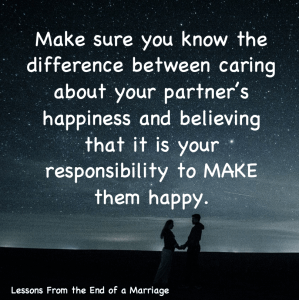
It all starts with understanding the distinction between caring about your partner’s happiness and taking responsibility for their happiness. The former is hopefully a keystone in every supportive relationship. If you care about someone, you obviously want the best for them. You want to do things that bring a smile to their face and mitigate the circumstances that bring them down.

Yet it is beyond your ability to MAKE them happy. Period. End of story. No matter what you do (or what they say), it is simply impossible for you to make another person happy.

That is an inside job.


Encourage Them When They’re Down

Remind them of their strengths. Of their previous successes. Without dismissing their concerns, highlight the more positive aspects of the situation. Express your belief and confidence in them – “I know you have this and I’ll have your back while you get through.”


Support Their Outlets

Accept that you cannot meet all of your partner’s needs. Actively encourage them to seek out their preferred outlets for release and support, whether that be time with a group of friends or alone time on a trail.


Distinguish Between Their Wants/Needs and What You Want For Them

It’s easy to get these two things confused and feel frustrated when our efforts are not appreciated because we’re working towards the wrong goal. Even if you disagree with their approach, your role is to act as a sounding board, not a dictatorial advisor.


Listen Without Judgment or Trying to Fix

One of the most important roles a marriage can provide is a place of sanctuary when it feels like the world is out to get you. Strive to be that safe place where they can speak without immediately facing unwanted advice or criticism. It doesn’t mean that you cannot disagree, just do it with intention and save it for the important things.


Respect Their Boundaries

For some of us, the sight of someone in distress is like a beacon, summoning us to be the rescuers. But they are an autonomous adult. When we swoop in, we’re sending the message that they are not capable of handling things on their own. You can hold their hand, but you can’t do the work for them.


Look For Ways to Bring in Delight

Actively seek ways to brighten your partner’s day. It can be as simple as a flirty note or funny GIF sent through text. This focus also helps to shift your mood if you have a tendency to get caught up in their unhappiness.


Spread Your Burdens

It’s natural to unload our biggest burdens on our partners. Yet it can also be a lot to bear. So make sure that you have more people than just your partner to share your own fears and struggles with. Even if you have to hire a listening ear.


Bring Your Best Self

And this means taking care of yourself. If you find that your partner’s unhappiness is increasing your own, address your own well-being. Do more of the things that make you happy. One of the best things you can do to increase their happiness is to take care of your own.


Accept Your Limitations and Respect Your Own Boundaries

Sometimes our partner’s unhappiness is more than a passing phase. If you suspect your spouse is depressed, it’s time to bring in professional help. And if they continually resist intervention, you have to make the decision how long you’re willing to wait. I often hear, “don’t leave your partner in a fire,” yet you also have to decide if you’re willing to burn if they continually deny the flames. You cannot fix them. All you can do is love them and support them while they fix themselves.