Should You Believe Your Triggers?

I could feel it washing over me like a great wave trying to pull me under, both blinding me and choking me. My body went into full-on fight or flight mode, any rational thinking put on hold until the emergency passed.

What was the emergency, you ask?

My now-husband mentioned wanting to build a home theater in the basement.

I know, it’s a terrifying image.

This happened over six years ago and now I can laugh at the absurdity of my (over)reaction. But at the time, I truly was convinced that this was a serious threat to my well-being. I was responding to something in the present – my husband wanting to build a theater – with the emotions born from past experiences – my ex-husband building a home office in the basement that became the center of operations for his deceptions.

On the day of this particular melt down over the proposed theater, I remember being aware that the intensity of my response in no way matched the reality of the situation. But there was another part of me that was whispering, “What if this reaction is because you’re picking up on some real threat in the present?”

And I didn’t know which voice to believe.

And that’s the problem, isn’t it? We never know know for sure if what we’re feeling is a misplaced echo from the past or our intuition picking up on a real threat in the present.

There are four basic categories between our reactions and what triggers them – Snip20191103_6.png
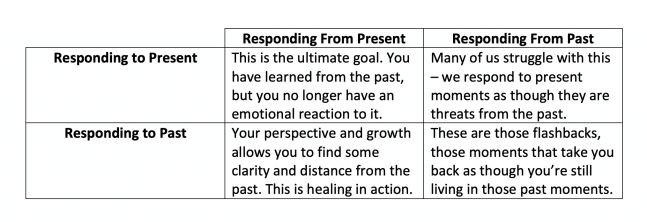
Responding to the Present From the Present

Your past experiences have taught you what to look for. You are better able to see actions that are misaligned to what you’ve been told and you’re more aware of unhealthy patterns. When something concerning happens, you use what you have learned to analyze it to decide if there are any real threats within.

You no longer have much emotional reaction from the past, so you trust that any you’re feeling now is an appropriate response to what is actually happening in the here and now. Furthermore, your reactions are on par with the behavior or sign you’re responding to. The response would be considered a reasonable one for anybody to have in similar circumstances.


Responding to the Present From the Past

Your past experiences are still living just beneath the surface. They have left you fragile, fearful. When something concerning happens in the present, it reignites those past concerns, an alarm sounding at full-blast, warning you that danger has arrived. Only the alarm is often false.

The emotional response is powerful, overwhelming, its intensity way out of line to what you’re responding to. You may even be aware that you’re overreacting, yet you feel powerless to stop it. Panic sets in. You become convinced that this is a sign that the past is about to repeat itself. You may respond with plans to flee, an instinct to fight or the desire to curl up and hide from the perceived threat. It’s best to take a time-out to allow some space for the body to calm before deciding to take any action.


Responding to the Past From the Present

This response comes when you encounter a reminder from the past, but you do not have an emotional response to it. Instead, you are able to look back with some clarity, applying what you know now to what you experienced then.

These are healing moments that provide valuable insight into what threats are real and which ones are born from a fear of being hurt again. This is learning – and healing – in action.


Responding to the Past From the Past

These are perhaps the most terrifying moments, when it’s as though a wormhole has transported you back to where you were with the same intensity of emotions and lack of perspective that you had when you were in the midst of it all.

When in the throws of a flashback, rational thinking and self-control is pretty much an impossibility. It becomes about survival, riding it out until it abates. Reminding yourself that it’s not real, that you are safe.


Should you believe your triggers?

Our emotional reactions are important, they provide us with information about our fears and about what is happening around us. Yet emotions are not always an accurate source of information. So listen to them, but don’t always believe everything they have to say.

When They Deny the Affair

Something’s up. Maybe you stumbled across an inappropriate text or perhaps there’s just a different energy in the air. Either way, your suspicions are growing, eating at you as your imagination begins to shift into overdrive.

Summoning your courage as you straddle the line between wanting to know and wanting to believe that everything is okay, you ask –

“Are you having an affair?”

And the response is volleyed back.

“No.”

You’re not sure how to feel. It’s the answer you want to hear. Want to believe. But at the same time, you’re not sure if you do believe it.

In some ways, you’d prefer a confirmation of your fears, because then at least you would know where you stand.

But this?

It’s maddening.

Agonizing.

Obviously someone isn’t telling the truth. But is it your partner or your own fears?

As you try to unravel the truth, begin by considering the reasons they may be denying an affair –

They may be trying to have their cake and eat it too.

“But I want them both!” you can just picture this person insisting like a spoiled toddler while stomping their feet. This is the stereotypical selfish cheater. They want what they want and they don’t expend too much energy thinking about how it might impact those around them. They lie not because they particularly enjoy lying, but because they want to get away with this for as long as possible. They are not worried about the truth hurting you; they are concerned about the impact the truth will have on their fun.

It’s rare that someone would only act selfishly in regards to a relationship. Instead, it tends to be their general approach to everything in life. Consider if they generally lack empathy and have a tendency to consider their own needs at the exclusion of others. These sorts of people will often speak of how they deserve happiness and may play the martyr or victim routinely.

They may enjoy the power that comes from deception.

These are worst type of cheaters. The actual affair may be ancillary to them; their primary motivation is the power and glee they gain from manipulating those around them. Although this type of person is obvious in some ways, when you’re under their spell woven with gaslighting and emotional abuse, your view is blurry.

These are the cheaters that will respond with outrage at your accusation, no matter how damning the evidence is against them. They will turn the fingers back at you, painting you as crazy, irrational or unfaithful in your own right.

It’s very difficult to see gaslighting when you’re in it. If you suspect that this may be your situation, talk to others you trust to gain their perspective and find a way to take a little break from the relationship to give yourself some space to think clearly.

They may be too scared to admit the truth.

They know they messed up. They know the truth will hurt you and they don’t want to hurt you. On one level, they may believe they are doing the right thing. Protecting you. On another level, they are afraid of seeing the hurt, the betrayal in your eyes and knowing that they are the one who put that there.

This puts you in a tough place. Your suspicions make you anxious and their response makes you frustrated and confused. Your emotions are high, yet the best way to uncover the truth is to stay calm so that they feel safer in revealing it. Is it fair to ask you to temper your emotions when they are the ones misbehaving? No. But then again, nothing about infidelity is fair. 

The good news is that this is the type of cheater that often feels great remorse for their actions. They are ones most likely to take responsibility when they are ready to face the truth. Patience may be called for here as you give them to space to summon up the courage needed to speak, but you also have the right to set your own boundaries about what you will not tolerate.

They may believe they are innocent.

Perhaps they define infidelity differently than you do and so even though they’ve crossed your line, they are still safely on the innocent side of their own demarkation. This happens often when there is an emotional affair; the betrayed partner is picking up on the emotional distance and redirected attention while the other proclaims their integrity is intact because the clothes have stayed on. Before accepting their proclamation of innocence, ensure that you are indeed talking about the same thing.

This can also happen when the betrayer is a pro at compartmentalization or rationalization. They see themselves as a “good” person, someone who would never cheat on their partner. And so they participate in impressive mental gymnastics in an attempt to reconcile their actions with their beliefs about themselves.

They may come up with a reason that the affair is inconsequential (“We only have sex. There is no emotional component, so it doesn’t impact my marriage.”). Or, they may keep that side of themselves completely separate from their normal guise, often using alcohol or other substances to help block out (or excuse) their actions.

This situation can be tricky to suss out, especially if they only show you the “good” side. Pay attention to how they handle mistakes and embarrassing situations. If they have a tendency to secret these relatively banal things away, it’s an indication that they have a tendency to split when experiencing shame.

They may be innocent.

This best case may be the real case. It’s possible that you misinterpreted something or allowed your fears or past experiences to reach false conclusions. Of course, you also have to be careful not to rush to the perceived security of this assumption too quickly. Because once we believe something, we inadvertently seek confirmation that it is true. And you don’t want your denial to offer a safe hiding place for a cheater.

Just as you don’t want to provide a safe haven for a cheater, you also don’t want to create a hostile environment for an honest person where they are constantly bombarded with fake accusations. This is why it’s important to pay close attention to your reactions, trust yourself to see and handle the truth, and keep your eyes open in regards to your partner. Don’t excuse their stuff and also don’t accuse them of yours.

So what can you do if you have suspicions that your partner denies?

Start here – What to Do When You Think Your Partner is Cheating

Can You “Affair-Proof” Your Marriage?

Searching For What You Don’t Want to Find

It’s a natural reaction.

Perhaps your partner has done something that makes you question their fidelity and you feel compelled to search their phone for confirmation.

Or maybe the lack of trust comes not from this relationship but a previous one and you’re determined to never be cheated on again.

You’re not proud of your reaction, yet you justify it. After all, if they are cheating, a little investigative work will pay off and if they have nothing to hide a little snooping doesn’t matter.

Or does it?

Apart from the moral ambiguities of snooping on your partner, searching for evidence of their misbehavior also hurts you. Here’s how:


False Positive

We tend to find what we expect to see. If your fears have already convinced you that infidelity is occurring, you are more likely to conclude that anything you find is evidence that supports your belief.

It’s a strange place to be. On the one hand, you’re praying that you don’t find anything and that your suspicions are misplaced and everything is okay. Yet on the other hand, you want validation that your intuition is correct.


Anxiety

Snooping leads to anxiety for two reasons. First, you know on some level that what you’re doing is wrong. There may be a sense of guilt and a concern of getting caught. Secondly, you’re living in a state of limbo. Before you find anything, it’s as though your partner is both cheating and faithful. And that uncertainty is both all-consuming and crazy-making.


Atmosphere of Distrust

It’s difficult to be a loving and present partner when you’re focused on trying to find what your significant other is doing wrong. As your partner picks up on this energy, an atmosphere of distrust begins to grow. And here’s the hard part – even if your partner HAS been faithful, if they feel like they’re constantly accused of cheating, they may decide that they might as well do it.


Limitations

Is it possible to find evidence that proves – without a shadow of a doubt – that your partner is faithful?

No.

Does monitoring their activity have some sort of protective power against cheating?

No.

Will continually looking for signs of infidelity bring you any sort of peace, functioning as sort of a credit monitoring service?

No.

So if snooping can’t prove fidelity, can’t prevent cheating and doesn’t make you feel any better, why do it?


Here’s some information on what you CAN do if you suspect your partner is cheating. 


And if you DO discover that your partner has been cheating, this is for you:

Finding Understanding In the Lies Cheaters Tell