Happiness is Divorce in the Rearview Mirror

happiness divorce

There is nothing fun about divorce. I can’t ever imagine anyone – even the most devout fan of Fifty Shades of Gray – choosing to go through a divorce for the entertainment factor. Even in the most clearcut of situations where both parties agree that the marriage is terminal, the process of severing two intertwined lives is awful. And when there are complicating factors? It’s awfuler (yeah, when it comes to divorce, that IS a real word. promise).

But once you’re through?

Once the courtroom and the endless requests for documentation are over.

After the decisions have been made and the consequences determined.

When the divorce is in the rearview mirror.

That’s when the happiness comes.

If you know how to look for it.


The…

Worst is Over

The final decree often brings with it a sense of relief. I personally went from never wanting a divorce to wanting a divorce more than anything else. I just wanted it to over. The months or years sandwiched between the decision to divorce (regardless of who makes the call) and the legal dissolution of marriage are horrible. It’s easy to feel lost and confused and attacked from all sides. The decree doesn’t make everything okay, but it sure helps to alleviate some of the unknown. The worst is over and now…

Healing Can Begin

It’s difficult to heal without resolution. After the legal process is over, you know what you have (and what you don’t). It’s a place – even if it’s rock bottom – where you can start to rebuild. Your focus can shift from the separation to yourself. Healing won’t happen immediately; the decree is no magic salve. But it WILL happen in its own time. One of the keys in healing from divorce is to recognize how far you have come. Celebrate your…

Accomplishments

You made it. It seemed impossible. But you’re through it and still breathing. At least on most days. That’s something to celebrate. Give yourself credit for your successes, both big and small. See yourself as a survivor and strive to be a thriver. Have gratitude for the blessings you have in your life, including your…

True Friends

Divorce has a way of sifting out the true friends from the mere hangers-on. The ones who remain are special. They have now seen you at your most vulnerable and still seek you out. That’s pretty damn cool. Enjoy the security and comfort provided by the stalwart confidantes, but also don’t be afraid to seek out…

New Beginnings

Just like we experience a surge of energy at the beginning of a new year, a new school term or after a birthday, divorce also clears away the old and leaves room for the new. Anything is possible when nothing is certain. Rather than focus on the loss, choose to see the potential. Because when you’re rebuilding your life from the ground up, you have…

Wisdom

Divorce is a helluva teacher. Don’t let those lessons go to waste.


Show Them the Door

You find an uninvited man standing in your living room.

He’s not saying or doing anything.

Just standing there.

What do you do?


Do you pretend that there is no man standing in your living quarters as you go about your daily life denying that he is there?

Do you insist that there shouldn’t be a man there and persist in your assertions even as he stands there?

Do you try to convince yourself that there isn’t a man there, that maybe it’s just a trick of the light?

Do you talk yourself into believing that it’s not a man even if it looks and acts just like one?

Do you consciously ignore the man hoping that he will get the message and just go away?

Do you distract yourself from thinking about the man with an afternoon cocktail or endless work?

Do you attack the man in anger, trying to beat him into oblivion?

Or, do you approach the man and engage in conversation to determine who he is and what he wants?


Which approach do you think will lead to the most favorable outcome?


Now, go through that same exercise again only, this time, the man is your negative feelings – your pain, your anger, your shame, your guilt. He embodies it all.

Do you pretend that there are no feelings as you go about your daily life denying that they are there?

Do you insist that there shouldn’t be feelings there and persist in your assertions even as they stand there?

Do you try to convince yourself that there are no feelings there, that maybe it’s just a trick of the mind?

Do you talk yourself into believing that it’s not pain/anger/shame/guilt even if it looks and acts just like it?

Do you consciously ignore the feelings hoping that they will get the message and just go away?

Do you distract yourself from thinking about the feelings with an afternoon cocktail or endless work?

Do you attack the feelings in anger, trying to beat them into oblivion?

Or, do you approach the feelings and engage in conversation to determine what they are and what they want?


Which approach do you think will lead to the most favorable outcome?


Approach your negative feelings with curiosity.

Shake hands with them.

Learn where they come from and what they need to go away.

And once they’ve served their purpose, feel free to show them the door.


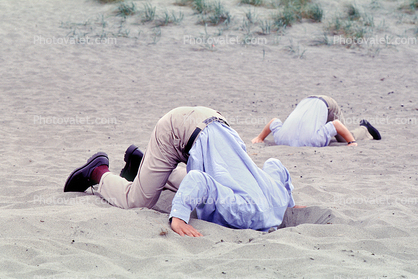
Love Is Only Blind When Your Head Is In the Sand

Do you ever look back at a former relationship and wonder what you saw in your one-time flame?

Or do you ever question a friend or family member’s choice in partners?

It’s easy when you’re outside of a relationship to view the bigger picture, the distance providing perspective while damping emotions.

But when you’re in it?

It’s all too easy to bury your head in the sand.


We stick our heads in the sand in relationships for a variety of reasons:

Avoidance

A wife sees a suggestive text on her husband’s phone from an unknown female. Her heart begins to race and panic floods her system. The hint of an affair is overwhelming to her; she cannot face the thought that her marriage is in trouble and that she may lose her husband. She turns away from the text and tries to pretend that she never saw it. That it didn’t happen.

When we see something that frightens us, we have two choices: approach or hide. In a relationship, the latter can cause problems as the truth is not faced because of the anxiety of losing the partnership. Of course, the fear persists even when the truth is not faced head-on. This state is usually temporary when either the truth becomes too big to avoid or the anxiety becomes too high to tolerate and the evidence is finally challenged. Burying your head out of fear may make you blind but it leaves you even more vulnerable to attack.

Mindlessness

A husband is busy at work, long hours and stressful clients have kept him away from home both physically and emotionally. He prides himself on providing for his family and doesn’t really have the time or energy to consider the status of the marriage as a whole. His wife, meanwhile, appreciates his efforts but feels isolated and lonely as her partner has become a husband in name only.

Heads can end up in the sand even without intentional digging. Stay still long enough and the tides will conspire to bury you. This is a blindness born of inattentiveness and busyness rather than willful evasion. Regardless of the motivation, the outcome is still a relationship in danger due to a lack of clarity and communication.

Willful Ignorance

A wife is pretty sure that her husband has a mistress. She intentionally chooses to turn a blind eye to his affair because he is a good father and stable husband. So she decides not to confront him and, even more, chooses to avoid situations that may reveal evidence of the infidelity. She knows something is there but chooses not to look.

This blindness is born more of pragmatism than fear. The reality is known to an extent and even quietly accepted. It’s a desire to pretend that life isn’t messy and emotions can be subjugated to reason. It’s a carefully edited and narrated form of the relationship. Although often dismissed, there is a sadness in this buried head that comes from lack of vulnerability and associated intimacy.

Bargaining

Prior to the marriage, a husband knows that his wife has problems with anger. He is uncomfortable with her temper and it raises red flags for him. However, he wagers her temperament against her other qualities and decides that the good outweigh the bad. When others bring up her outbursts out of concern, the husband responds by dismissing the concerns and tallying the pros that she brings to the table.

This is a common approach when a partner has issues with violence and/or substance abuse. There may be several very good qualities that are only occasionally accompanied by the bad. It’s a dangerous game; however, as the blinded partner slides into enabling the poor behaviors and choices.


A healthy relationship is one where both partners have their heads tall, looking out for problems on the horizon and addressing them as they approach. Burying your head may make you feel safe for a time but it’s no way to live.

Have the courage to lift your head.

Trust that you can handle whatever you see.

True love isn’t blind.


Are Expectations Dooming Marriage?

Expectations.

We build them up.

We revel in them.

And then, all too often, reality dashes them.

We hold them – the expectations and the actual – side by side and look for flaws, not unlike the drawings in the Hallmark magazines of our youth.

And we curse reality, bemoan our bad luck or grow angry at those who contributed to the failure of the imagined.

But maybe we’re directing our outrage the wrong direction.

Maybe it’s not reality that needs to change, but our expectations of it.


And now, more than ever before in history, we have very high expectations of marriage. Men and women no longer operate in defined domestic spheres, opening up vast swaths of terrain open to negotiation and yes, expectation. We are serenaded with romantic stories with all of the rough edges Photoshopped into perfection and we grow to expect our marriages to play out in kind. We expect our men to be emotional and our women to be equal wage earners, yet we don’t yet know how to negotiate the changes that ensue. We have lofty personal goals at the time of marriage and expect the marriage will support those goals. We marry young and carry the expectation that the chosen spouse will still be a match 50 or 60 or even 70 years down the line.

Expectations are not inherently damaging; they act as guides and as goals, especially when they reflect areas where you have control. Expectations become dangerous when they grow too strong and too broad, making assumptions about the behavior of others or of the stars.

The following are some of the potentially destructive expectations of marriage along with ways to shift those predictions into the realm of healthy and realistic:


He/she is my soulmate and will anticipate and meet all of my needs.

It used to be the expected norm that men and women would have many of their social needs met through same-gender friends. In our busy and transient lives, adult time with friends often gets shifted aside with the result of the spouse bearing the brunt of the social needs. It’s unfair and unrealistic to expect one person to meet (let alone anticipate) all of your needs. While most partners agree certain needs should only be met within marriage, there are many others that can be found through friends, classes or groups. If your spouse shares ALL of your interests, you are married to a mirror, not a person.

He/she will change after marriage (or the birth of a baby, or after the completion of school, etc.).

This is a dangerous expectation because it bases present decisions on imagined future results that are not under your control. Major events WILL  likely change your partner, but the change may not be in the direction you wanted. Make your decisions based upon the current day and the core traits that help one to navigate to change (adaptability, communication, perseverance) rather than hope alone. He or she may change but don’t assume.

The way things are in the beginning is the way they’ll always be.

The beginning of a relationship acts much like Photoshop; we filter out the negative and enhance the positive. Enjoy it. But don’t drown in it. Reality, when it comes, can be a bit of a shock, but it also carries with it the potential deeper trust and intimacy. Everything changes. To expect otherwise is to live in disappointment.

Good relationships don’t require effort and/or intention (i.e. work).

ANYTHING worthwhile in life requires effort. And that includes marriage. It shouldn’t feel like you’re slaving away in the salt mines every day but it also won’t always be a day at the beach. Know that some days will be harder than others and that, if done well, the work you put in will pay dividends in your marriage. A marriage that needs effort doesn’t mean it’s not good; it just means that it is a union between two humans.

We will grow together through life’s difficulties.

I wish this was always true. But statistics prove otherwise. Marriages are more likely to fall apart during times of strain: death or illness of a child, infertility, unemployment. We expect that the way we feel and the way we demonstrate those feelings about the event in question is the same way our spouse feels. There are no magic salves for relationships weathering crisis, but you can strive to make sure you are a strong team before the wave hits.


So, what are realistic expectations of marriage?

A partnership built upon shared goals and values that operates with mutual respect and fidelity. A marriage that is not perfect and two people who accept imperfections in themselves and their partner. A union that does not meet all of your needs but that acts as a safe haven where you can be vulnerable and intimate. A merger of two people who are willing to take responsibility and work for the betterment of both.

Marriage can be wonderful. But it won’t ever be perfect.

Make sure your expectations are in line.

The Best is Yet to Come

I had a conversation the other day where I challenged someone to describe the good that came from a recent and devastating break-up (I know, you’re shocked, right?).

Part of her response-

I love knowing that my best and happiest love is yet to come. I have that to look forward to.

She actually made me speechless with that assessment. In all my years of dissecting out every little scrap of good from my horrific divorce, this was one benefit I never unearthed. And yet, as soon as I heard it, I felt it.

And she’s right.


It’s so easy to grasp onto what was rather than hold hope for what can be.

It’s so easy to view the past through a rose tint and imagine that no future can ever measure up.

It’s so easy to focus on what has been lost rather than what can be gained.

It’s so easy to fill up on sadness and not leave room for smiles.


We zero in on what we know and what we know is the past, the pain.

Try making the belief that the best is yet to come at the center of your heart and aim your thoughts that way.


What I love about her words is that they focus on hope. They build excitement and anticipation. They speak of an assurance that our hearts are capable of love even after heartbreak.

The best is yet to come.

Are you ready for it?