Should You Believe Your Triggers?

I could feel it washing over me like a great wave trying to pull me under, both blinding me and choking me. My body went into full-on fight or flight mode, any rational thinking put on hold until the emergency passed.

What was the emergency, you ask?

My now-husband mentioned wanting to build a home theater in the basement.

I know, it’s a terrifying image.

This happened over six years ago and now I can laugh at the absurdity of my (over)reaction. But at the time, I truly was convinced that this was a serious threat to my well-being. I was responding to something in the present – my husband wanting to build a theater – with the emotions born from past experiences – my ex-husband building a home office in the basement that became the center of operations for his deceptions.

On the day of this particular melt down over the proposed theater, I remember being aware that the intensity of my response in no way matched the reality of the situation. But there was another part of me that was whispering, “What if this reaction is because you’re picking up on some real threat in the present?”

And I didn’t know which voice to believe.

And that’s the problem, isn’t it? We never know know for sure if what we’re feeling is a misplaced echo from the past or our intuition picking up on a real threat in the present.

There are four basic categories between our reactions and what triggers them – Snip20191103_6.png
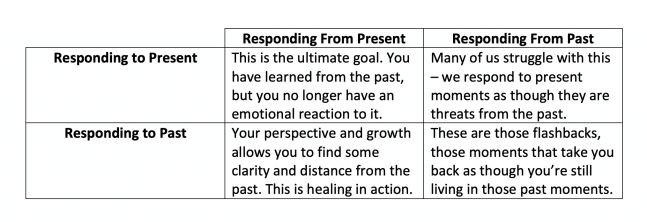
Responding to the Present From the Present

Your past experiences have taught you what to look for. You are better able to see actions that are misaligned to what you’ve been told and you’re more aware of unhealthy patterns. When something concerning happens, you use what you have learned to analyze it to decide if there are any real threats within.

You no longer have much emotional reaction from the past, so you trust that any you’re feeling now is an appropriate response to what is actually happening in the here and now. Furthermore, your reactions are on par with the behavior or sign you’re responding to. The response would be considered a reasonable one for anybody to have in similar circumstances.


Responding to the Present From the Past

Your past experiences are still living just beneath the surface. They have left you fragile, fearful. When something concerning happens in the present, it reignites those past concerns, an alarm sounding at full-blast, warning you that danger has arrived. Only the alarm is often false.

The emotional response is powerful, overwhelming, its intensity way out of line to what you’re responding to. You may even be aware that you’re overreacting, yet you feel powerless to stop it. Panic sets in. You become convinced that this is a sign that the past is about to repeat itself. You may respond with plans to flee, an instinct to fight or the desire to curl up and hide from the perceived threat. It’s best to take a time-out to allow some space for the body to calm before deciding to take any action.


Responding to the Past From the Present

This response comes when you encounter a reminder from the past, but you do not have an emotional response to it. Instead, you are able to look back with some clarity, applying what you know now to what you experienced then.

These are healing moments that provide valuable insight into what threats are real and which ones are born from a fear of being hurt again. This is learning – and healing – in action.


Responding to the Past From the Past

These are perhaps the most terrifying moments, when it’s as though a wormhole has transported you back to where you were with the same intensity of emotions and lack of perspective that you had when you were in the midst of it all.

When in the throws of a flashback, rational thinking and self-control is pretty much an impossibility. It becomes about survival, riding it out until it abates. Reminding yourself that it’s not real, that you are safe.


Should you believe your triggers?

Our emotional reactions are important, they provide us with information about our fears and about what is happening around us. Yet emotions are not always an accurate source of information. So listen to them, but don’t always believe everything they have to say.


Learning to Trust Again: How to Deal With the Triggers

triggers

“Will I ever learn to trust again?” I implored of my dad after receiving the surprise text that my husband had left the marriage and left the state. At that point, I was concerned about learning to trust somebody else after being the victim of horrendous gaslighting and betrayal.

It was only months later that I realized the true concern was not trusting others, rather I needed to know if it was possible to learn to trust myself and my own perceptions again. I kept questioning my responses to situations, wondering if I was listening to my intuition or overreacting because the circumstances triggered memories created by the earlier trauma.

Determined not be deceived again, I started paying more attention to my emotions and gut reactions to a situation. However, I was also aware that my emotions were not always rational and were prone to sending out false alarms since they were still raw from the betrayal. Before giving credence to my emotional responses, I learned to ask myself the following questions to determine if they were a reaction to something in the present moment or if they were simply an emotional echo from the past:

Is my response disproportionate to the situation?

It was just a silly argument over a coffeepot with my now-husband in our early days of dating. But my body saw it as life or death. I don’t even remember the details, but I do remember that the intensity of my response scared me. My body felt as though electricity was coursing through my vessels, charging my limbs so that I was prepared to fight or flee.

In reality, there was no danger. Not only was I physically safe, but this event did not even register on the relationship threat scale. My overreaction had nothing at all to do with the present moment and everything to do with the trauma in my past.

Am I experiencing a sense of déjà vu?

Shortly before our wedding, my now-husband detailed to me his plans for turning the basement into a home theater. As he was going over the floorplan and the modifications that would be needed, I was transported to a similar discussion with my first husband when he decided to build himself an office in the basement. An office that soon became the headquarters for his deceptions.

The whole time the basement theater was taking shape, I felt like I was occupying two locations in time and space. As much as I tried to stay present with the excitement of the theater, my fears kept pulling me back to the moment when I discovered the extent of my first husband’s lies hidden within his below-ground office.


Am I feeling like I’m out of control? 

When I discovered that my first husband had been living a double life and, by extension, I had been living a fabricated one, I entered free fall. It’s a disorienting feeling to realize that you’ve been manipulated for so long. When I’m triggered, my thoughts begin to spiral out of control. My mind will race from one thing to the next and it’s like the air has been bled from my normal self-soothing pathways.

I’ve learned that this out-of-body reaction only occurs when something takes me back to those early moments of utter and complete panic. When I’m responding to something solely anchored in the present day, my feet remain firmly anchored on the ground and I feel in control of my emotions and my responses.


Am I reaching premature conclusions?

Perhaps in a desperate attempt to never be deceived again, my subconscious brain began to assign reasons to any single point of data, no matter how inconsequential or likely benign. It was the equivalent of a hypochondriac assuming that a headache must be the result of a fatal brain tumor, rather than first addressing the much likelier causes of dehydration or too much caffeine.

When trying to ascertain if a perceived threat was real, I learned to list, in writing, the facts and only the facts. This helped me see if I was reaching a logical conclusion based on the available information or if I took a leap of panic into the worst-case scenario.


Am I assuming malicious intentions?

One of the hallmarks of over responding to a stimulus is taking everything as a personal affront. Whenever I find myself taking things too personally and assuming that it is a directed attack towards me, I know now that I’m really reacting to what has happened in the past.

A key way that this used to manifest in my new relationship is whenever my husband would be more reserved or withdrawn, I immediately assumed that I was the reason for the distance and that he was pulling away intentionally. This hypothesis would then be accepted even without any evidence to support it.


The more I answered, “Yes” to these questions, the more likely my response was rooted in the past and had little to do with my present situation. I also understood that continuing to have an emotional reaction to these situations would have a detrimental impact on my present life. And it was my responsibility to learn how to neutralize the triggers and my responses.

One event in particular highlighted the progress I was making on deactivating my triggers. It was shortly after my now-husband and I married. While at work, I received a notification that money had been transferred out of a joint gift account in the amount of $500, a little less than half what was available. The alert did not specify where the money moved.

My stomach dropped as my brain raced back to the memory of examining the account records after my ex left, where I discovered countless transfers in the $500 range. Transfers to accounts that I did not have access to. My emotional response in the present was telling me to panic, that this was a sign of deception and marital fraud all over again.

But this time, I stayed in control. I focused on the facts: my now-husband had never shown any signs of betrayal, I had the vast majority of my funds in my name only and so I wasn’t at the same risk as before, and all I knew was that the money had moved. Resisting the urge to make this my husband’s problem, I took a few deep breaths and continued my day.

Once I arrived home, I pulled up the account on my computer. The money had been moved into our joint savings account, as we had previously agreed. The amount was determined by limits set by the bank. What my triggers had assumed was deception was, in reality, an act of kindness.

And that’s the problem with triggers. They conclude guilt and demand proof of innocence. Deactivating them lies in believing first in decency yet also keeping the eyes open to signs of dishonesty or hostility. Trust in your perceptions but verify before assuming.

Ten Unexpected Episodes That Left Me Feeling Triggered

triggered

After my former life imploded with a tsunami divorce, there were some situations that I knew would be difficult to face. In order to avoid being triggered, I drove the long way to avoid seeing my former neighborhood with the entrance sign that my husband fabricated the letters for. I was cautious not to go to “our” restaurant alone or when I was feeling low. Looking ahead, I knew that I would struggle with any hints of abandonment. And I studiously avoided any media that dealt with the subject of affairs or fraud.

But then there were the unexpected triggers. Those seemingly innocent events or circumstances that sucker-punched me to my knees, my head swirling with flashbacks instead of cartoon birds. In hindsight, these seem innocuous. Silly, even. Yet they were anything but at the time they occurred.

In chronological order, these were the ten unexpected episodes that left me feeling triggered:

A Tap on the Shoulder

It was just an innocent and perfectly acceptable tap. A student needed my attention while the class was testing. Not wanting to make any noise and coming up from behind me, she simply tapped me on my shoulder. Three months earlier, it would have been a non-event. But that day?

Oh, it was an event.

You see, my ex and I had this little game where we would tap the other on the shoulder at random times as a way to request a kiss. So when that student tapped my shoulder, I felt my stomach take an express elevator down as I again realized the enormity of what I had lost.

The Words, “Dear Reader”

My ex used to write creative fiction when he was in high school and he often shared these stories with me. He had this habit of occasionally addressing the reader directly which always got under my skin (although I never said anything).

Years later, after he abandoned me, was arrested and released on bail, he attempted suicide after emailing my mom and his other wife a suicide note. The tone reminded me of those youthful stories with its undercurrent of “dear reader,” as though he was doing us a favor.

I made it several months before I encountered those words in a book written by some completely innocent author. The text was flung across the room before it found its way back to the library.

A Traffic Jam

Years ago, I read a scientific article about how traffic jams are actually related to fluid dynamics and how understanding the latter has led to unique strategies in major cities. Excited about this information, I shared the study with my husband. He laughed at me and soon “fluid dynamics” became a joke whenever we were stranded in Atlanta traffic.

Since I stayed close to home after the tsunami divorce, months passed before I was impacted by traffic. As my car came to a stop behind miles of red brake lights, I automatically said the words, “damned fluid dynamics” as tears poured down my face. I would never again have someone to share that joke with.

Getting Picked Up at the Airport

I knew to steal myself for the hazardous materials sign at the entrance to security since that was the last place I ever saw my husband while he was still my husband. But I didn’t expect to have a panic attack on the other end of the trip.

My now-husband, then-boyfriend promised to pick me up after a visit back to Texas. As I stood at the curb waiting for him to arrive, I realized that I half expected him to not show, which is what I believe my ex husband had originally planned before concern for the dogs changed his approach.

When my boyfriend’s car pulled up as promised, I shook with both relief and release of stored trauma.

Small Lies of No Consequence

I teach middle school. And middle schooler lie. Often. About stupid things.

In the past, I could laugh off these stupid lies even as I made it clear that I wasn’t going to fall for it. After all, I knew that these fibs weren’t personal. They were just the excuses offered up by teenagers with partially-formed brains and a desire to avoid consequences.

But something changed after I learned that I had been living a lie crafted by my ex. An allergy of sorts. Any exposure to falsehoods and I would have a severe reaction. For the first time in my entire career, I would have to excuse myself so that I could calm down before responding to a kid.

The Air Blower at the Entrance to Home Depot

I walked through the entrance of Home Depot, the rush of air drowning out all of my senses. When I came to on the other side of the blast, I found myself transported to the past.

Money Moved From One Account to Another

This was a silly one. My now-husband and I had a gift account from our wedding and we had agreed to move the money to our joint savings account. But apparently my emotions didn’t remember this agreement.

I’m proud of how I handled this one.

A Basement Theater

I’m not so proud of how I handled this one. My ex husband built himself an office in the basement. In reality, it was command central for his other life. Needless to say, I developed a bit of an aversion to basements after this.

So when my now-husband wanted to build a theater downstairs, I responded in a pretty poor manner, letting fear do the talking for me.

Ugh. I’d like to forget that particular outburst.

Mums

This one was a surprise. After all, they’re just flowers. But when I saw them – and appreciated them – I suddenly realized how much I had allowed my ex to be my voice.

Winning Teacher of the Year

I received the honor of Teacher of the Year towards the end of my first marriage. My husband was gone at the time (allegedly on a work assignment) yet he had flowers delivered to my classroom before he even knew that I won. Months later, he attended the awards ceremony with me. The professional photos from that night were the last we had taken of us as a couple.

Exactly ten years later, I won again. My husband was out of town.

Gulp.

I had to remind myself that I married a very different man this time. Which soon became evident. My ex sent expensive flowers to my work where they would be sure to be admired by others. My now-husband made an immediate Facebook post talking about how proud he was of his wife. The flowers came, but to the house. They weren’t meant for public adoration.

The triggers came fast and furious in the beginning. Over time, they lessened in both intensity and frequency. It’s been over a year-and-a-half since I was last triggered. I’d like to say that I’m done with them, but I also know that life likes to keep us on our toes. Luckily, I trust now that the feelings will fade and the event will lose its power to impact me.

The best things about triggers is that once they are defused, they are harmless.

Learning to Trust Again: How to Deal With the Triggers

triggers

In my experience, the most persistent side effect of being cheated on is the unrelenting and underlying uncertainty if you’re responding to your intuition or over-reacting to something from your past. I have often had internal internal arguments where one side, afraid of being caught unaware again, is pulling all of the alarms, screaming that the sky is, indeed, falling and the other side is calmly dismissing these fears, reassuring me that the danger is only an echo from the past. This can manifest as an inability to trust others, but really it comes down to learning to trust myself again.

There are times when the triggers are activated because of a legitimate and present concern. At those times, it’s important to listen to your gut and pay attention to its warnings. And there are other times when the alarms were pulled too soon, acting more from perceived danger than from a true emergency.

The problem lies in knowing which voice to listen in which situation. Dismiss all warnings, and you open yourself up to betrayal again. Listen to every advisory and you’re preventing trust from ever building (and also making yourself crazy in the process).

Here are five questions that I’ve learned to ask myself over the years to determine if I am being triggered by a true threat or merely the fear of one.  And, as with everything, practice makes better.