How to Apply Labels

As a teacher, I am quite familiar with the application of labels. Each summer, prior to ever meeting my new students, I study the rosters. Many of the names have associated labels next to them: ADHD, learning disability, autistic, ESOL, etc. These labels are helpful when these children are nothing more than a list of names. It is a starting point.

When I learn that hypothetical Johnny has ADHD, I use that information when I create my first seating chart. I know that he might be a good choice to run an errand to the front office or to help me hand out papers. I won’t be surprised at an off-topic outburst and I’ll have strategies at hand for how to handle one if it occurs. Before ever meeting Johnny, I can have an idea of some of his characteristics and I can plan ahead to meet his needs. However, it would be completely inappropriate for me to stop there. Johnny may have ADHD but he is not his label. As I get to know him, the label loses its importance. The diagnosis tells me nothing of Johnny’s strengths and weaknesses, his adaptive behaviors, his likes and dislikes or especially his personality.

A label should be an anchor, not a limitation.

Whenever I plan a lesson that introduces a new math concept, I start by anchoring the new material to prior knowledge. When I tell students that the new concept is like something they have seen before, it gives them a place to start. Then, as they learn the new material, they can adjust the expectations laid out by the early comparison.

Labels work that same way – they initiate expectations that should be tempered with experience.

When I tell you I am a teacher, you have a starting point for understanding me. You know that I’ve been to college. You can assume that I’m a people person. Maybe you think of a particular teacher in your past. Then, I tell you I grew up in the 1980s. Maybe that causes a revision of your earlier expectations or maybe it just allows you to flesh things out, as you make decisions about what music I may listen to or how I wear my hair. We can continue that process, with each label adding more information and more clarification. Eventually, you would know me and those labels would be inconsequential. Until you were trying to describe me to someone else, that is.

Labels can help us find understanding.

When I went through my divorce, I grasped at labels to describe my husband. I realized that he was not all of the things I thought he was. He was a stranger. So, like we all do when first getting to know someone, I turned to labels to try to develop a framework to anchor new understanding. My favorite designation for him was sociopath. It explained the callousness and extreme nature of the betrayal. It was a starting point. But not the end. As with all labels, some parts fit and others didn’t. As I worked to get to “know” him again, I revised my views, adding some terms and removing others, until the labels no longer mattered.

I use labels when I write about my story. I temper the word ‘divorce’ with ‘tsunami’ to capture the suddenness of my experience. I use the label ‘trauma’ to convey the overwhelming loss. I recently introduced the term ‘PTSD,’ not as a diagnosis, but as a framework to discuss the anxiety and flashbacks that permeated my existence. Those single words hold pages of information. It is a kind of shorthand – a broad strokes sketch of the entire story.

Labels are like Cliff Notes. We use them as shortcuts as we develop our own understanding or to help someone else develop theirs. Just like Cliff Notes, they are not the entire story, full of detail and nuance. If we stop at labels, we are limiting ourselves and others. We may be blinded by assumptions as we fill in the gaps in our knowledge automatically.

Don’t be afraid to use labels but also be careful not to apply them with superglue. They should be used to anchor understanding, not to limit understanding.

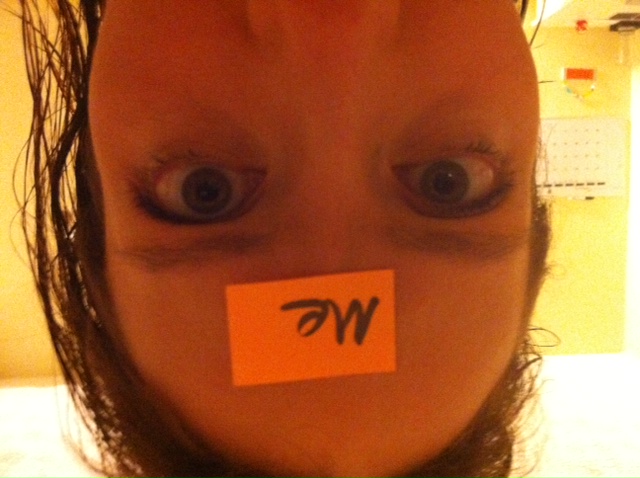
Labels

In the early months of the divorce, I was obsessed with labels. I needed to be able to classify everything, to make sense of the nonsensical.  It reminded me of a time when I was a kid.  My parents bought this little label maker that would print out stickers of what you typed.  I spent a day labeling everything in sight before the cost of the sticky paper brought my challenge to an end.

An electronic label maker, depicting buttons, ...
Image via Wikipedia

Most of my labeling energies went towards my ex.  Was he a narcissist, indifferent to those around him, viewing me as merely an object.  Was he an addict, as we found out after he left that he had been hiding alcohol consumption.  Perhaps he could be a sociopath, devoid of any sense of right or wrong.  Maybe he was depressive, and unable to make clear decisions. Of course,  he could just be a jerk.  Each of these labels had evidence to support their application, but there was also evidence against it.  I went round and round, sure that if I just knew what to call it, I would find understanding.

I fought against the labels that may have been applied to me by my psychiatrist.  Each visit, biweekly at first, she would ask me if I was suicidal.  I bristled at the thought that she contemplated applying that label to me.  Each visit, I denied it vehemently, hoping that my insistence would keep that word from my file.

Even the divorce itself had labels.  I was the one to file, as he just planned to run away.  Originally, I was going to do a divorce by publication, as we did not know where he was.  That progressed to a no-fault divorce once I found him, but before we knew of the bigamy.  The bigamy changed the label again to a fault divorce.

None of these labels mattered.  My ex is who he is, regardless of what I call him.  My psychiatrist supported me with the medication I needed no matter the words she wrote on my file.  And divorce is horrendous, despite the category it falls under.  Just like those sticky labels I applied as a kid, labels can be applied, removed, and reapplied without changing the object beneath.  Apart from a little residue, that is.

Where Is He Now?

When I share my story, one of the most frequent questions I get is, “Where is he now?”  I don’t know the answer to that question. Here is what I do know.

From the day he left in July of 2009 until the divorce in 2010, I kept tabs on him.  I had my ways.   From this, I learned that his wife, who left him upon his arrest, elected to take him back (I even knew when she had dental work done).  I knew he spent time at his parent’s house in our hometown.  He visited his wife’s family.  I knew the newlyweds went to Uganda in February of 2010.  If you’re looking for a laugh, try telling your divorce attorney that your husband is in Africa with his wife (showering with monkeys, according to her blog) weeks before his court date.  Based upon the look on her face, I don’t think she gets that one much…  I kept up with him over those months because his actions still affected me.  He still could harm me financially; his presence in court could change the outcome, and I was still afraid of running into him.

The last day I checked on his where-a-bouts was the day after the divorce.  I figure at this point, his story is no longer tied to mine, and I don’t want to live my life trying to figure out what he is doing.  This decision has not always been easy.  He has not upheld his financial or legal obligations in the divorce, with the IRS, or in the felony bigamy charge.  There are times that I am so angry, that I want to find him and try to make him face these issues.  The reality is that I don’t want to be his bounty hunter, even if it means I never get the money owed me.

There are also times that curiosity tries to get the best of me.  Is he alive or dead?  In the country or an ex-pat?  Still with the wife?  Living in the same area where I might run into him? These are just questions that I really don’t need to know the answer to.  Right now, all I have is the hope that wherever he is, he is not lying, manipulating, and devastating anyone else.  The only place he exists for me is in my memories and that is where I want him to stay.

More Information: Who Is He?

Update: A Strange Place to Be

Update April 2013: Facing the Dragon

To read the rest of the story, click here.