6 Ways Re-Watching Your Past Can Help You Move On

Brock and I are currently re-watching all of the released seasons of Game of Thrones.

We were late to the GOT party, only bingeing on the first 5 seasons just last year. But even though the characters and plots should be fresh in our memories, we realized after recently viewing season 6 that we had significant gaps in our comprehension and analysis of the story.

The initial viewing was a journey of emotion, raw and often impulsive. It provided us with feeling (so much feeling!), but left much to be desired in terms of understanding. The second viewing has been illuminating. The emotional response has nowhere near the intensity that it did in the beginning, but from this perspective, we are now able to make connections that eluded us earlier. It all makes sense now. 

After the finale of season one wrapped the other evening, I realized that the process of re-watching Game of Thrones in order to build a complete picture of the story and find understanding of the characters and their motivations was analogous to how I approached processing my own past.

Here are 6 ways that re-watching your past can help you move on:

Re-Watching As an Active Pursuit

If we simply sat inert on the sofa with Game of Thrones playing on the television, we would gain nothing more from the experience. Instead, we are alert as we watch, looking for clues and connections we missed the first time. We utilize the pause button so that we can discuss a theory or a sudden realization. When we’re still confused, we seek help, learning from those who are more experienced. Overall, we benefit from considering other perspectives and opinions as we develop our own.

It’s easy to be passive about your past, allowing mental films to play on repeat. This is ruminating, not processing (learn more about this) and keeps you stuck instead of helping you move on. Instead, be an active participant as you review your marriage and its demise. Focus on making connections and creating understanding. Seek outside viewpoints and guidance, but also realize the importance of adhering to what feels true to you.

Analysis is Easier When All is Revealed

When we first watched Game of Thrones, we had to accept certain actions and decisions by the characters at face value. We didn’t yet understand the history and background that would lead a character towards a certain choice (especially because some of these connections are not revealed until much later). This time through, we’re able to piece together the long-standing conflicts between the families and follow the wrongs that have been committed on all sides. It doesn’t make some of their decisions any more palatable (I had forgotten how gruesome the Stark slaughter is!), but it does provide some insight into their motivations.

When you’re reviewing a marriage after it has ended, you have all of the puzzle pieces you need to create an awareness of the big picture and to propose some plausible motivations for choices and behaviors. If you can find some understanding into why your ex did what they did, it can help soften any residual anger and release any lingering victimhood. Seeing the bigger picture doesn’t excuse poor choices, but it does help to see them a bit differently.

Assumptions Are Often Incorrect

As we watched the first time through, we lost track of many of the details and often took a wrong turn while trying to decipher the tangled branches of the family trees. We made assumptions to fill in the gaps of knowledge and to bridge between story points. We help many of those assumptions through all of the initial viewing. They became our lens for creating understanding. And now many of those conclusions have been challenged and it impacts the way we interpret further information.

The end of a relationship is a fertile breeding ground for assumptions. So much is unknown and so much is felt, that we easily assign erroneous conclusions. Conclusions that then become the basis for any further interpretation. By actively re-watching with an open mind, you can evaluate your early assumptions and decide if they still hold true or if they would benefit from revision.

Nobody is All-Good or All-Bad

I had forgotten how much we hated him in the beginning. One of the characters is a multi-faceted and overall kind man in the latter seasons. But in the first episodes? He comes across as a self-centered and impulsive man. And he was. Until he faced things that forced him to change his ways and broaden his perspective. Throughout the story, we see the weaknesses and strengths of all the characters, even those who are most celebrated or reviled. Some have commendable motivations for horrific acts while others perform valiantly in one venue and are reprehensible in others. Ultimately, there are no “good guys “and “bad guys”. There’s just guys, trying to make it through.

At the end of marriage, especially when your spouse behaved badly, it’s easy to cast them as the “bad guy” and paint yourself as “the good one.” It feels virtuous at first and there’s a comfort to be found in shifting all blame. But eventually, you end up typecast, not as the “good guy,” but as the victim. As you re-watch your past, be alert to signs that your ex had a good side and be aware of your own darker urges and behaviors. Nobody is all-good or all-bad. We’re simply all human.

A Negative Event Can Lead to Positive Outcomes

One of the aspects I love most about Game of Thrones is the strong characters who refuse to be limited by the tragedies that befall them. It’s easy to paint some of these events as negative. And in the short-term, they often are. But then we see the characters learn from the event, challenge their limitations and finally grow stronger than they were initially. As you see a paralyzed child learn to master his mind, it’s no longer clear that the event that caused his injury was detrimental to his life in the long run. And now, watching those early tragedies, there is none of the original sadness, because we see it as a beginning, not as an end.

Our lives aren’t filled with as many plot twists as the series (thank goodness!), but we all expereince events that are easy to qualify as negative because they are unwanted and often injurious in the beginning. Work to slide the “negative” label off the events in your life. Start by striving to see them as neutral, simply what happened. Then, take inspiration from your favorite characters and think about how you can create positive outcomes. How can you make this your beginning?

There Will Always be Some Mysteries

Re-watching has answered many questions. And prompted many more. The writers of Game of Thrones are careful to always withhold some information. They reveal clues rather than announce outright. There is always room for questioning and position-taking. And re-taking. It can be frustrating at times when you just want to know the facts and all you’re getting are hints. Life is no different. There will always be some mysteries, forcing an acceptance of some unknowns and acknowledging the limitations of re-watching.

No matter how many times you revisit your past, there will remain some unanswered questions. There is no benefit to continue to re-watch after you have learned what you can. Work to find an acceptance of the unknowns. You don’t need to know every detail in order to understand the first part of the story and to begin to write the rest.

Just as the events in Game of Thrones unfold in the same way the seond time through, revisiting your past does not change it. That’s not why you re-watch. You view again to see with newly opened eyes, to approach with a less emotional and fearful mind and to gain understanding and acceptance. And once you’ve done that, the past no longer has anything meaningful left to offer and can safely be taken off your mental queue.

After all, there’s always another show:)

Why I’m Attracted to People With a Difficult Past

It happens to me all the time.

A knowing look between virtual strangers. Words left unsaid yet with full meaning comprehended. A nod to the side, understood to reference “all that”in the midst of casual conversation.

It says, “I see you. And I see that you have suffered. And even though I don’t know your story, I know that we are kin.”

People that have a past, that have been through stuff, have a way of finding each other. It’s a club none of signed up for, yet we now all know the secret handshakes and code words used to identify other members.

If I inventoried the people most important to me, their combined tragedies would fill a country music album. There are motherless children, those who have been abused and abandoned, people who are enduring long and painful and scary medical ordeals and others who have suffered great losses.

But suffering isn’t the only thing they have in common.

They also have the overcoming (or at least the first steps) of it.

—–

One of the reasons I was attracted to my first husband was that he had a maturity and perspective that comes from going through difficult experiences. It made him stand out from the largely affluent and untouched kids at my high school. As my own life experiences – a sense of abandonment by my dad, a health crisis and the unexpected deaths of several friends – compounded, I no longer felt as though I had anything in common with the average 16 year old.

Then I met him.

And we had that unspoken conversation. That handshake of pain. A meeting of eyes that had seen more than they should.

We didn’t feel as though we belonged in the worlds we inhabited. But we felt as though we belonged together.

It was an hysterical bonding of sorts. A grasping. A union born from suffering.

Of course, I didn’t see any of that at the time. I just knew that I felt understood. That he could relate to facing challenges greater than deciding what to wear the next day or what to do when you hadn’t studies for a test.

Little did I know that he would later become the source of my greatest life lesson to date.

—–

It’s completely natural for people that have difficult pasts to gravitate towards one another. After all, we often bond over shared experiences and beliefs. And we look for people that can relate to and empathize with our own situations.

That attraction isn’t always healthy; however, sometimes bonds formed from suffering become mired in suffering. The pain simply is transferred from one to another, keeping it nurtured and alive. Sometimes one person takes on a victim role and the other, needing to be needed, plays the savior. The past can become the seed that holds the relationship together and a reticence to release it (and possibly the bond) develops.

I see these unhealthy relationships like two weak swimmers trying to save the other from drowning. The combined efforts only seek to weight them both down.

—–

When I started dating again after divorce, I intentionally looked for men that didn’t have pasts. They were surprisingly common, those guys that had made through 30, 35 even 40 years of life relative unscathed.

They intrigued me.

But they didn’t attract me.

Sure, they weren’t as superficial and two-dimensional as a gaggle of sheltered teenagers.

They were perfectly nice and nothing was glaringly wrong.

But they also didn’t get it.

They had never had to face a loss that made every breath feel as though oxygen had been replaced with concrete. They had never been forced to dig so deep within themselves that they feared they would get lost before they got out. They had an easy assurance that everything was going to be okay. Because for them, it always had been.

I felt separate from them. Different.

And I also felt a strange need to protect them. To let them be in their unaffected worldview for as long as fate allowed.

They seemed fragile to me. Untoughened. Untested.

I was equally uninterested in men who still lived in their pasts and showed no signs of wanting to move on or those who tried to pretend that it wasn’t a big deal. I knew what happened when suffering was damped down and pushed aside – my ex taught me that one. And I had no desire to live someone else’s past.

I found myself attracted to men who had been through the lows of life and had climbed out, one difficult step at a time. Someone who also knew how bad it could be and yet hadn’t given up. Someone who developed strength with every step and wisdom from every glance back. Someone who wouldn’t pull me down or carry me along, but who would walk with me.

We’re often dismissive of difficult pasts as being unwanted baggage.

Yet often the people with the most to carry have the greatest spirits.

—–

When I look around at the amazing people I choose to have in my life, I’m blown away by their resilience and attitudes. I surround myself with them because they understand and also because they inspire.


The Danger Of Holding On

holding on

One of my guilty (okay, so I don’t really feel guilty about it but it seems like I should) summer pleasures is catching a few minutes of television during the day. Last week, I saw the last few segments of the show, My 600-Pound Life. In this episode, a super-morbidly obese woman was in the hospital and being considered for bariatric surgery. The surgeon was reticent, both because of the patient’s extreme size and her refusal to attempt to walk.

It was the latter issue that grabbed my attention.

There were several scenes shown that all followed the same pattern:

“You need to walk. It’s critical for your health and recovery.”

“I can’t walk. I just can’t do it. I’m not feeling well.”

“What’s wrong?”

“I just don’t feel well.”

“I’m going to get some people here to help you get up.”

After the nurses or EMTs were summoned, they would surround her and using the sheet, would prop her into a sitting position and then slowly slide her legs off the bed until her feet were on the floor.

“I can’t! I can’t! Get me back up!” she cried at every attempt, even before her weight was fully on her feet.

Over the many months that these scenes span, you see her health decline as the frustration of her son and her doctor continue to rise.

Meanwhile, the featured woman is holding on to her conviction that she cannot walk, holding on to the weight encasing and imprisoning her and holding on to her identity as helpless.

START NOW

Just down the street from me, a new sign appeared last week advertising a soon-to-be-constructed storage facility. Although I should know better, I was shocked to see one in my area, which is mainly populated with large (and in the cases of the neighborhoods built in the last 15 years, huge) homes, most of which have basements because of the topography. There are few apartments and not many military personal, since it is not located near any of the bases.

In other words, there should not be much of a need for additional storage. But apparently, there is. The storage company’s research must have indicated that these families living in 2,500+ square foot homes need even more space to hold their belongings.

And I wonder how many of those storage units end up like my ex-in-law’s – rarely opened, never inventoried and filled with ever-decaying detritus even as they write a monthly check so that they can hold on to their belongings. Paying rent simply to avoid letting go.

I’m reading a book right now that features a woman who struggles with infertility. My heart ached for her as her hopes and grief grew with each successive miscarriage. I was elated when one pregnancy finally resulted in a healthy baby. Now, I thought, she has what she wants and get busy loving her child and reconnecting with her husband.

But at least so far, it’s not that simple. The woman has trouble appreciating what she has because of all that she has lost. Her attention and energy is devoted to the babies that didn’t make it rather than the one who did. And her grasp on the past is pushing away those who occupy her present.

There is always a cost for holding on.

The choice to keep one thing – an object, a belief, an emotion – always comes at the expense of something else.

It’s scary to let go.

We fear the loss more than we anticipate the freedom of space.

We surround our choice with justifications, clouding our judgement and defending our decision.

We identify with our collections, worrying that by paring them done, we somehow cut off a bit of ourselves.

But there is always a cost for holding on.

Grasping one thing means forgoing another.

It’s scary to let go. But sometimes that opens us up to reach for something better.

The woman in the show finally let go of her belief that she couldn’t walk. And those first few steps, supported by a walker and several attendants, were magical to watch. Her face filled not only with a smile, but with hope and confidence. She released the anchor and set sail on a new life.

Ruminating vs. Processing. Do You Know the Difference?

I often find that people are confused about the difference between ruminating on the past and processing the past. They think they are doing one when, in reality, they are often doing more of the other. I can see where the confusion exists – both ruminating and processing involve thinking about (and perhaps talking about) the past.

And that’s about where the similarities end.

So then what does separate ruminating from processing?

Ruminating

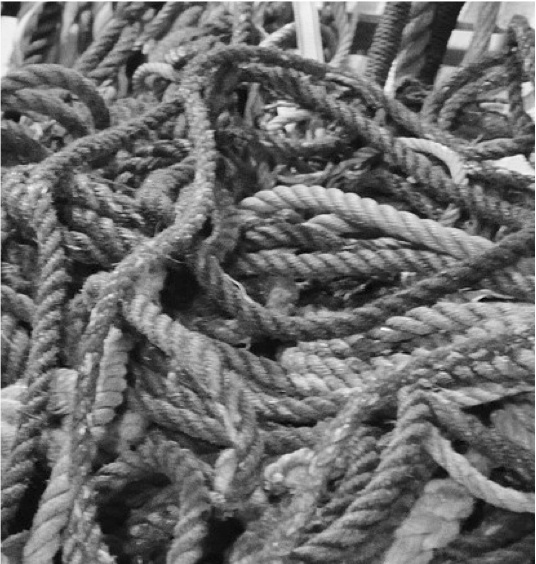
tangleRumination starts in the past and it stays in the past. It starts with thought and it stays with thought. It is time spent pondering the “what ifs” and playing choose-your-own-adventure with experiences now past. Rumination gets you nowhere. It has no goal and no purpose apart from endlessly exploring those well-tread mental paths. It can be a trap as its labyrinthine cords bind you to your past. Rumination thrives on recursive thought, one idea leading you to the next and to the next with no external input.

It’s easy to ruminate. Trigger a sad memory and this can easily be the default setting initiated. It’s the automatic pilot of the traumatized mind. It takes no energy to sustain and, in fact, requires energy to break out of its insidious cycle. Excessive rumination may be a sign of depression. If you find that you are having difficulty breaking out of the cycle, seek help. It’s out there.

Processing

smoothProcessing may initiate from the past, but it is then future-focused. It begins with thought and then continues in action. Unlike the unfocused meandering of rumination, processing is directed. There is an end goal in mind and steps are taken to reach that intention.

When you’re processing, you’re not just going over it.

You’re making sense of it.

It’s difficult to process. First, you have to summon the courage to face things you would rather bury and leave for dead. Then, you have to be willing to take responsibility not only for your part in whatever happened, but also for your well-being going forward. The past must be examined for patterns and connections. New input needs to be considered and assumptions dropped; the well-worn mental paths may indeed be missteps and it might be time to carve some new ones. Those memories can be combed through until sense is made and the endless loops are broken.

And then comes the hardest part. Processing requires action.

It’s not just your thoughts that need to change in order to release the past.

You do.

Past Perspectives

My husband recently had someone from his past get in touch with him after 20 years. The results have been interesting. It’s made my husband reflect back upon a time in his life where he normally doesn’t trek along memory lane. I’ve enjoyed listening to the stories of the experiences that helped to turn the Brock of then into the Brock I know.

With my ex, I knew those formative experiences. Hell, I was there for many of them. With Brock, I only know what he tells me. And, as we all do, the stories are filtered through the lens of now. Current knowledge and position making sense of the past.

But sometimes those memories are called into question.

From his perspective, that was a time when he was still young and stupid. He possessed big goals and was starting to make the first steps into making them happen, but was still full of more questions than certainty. And many of the tales I’ve heard certainly back that up:)

But the person who contacted him saw him differently – a man who was confident. A leader. Someone who would be successful.

And it’s interesting to watch Brock assimilate that perspective into the one that he has of himself at that age.

It’s so true that we form narratives of ourselves. We craft our stories from within our own minds, perhaps more aware of the fears and the doubts rather than the actions that others witness. Often, others see the strength in us when we focus on our weakness.

What we perceive and what comes through to the outside world can vary greatly. It’s not unlike the shifting view of the world when closing one eye at a time. And the truest picture of ourselves comes when we see with both eyes, our own and those around us.